Metallic Facade Procurement Guide for Solid Aluminium Cladding Specifications
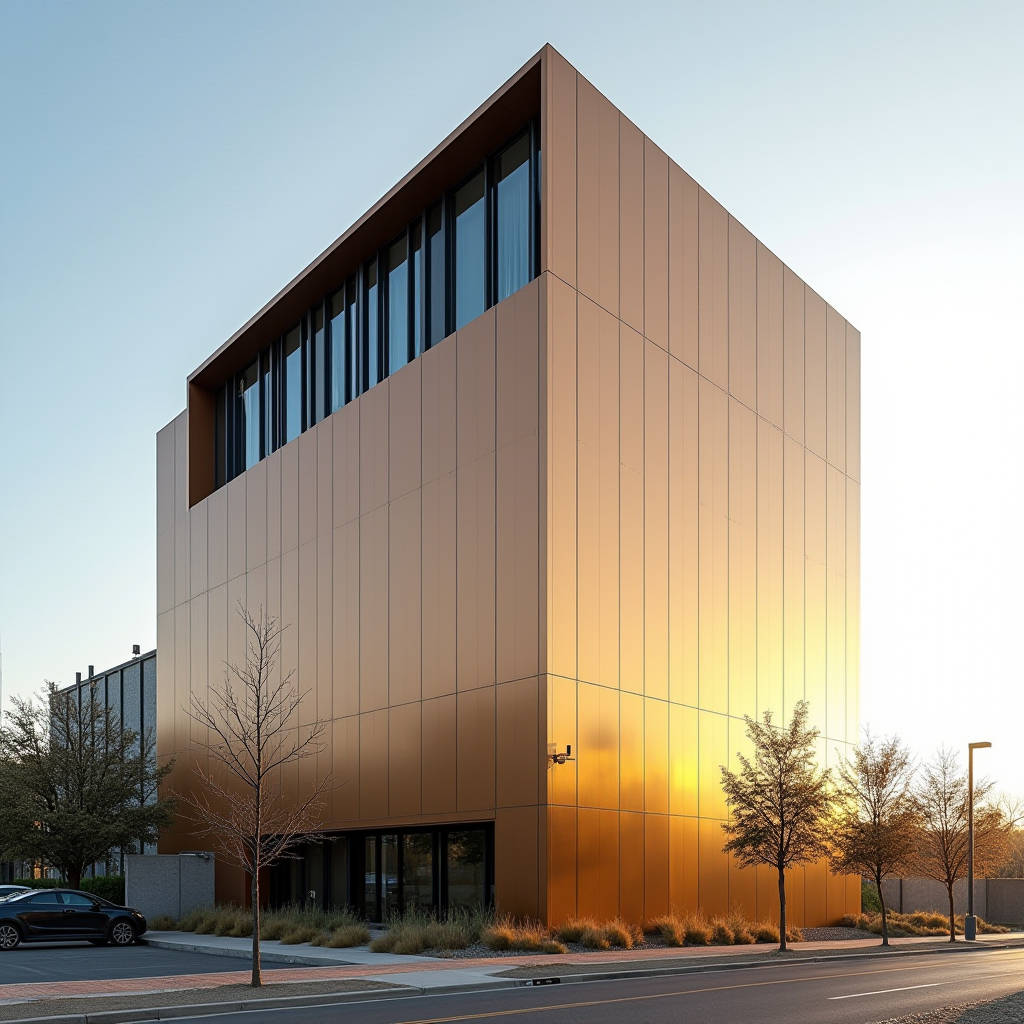
When a project specification calls for a metallic facade, the procurement team isn't just picking a colour. They're committing to a specific alloy, a defined coating system, and a panel profile that must hold flat across a 20-storey elevation. Over the last decade, I've watched too many tenders go sideways because the submittal confused PVDF-coated solid aluminium with polyester-finished composite sheet. The two look similar in a brochure. On site, under low-angle morning light, the difference is unmistakable — and expensive to fix. This article walks through what a metallic facade actually demands in terms of material grade, coating chemistry, fabrication tolerance, and supply chain logistics. No theory. Just the stuff that shows up on a mill certificate, a packing list, and a snag list.
What a Metallic Facade Specification Actually Means
A metallic facade is a rainscreen or curtain wall system where the visible outer skin is formed from solid aluminium panels — typically alloy 3003, 3004, or 5005 — finished with a metallic-effect fluoropolymer coating. The "metallic" descriptor refers to the visual result: a surface that mimics the lustre of metal through mica pigments or fine aluminium flake suspended in the coating resin. This is not anodised aluminium. It's not brushed stainless. It's a precisely engineered paint system applied to mill-finished sheet, then oven-cured at peak metal temperatures between 232°C and 249°C.
In tender documents, the phrase "metallic facade" often appears without adequate granularity. A competent submittal should clarify at minimum: base alloy and temper, sheet thickness (2.0mm, 2.5mm, or 3.0mm for most ventilated façade applications), coating system brand and resin type (Kynar 500® or Hylar 5000® PVDF, 70% resin minimum), metallic pigment type and orientation, and the quality assurance protocol for batch-to-batch colour consistency. Without these, the contractor is pricing a promise, not a product.
Alloy Selection and Why It Affects Flatness
For a metallic facade, alloy choice directly governs how the panel behaves after routing, folding, and welding. Alloy 3003 offers good formability and corrosion resistance at a moderate price point. Alloy 5005 provides a finer grain structure, which translates to less orange-peel effect under metallic coatings — a detail that becomes visible on large, uninterrupted elevations. Temper matters too. H14 temper is standard for flat panels; H24 may be specified where additional forming is required. I've seen projects where the contractor substituted 3003-H14 for 5005-H14 without notifying the architect. The result: a subtle ripple across the south-facing elevation that only became apparent after the scaffolding came down.
Field Note: If the specification requires a metallic facade with a mirror-like or high-gloss metallic finish, insist on alloy 5005-H14 and request a full-size sample panel — not a hand spray-out — for approval. The directional reflectance of metallic pigments under factory coating conditions cannot be replicated on a 150mm × 150mm coupon.
PVDF Coating Systems for Metallic Finishes
The coating on a metallic facade does two jobs: it protects the aluminium substrate from corrosion and UV degradation, and it delivers the aesthetic. For exterior architectural applications, the industry benchmark is a three-coat PVDF system: a corrosion-inhibiting primer (5–10 microns), a colour coat containing the metallic pigment (25–30 microns), and a clear topcoat (15–20 microns). Total dry film thickness lands between 40 and 60 microns, measured in accordance with ASTM D7091.
The resin system is non-negotiable. Kynar 500® PVDF resin, manufactured by Arkema, must constitute no less than 70% of the total resin solids by weight. This is verified through batch-specific certification, not a generic datasheet. Some fabricators will offer a "PVDF-type" coating using a lower-cost FEVE resin. It cures faster and costs less. It also chalks faster and shifts colour within 5–7 years in high-UV exposure. For a metallic facade on a coastal or high-altitude project, the difference between genuine PVDF and FEVE is the difference between a 20-year warranty that holds and one that doesn't.
Metallic Pigment Orientation and Colour Consistency
Metallic coatings are directional. The aluminium flakes or mica particles align during spraying, and the final appearance changes depending on viewing angle and light incidence. This is quantified as "flop" — the change in lightness as the viewing angle shifts from face-on to near-grazing. Two panels coated with the same paint batch can look different if they were sprayed in different orientations relative to the conveyor line. A proper metallic facade specification requires that all panels for a given elevation be coated in the same orientation, with the same gun settings, and preferably in a single production run.
Colour tolerance is measured with a spectrophotometer and expressed as Delta E (CIE Lab). For solid colours, a Delta E of ≤1.0 is standard. For metallic finishes, a Delta E of ≤1.5 is more realistic, and some specifications accept ≤2.0 for large projects where absolute uniformity across 5,000 panels is physically impossible. The key is to agree on the tolerance band before production starts, and to define the measurement geometry — specular included vs. specular excluded — in the quality plan.
Fabrication Tolerances That Affect Installed Appearance
A metallic facade panel leaves the factory flat. It arrives on site flat. Whether it stays flat depends on the fabrication method, the stiffener design, and how it's fixed to the substructure. The critical tolerances are:
- Panel flatness: Maximum deviation of 0.5% of the panel's diagonal dimension, measured per ISO 2768. On a 1,200mm × 3,000mm panel, that's roughly 1.6mm of bow.
- Fold angle accuracy: ±0.5° on all folded edges. A 0.5° error on a 3-metre edge creates a 2.6mm gap at the far end.
- Corner weld quality: Continuous TIG weld, ground flush, with no pinholes visible under 3× magnification.
- Stiffener attachment: Reinforcing ribs must be spot-welded or structurally bonded with a two-part epoxy. Silicone alone is not acceptable for structural stiffener bonding on any metallic facade.
These numbers aren't academic. On a recent 12-storey project in Southeast Asia, the contractor rejected 18% of delivered panels because the stiffener spacing was inconsistent, causing visible pillowing under afternoon sun. The rework cost exceeded the original fabrication margin.
Supply Chain Realities: Lead Times, Packaging, and Logistics
Procuring a metallic facade for a mid-rise commercial building typically involves 2,000–8,000m² of panels. The lead time from order confirmation to ex-works ranges from 4 to 7 weeks, depending on whether the metallic coating is a stock colour or a custom match. Custom metallic colour matching adds 7–10 days for lab formulation and spray-out approval. Production capacity at established factories — including manufacturers like Futeng® — typically runs 3,000–5,000m² per week for standard metallic finishes, with capacity allocated on a first-come, first-served basis.
Packaging deserves more attention than it gets. Metallic-coated panels are susceptible to microscratching if they shift during transit. The standard export packaging protocol is: a peelable protective film (minimum 60 microns thickness) applied to the coated surface, followed by interleaving with foam or kraft paper, then crating in fumigated plywood cases with steel edge protectors. For FOB shipments, the crates must be rated for stacking at least three high in a container. I've seen entire shipments of metallic facade panels arrive with scuff marks because the protective film was specified at 40 microns instead of 60. The cost difference is negligible. The snag list isn't.
Pro Tip: For CIF deliveries to the Middle East or Southeast Asia, specify that the protective film must be UV-stabilised. Standard film degrades under prolonged sun exposure during port storage and customs clearance, leaving adhesive residue that requires solvent cleaning before installation.
Installation Factors That Make or Break the Finish
The substructure is the foundation of any metallic facade. Whether it's a steel channel grid or an aluminium T-profile system, the tolerance for the supporting framework must be tighter than the panel tolerance. If the grid is out by 5mm, the panels will follow — and metallic finishes are unforgiving. A 3mm step between adjacent panels catches light instantly.
Key installation checks before panel mounting begins:
- Grid survey: Laser survey the entire substructure. Maximum deviation from plane: ±2mm over any 3-metre span.
- Bracket torque: All anchor bolts and bracket connections torqued to specification and verified with a calibrated wrench.
- Mock-up approval: A minimum 3-panel × 3-panel on-site mock-up, viewed under natural light at morning, noon, and late afternoon, approved by the architect before bulk installation proceeds.
- Handling protocol: Installers must wear clean, non-abrasive gloves. Panels should be lifted, not dragged, from the packing crate.
Thermal movement is another factor. A 3-metre aluminium panel will expand approximately 1.6mm with a 20°C temperature swing. Joint design must accommodate this movement without transferring stress to the coating. For metallic facades, open joints (6–8mm) with a dark-coloured rear baffle are common, as they conceal the joint shadow while allowing drainage and ventilation.
Comparing Metallic Facade Coating Options
Not all "metallic" finishes are created equal. The table below breaks down the three most common coating systems specified for metallic facades, with data that matters for procurement decisions.
| Parameter | 3-Coat PVDF (Kynar 500®) | 2-Coat PVDF | FEVE Fluoropolymer |
|---|---|---|---|
| Resin System | 70% PVDF minimum | 70% PVDF (primer + colour) | FEVE resin, solvent-based |
| Total DFT (microns) | 40–60 | 30–40 | 35–50 |
| Metallic Pigment Stability | Excellent — clear coat protects pigment | Moderate — pigment exposed | Good initially, fades faster |
| UV Resistance (AAMA 2605) | Passes 10-year Florida exposure | Passes 5-year; marginal at 10 | Passes 5-year; fails 10-year |
| Colour Retention (Delta E after 10 yrs) | ≤5.0 | ≤7.0 | ≤10.0 |
| Chalk Resistance (ASTM D4214) | Rating 8+ after 10 years | Rating 6–7 after 10 years | Rating 5–6 after 10 years |
| Warranty (Typical) | 20–25 years | 15–20 years | 10–15 years |
| Relative Cost Index | 100 (baseline) | 80–85 | 60–70 |
The cost difference between 3-coat and 2-coat PVDF is real — roughly 15–20% on the coating line. For a metallic facade on a north-facing elevation in a temperate climate, 2-coat may be adequate. For south-facing or coastal installations, the 3-coat system's clear topcoat pays for itself by preserving the metallic lustre and avoiding premature chalking. The FEVE option should be reserved for interior applications or projects where a 10-year lifecycle is acceptable.
Quality Assurance Documentation
Before accepting delivery of metallic facade panels, the following documentation should be in hand:
- Mill certificates for the aluminium coil, confirming alloy, temper, and compliance with ASTM B209 or EN 485.
- Coating batch certificates showing PVDF resin content, pigment type, and DFT measurements per panel batch.
- Adhesion test reports — cross-hatch or pull-off, per ISO 2409 or ASTM D3359.
- Gloss level readings — measured at 60° geometry, with tolerance of ±5 units for metallic finishes.
- Third-party test reports for AAMA 2605 compliance if specified, covering accelerated weathering, salt spray resistance, and chemical resistance.
For large-scale projects, it's common practice to engage a third-party inspection agency to witness the coating process and sign off on colour consistency before the panels are crated. This adds roughly 3–5% to the procurement cost and can prevent disputes that cost far more downstream.
When the Metallic Facade Goes Wrong: Common Failure Modes
After 10 years in this trade, I've catalogued a short list of recurring problems. They're all avoidable.
Colour drift across elevations. Panels for the east and west elevations were produced in separate coating runs, three weeks apart. The metallic pigment batch had a slightly different particle size distribution. Result: visible colour mismatch at the building corners, where the two elevations meet. Solution: specify single-run production for all visible elevations, or produce and approve a full set of boundary panels before splitting the order.
Coating delamination at folded edges. The fabricator used a sharp V-groove tool that cut too deep into the aluminium, creating a stress riser. The PVDF coating cracked along the fold line, and moisture ingress caused progressive delamination. Solution: specify a minimum bend radius of 1.5× material thickness and verify that the groove tool leaves at least 0.3mm of residual material.
Oil canning on large flat panels. This is the waviness or buckling visible under certain lighting conditions, even when the panel is within flatness tolerance. It's inherent to thin-gauge metal and exacerbated by metallic finishes. Mitigation: use 3.0mm sheet instead of 2.0mm for panels exceeding 1.5m² in area, and ensure stiffener spacing does not exceed 500mm centres.
Specifying a Metallic Facade for International Procurement
When sourcing metallic facade panels across borders, the specification must bridge different regulatory environments. A project in the EU will reference EN 13501 for fire classification and EN 485 for aluminium sheet. A project in the Middle East may reference ASTM standards or local civil defence requirements. The key is to define the performance requirements, not just the product name.
A robust international specification for a metallic facade should include:
- Material: Solid aluminium alloy sheet, 2.0mm / 2.5mm / 3.0mm thickness, conforming to ASTM B209 or EN 485.
- Coating: 3-coat PVDF system with Kynar 500® or Hylar 5000® resin, minimum 70% resin solids, total DFT 40–60 microns, conforming to AAMA 2605.
- Finish: Metallic, colour [insert RAL or custom code], gloss level [insert value] at 60° geometry, Delta E ≤1.5.
- Fabrication: CNC routed and folded, with continuous TIG-welded corners, ground flush, and structurally bonded stiffeners.
- Packaging: UV-stabilised protective film (≥60 microns), foam interleaving, fumigated plywood crates suitable for containerised sea freight.
- Documentation: Mill certificates, coating batch certificates, adhesion test reports, and third-party inspection sign-off where applicable.
Suppliers with established export operations — Futeng® being one example with a track record in solid aluminium cladding — can typically provide all of the above as standard documentation. The important thing is to ask for it before the purchase order is issued, not after the containers have sailed.
The metallic facade you specify is the metallic facade you'll look at for the next 20 years. Getting the alloy, coating, fabrication, and logistics right isn't complicated. It just requires knowing which numbers matter and refusing to compromise on them. The difference between a building that looks sharp after a decade and one that looks tired after five years usually comes down to decisions made in the first three weeks of procurement.