Anodized Aluminium Cladding Panels: Colours, Classes & Costs
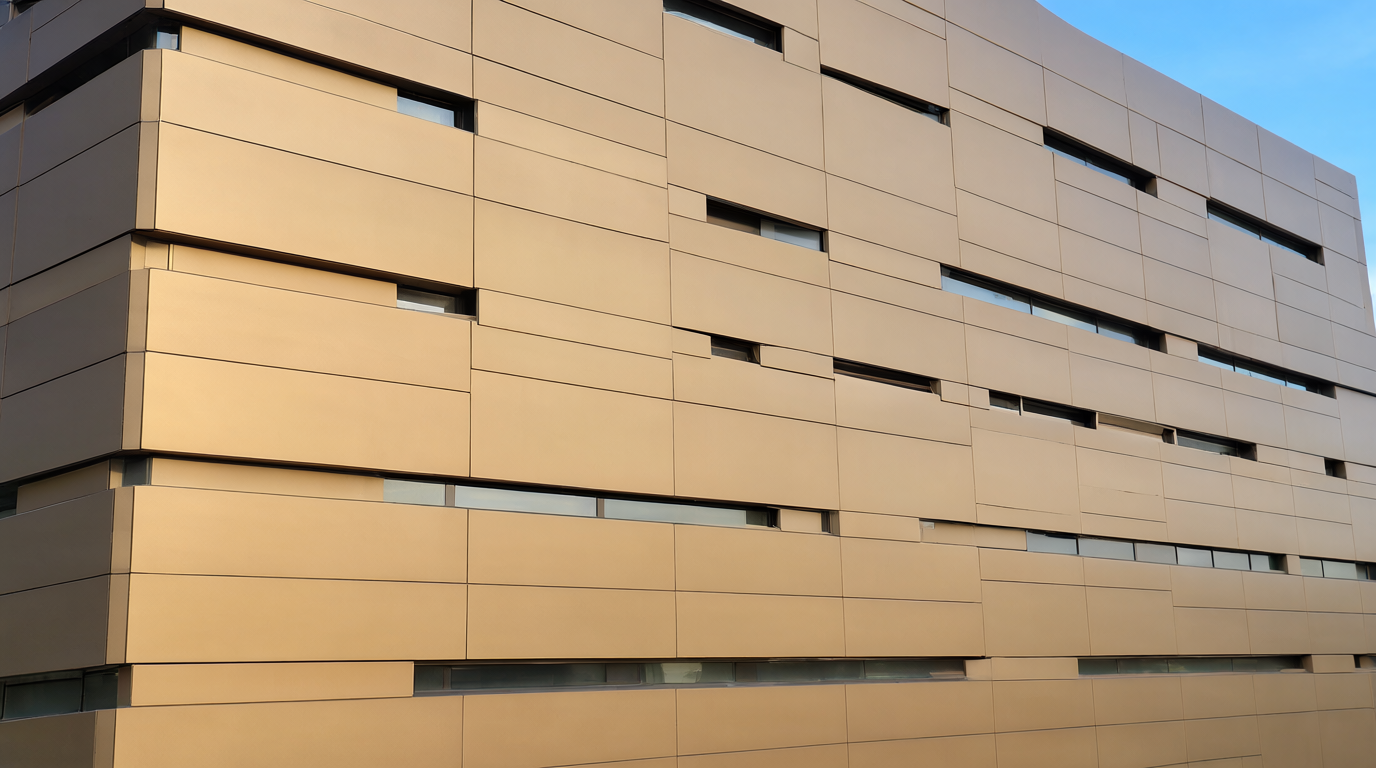
Anodized aluminium cladding panels are the quiet classic of metal facades: the warm silver-to-bronze metallic skin you see on transit hubs, bank fronts and flagship stores is usually not paint at all. Anodizing grows a hard oxide layer directly out of the aluminium surface, so the finish is part of the metal rather than a film sitting on top of it. That single fact drives everything that follows — how the panel ages, how it handles UV and salt air, what colours it can be, and how a damaged panel is dealt with. This guide covers how the process works, the classes and thicknesses specifiers quote, the real cost position, and when anodized beats a painted panel.
What Exactly Is an Anodized Aluminium Cladding Panel?
Anodizing is an electrochemical process that controls, accelerates and enhances natural oxidation. Clean aluminium parts pass through a series of tanks; in the anodize tank, current passes through the metal in an acid bath and converts the surface into a thick, uniform, extremely hard anodic oxide. Before the pores of that fresh oxide are closed by sealing, metallic-salt coloration produces the familiar natural silver, champagne, bronze and black tones. Because the colour lives inside the oxide, an anodized finish cannot peel or flake the way a film can, and it weathers slowly and evenly for decades.
Modern architectural lines have also moved from aggressive caustic pre-etching to fluoride-based acid etching — faster, and it removes roughly 90% less aluminium, which matters when panel dimension and flatness must survive the process.
Classes and Thickness: What the Standards Mean
Anodize quality is specified by coating thickness, not brand names. US practice follows AAMA 611 classes; European projects reference ELOXIAL or ISO 7599 (AA10–AA25); typical architectural anodizing sits at 15–25 microns.
| Class | Minimum thickness | Where it belongs |
|---|---|---|
| Class I | 0.7 mil ≈ 18 µm (ISO AA20/AA25) | The default for exterior facades; the minimum serious specifiers set for coastal and high-exposure walls |
| Class II | 0.4 mil ≈ 10 µm (ISO AA15) | Interior cladding, ceilings, column covers, signage; sheltered exterior only in mild climates |
| Class III | 1.0 mil ≈ 25 µm and up | Marine fronts, industrial zones, heavy-abrasion public interiors and transit nodes |
The Colour Palette: What You Get — and What You Don't
- Natural silver — the classic anodic clear finish; in Europe "natural anodized" cladding panels have been a standard for decades.
- Champagne to bronze to black — a graded metallic family from metallic-salt coloration, with the characteristic anodic sheen that shifts subtly as the viewing angle moves across a facade.
- Bright or matte prep — electro-polished bright finishes and matte chemical finishes sit under the same anodic film; choose the prep, not just the colour.
The honest limit: anodizing cannot produce saturated colours or a precise corporate Pantone. If the design demands a specific red, blue or green, a PVDF/FEVE painted panel is the right tool — see the comparison in our external cladding panels guide.
Anodized vs PVDF vs Powder Coating
| Factor | Anodized | PVDF / FEVE coil coat | Powder coat |
|---|---|---|---|
| What it is | Oxide grown from the metal, integral | Fluoropolymer film baked onto coil, 25–40 µm, cured before forming | Electrostatic polymer film oven-cured, 60–80 µm |
| Colour range | Metallic family only: silver, champagne, bronze, black | Almost any RAL/Pantone, bright metallics included | Any RAL, incl. textures and wood grains |
| UV behaviour | No organic binder to attack; weathers evenly for decades | Excellent; top-tier retention over 20+ years (AAMA 2605) | Standard polyester chalks and fades outdoors |
| Damage | Cannot be touched up — replace the panel | Spot repair sometimes possible | Easiest to touch up |
| Cost band | Premium; comparable to top PVDF work | Premium | Budget to mid |
For a facade that must still look right at year twenty, the shortlist is anodized or AAMA 2605-class PVDF — and the decision is about colour ambition versus metallic honesty, not raw durability. Both carry the same caution: never let a quote price a true anodized or PVDF panel like a basic polyester coil.
Where Anodized Cladding Panels Excel
- High-UV and sunbelt climates — the anodic layer shrugs off direct sunlight that slowly attacks organic binders; specifiers pick it where glass, louvers and metal mix on hot, exposed elevations.
- Coastal exposure — Class I anodize (≥18 µm) is treated as the appropriate exterior minimum for salt-laden air; the surface is the same corrosion-resistant oxide that protects bare aluminium, simply thickened and hardened.
- Heavy-touch interiors — lobbies, airports and lifts: anodized wall linings and ceilings resist bumps, scratches and daily cleaning wear better than paint systems.
- Premium metallic design language — champagne and bronze anodized panels have anchored flagship retail and corporate entrances since the era of the great department-store fronts; the look reads as metal because it is metal.
Limitations a Good Specifier Plans For
- No touch-up repair — scratch an anodized panel deep enough and the fix is panel replacement, so order spares with the original job, from the same production lot.
- Batch-to-batch colour consistency — champagne and bronze tones are sensitive to alloy, temper and pre-treatment; specify one alloy and temper (5005/3003 sheet is the architectural norm), one bath family, and sign off a full-size mock-up first.
- Form after anodizing, carefully — on solid panels the film survives bending, but weld zones and sharp bends can show witness lines; fabricate-then-anodize is not possible for a seamless look, so shop drawings must place joints accordingly.
- Palette discipline — metallic only; pair anodized zones with PVDF-painted zones deliberately when the design wants both.
What Do Anodized Aluminium Cladding Panels Cost?
Anodized solid panels sit in the same planning band as quality PVDF-painted solid aluminium — for 2.0–3.0 mm factory-direct material, budget roughly USD 40–100/m² depending on class, colour, alloy and panel size, before subframe and installation; full engineered wall packages remain in the USD 150–350/m² territory discussed in our cost and specification guide. The cost drivers are different from paint, though: thickness class (10 vs 18 vs 25 µm), the champagne/bronze colour family (darker metallics cost more than natural clear), bright electro-polish preparation, and lot-consistency management across a large order.
Frequently Asked Questions
Does anodized aluminium cladding fade?
Not like paint. The colour is held in an inorganic oxide with no organic binder for UV to attack, so metallic-salt bronze tones weather slowly and evenly rather than chalking; a Class I exterior spec in coastal air is standard practice.
Can a scratched anodized panel be repaired?
No meaningful on-site touch-up exists — the colour is inside the metal. Replace the panel, which is why spare panels from the same lot should be ordered at purchase.
Is anodized better than PVDF for a facade?
Different jobs. Choose anodized for honest metallic tones, even ageing and no coating to fail; choose AAMA 2605 PVDF when the design needs specific or saturated colours. Both are 20-year-plus finishes when specified at the right class.
Which aluminium alloys anodize well for cladding?
Architectural sheet anodizing normally runs on 5005 or 3003 alloys (and 6063 for extruded trim and profiles); high-silicon cast alloys anodize badly, which is one more reason cladding should be fabricated from wrought sheet.
What is the difference between ELOXIAL and AAMA anodize classes?
Same finish, different rulebook: AAMA 611 (North America) grades by 0.4/0.7/1.0 mil classes, ELOXIAL/ISO 7599 (Europe) by AA10–AA25 micron grades. Convert by thickness, and specify the class, not the label.
Working With a Fabricator: the Anodized Path at Futeng
Our anodized aluminium cladding panel line (SKU FT-CP-40) is built on the same 1.5–3.0 mm solid aluminium platform as the rest of our solid panel range — max format 6000 × 1500 mm, minimum order 50 m², fabricated in Guangzhou with colour-lot management and full-size mock-up sign-off before production. Anodized finishes dress exterior facades, interior linings, ceilings and column covers alike; send your elevation drawings through our facade cladding team or straight via contact and we will quote the finish class, alloy and panel schedule your design actually needs.