External Aluminium Cladding Panels: Types, Costs & Spec Guide
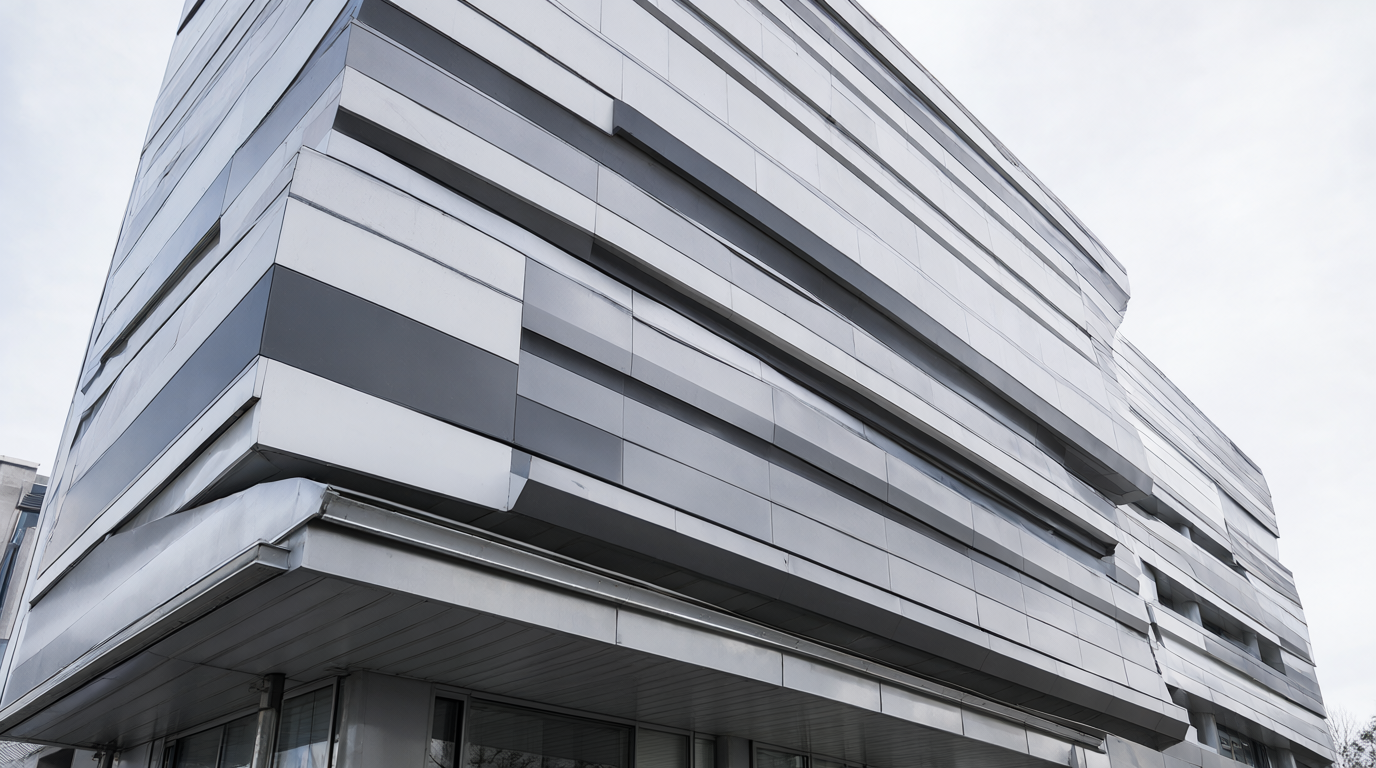
External aluminium cladding panels are the outer skin of modern commercial facades: formed aluminium panels fixed to a subframe a few centimetres out from the building, creating a drained, ventilated cavity that manages rain, wind, heat and fire risk all at once. Market analysts put the global rainscreen cladding industry at roughly USD 10 billion in 2020 and heading toward USD 18–24 billion between 2027 and 2030, driven by energy-efficiency targets, facade remediation works and the shift toward non-combustible materials. This guide explains the panel types, the system behind them, realistic 2026 cost ranges and the specification decisions that separate a 40-year facade from a facade that needs replacing at year ten.
What Are External Aluminium Cladding Panels?
Aluminium cladding is a non-loadbearing exterior skin of aluminium panels or planks fixed over the structural wall, usually with a ventilated cavity behind it. Four approaches dominate specification: solid aluminium panels, formed cassette panels, open rainscreen/batten systems, and aluminium composite panels (ACP/ACM). Joints complete the character of the wall:
- Open-joint systems — deliberate gaps let rainwater enter the cavity and drain away; simplest and most common.
- Closed-joint systems — joints sealed at the face, with drainage at designated outlets; cleaner monolithic look.
- Hybrid layouts — open and sealed zones mixed on one facade for design flexibility.
The Anatomy of a Working External Cladding System
The panels you see are only the visible layer. A correctly detailed wall is an assembly of control layers, each doing one job:
- Backup wall and load path — brackets and rails transfer wind and dead loads into the structure.
- Air and water control layers — membranes and flashings behind the cavity; the cladding itself is a rain screen, not the waterproofing.
- Thermal layer — continuous insulation kept clear of the cavity to avoid thermal bridging and blocked airflow.
- Ventilated cavity — typically a 20–50 mm minimum depth depending on market and system, draining and drying incidental water.
- Cladding skin — the aluminium panels, clips and movement joints.
One caution from enclosure consultants: a drained, ventilated cavity is not automatically a pressure-equalised rainscreen. Pressure equalisation requires designed venting, compartment boundaries and an airtight inner layer, proven by AAMA 508.1-style static and dynamic testing. Specify and test the assembly you actually need.
Types of Aluminium Cladding Panels for External Walls
| Panel type | Construction | Best suited to | Factory-side price, 2026 (USD/m²) |
|---|---|---|---|
| Solid aluminium panel | Single homogeneous sheet, 1.5–3.0 mm (4 mm+ in high-wind zones), folded with stiffeners | Commercial facades, schools, hospitals, high-rise, formed and curved geometry | 38–85 (entry 3 mm PVDF quotes start lower, around 25) |
| Aluminium composite panel (ACP) | 0.5 mm skins on PE, fire-retardant or mineral core, 4 mm total; exterior skins often 5005-H32/34 alloy | Budget low-rise cladding, retail fronts — mineral-core grades only where codes demand | 18–45 |
| Aluminium honeycomb panel | Aluminium skins bonded to an aluminium honeycomb core | Large flat formats, transport hubs, soffits, premium lightweight walls | 55–130 |
| Perforated / laser-cut panels | Solid sheet with defined open-area ratio | Screens, louvers, sun shading, ventilation, acoustic facades | 45–110 |
| Curved / 3D welded panels | CNC-stretched or roll-formed double curvature, welded corners | Entrances, landmark sculptural facades | 65–150+ |
Coatings: What Holds Up Outdoors
For exposed facades, the coating standard matters more than the colour. Fluorocarbon PVDF systems (70%+ resin, AAMA 2605 class) hold colour and gloss for 20+ years of UV, acid rain and salt air; powder coatings chalk and fade in the same exposure and belong indoors or in sheltered applications. The practical rule from 2026 market data:
- 2.0 mm with basic coating: 5–8 year service life — interior or temporary only.
- 3.0 mm PVDF to AAMA 2605: 15–20 years — the general-purpose commercial facade.
- 4.0 mm fully custom with premium coating: 25+ years — landmark and high-rise work.
Maintenance across all tiers is genuinely minimal: routine washing with soap and water, an inspection of joints and fixings on a cycle of years, and panel-by-panel replacement rather than whole-wall re-cladding.
Fire Safety: The Rule Everyone Now Applies
After Grenfell, Lacrosse and Neo200, the lesson coded into NFPA 285, the NCC, and BS 8414/EN 13501-1 regimes is simple: the core decides the risk. PE-core composite panels fail non-combustibility tests and are excluded from most mid- and high-rise external walls; fire-retardant cores often still classify as combustible; mineral-core "A2" composites can pass but require product-specific test reports. Solid aluminium has no core at all and classifies A1 to EN 13501-1 inherently — which is why, on our site, solid aluminium panels carry the most demanding projects, and why our wall systems are tested to BS 8414-1 as complete assemblies rather than as loose sheets.
What Do External Aluminium Cladding Panels Cost to Buy and Install?
Beyond the factory-side ranges in the table above, current market guides put material-only costs for aluminium facade panels at roughly USD 30–150/m² and full supply-and-install packages at USD 150–350/m² in most export markets. The quote differences come from five levers:
- Thickness and alloy — 3003/5005 sheet at 3.0 mm is the commercial default; 4 mm+ for high wind premiums the material.
- Geometry — curved panels can approach double the cost of equivalent flats; perforation adds machining time and material waste.
- Finish — wood-grain, stone-look and special metallic colours run 15–30% above standard solid colours.
- Subframe complexity — complex panel geometry drives specialised brackets; expect installation labour to rise roughly 40% when you move from simple flats to sculptural forms.
- Channel — factory-direct orders over ~500 m² typically save 15–25% against reseller pricing.
Judge quotes on total cost of ownership: an AAMA 2605 facade that avoids repainting at year 10 is cheaper than a "bargain" panel line that needs early replacement, even when the invoice looks larger on day one.
Installation: The Subframe Decides Everything
Hidden work determines visible results. Aluminium expands around 23 µm/m·K, so a 3–4 m panel moves 4–5.5 mm across a normal temperature swing — fixings must include fixed points plus slotted holes that let panels slide. Where steel brackets meet aluminium, galvanic isolation (stainless 304/316, nylon or EPDM pads) is mandatory, and 316 grade belongs at the coast. Bracket spacing is calculated from the site wind-pressure map — corner and edge zones always closer than field zones — with the fixing into the substrate usually the weakest link in the load path. Before panels cover the wall, good projects record hold points: substrate condition, membrane continuity, flashing at openings, cavity drainage. As-built 3D scanning converts survey data into coordinated shop drawings so every panel arrives numbered and true.
Frequently Asked Questions
How long do external aluminium cladding panels last?
With PVDF coating to AAMA 2605, expect 20+ years of coating performance and a facade system life measured in decades; the 4 mm composite market and solid-panel market differ, but solid aluminium facades routinely reach 40+ years with soap-and-water maintenance and joint inspections.
What thickness should I specify?
2.0–2.5 mm for small panels and low-rise zones, 3.0 mm as the commercial standard for facade cladding, and 4.0 mm+ for large formats, high-wind zones or impact-exposed areas. Panel size, not just thickness, drives the choice.
Is aluminium cladding recyclable?
Yes — aluminium is 100% recyclable with no loss of properties, and specifying high-recycled-content sheet supports LEED and BREEAM credits; it is one of the main reasons analysts project continued growth in the cladding market.
Aluminium vs steel cladding — which is better?
Aluminium is up to 65% lighter than steel for comparable strength, never needs anti-rust primers, and stays in the same material family as its fixings, simplifying detailing; steel wins where spanning strength or tighter budgets dominate. Mixed metals must be isolated to prevent galvanic corrosion.
What is the difference between solid and honeycomb panels?
Honeycomb cores deliver extreme flatness at very low weight for large formats, while solid sheets handle deep folds, curvature and impact better at a lower price; see our aluminium honeycomb panels for the stiffness-focused option.
Specify the Whole System, Not Just a Panel
The strongest specifications are written as an assembly: alloy and thickness, coating class, core rules, subframe design, test evidence for the wall — not a product brochure. Futeng® fabricates solid, perforated, curved and honeycomb aluminium cladding panels in a 50,000 m² ISO 9001-certified plant, supports fabrication drawings and 3D site scanning, and ships engineered panels with numbered fixing details worldwide (typical lead time 15–25 days, minimums from 50 m²). If you want the fire-behaviour story behind the solid option, read our companion piece on the fire performance of solid aluminium cladding — then send us your drawings for a system-level quote.