How Vertex Aluminum Facade Corporation Controls Wind Deflection and PVDF Tolerance in Solid Aluminium Cladding
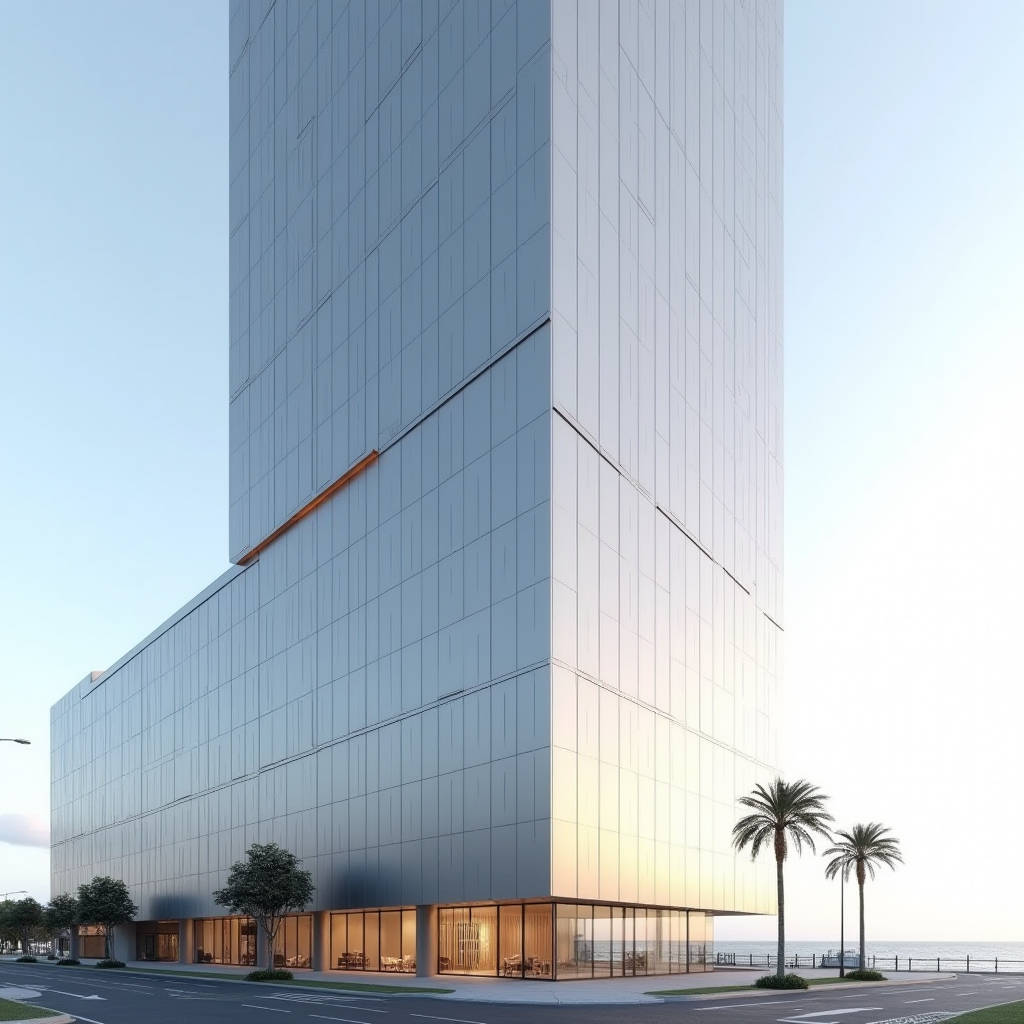
When a curtain wall spec calls for solid aluminium cladding panels in a coastal high-rise, the conversation usually narrows to one question: how do we keep the panels on the building for thirty years without visible corrosion or fastener fatigue. That is the practical territory where a supplier like vertex aluminum facade corporation earns or loses repeat business. This article looks at the under-discussed engineering layer behind solid aluminium facade systems: wind load transfer, panel deflection limits, PVDF coating performance on 2.0 to 3.0 mm solid sheet, and the fabrication tolerances that decide whether a facade reads as crisp geometry or as a wavy surface under raking light.
Why Solid Aluminium Panels Fail Where They Should Not
Most facade failures involving solid aluminium sheet are not material failures. They are tolerance failures. A 3.0 mm panel of 3003-H14 or 5005-H24 aluminium will not crack under normal building movement, but it will telegraph every millimetre of unevenness from the supporting subframe if the panel was bent on worn tooling or if the rivet and stiffener layout was guessed rather than calculated. The result is a facade that looks fine in the shop drawing and embarrassing on the street.
For a fabricator operating as a vertex aluminum facade corporation, the control points are specific: flatness after routing and bending, consistent hem and return leg dimensions, and a stiffener bond that does not telegraph through the face. These are measurable, and a serious supplier should be able to share the numbers rather than a brochure.
Material Specification That Actually Matters
Solid aluminium cladding panels are typically supplied in 2.0 mm, 2.5 mm, and 3.0 mm thicknesses, with 3.0 mm the default for large-format panels over roughly 1.2 m in the short dimension. The alloy choice follows the forming method. 3003 offers easier bending for complex profiles, while 5005 and 5052 give higher strength where wind loads dominate. A competent supplier will not let alloy choice drift silently between quotes, because yield strength changes the deflection calculation.
| Property | 3003-H14 | 5005-H14 | 5052-H32 |
|---|---|---|---|
| Typical panel thickness | 2.0 - 3.0 mm | 2.0 - 3.0 mm | 2.0 - 3.0 mm |
| Tensile yield strength | ~145 MPa | ~130 MPa | ~195 MPa |
| Bending / forming ease | Excellent | Very good | Good |
| Typical application | Complex folded panels | Standard facade cladding | High wind load zones |
The coating system sits on top of this. PVDF, applied as a two- or three-coat system, remains the standard for exterior solid aluminium because of its resistance to chalking and colour fade. A three-coat PVDF on a chromate or chrome-free pretreatment typically delivers a dry film thickness of 28 to 35 microns on the exposed face, with the primer and barrier coat doing most of the corrosion work.
Wind Load Is a Deflection Problem, Not a Strength Problem
The governing failure mode for a large solid aluminium panel is rarely rupture. It is deflection. Under negative wind pressure, a panel that deflects too far will oil-can, pop its stiffeners, or fatigue the rivet holes over thousands of load cycles. The industry benchmark is to limit panel deflection under service wind load to no more than the short span divided by 90, and under ultimate load to roughly the span divided by 60. A 1.2 m short span therefore allows about 13 mm of deflection at service level before the panel starts to look and behave badly.
This is where a vertex aluminum facade corporation earns its engineering fee. The stiffener pattern, the number of attachment points, and the rivet spacing on the return leg all follow from the calculated deflection, not from habit. Panels on the top floors of a 40-storey tower in an open coastal site may see design pressures above 2.5 kPa, while a sheltered low-rise pocket sees half that. The panel system has to be sized accordingly, and the fabrication drawing should show the difference.
A Worked Estimate
Take a 1.5 m by 1.0 m panel in 3.0 mm 5052-H32, simply supported on a routed return leg with two intermediate vertical stiffeners. At a design wind pressure of 1.8 kPa, the panel can be expected to deflect in the range of 8 to 11 mm at the free centre, which sits inside the L/90 limit for the 1.0 m short span. Remove one stiffener and the deflection can climb past 15 mm, which is visible as a soft pillow under oblique light. The difference between the two outcomes is one aluminium stiffener and a few rivets, but it separates a facade that stays flat from one that reads as second-rate.
Tolerances That Show Up in Raking Light
Architects notice flatness and joint alignment long before they notice alloy chemistry. A solid aluminium panel with a face flatness within 0.5% of the panel dimension, and a joint width held to plus or minus 1.5 mm, will read as a disciplined grid. Beyond that, the facade starts to look hand-made. The tolerances that matter in practice include:
- Panel length and width within plus or minus 1.0 mm for panels under 2 m.
- Return leg depth held to plus or minus 1.0 mm so adjacent panels align.
- Diagonal difference under 2.0 mm to prevent racked corners.
- Stiffener placement within plus or minus 2.0 mm of the drawing.
These numbers are not aspirational. They are the difference between a fabricator that can hold a 10 mm open joint across a 60 m elevation and one that cannot. A supplier that treats these tolerances as routine, and can demonstrate them with a first-article inspection report, is the kind of partner a facade contractor keeps on the bid list.
Coating Performance and the Coastal Question
Coastal projects raise the stakes on two fronts: salt spray and UV. A PVDF coating on solid aluminium is specified against standards such as AAMA 2605, which sets minimum performance for colour retention, chalk resistance, and gloss retention over years of exposure. For a marine environment, the pretreatment matters as much as the topcoat, because corrosion starts at cut edges and fastener holes.
The practical guidance is to require a three-coat PVDF system with a chrome-free pretreatment that meets the salt spray and filiform corrosion resistance in the relevant ASTM methods, typically ASTM B117 for salt spray and ASTM D2803 or the equivalent for filiform. Edge coverage is the weak point: a panel that is cut and bent after coating exposes raw aluminium at the cut, which is why a quality fabricator applies an edge treatment or specifies a cut-edge-tolerant system for aggressive sites.
Fabrication Sequence and Quality Gates
The sequence from coil to installed panel has more failure points than most procurement managers assume. A disciplined fabrication flow looks like this:
- Coil inspection for gauge, temper, and surface before shearing.
- CNC routing and punching of the developed blank, including stiffener slots.
- Bending on press brakes with consistent tooling to hold return leg depth.
- Stiffener bonding or riveting with a controlled adhesive film thickness.
- Coating inspection for dry film thickness, colour, and gloss.
- First-article dimensional check against the approved drawing.
Each of these gates has a tolerance and a test. A fabricator that skips the first-article check or the adhesive thickness control will ship panels that look acceptable in the crate and become a problem on the scaffold. For a project team evaluating a vertex aluminum facade corporation, the question to ask is not whether they can bend aluminium, but whether they can show the inspection records that prove the bending was controlled.
Attachment and Thermal Movement
Aluminium moves. A 3 m panel of solid aluminium will expand and contract roughly 1.7 mm across a 50 degree Celsius temperature swing, using a coefficient of linear expansion of about 23.6 x 10^-6 per degree Celsius. If the attachment system does not allow for this, the panel will buckle or the fasteners will work loose. The standard approach is a slotted or oversized hole at the fixed points and a combination of fixed and floating connections so the panel can breathe without rattling.
The fastener itself is a common point of neglect. Stainless steel fasteners are the norm, but the contact between stainless steel and aluminium in a wet environment can drive galvanic corrosion if an isolating washer or sleeve is omitted. A careful facade detail separates the two metals, and a careful fabricator pre-drills and isolates rather than relying on site improvisation.
Where the Specification Meets the Supply Chain
Procurement teams often treat solid aluminium cladding as a commodity, but the lead time and the risk profile say otherwise. A large facade order can involve thousands of unique panel sizes, each with its own drawing, and the fabrication schedule has to match the installation sequence floor by floor. A supplier that runs an organised drawing approval process, with a clear revision trail and a realistic lead time, removes more project risk than a slightly lower unit price ever will.
This is the level where a fabricator such as Futeng® tends to be evaluated: not on the brochure, but on whether the engineering package, the tolerance record, and the delivery schedule hold together. A facade contractor that has been burned once by late panels or drifting tolerances will pay a premium for a supplier that can prove control.
A Practical Checklist for the Facade Team
Rather than a generic approval list, here is the set of questions that separates a dependable solid aluminium supplier from the rest:
- Can they provide a deflection calculation for the largest panel at design wind pressure, not just a material data sheet?
- Do they hold panel flatness within 0.5% and joint width within plus or minus 1.5 mm?
- Is the PVDF coating a three-coat system on a chrome-free pretreatment, with AAMA 2605 test data?
- Do they isolate stainless fasteners from the aluminium to prevent galvanic corrosion?
- Can they show a first-article inspection report and a revision-controlled drawing process?
The answers to these questions determine whether the facade performs for thirty years or becomes a warranty claim in year five.
Closing the Loop on Solid Aluminium Cladding
The value of a solid aluminium cladding panel is not in the metal itself. It is in the engineering discipline that keeps the panel flat, the coating intact, and the fasteners quiet through decades of wind and weather. A vertex aluminum facade corporation that treats deflection, tolerance, and corrosion as calculable and verifiable problems, rather than as marketing points, is the supplier a serious facade contractor wants on the job. The specification should reflect that discipline in the numbers, because the numbers are what survive the first winter storm and the tenth summer of UV.