600 mm Rail Spacing for Aluminium Cladding Material Without Oil Canning Risk
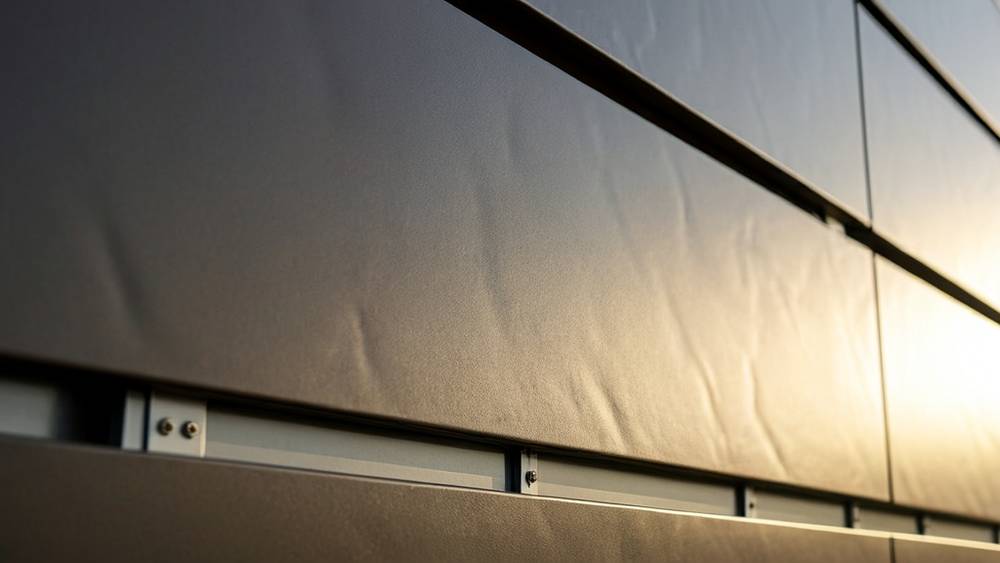
When a general contractor asks whether solid aluminium cladding material can span 600 mm between support rails without oil canning, the answer depends on three variables that most spec sheets gloss over: alloy temper, panel thickness, and the forming method used at the fabricator's plant. Aluminium cladding material in the 5000-series and 3000-series families behaves differently under thermal cycling and wind suction, and a 2.5 mm panel formed on a press brake will not perform identically to a 3.0 mm panel routed and folded with return edges. This article pulls apart those variables so you can write a specification that actually holds up on site.
Why Span Tables Alone Cannot Guarantee Flatness
Most manufacturers publish span capability charts showing that 3.0 mm solid aluminium cladding material can clear 600 mm centres, and 2.5 mm can handle 450 to 500 mm. Those numbers are useful as a starting point but they assume laboratory conditions: uniform pressure, ambient temperature around 23°C, and panels that left the factory perfectly flat. On a real facade in Dubai in July or Toronto in January, the aluminium skin temperature can swing from -20°C to +80°C inside a single 24-hour cycle. Thermal expansion of aluminium is roughly 24 × 10⁻⁶ per °C. A 3-metre-long panel subjected to a 60°C temperature rise will expand by approximately 4.3 mm. If the substructure does not accommodate that movement, the panel buckles, and what started as a subtle wave becomes visible oil canning within the first season.
Oil canning, the waviness or rippling seen on flat metal surfaces, is not a material defect. The American Architectural Manufacturers Association (AAMA) addresses this in AAMA 508 and 509 documents, which state that some degree of waviness is inherent to sheet metal products. But that does not mean it is uncontrollable. Panel thickness, alloy selection, stiffener layout, and the way the fabricator handles the sheet during routing and folding all shift the threshold at which oil canning becomes visually objectionable.
Alloy Temper: The First Decision That Shapes Everything
Not all aluminium cladding material labelled "3.0 mm" arrives at the job site with the same stiffness. The alloy and temper dictate the modulus of elasticity and yield strength, which directly control how a panel resists buckling under compressive stress.
| Alloy & Temper | Yield Strength (MPa) | Typical Cladding Thickness | Oil Canning Resistance | Formability | Cost Index (Relative) |
|---|---|---|---|---|---|
| 3003-H14 | 145 | 2.0 – 3.0 mm | Moderate | Excellent | 1.0 |
| 3003-H16 | 170 | 2.0 – 2.5 mm | Good | Good | 1.05 |
| 5052-H32 | 195 | 2.0 – 3.0 mm | Very Good | Good | 1.2 |
| 5005-H14 | 140 | 2.0 – 3.0 mm | Moderate | Excellent | 1.1 |
| 5005-H34 | 150 | 2.5 – 3.0 mm | Good | Very Good | 1.15 |
5052-H32 offers roughly 35% higher yield strength than 3003-H14 at the same thickness. For a project where the architect insists on large flat panels with minimal stiffener intrusion, paying the 20% premium for 5052 often eliminates the need for additional intermediate supports. 5005-H14, commonly specified for its anodising response, sits closer to 3003 in stiffness and requires tighter rail spacing or thicker gauge when flatness is critical.
Futeng® has supplied projects where switching from 3003-H14 to 5052-H32 at 2.5 mm thickness resolved oil canning complaints without changing the support grid, saving the contractor from re-engineering the substructure mid-project. The material cost delta was recovered through reduced stiffener fabrication and fewer callbacks.
Panel Thickness and the 2.5 mm vs 3.0 mm Debate
The construction industry has gravitated toward 2.5 mm and 3.0 mm as the two standard thicknesses for exterior solid aluminium cladding material. The difference of 0.5 mm sounds negligible, but bending stiffness is proportional to the cube of thickness. A 3.0 mm panel is approximately 73% stiffer than a 2.5 mm panel of the same alloy. That stiffness directly resists the compressive stresses that trigger oil canning.
However, thickness alone is not a magic bullet. A poorly fabricated 3.0 mm panel with inadequate return edges and no intermediate stiffeners will still oil can. Conversely, a well-engineered 2.5 mm panel with properly bonded stiffeners, routed grooves spaced correctly, and adequate edge restraint can perform flawlessly on 600 mm centres. The key is understanding that thickness and stiffener design work together. Reducing thickness to save material cost while adding stiffeners shifts cost from material to labour; the net effect depends on local fabrication rates and project logistics.
Fabrication Methods and Their Effect on Internal Stress
The way a solid aluminium cladding panel is formed introduces or relieves internal stress, and that stress determines how the panel behaves once mounted.
Press Brake Folding
Press brake forming bends the panel edges by applying force along a linear die. This method is fast and suited to simple rectangular panels. The bend line introduces compressive stress on the inside radius and tensile stress on the outside. If the bend radius is too tight (less than 1.5 times material thickness for 5000-series alloys), micro-cracking and residual stress accumulate. Those residual stresses release gradually under thermal cycling, and the panel that looked flat upon installation develops waves after six months.
CNC Routing and Folding
Routing a V-groove along the fold line removes material, leaving a thin web (typically 0.3 to 0.5 mm) that acts as a hinge. The panel is then folded by hand or machine. This method produces a sharper external corner and introduces far less residual stress than press brake forming, because the bending moment is absorbed by the thin web rather than the full material thickness. The trade-off is that the corner is structurally weaker and may require a welded or bonded reinforcement at the groove if the panel carries wind load across that edge.
Stiffener Attachment
Stiffeners, typically aluminium extrusions or hat sections, are bonded to the rear face of the panel using structural adhesive (epoxy or polyurethane). The quality of that bond matters immensely. A stiffener that is only partially bonded will separate under thermal movement, leaving the panel unsupported exactly where it needs restraint. Fabricators following ISO 25239 for friction stir welding or qualified adhesive bonding procedures per EN 17460 produce panels with consistent stiffener performance. Spot-bonding or using generic construction adhesive invites failure.
Support Rail Spacing: What the Standards Say and What They Miss
EN 13830 for curtain walling and AAMA 508 both provide frameworks for determining allowable deflection under wind load, typically limiting deflection to L/175 or L/240 depending on the cladding type and project specification. These standards address structural safety and water penetration, but they do not directly regulate oil canning. A panel can meet L/175 deflection limits and still exhibit visible waviness.
The practical relationship between rail spacing and oil canning for solid aluminium cladding material is influenced by:
- Panel aspect ratio: Long narrow panels (3:1 or greater) are more prone to waviness along the long axis than square panels.
- Edge restraint: Panels with continuous return edges on all four sides resist buckling better than panels with only two folded edges and two loose edges.
- Stiffener spacing: Intermediate stiffeners should be placed no more than 400 to 500 mm apart for 2.5 mm panels and 500 to 600 mm for 3.0 mm panels, measured parallel to the support rails.
- Fixity: Fixed points and sliding points must be correctly positioned. A panel constrained at both ends with no allowance for thermal movement will buckle regardless of thickness.
A rule of thumb used by experienced facade engineers: for 3003-H14 at 2.5 mm thickness, limit rail spacing to 500 mm if the panel exceeds 1.2 m in the short dimension. For 5052-H32 at 3.0 mm, 600 mm centres are achievable with proper stiffening. These are guidelines, not guarantees; a mock-up is always the final arbiter.
Thermal Movement and the Hidden Oil Canning Trigger
Thermal expansion often gets discussed in abstract terms, but the numbers are stark. A 4-metre aluminium panel in a dark colour (solar absorptance above 0.7) can reach 85°C on a summer afternoon. If installed at 20°C, the panel wants to grow by about 6.2 mm. If the fixing system does not provide a sliding connection at one end, that 6.2 mm of expansion converts to compressive stress within the panel skin. The stress magnitude can exceed 100 MPa, well within the range that induces elastic buckling in thin sheet metal.
The solution is a combination of slotted holes, sliding clips, and correctly positioned fixed points. Each panel should have one fixed point (typically near the centre) and all other connections should permit movement in the plane of the panel. The slot length must be calculated for the specific panel length and expected temperature range, with a safety factor of at least 1.5. A 4-metre panel in a temperate climate needs approximately 10 mm of movement accommodation.
Coating Systems and Their Minor But Real Influence
Coating does not directly cause or prevent oil canning, but it affects the surface reflectivity that makes waviness visible. High-gloss PVDF coatings (gloss above 70 GU at 60°) act like a mirror; even minor waviness becomes highly visible under glancing light. Matte finishes (gloss below 30 GU) and textured coatings diffuse reflected light and make the same level of waviness far less noticeable.
For projects where absolute visual flatness is non-negotiable and the architect has specified a high-gloss finish, the specification must tighten the allowable waviness tolerance and the support grid accordingly. ASTM International provides guidance through ASTM E284 for appearance assessment, but the industry still relies heavily on mock-ups viewed under representative lighting conditions.
Specifying Flatness Tolerances in a Way That Can Be Measured
Vague requirements like "panels shall be free of oil canning" are unenforceable. A defensible specification quantifies waviness using either the IQL (Industry Quality Level) approach or a direct measurement method:
Under diffuse interior lighting at a viewing distance of 3 metres and an angle of 45 degrees, waviness shall not exceed 2 mm peak-to-valley deviation over any 300 mm gauge length, measured with a straight edge and feeler gauge.
This language, adapted from guidelines published by the Metal Construction Association (MCA), gives the contractor and fabricator a clear pass/fail criterion. It also ties the assessment to specific lighting and viewing conditions, because a panel that looks flat under overcast sky may show ripples under low-angle morning sunlight.
Mock-Up Protocol: The Only Test That Matters
No span table, finite element analysis, or factory quality certificate replaces a full-scale mock-up. The mock-up should replicate:
- The actual panel size, alloy, thickness, and coating specified for the project.
- The support rail spacing and fixing method as designed.
- Orientation matching the building facade (vertical, inclined, or soffit).
- Viewing conditions that mimic the worst-case lighting the facade will experience.
Inspect the mock-up at multiple times of day if the facade faces east or west. Photograph it under direct sunlight at a shallow angle. If oil canning is visible under those conditions, adjust the specification before ordering production quantities. The cost of a mock-up panel and frame is trivial compared to replacing or reworking 2,000 square metres of installed cladding.
Fabricator Capability: Where the Specification Meets Reality
A technically perfect specification means nothing if the fabricator cannot execute it. When sourcing solid aluminium cladding material, ask the fabricator:
- What is the maximum panel size they can route and fold while maintaining flatness?
- Do they use CNC routers with vacuum hold-down tables to minimise sheet distortion during machining?
- What structural adhesive system do they use for stiffener bonding, and can they provide test data for bond strength after thermal ageing?
- Do they have a documented quality control process for flatness inspection before packing?
Fabricators who invest in flatbed CNC routers with automatic tool changers and vacuum tables produce panels with lower internal stress than those using manual routing jigs. The difference shows up as reduced oil canning on site. For large-scale commercial projects, selecting a fabricator with ISO 9001 certification and specific experience with solid aluminium panel systems reduces the risk of on-site disputes.
The relationship between aluminium cladding material thickness, alloy selection, fabrication method, and support spacing is not a mystery. It is a set of interdependent engineering decisions that can be specified, tested, and verified. When the specification addresses each of these variables explicitly and the mock-up confirms the result, oil canning becomes a manageable risk rather than an expensive surprise.