6063 T5 or 6082 T6 Aluminum Brise Soleil Alloy Selection for 30 Year Facade Life
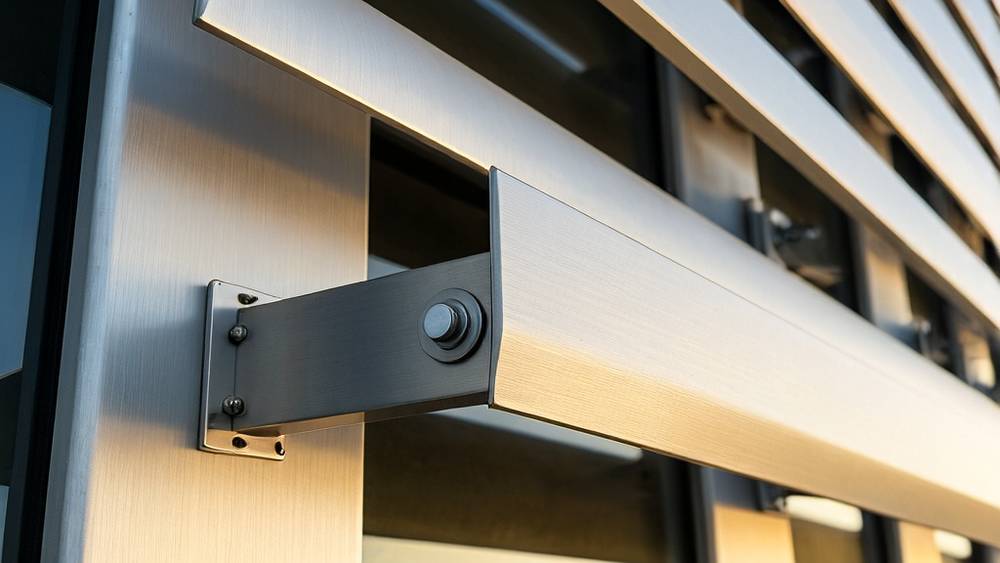
When specifying aluminum brise soleil for a commercial facade, most project teams focus on blade shape, finish color, and bracket spacing. One variable rarely gets the attention it deserves until it is too late: the alloy grade of the aluminum extrusion itself. Walking through a completed project in Manchester last year, our technical team noted hairline stress fractures forming around the bolted connections of a horizontal blade system after just 18 months in service. The root cause was not wind loading or faulty installation. The alloy was 6063-T5, and it had been specified into a coastal environment where cyclic salt spray and thermal swing demanded something with higher mechanical thresholds. This article examines how alloy selection for aluminum brise soleil components governs structural longevity, corrosion resistance, and fabricability, and why 6063-T6 versus 6082-T6 is a decision that belongs in the specification phase, not the value-engineering meeting.
Why Alloy Grade Matters More Than Blade Profile
The brise soleil market has standardized around a handful of extruded aluminum profiles: aerofoil, elliptical, rectangular, and Z-blade. Architects tend to select these based on visual rhythm and shading angle. Structural engineers, however, need to look one layer deeper. The aluminum alloy and its temper designation directly control three performance vectors that determine whether the system will still look and function as designed after a decade of exposure.
First, ultimate tensile strength (UTS). A 6063-T5 extrusion delivers approximately 150–175 MPa UTS. Step up to 6063-T6 and that figure climbs to 205–245 MPa. Move to 6082-T6 and you reach 310–340 MPa. For a horizontal blade spanning 1,800 mm between support arms, that difference translates into either a slimmer, more elegant section or a thicker, bulkier one to carry the same wind and dead load.
Second, yield strength. This is the stress at which permanent deformation begins. For brise soleil blades cantilevered beyond their last support bracket, yield strength governs the deflection behavior under gust loads. A blade that yields slightly during a storm does not necessarily fail, but it will not return to its original geometry. Over multiple cycles, the system develops visible sag.
Third, corrosion resistance in specific environments. Not all 6000-series alloys behave identically in chloride-rich atmospheres. The copper content, even in trace amounts, influences pitting susceptibility. This is where alloy selection intersects with geography.
6063-T5, 6063-T6, and 6082-T6: A Technical Comparison
The three alloys most commonly encountered in aluminum brise soleil supply chains represent a clear hierarchy of mechanical performance and cost. Understanding the trade-offs prevents both over-specification (paying for strength you do not need) and under-specification (inheriting a maintenance liability).
6063 is sometimes called an "architectural alloy." It extrudes beautifully, accepts anodizing with excellent color uniformity, and costs less per kilogram than 6082. The T5 temper is achieved by cooling from the extrusion temperature and artificial aging. T6 requires a full solution heat treatment followed by artificial aging, delivering roughly 30% higher tensile and yield strength for the same profile geometry.
6082-T6 is a structural alloy. It contains higher magnesium and silicon plus manganese, which boosts strength significantly but slightly reduces extrudability. Complex aerofoil shapes with thin trailing edges are harder to produce in 6082 than in 6063. The corrosion resistance of 6082-T6 is generally rated as very good, but in severe marine environments, its slightly higher copper content (up to 0.10% compared to 0.10% max in 6063, though typically lower in practice) means that specifying a robust surface treatment becomes non-negotiable.
| Property | 6063-T5 | 6063-T6 | 6082-T6 |
|---|---|---|---|
| Tensile Strength (UTS) | 150–175 MPa | 205–245 MPa | 310–340 MPa |
| Yield Strength (0.2% offset) | 110–130 MPa | 170–200 MPa | 260–280 MPa |
| Elongation at Break | 8–10% | 8–10% | 10–12% |
| Extrudability | Excellent | Excellent | Good (limited on thin walls) |
| Anodizing Response | Excellent, uniform | Very good | Good (slight tone variation possible) |
| Weldability | Very good | Very good | Good |
| Relative Material Cost | Baseline | +8–12% | +18–25% |
| Typical Application | Low-wind inland, vertical fins | Mid-rise, moderate spans | Coastal, long-span, cantilevered |
Reading the Environmental Context Before Selecting an Alloy
A project 15 km inland in a temperate climate has fundamentally different metallurgical demands than one 200 m from a breaking surf line. The decision tree starts with three environmental variables.
Distance from coastline and prevailing wind direction. The ISO 9223:2012 classification for atmospheric corrosivity divides environments into C1 (very low) through CX (extreme). Most urban and inland locations fall into C2 or C3. Coastal areas within 500 m of the sea typically register C4 or C5. In a C4 environment, 6063-T5 with a 60-micron minimum PVDF coating may perform adequately for 15–20 years. In C5, upgrading to 6063-T6 or 6082-T6 and specifying a marine-grade pretreatment becomes the prudent path.
Thermal cycling amplitude. Aluminum brise soleil components expand and contract at approximately 23.4 × 10⁻⁶ per °C. A 3,000 mm blade experiencing a 50°C temperature swing moves roughly 3.5 mm. This movement must be accommodated by the connection details. Higher-strength alloys do not change the coefficient of thermal expansion, but they better resist the fatigue stresses that accumulate at fixed connection points over thousands of thermal cycles.
Wind load regime. A 40-story tower in an exposed urban location will experience gust pressures that a suburban two-story building never sees. The alloy choice directly affects whether a given profile can meet span tables without increasing section depth. For a project in Miami-Dade County, where Florida Building Code requires impact resistance and elevated wind load factors, 6082-T6 often becomes the default starting point for any aluminum brise soleil component spanning more than 1,500 mm.
Fabrication Constraints That Architects Overlook
Alloy selection does not just affect in-service performance. It shapes what is possible during fabrication and how much the finished system costs.
Extrusion complexity. 6063 flows through a die more readily than 6082. For profiles with sharp corners, thin trailing edges, or hollow chambers, 6063-T6 offers a sweet spot: higher strength than T5 without the die wear and production speed penalties of 6082. A manufacturer like Futeng® regularly advises clients that a 2,400 mm aerofoil blade in 6082-T6 may require a minimum wall thickness of 2.5 mm to extrude cleanly, whereas the same profile in 6063-T6 can be produced at 2.0 mm.
Anodizing quality. The aesthetic standard for architectural anodizing is typically AA-M12C22A31 (Class I architectural anodize) per The Aluminum Association standards. 6063 achieves this finish with remarkable consistency because its metallurgical structure is forgiving. 6082 can show slight color variation after anodizing, particularly on large batch runs. When the specification calls for a uniform bronze or champagne anodized finish across 500 blades, 6063-T6 is the safer substrate.
Cutting and machining. 6082-T6 machines cleanly but requires more tool pressure, which increases wear on CNC equipment. For fabricators producing thousands of precisely slotted blades, this cost shows up in tooling replacement cycles and cycle time per part. 6063-T5 and T6 are gentler on tooling and faster to process.
Coating Compatibility Across Alloy Types
Surface treatment is the interface between the aluminum substrate and the environment. The alloy underneath directly influences coating adhesion, pretreatment effectiveness, and long-term corrosion creep at scribe lines.
PVDF (polyvinylidene fluoride) liquid coatings meeting AAMA 2605 standards are the dominant specification for aluminum brise soleil in North America and the Middle East. These systems rely on a chromate or chrome-free conversion coating to bond the paint to the metal. 6063 alloys respond predictably to these pretreatments. 6082, with its higher magnesium content, can develop a slightly different oxide layer during pretreatment that, if not properly controlled, may reduce coating adhesion by 5–10% in pull-off tests. Reputable coaters adjust their chemical baths to account for this, but it requires communication between the extruder, coater, and specifier.
Powder coatings meeting Qualicoat Class 2 or AAMA 2604 are common in European and Asian markets. These are more tolerant of alloy chemistry variations than liquid PVDF, but the same principle applies: the pretreatment step should be validated on the specific alloy being used, not a generic 6063 coupon.
For projects in the Gulf region, where aluminum brise soleil faces combined UV, sand abrasion, and saline humidity, specifying a 70-micron minimum PVDF three-coat system over 6063-T6 or 6082-T6 with chrome-free pretreatment has become the de facto standard among tier-one facade contractors.
Galvanic Corrosion: The Hidden Risk at Connection Points
An aluminum brise soleil system is never just aluminum. It connects to steel brackets, stainless steel fasteners, and sometimes galvanized steel support arms bolted back to the primary structure. At every interface, galvanic corrosion is a potential failure mode.
The galvanic series in seawater places aluminum as anodic relative to carbon steel and most stainless steels. When moisture forms an electrolyte bridge between an aluminum blade and a steel bracket, the aluminum sacrifices itself. The rate of attack depends on the cathode-to-anode area ratio, the conductivity of the electrolyte, and the specific alloy's position on the galvanic series.
6082-T6, with its slightly different electrochemical potential compared to 6063, can exhibit marginally different galvanic behavior. The more important variable, however, is the isolation strategy. Best practice includes nylon or EPDM isolating washers at every bolted connection, stainless steel fasteners (grade 316 in coastal zones, minimum 304 inland), and a design that avoids trapping water at connection points. The ISO 9223 corrosion classification should inform isolation detailing just as it informs alloy selection.
Cost-Per-Year: Reframing the Alloy Decision
Procurement teams often compare alloy options on upfront material cost per kilogram. This framing misses the point. A more useful metric is cost-per-year of service life, factoring in the probability of premature degradation, maintenance interventions, and the logistical nightmare of replacing failed blades on an occupied building.
Consider a 2,000 m² aluminum brise soleil facade. The raw extrusion cost difference between 6063-T5 and 6082-T6 might be €18,000–€25,000 on a total package of €400,000–€500,000. That is roughly 5%. If 6063-T5 develops stress corrosion cracking at 12 years in a C4 environment and requires blade replacement, the remedial cost, including access, labor, and business disruption, can exceed the original installation cost.
For inland, low-rise projects with sheltered elevations and blade spans under 1,200 mm, 6063-T5 with a quality PVDF coating is an entirely appropriate, cost-effective choice. For anything exposed, tall, coastal, or cantilevered beyond 1,500 mm, stepping up to 6063-T6 or 6082-T6 should be treated as insurance, not an upgrade.
Specifying Alloy Grade in Tender Documents
One of the most common gaps in aluminum brise soleil specifications is the absence of an explicit alloy and temper designation. Many performance specifications state "aluminum alloy to BS EN 755" or "aluminum extrusion to EN 12020" without narrowing the field. This ambiguity invites value engineering that may deliver 6063-T5 when the design assumed 6082-T6.
A robust specification for aluminum brise soleil should include the following in its materials clause: alloy grade per EN 573-3 or ASTM B221, temper designation, minimum mechanical properties (UTS, yield, elongation), surface treatment standard and minimum thickness, and environmental corrosivity category per ISO 9223. When requesting samples or mock-ups, require certification showing the alloy chemistry and mechanical test results for the actual batch being supplied.
Futeng® and other established extruders and fabricators can provide mill test certificates (MTCs) that trace each heat of aluminum from smelter to finished profile. For projects seeking LEED or BREEAM credits, this traceability also supports the materials and resources documentation requirements.
The difference between an aluminum brise soleil system that performs for 30 years and one that fails in 10 is rarely visible in the first 12 months. It lives in the alloy designation on the mill certificate and the quality of the pretreatment before the first coat of paint goes on.
Regional Practice Differences Worth Knowing
Specification norms vary by region, and understanding these norms helps international project teams align expectations.
In the United Kingdom, BS 5950 and the upcoming Eurocode 9 (EN 1999) govern aluminum structural design. 6063-T6 is the most commonly specified alloy for brise soleil in London commercial projects, with 6082-T6 reserved for long-span or high-exposure applications. The trend toward design-build procurement in the UK means that the contractor's design portion often includes alloy selection, and the client's performance specification should explicitly require evidence that the chosen alloy meets the assumed structural model.
In the Middle East, particularly the UAE and Saudi Arabia, 6082-T6 with a marine-grade PVDF coating has become the default for aluminum brise soleil on high-rise towers. The combination of extreme summer temperatures (ambient air exceeding 48°C, pushing surface temperatures on dark-colored blades above 80°C), saline humidity along the Gulf coast, and occasional sandstorms creates a punishing service environment. Specifying 6063-T5 in this context would be considered a material error by most experienced facade consultants.
In North America, the Aluminum Design Manual published by The Aluminum Association provides allowable stress design and load and resistance factor design methodologies. 6063-T6 is widely available and commonly specified. 6082-T6 is less common in the US supply chain, and some projects substitute 6061-T6, which offers similar mechanical properties to 6082-T6 with slightly different corrosion behavior and extrudability characteristics.
Understanding which alloys are locally stocked and which require mill-run minimums can significantly impact lead times. A 6082-T6 profile that requires a 2,000 kg extrusion run may add 8–10 weeks to the program if the local extruder does not regularly produce it. Early engagement with the supply chain is essential.
Making the Right Call: A Practical Decision Framework
Alloy selection for aluminum brise soleil does not have to be complex if the decision is structured. The following framework, developed from lessons learned across hundreds of projects, reduces the choice to a few clear questions.
Step one: Classify the environment. Determine the ISO 9223 corrosivity category. If C4 or C5, eliminate 6063-T5 from consideration for structural blades. If C2 or C3, keep all options open and evaluate based on other factors.
Step two: Calculate the governing span condition. Identify the longest unsupported blade span and the worst-case wind load combination. Run a preliminary stress check against the yield strength of 6063-T6. If utilization exceeds 80%, move to 6082-T6.
Step three: Verify the finish requirement. If the project demands Class I architectural anodizing with tight color tolerances, favor 6063-T6. If PVDF or powder coating will be used and the environment is severe, either alloy family can work, but confirm pretreatment compatibility with the coating applicator.
Step four: Audit the connection design. Ensure that the structural model accounts for thermal movement, that isolation materials are specified at all bi-metallic interfaces, and that fastener grades are appropriate for the environment. No alloy can compensate for poor connection detailing.
Step five: Lock the alloy in the specification. Write the alloy designation, temper, and the standard it must conform to into the performance specification and the bill of quantities. Do not leave it to interpretation.
The aluminum brise soleil on a building facade is among the most visually prominent and structurally active components of the envelope. It shades the glazing, modulates daylight, and defines the architectural character of the elevation. It also lives outdoors, fully exposed, for the life of the building. The alloy grade that makes up its blades, brackets, and support arms is not a commodity detail. It is a design decision with a 30-year tail. Making that decision with data, environmental awareness, and a clear understanding of the trade-offs between 6063-T5, 6063-T6, and 6082-T6 is what separates durable facades from costly post-occupancy remediation programs.