2 0 mm vs 3 0 mm Solid Alum Cladding Panels Deflection Cost and Oil Canning Reality
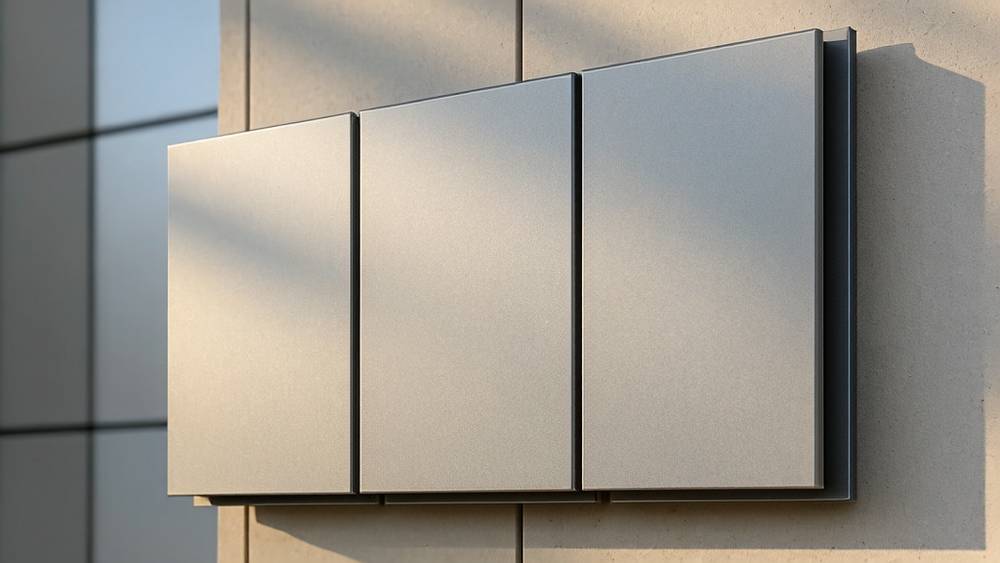
When a building envelope consultant specifies solid aluminium panels for a rainscreen facade, the first technical question that lands on the procurement desk rarely concerns colour or finish. It concerns thickness: 2.0 mm, 2.5 mm, or 3.0 mm. That single decision ripples through wind load performance, flatness tolerance, fabrication cost, and ultimately whether the installed alum cladding system will pass a post-installation inspection without a punch list full of oil canning notations. This article strips away the marketing generalities and examines what actually happens when you move from 2.0 mm to 3.0 mm solid aluminium sheets across five measurable dimensions: deflection under uniform wind pressure, fabrication behaviour, installed weight, cost per square metre, and long-term visual stability.
Why Panel Thickness Becomes the First Engineering Gate
Solid aluminium cladding panels are not structural members in the classical sense, but they are expected to behave like them. Wind loads transfer through the panel face into the carrier framing, and any deflection visible to the naked eye becomes a contractual defect. The governing standard in most international specifications, ASTM E330/E330M for structural performance under static air pressure, does not prescribe a single deflection limit for cladding panels. Instead, project specifications typically borrow L/60 or L/90 limits from framing standards, and this is where thickness starts to matter.
A 2.0 mm solid aluminium panel spanning 600 mm between stiffeners will deflect more than twice as much as a 3.0 mm panel under identical negative wind pressure. That is not a linear relationship, because bending stiffness scales with the cube of thickness. Moving from 2.0 mm to 3.0 mm increases stiffness by roughly 3.4 times, assuming the same alloy and temper. For a curtain wall contractor bidding a 40-storey tower in a typhoon-prone region, this single parameter determines whether the panel schedule requires intermediate stiffeners, which add fabrication hours and material cost.
The alloy choice compounds the thickness decision. Most solid alum cladding panels are specified in AA 3003-H14 or AA 5052-H32. AA 5052 delivers approximately 15% higher yield strength, which means a 2.5 mm 5052 panel can sometimes substitute a 3.0 mm 3003 panel on deflection-governed spans. But 5052 costs more per kilogram, and the procurement arithmetic is never straightforward. What looks like a material-saving switch can backfire when the fabricator's press brake tooling struggles with the harder temper, increasing labour time and scrap rates.
Deflection Under Wind Load: The Numbers Behind the Spec
Engineers calculate cladding panel deflection using plate bending theory, but the reality of a rainscreen panel with folded returns and intermittent stiffener bonding departs from a simply supported plate model. Still, the comparative data holds practical value. Consider a 1,200 mm × 600 mm panel with 25 mm folded returns on all four edges, subjected to a design wind pressure of 2.0 kPa (typical for mid-rise buildings in many urban locations).
The 2.0 mm panel in AA 3003-H14 will show centre-span deflection in the range of 8-10 mm under service-level wind loads. That exceeds the commonly applied L/90 criterion (6.7 mm for a 600 mm span) and will likely trigger a request for stiffeners. The 2.5 mm panel drops deflection to roughly 4.5-5.5 mm, passing L/90 with margin. The 3.0 mm panel brings it below 3 mm, well within even tighter L/120 limits sometimes demanded on prestige projects.
But stiffeners are not free. A typical extruded aluminium stiffener, bonded to the panel rear face with structural silicone or two-part epoxy, adds $8-15 per linear metre in material and labour. If every panel in a 5,000 m² facade requires two stiffeners, the added cost can exceed $80,000. Suddenly the 3.0 mm panel, which may eliminate stiffeners entirely, looks cheaper even though raw material cost per kilogram is identical across gauges.
Panel bending stiffness scales with the cube of thickness. A 3.0 mm panel is 3.4× stiffer than a 2.0 mm panel. This nonlinear relationship is the single most important engineering fact in solid aluminium cladding specification.
Oil Canning: The Visual Defect That Thickness Cannot Cure Alone
Oil canning, the waviness or buckling visible under raking light on flat metal panels, is the most persistent quality complaint in architectural alum cladding. It has no structural significance and no ASTM pass/fail threshold, yet it drives disputes between contractors, fabricators, and architects more often than any other single issue.
Thicker panels resist oil canning better, but the relationship is not as strong as the deflection math suggests. A 3.0 mm panel can still oil can if the fabrication process introduces residual stresses: over-bending the returns, welding stiffeners with too much heat, or running the coil through a leveler with worn rollers. The Metal Construction Association's guidance document on oil canning identifies thickness as one of seven contributing factors, alongside panel width-to-thickness ratio, alloy temper, and fabrication method.
Practically speaking, oil canning becomes noticeably less frequent once panel thickness exceeds 2.5 mm, provided the fabricator maintains proper process control. Below 2.0 mm, oil canning is almost inevitable on large flat panels unless the design incorporates intentional breaks, reveals, or perforations that break up the visual plane. Some architects deliberately specify a light stucco-embossed surface on thinner panels to mask the waviness, accepting the aesthetic trade-off for budget reasons.
Fabrication Behaviour: What Happens on the Press Brake
Solid aluminium panels arrive at the fabricator as flat sheets, typically in 1,500 mm or 2,000 mm widths. The first operation is cutting to size on a CNC router or panel saw, followed by folding the perimeter returns on a press brake. This is where thickness changes the workflow.
A 2.0 mm panel folds cleanly with standard V-die tooling and moderate tonnage. Operators can run at high cycle rates with minimal adjustment between panels. A 3.0 mm panel demands wider V-die openings to avoid cracking the outer fibre of the bend, and the required tonnage increases substantially. Minimum bend radius also grows: for AA 3003-H14, the recommended inside bend radius is approximately 1× thickness for 2.0 mm (2.0 mm radius) but 1.5× for 3.0 mm (4.5 mm radius). That larger radius eats into the flat face dimension and must be accounted for in the blank size calculation.
Springback also varies with thickness. Thicker material springs back more after bending, meaning the press brake operator must over-bend by a larger angle to achieve the specified 90° return. This requires more trial-and-error adjustment and can slow production by 15-20% compared to 2.0 mm material. Fabricators who quote a single per-panel price regardless of thickness are either building margin into the thinner-gauge work or losing money on the thicker panels.
Weight Implications on the Carrier System
Solid aluminium density is 2,730 kg/m³. A 2.0 mm panel weighs 5.46 kg/m² before returns and stiffeners; a 3.0 mm panel weighs 8.19 kg/m². That 50% increase in self-weight flows through to the carrier framing, brackets, and ultimately the building structure.
On a unitised curtain wall system, the additional 2.73 kg/m² rarely governs the mullion design, which is typically controlled by wind load and inter-storey drift. But on a rainscreen system with thermally broken help brackets fixed back to the structural wall, the dead load increment can push bracket spacing from 600 mm centres to 450 mm centres, adding 33% more brackets and fasteners across the entire facade.
The weight difference also affects handling. A standard 1,200 mm × 2,400 mm panel in 3.0 mm weighs approximately 23.6 kg, which is within the single-person lift limit under most health and safety regulations but approaching the threshold where a two-person lift or vacuum lifter becomes advisable. On a high-rise installation with panels being manoeuvred from a hoist, the productivity difference between one-person and two-person handling can be 30-40% on installation rates.
Panel Weight Comparison by Thickness
| Thickness | Weight (kg/m²) | Standard Panel 1.2×2.4 m (kg) | Handling Recommendation |
|---|---|---|---|
| 2.0 mm | 5.46 | 15.7 | Single person, no equipment |
| 2.5 mm | 6.83 | 19.7 | Single person, suction cup recommended |
| 3.0 mm | 8.19 | 23.6 | Two-person or vacuum lifter |
Cost Arithmetic: Material, Fabrication, and Installed
The raw aluminium coil price per kilogram is essentially identical across 2.0, 2.5, and 3.0 mm gauges when sourced from the same mill. What changes is the kilograms per square metre. At a coil price of approximately $4.50-5.50 per kg for PVDF-finished AA 3003 (subject to alloy surcharges and regional variation), the material cost per square metre scales directly with thickness.
But material is only 35-45% of the total installed cost for a typical solid alum cladding project. Fabrication labour, stiffeners, brackets, fasteners, and on-site installation make up the remainder. The cost comparison must therefore look at the fully installed system, not the sheet price.
A 2.0 mm panel with two bonded stiffeners might cost $95-110/m² supplied and fixed, whereas a 3.0 mm panel without stiffeners could land at $85-100/m². The thicker panel saves on stiffener material, stiffener bonding labour, and the quality control inspection of every bond line. It also eliminates the risk of stiffener delamination, a latent defect that can manifest years after installation when differential thermal movement breaks the adhesive bond.
| Cost Element | 2.0 mm + 2 Stiffeners | 2.5 mm + 1 Stiffener | 3.0 mm, No Stiffeners |
|---|---|---|---|
| Sheet material | $24-30/m² | $31-37/m² | $37-45/m² |
| Fabrication labour | $18-22/m² | $17-20/m² | $15-18/m² |
| Stiffeners (material + bonding) | $16-30/m² | $8-15/m² | $0 |
| Carrier system (brackets, rails) | $18-25/m² | $18-25/m² | $18-25/m² |
| Installation labour | $22-30/m² | $22-28/m² | $24-32/m² |
| Estimated total supplied & fixed | $98-137/m² | $96-125/m² | $94-120/m² |
These figures are indicative for a mid-complexity rainscreen project in a competitive market. Actual pricing varies with panel size, perforation requirements, finish specification, and regional labour rates. The key takeaway is that the cheapest material gauge rarely produces the cheapest installed system.
Finish Durability and the Thickness Factor Nobody Discusses
PVDF architectural coatings, typically applied at 25-35 microns dry film thickness per AAMA 2605 requirements, perform identically across all panel thicknesses from a weathering standpoint. The coating does not care how thick the substrate is. But there is an indirect relationship that matters on coastal or high-pollution sites.
Thinner panels deflect more under thermal cycling. A 2.0 mm dark-coloured panel facing direct afternoon sun can reach surface temperatures of 80°C, and the thermal bowing amplitude is larger than for a 3.0 mm panel. The coating itself is flexible enough to accommodate this movement, but the sealant joints between panels are not. Repeated thermal cycling of thinner, more mobile panels can accelerate sealant fatigue at the perimeter joints, eventually leading to water ingress behind the rainscreen.
The ISO 9227 neutral salt spray test and ASTM B117 accelerated corrosion testing apply equally regardless of thickness, but real-world performance on coastal projects favours the thicker panel simply because it stays flatter and keeps the joint geometry stable over decades.
When 2.0 mm Makes Sense
Thin-gauge solid aluminium panels are not inherently wrong. They are the right answer in specific scenarios. Internal lobby cladding, where wind load is zero and the viewing distance is close enough that small deflections are invisible. Soffit panels under canopies, where gravity works in the panel's favour and the span between fixings is typically shorter. Projects where the architectural design already breaks the facade into small panels below 0.5 m², making deflection a non-issue regardless of thickness.
2.0 mm also makes sense when the panel design incorporates deep formed ribs, returns exceeding 40 mm, or a cassette profile that inherently stiffens the face. A well-engineered 2.0 mm cassette with 50 mm returns can outperform a flat 3.0 mm panel on deflection, because the return depth contributes far more to section modulus than the face thickness alone.
When 3.0 mm Is Non-Negotiable
There are project conditions where specifying anything below 3.0 mm is an invitation to problems. High-rise towers above 100 metres, where wind pressures escalate with height and the cost of accessing a panel for remedial work dwarfs any upfront material saving. Projects in the Middle East or Southeast Asia where ambient temperatures drive thermal movement to extremes. Perforated panels with open areas above 30%, where the remaining metal web must carry all the wind load with reduced cross-section. And any project where the architect has specified a high-gloss or mirror finish, which amplifies every millimetre of waviness into a visible defect.
On one 55-storey residential tower in a cyclone-prone coastal city, the facade consultant originally specified 2.5 mm solid aluminium panels with stiffeners at 400 mm centres. The contractor proposed a value-engineering switch to 3.0 mm panels with no stiffeners, backed by finite element analysis showing equivalent deflection performance. The switch saved approximately $120,000 in stiffener fabrication and bonding while eliminating the quality risk of field-bonded stiffeners in a high-humidity environment. The installed facade has now weathered three cyclone seasons without a single oil canning complaint.
Specifying Thickness: A Practical Decision Framework
Rather than defaulting to a standard gauge, the specification writer and the contractor should work through a short sequence of questions that lead to a defensible thickness choice. The first question is span: what is the maximum clear span between stiffeners or fixing points? The second is wind load: what is the design pressure from the wind engineering report, and does it include local pressure coefficients for corners and edges? The third is finish: will the panel be matte, gloss, or textured? The fourth is access: what will it cost to replace a panel if it oil-cans after handover?
Suppliers like Futeng® regularly field these questions from contractors and consultants who are value-engineering a facade package and need to understand the full cost picture, not just the sheet metal price. The conversation that starts with "what is your price for 2.5 mm PVDF panels" often ends with a re-engineered 3.0 mm solution that costs less overall once stiffeners, labour, and risk are factored in.
The Aluminum Association publishes alloy and temper data that underpins these decisions, and the Centre for Window and Cladding Technology offers guidance on deflection limits for rainscreen panels. Engineering judgement, informed by these references and by the nonlinear stiffness relationship between thickness and deflection, will produce a better outcome than any rule of thumb.
Solid aluminium cladding panel thickness is not a catalogue selection. It is an engineered decision that determines whether the facade performs quietly for 30 years or generates callbacks from the first month after practical completion. The arithmetic favours going thicker than instinct suggests, because the money saved on stiffeners, the risk eliminated on oil canning, and the long-term joint stability almost always outweigh the incremental cost of the extra aluminium.