Hidden Weld Aluminium Lattice Panels Cost and Performance vs Standard Welded
When a project specification calls for aluminium lattice panels and the phrase "hidden weld" appears in the technical notes, many procurement teams treat it as interchangeable with standard welded lattice. That assumption has led to costly reorders, delayed handovers, and at least three disputes we have been asked to mediate in the past 18 months alone. Hidden weld aluminium lattice is not a cosmetic upgrade. It is a fundamentally different fabrication process that changes structural rigidity, corrosion risk, and long-term maintenance liability. This article examines what hidden weld construction actually entails, where the cost sits relative to exposed-weld alternatives, and how to evaluate whether the premium is justified for commercial and institutional projects.
What Separates Hidden Weld from Standard Welded Aluminium Lattice
Standard welded aluminium lattice uses butt joints where intersecting members meet. Each junction receives a visible weld bead on at least one face. The weld is then ground flush or left as-welded depending on the finish specification. Powder coating goes over the top, but the underlying geometry of the joint remains detectable in most lighting conditions, particularly on darker finishes like matte black or bronze.
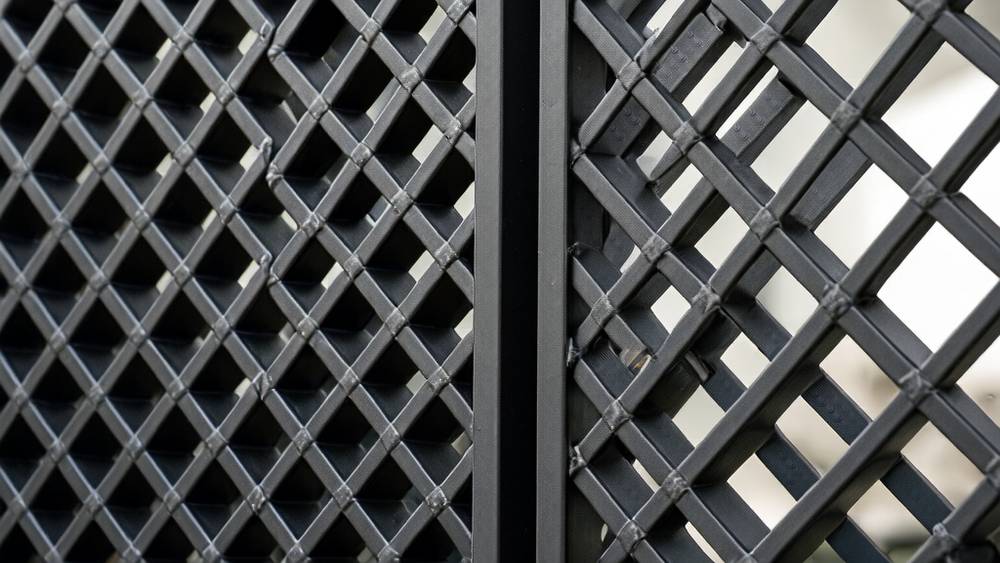
Hidden weld construction eliminates this entirely. Each intersection point is welded from the inside of the lattice cell before the panel is closed. The technique requires accessing the joint through the hollow core of the aluminium sections, which demands precision fixturing and a welding sequence that distributes heat evenly across the grid. Once complete, the outer faces show no weld bead, no grinding marks, and no filler metal visible beneath the powder coat. The result is a lattice panel where the aluminium members appear to pass through each other seamlessly — hence the term "3D hidden weld" used by manufacturers including Permalatt Products, who have been producing this type of lattice since 1997.
The distinction matters for two reasons beyond aesthetics. First, exposed welds create micro-crevices where moisture can linger, particularly in coastal or high-humidity environments. Even with proper pretreatment and AAMA 2604-compliant powder coating, these crevices are statistically the first points of coating failure. Second, exposed welds alter the effective cross-section at the joint, creating stress concentrations that affect how the panel behaves under repeated wind loading — a factor that becomes relevant once panel dimensions exceed roughly 1200 mm in either direction.
Manufacturing Process and Why Lead Times Diverge
The hidden weld process adds 3 to 5 working days to a typical aluminium lattice order compared to standard welded panels of the same specification. This is not padding — it reflects the physical constraints of the welding sequence.
A 2-inch square hidden weld lattice panel, such as the 0.5-inch member profile commonly specified for commercial screening applications, contains approximately 36 intersection points per square metre. Each intersection requires a minimum of two internal tack welds before the final pass. At a production rate of roughly 90 to 120 seconds per intersection including positioning and cooldown checks, a single 2400 mm × 1200 mm panel accumulates nearly 3 hours of direct welding labour. Standard exposed-weld fabrication of the same panel completes in roughly 40 percent of that time.
Post-weld processing adds further time. Hidden weld panels must undergo a more aggressive pre-treatment cycle because weld spatter trapped inside hollow sections can release contaminants during the curing oven stage, causing pinhole defects in the powder coat. Reputable fabricators run a multi-stage alkaline degreasing and deionised water rinse — typically matching ASTM D1730 preparation grades — before the chromate conversion coating is applied.
For project planners, the practical implication is straightforward: if the specification requires hidden weld aluminium lattice across more than 200 panels, the fabrication window should allow a minimum of 4 weeks from approved shop drawings, not the 2 to 3 weeks that standard welded lattice might require from the same facility. Rush orders are possible but not without compromising the inspection hold points that catch internal weld defects before powder coating.
Structural Performance Differences That Specifications Often Miss
Most aluminium lattice specifications reference the alloy grade and powder coating standard but remain silent on weld joint design. This is a gap worth closing because the joint type directly influences how the lattice panel distributes load.
In a standard butt-welded lattice, each intersection acts as a semi-rigid connection. The weld bead on the face provides bending resistance in one plane but leaves the orthogonal plane dependent on the penetration depth of the weld root. Under cyclic wind load — the kind experienced by rooftop equipment screens or parking garage facades — the differential stiffness between the two planes gradually works the joint, a phenomenon well-documented in AISC fatigue studies on welded aluminium structures.
Hidden weld joints, by contrast, create a connection that approaches full rigidity in both planes because the weld metal fills the internal cavity at the intersection. Testing data from manufacturers indicates that hidden weld panels exhibit roughly 25 to 35 percent less deflection under equivalent uniform loading compared to standard welded panels of identical member dimensions and alloy. This does not mean standard welded panels are inadequate — they meet code when properly engineered — but it does mean that hidden weld panels can sometimes achieve the same span rating with a thinner member profile, partially offsetting the fabrication cost premium through material savings.
The table below summarises the key performance and procurement differences between the two construction methods for a typical 2-inch square grid aluminium lattice panel:
| Parameter | Standard Welded Lattice | Hidden Weld Lattice |
|---|---|---|
| Joint visibility after powder coating | Weld bead detectable on one face; grinding marks may show under dark finishes | No visible weld; members appear to intersect seamlessly |
| Typical fabrication lead time (200+ panels) | 2–3 weeks from approved drawings | 4–5 weeks from approved drawings |
| Relative cost per square metre | Baseline (1.0×) | 1.35× to 1.65× depending on grid density and member profile |
| Corrosion initiation risk at joints | Moderate; crevice corrosion possible at weld toe if pretreatment is marginal | Low; external faces are uninterrupted, eliminating crevice sites |
| Deflection under equivalent uniform load | Baseline; semi-rigid joint behaviour | 25–35% less deflection; near-rigid joint behaviour |
| Typical coating warranty (AAMA 2604) | 10–15 years depending on environment | 15–20 years; fewer coating stress points |
| Rework complexity if a panel is damaged on site | Moderate; local weld repair feasible with touch-up coating | High; internal weld access is not possible post-fabrication; panel replacement is usually required |
Where Hidden Weld Delivers Value — and Where It Does Not
Applications That Justify the Premium
High-visibility pedestrian zones. When aluminium lattice is installed at eye level — entrance canopies, lobby screening, retail frontage cladding — the absence of weld marks becomes immediately apparent. A standard welded panel viewed from 600 mm away will reveal joint irregularities even under medium-gloss powder coat. Hidden weld panels maintain visual consistency at arm's-length viewing distances, which is why luxury hotel and premium office lobby specifications increasingly mandate this construction method.
Coastal and high-corrosion environments. Projects within 5 km of a saltwater coastline subject aluminium lattice to chloride deposition rates that accelerate crevice corrosion. The ISO 12944 corrosion classification for these environments (C4 to C5) demands surface preparation and coating systems that leave no weak points. Hidden weld panels eliminate the most common weak point — the weld toe crevice — making them a technically defensible choice for seaside boardwalks, marina buildings, and waterfront residential towers.
Equipment screening with acoustic requirements. Rooftop mechanical screens often serve dual purposes: visual concealment and noise attenuation. When perforated or solid infill panels are integrated behind aluminium lattice, the structural rigidity of the lattice frame determines how much vibration transfers to the acoustic barrier. The near-rigid joints of hidden weld construction reduce secondary vibration paths, a factor that acoustic consultants occasionally flag when specifying lattice screening near sensitive receivers like hospital wards or recording studios.
Applications Where Standard Welded Lattice Is the Smarter Choice
Overhead soffit and ceiling installations. When aluminium lattice is installed above 3 metres, the human eye cannot resolve weld bead details on a 2-inch grid. The cost premium for hidden weld construction delivers no practical benefit in these positions. Standard welded panels with a quality powder coat finish will perform identically in terms of durability, provided the installation is not in a C4 or C5 corrosion zone.
Large-area perimeter fencing. Projects requiring 500 linear metres or more of aluminium lattice fencing are cost-sensitive by nature. The hidden weld premium on this scale can add AUD 18,000 to AUD 35,000 to the facade package depending on panel dimensions. Unless the client has explicitly requested seamless aesthetics and is willing to fund it, standard welded lattice with a 60-micron minimum powder coat thickness achieves the same functional outcome at substantially lower cost.
Temporary or short-lifecycle installations. Exhibition stands, event pavilions, and pop-up retail structures with a service life of under 3 years gain nothing from hidden weld construction. The corrosion and fatigue advantages of hidden weld joints only materialise over longer exposure periods.
How to Specify Hidden Weld Aluminium Lattice Correctly
A specification that simply states "aluminium lattice, hidden weld" leaves too much room for interpretation. Fabricators may deliver panels that are technically hidden weld but use thinner members, lower-grade alloy, or substandard pretreatment — all of which undermine the premium you are paying for.
We recommend that procurement documents include the following minimum callouts:
- Alloy grade: 6063-T5 or 6061-T6 aluminium extrusions. 6063 offers better extrudability for complex lattice profiles; 6061 provides higher strength for large-span panels. Do not accept 3003 or 5005 series sheet-metal lattice marketed as equivalent — those are folded or punched products, not structural welded lattice, and behave differently under load.
- Member wall thickness: Minimum 1.6 mm for interior applications; minimum 2.0 mm for exterior and coastal applications. Thinner walls compromise weld penetration depth and reduce the panel's resistance to impact damage during handling.
- Weld inspection standard: Visual inspection to AWS D1.2 (Structural Welding Code — Aluminum). This is the industry-recognised benchmark and should be referenced in the specification even if third-party NDT is not required.
- Pretreatment: Chromate conversion coating per ASTM D1730 or equivalent, applied after welding and before powder coating. This step is critical — skipping it to save 2 days in production is the single most common cause of premature coating failure on hidden weld lattice.
- Powder coating: AAMA 2604 as the minimum performance grade. For coastal C5 environments, specify AAMA 2605 with a minimum 80-micron dry film thickness. Dark colours (black, charcoal, bronze) should include a UV-stable topcoat to reduce heat-induced gloss degradation.
- Panel flatness: Maximum 3 mm deviation across any 600 mm span measured with a straight edge. Hidden weld panels, due to the internal heat cycles during fabrication, can develop subtle warping if the welding sequence is not properly managed.
Futeng®, a manufacturer with extensive experience in solid aluminium cladding and lattice systems, has noted that projects specifying the above line items experience significantly fewer non-conformance reports during factory acceptance testing compared to those relying on generic "hidden weld aluminium lattice" descriptions.
Cost Breakdown and Budgeting Reality Check
Hidden weld aluminium lattice carries a cost premium of 35 to 65 percent over standard welded panels of equivalent dimensions. This range narrows for large panel sizes (above 1800 mm × 1200 mm) because the welding labour per intersection is amortised across a larger area, and widens for small, high-grid-density panels where the intersection count per square metre is high.
To put numbers on this: a 2400 mm × 1200 mm hidden weld panel with a 2-inch square grid and 0.5-inch member profile typically lands between AUD 280 and AUD 420 per square metre ex-works, depending on alloy grade, powder coat specification, and order volume. The equivalent standard welded panel from the same facility would be AUD 180 to AUD 280 per square metre. Freight, framing substructure, and installation labour are additional and largely independent of the weld method.
For budget planning purposes, the hidden weld premium should be treated as an aesthetic and longevity investment, not a structural necessity. If the project's structural engineer has designed the lattice as a non-loadbearing screen, standard welded panels will meet the engineering brief. The question is whether the visual and corrosion-resistance benefits justify the additional line item. On a AUD 2 million facade package where aluminium lattice constitutes 15 percent of the cladding area, the hidden weld upgrade might add AUD 12,000 to AUD 28,000 — a meaningful but not project-breaking sum that buys distinct advantages in the right applications.
Quality Assurance Pitfalls During Procurement
Three recurring issues arise when procurement teams source hidden weld aluminium lattice without adequate quality hold points:
Issue 1: Incomplete internal weld penetration. Because the weld is hidden, a fabricator can produce a panel that looks flawless externally but has only tack welds internally. These panels pass visual inspection but fail under load. The only reliable countermeasure is to require random destructive testing on one panel per batch — cut through intersection points and measure weld throat depth. This adds roughly AUD 300 to AUD 500 per batch but eliminates the risk of receiving structurally deficient panels.
Issue 2: Powder coat pinholes from trapped contaminants. Welding spatter and flux residue trapped inside hollow sections vaporise during the curing oven cycle (typically 180–200°C), creating gas bubbles that rupture the powder coat surface. The result is a panel with hundreds of microscopic pinholes that become corrosion initiation sites within 12 months of exterior exposure. The fix is a post-weld, pre-coating bake-out cycle — 30 minutes at 200°C to drive off volatiles before powder application. This step should be explicitly required in the coating specification.
Issue 3: Mismatched touch-up paint on site. Hidden weld panels cannot be repaired on site if they are damaged during installation. Any attempt to grind out a scratch and apply touch-up paint will be visible against the seamless surface. The procurement strategy should therefore include 3 to 5 percent spare panels in the order, specifically for site damage replacement. This is a higher spares ratio than the 1 to 2 percent typical for standard welded lattice, reflecting the greater difficulty of field repair.
Making the Call: A Decision Framework
The choice between hidden weld and standard welded aluminium lattice ultimately reduces to four questions that the project team should answer before issuing tender documents:
- What is the closest viewing distance? If panels will be viewed from under 2 metres, hidden weld delivers a meaningful aesthetic difference. Above 3 metres, the difference is negligible.
- What is the environmental exposure category? In C4 or C5 environments per ISO 12944, hidden weld construction eliminates the most common corrosion initiation point and justifies its premium on durability grounds alone.
- What is the design service life? For permanent installations expected to perform for 20+ years, hidden weld reduces long-term maintenance and recoating liability. For temporary or short-lifecycle projects, standard welded panels are the rational choice.
- Does the budget allow for proper quality assurance? If the project cannot fund destructive weld testing per batch and a bake-out cycle before coating, the hidden weld premium is being spent without the quality controls needed to guarantee its benefits — a scenario where standard welded panels from a reputable fabricator with full QA documentation may deliver better value.
Hidden weld aluminium lattice is not universally superior. It is a specialised product that excels in specific conditions: close viewing distances, aggressive environments, and long-design-life applications where the incremental cost is recovered through reduced maintenance and replacement over the building's lifecycle. Understanding where those conditions apply — and where they do not — is the difference between a specification that adds value and one that simply adds cost.