Site Fab or Factory Panel What 10000 Sq Ft of Aluminum Sheet for Wall Actually Costs
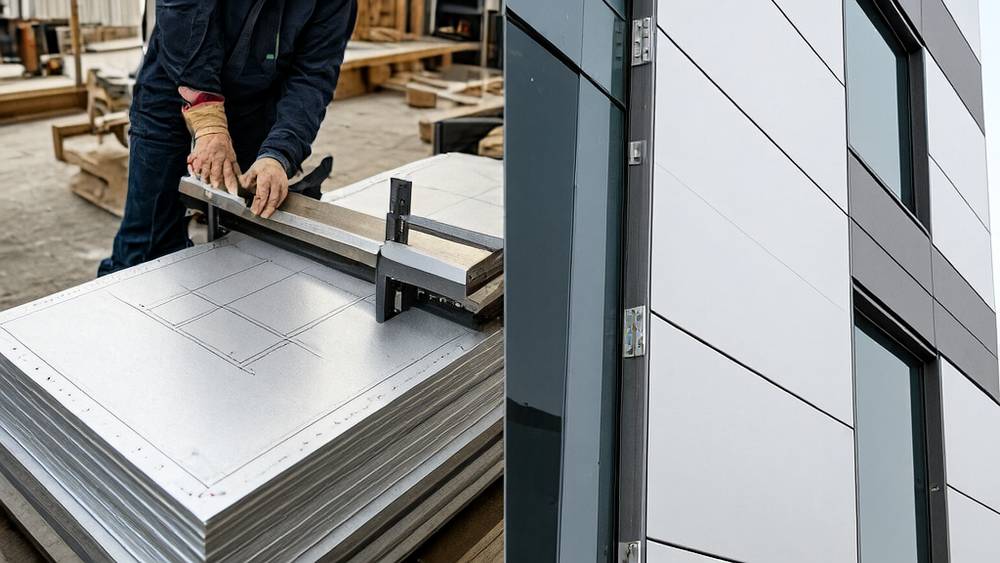
Specifying an aluminum sheet for wall cladding means confronting a decision that most project guides gloss over: whether to fabricate panels on site from raw sheet stock or order factory-finished panels cut, bent, and coated to size. On a 15,000-square-foot commercial facade, that single choice shifts material waste rates from under 5% to over 18%, moves lead times by six to eight weeks, and determines whether your install crew spends more hours running shears than hanging panels. This article examines what that split really costs — in dollars, schedule days, and warranty exposure — using data from three project scales so procurement managers and facade contractors can run their own numbers before a single sheet hits the loading dock.
The Real Split: What "Sheet" Means in Wall Cladding Procurement
The phrase "aluminum sheet for wall" pulls double duty in specification documents. Some RFQs mean flat mill-finish or pre-painted coil stock — 4 ft × 8 ft or 4 ft × 10 ft sheets in 0.040 in to 0.125 in thicknesses — destined for on-site cutting, routing, and bending. Other RFQs mean the same alloy grades but delivered as fabricated panels: cut to final dimensions, edges returned, stiffeners attached, and PVDF or FEVE coating cured. Both are solid aluminum. Both can meet ASTM B209 and EN 485. But the procurement path, cost structure, and risk profile diverge sharply from that point forward.
Three alloy families dominate wall-sheet supply chains. Alloy 3003 (manganese-bearing, tensile strength around 17–20 ksi) is the workhorse for interior wallcovering and low-rise exterior soffits where formability matters more than strength. Alloy 5005 and 5052 (magnesium-bearing, 28–33 ksi tensile) carry the bulk of mid-rise and high-rise exterior cladding because they resist salt-spray pitting and hold flatness under thermal cycling. The alloy choice itself is rarely the cost driver — at the time of writing, the spread between 3003-H14 and 5052-H32 sheet is roughly $0.40–$0.70 per pound. The cost driver is what happens after the sheet leaves the rolling mill.
Futeng® has observed across multiple export projects that contractors who treat sheet procurement and panel fabrication as a single decision — rather than sequential purchases — consistently land 12–18% lower on total installed cost. The mechanism is straightforward: nesting optimization software achieves materially better yield when it sees the entire facade geometry at once, not one trade's scope at a time.
Cost Stack Analysis: Raw Sheet vs. Factory-Fabricated Panel
To ground this comparison, consider a representative 10,000-square-foot ventilated rainscreen facade using 0.080 in (2.0 mm) 5052-H32 aluminum. All figures assume a mid-spec architectural PVDF coating (70% Kynar 500® or equivalent), non-coastal environment, and North American labor rates.
| Cost Component | Raw Sheet Path ($/sq ft) | Factory Panel Path ($/sq ft) | Delta |
|---|---|---|---|
| Aluminum substrate (mill-finish sheet) | $2.80–$3.40 | $2.60–$3.10 | Factory buys at mill-direct volume |
| Cutting & fabrication labor (on site vs. factory) | $1.90–$2.80 | $0.80–$1.20 (bundled in panel price) | Site labor 2–3× factory labor |
| Coating (PVDF, 3-coat) | $1.50–$2.20 (post-fab batch spray) | $0.90–$1.40 (pre-fab coil or inline) | Coil coating yield advantage |
| Material waste (offcuts, errors) | $0.60–$1.10 (12–18% waste) | $0.15–$0.35 (2–5% waste) | Nesting software + CNC precision |
| Stiffeners, brackets, clips | $0.80–$1.30 (sourced separately) | $0.70–$1.10 (kitted with panels) | Bulk procurement savings |
| Quality control & rework | $0.40–$0.75 | $0.10–$0.25 | Factory QC under roof |
| Total estimated installed cost | $8.00–$11.55 | $5.25–$7.40 | 25–36% premium for site-fab |
These numbers shift with project scale. Below roughly 3,000 sq ft — a small retail storefront or restaurant interior — the factory panel path loses some advantage because freight minimums and setup charges amortize over fewer square feet. At that scale, sourcing standard-size aluminum sheet for wall panels from local metal service centers and cutting on site can be cost-neutral or slightly cheaper, provided the geometry is simple (rectangular, no returns, no perforation). Above 5,000 sq ft, the factory path almost always wins. Above 20,000 sq ft, the gap widens further because factory nesting across hundreds of panels captures yield improvements that site cutting cannot match.
Waste Rates: Where the Money Disappears
Site-fabricated aluminum sheet for wall cladding generates waste at three points: (1) the initial cut plan, typically laid out by an installer with a tape measure and a Sharpie rather than nesting software; (2) miscuts from manual shear or circular-saw operations where a 1/16 in error on a 10-foot panel means the piece is scrap; and (3) field modifications when as-built dimensions differ from shop drawings. Each of these is individually modest — a strip here, a corner there. Cumulatively, on a project with moderate geometric complexity (say 30% non-rectangular panels), 12–18% of purchased sheet becomes dumpster fill.
Factory-fabricated panels reverse this. Nesting algorithms — the same class of software used in aerospace sheet-metal optimization — pack hundreds of panel shapes onto standard coil widths (typically 48 in, 60 in, or 72 in) to maximize yield. CNC routers and turret punches cut within ±0.005 in, eliminating the "trim-to-fit" waste that manual methods produce. The result is a consistent 2–5% waste rate, most of which is recycled back into the aluminum supply chain at near-scrap-value pricing. At current 5052 sheet pricing, a 10-percentage-point waste reduction on a 10,000 sq ft project saves roughly $3,000–$5,000 in material alone, before accounting for the labor cost of handling and disposing of that waste.
This waste differential also carries a schedule implication that cost tables rarely capture. Site-cut waste must be sorted, stored (aluminum scrap attracts theft on active job sites), and hauled. Factory waste stays at the factory and enters the recycler's furnace within days.
Coating Quality: Batch vs. Continuous Process
The coating step exposes the sharpest technical difference between the two paths — and the one most likely to surface during a warranty claim.
When an aluminum sheet for wall applications is coated as a finished panel (post-fabrication), it goes through a batch spray line. The fabricated panel — already cut, bent, and sometimes stiffened — is hung on a conveyor, cleaned, pretreated with a chrome or titanium-zirconium conversion coating, then sprayed with primer, color coat, and clear coat in successive booths before oven curing. This sequence works. It has served the architectural aluminum industry for decades. But it introduces variability: edges and returns receive less uniform coating thickness than flat faces; hanging marks can appear; and batch-to-batch color matching across a large facade requires tight process control that not every coating shop maintains.
By contrast, when the aluminum sheet for wall panels is coil-coated before fabrication, the flat sheet passes through a continuous coil-coating line at speeds of 200–400 ft/min. Pretreatment chemical baths, primer roller-coating, color-coat application, and oven curing happen in a single uninterrupted pass. Dry film thickness is controlled to ±0.1 mil across the entire coil width. The resulting coated sheet is then fabricated into panels — the bend radii, fastener holes, and cut edges are all post-coating operations. The aesthetic trade-off is that cut edges are bare aluminum (typically hidden by joinery or edge returns in a well-detailed rainscreen). The quality trade-off is that coil-coated PVDF consistently meets AAMA 2605 specifications for film thickness, gloss retention, and chalk resistance with lower variability than batch-sprayed equivalents.
For projects within 3 km of breaking surf or in industrial zones with airborne chlorides or sulfur compounds, this distinction matters. Batch-sprayed panels in these environments have shown edge corrosion initiating at cut and return edges within 5–7 years when edge coverage is below 0.8 mil. Factory coil-coated sheet fabricated into panels with properly detailed edge returns avoids that failure mode entirely because the face coating is uniform and the hidden edges are protected by joinery geometry rather than coating alone.
Schedule Reality: Lead Times and Cash Flow
Raw aluminum sheet for wall cladding can be on site in 2–3 weeks from a domestic service center, or 6–8 weeks for mill-direct orders from overseas. That speed is seductive. But the clock doesn't stop when the sheet arrives. Site fabrication — measuring, cutting, bending, attaching stiffeners, possibly sending panels off-site for batch coating — adds another 3–6 weeks of labor duration before the first panel goes on the wall. During those weeks, scaffolding or mast climbers are standing idle, general conditions costs are accruing, and the GC is asking why the facade contractor's crew is running a shear instead of hanging panels.
Factory-fabricated panels invert the timeline. The lead time is longer upfront: 8–12 weeks from approved shop drawings to delivered panels is typical for a mid-sized project. But the panels arrive as a kitted system — panel, stiffener, clip, fastener — ready to hang. Installation proceeds at 800–1,200 sq ft per crew-day for a standard rainscreen, versus 400–600 sq ft per crew-day when site fabrication runs in parallel with installation. The critical-path duration from order to watertight facade is often shorter with the factory path despite the longer procurement lead time, simply because installation velocity is 2× to 3× faster.
The cash-flow profile differs too. Raw sheet requires paying for material upfront (or within 30 days net), then carrying labor, coating, and waste costs for weeks before progress billings catch up. Factory panels are typically invoiced on delivery, aligning the cash outflow more closely with the installation progress that triggers payment applications. For contractors operating on thin margins, this working-capital timing can be as important as the per-square-foot price.
When Site Fabrication Makes Sense
There are legitimate scenarios where cutting aluminum sheet for wall panels on site is the better call — and pretending otherwise would mislead the reader.
Small-scale and geometrically simple projects. A 2,000 sq ft interior wallcovering in a warehouse office, using mill-finish 3003 sheet in standard 4 × 8 or 4 × 10 dimensions with no returns and no coating: the factory path adds freight and setup costs that outweigh the waste savings. Buy the sheets from a local service center, shear to size, and screw them up.
Remote locations. A project 500 km from the nearest industrial coating facility faces freight costs that can add $1.50–$2.50 per sq ft to factory-fabricated panel pricing. If the site has skilled sheet-metal labor and the geometry is straightforward, site fabrication with locally sourced sheet may be the pragmatic choice.
Phased or unpredictable scopes. Renovation projects where as-built dimensions are unknown until the old cladding comes off — and where each floor reveals different substrate conditions — benefit from the flexibility of on-site cutting. Ordering factory panels for a scope that changes weekly is a recipe for expensive remakes.
Schedule-critical, small-scope work. When 500 sq ft of aluminum soffit panels must be on the wall by Friday and the factory needs eight weeks, the question answers itself. Buy sheet stock, cut it, install it.
The common thread: site fabrication wins when the project is too small, too remote, or too uncertain to justify the upfront coordination that factory fabrication demands. The break-even is typically around 3,000–5,000 sq ft, depending on geometric complexity and coating requirements.
Geometric Complexity as the Deciding Factor
Square footage alone is an incomplete metric. A 5,000 sq ft facade composed of 50 identical rectangular panels (100 sq ft each) is a fundamentally different procurement problem than a 5,000 sq ft facade with 200 panels across 15 unique shapes, including tapered, curved, or perforated elements.
The first scenario — repetitive rectangles — can be site-fabricated efficiently. An experienced crew with a shear, a brake press, and a jig can batch out identical panels with acceptable tolerances. Waste stays manageable because the cut plan is simple. The second scenario — varied geometry — is where site fabrication's cost and quality disadvantages compound. Each unique panel shape requires a separate setup. Each tapered or curved edge increases the probability of a miscut. Each perforated panel demands routing time that ties up labor and equipment. On projects where unique-panel-count exceeds 30% of total panel count, factory fabrication's nesting software and multi-axis CNC capability generate savings that dwarf the raw-material cost differential.
This is also where the aluminum sheet for wall specification needs to address more than just alloy and thickness. Specifying that panels be fabricated from coil-coated sheet — rather than batch-sprayed after fabrication — becomes important when perforated panels are in the mix, because post-fabrication spraying of perforated sheet invariably clogs holes with coating, requiring manual clean-out that adds labor and risks scratching the cured finish.
Warranty Exposure and Recourse Structure
The procurement path determines who stands behind what — and how many parties stand between the owner and a remedy.
In the raw-sheet path, the owner or GC typically holds separate warranties from: the sheet supplier (conformance to ASTM B209), the coating applicator (conformance to AAMA 2605 or 2604), the fabricator (workmanship), and the installer (workmanship and water management). When a panel delaminates at a bend line or chalk appears within three years, the four parties point fingers at each other. The owner's path to a fix runs through forensic analysis before any party admits responsibility.
In the factory-panel path, a single entity — the panel manufacturer — typically warrants the complete panel system: substrate, coating, fabrication, and often the attachment engineering if proprietary clips are used. This single-source warranty structure doesn't eliminate disputes, but it eliminates the finger-pointing between material supplier and fabricator that bedevils the multi-party path. For an owner or developer, this difference in recourse clarity often outweighs a $1.00–$2.00 per sq ft premium on the panel price.
The Metal Building Manufacturers Association (MBMA) and Metal Construction Association (MCA) both publish guidelines on warranty structures for metal wall panels that procurement managers should reference when drafting contract exhibits. The key provision: warranty duration should start from the date of substantial completion, not the date of panel shipment, to avoid the scenario where panels sit in a warehouse for six months eating into the warranty period before they're ever installed.
Making the Call: A Decision Framework
Rather than a blanket recommendation, the following decision sequence has proven useful across dozens of projects:
- Quantify the total square footage and unique-panel count. If unique panels exceed 30% of total count, lean factory. If under 10% and total area is under 5,000 sq ft, site fabrication is viable.
- Assess the coating requirement. If the spec calls for AAMA 2605 PVDF and the project is within 5 km of salt water or industrial emissions, coil-coated sheet fabricated into panels is the lower-risk path. Batch spray is acceptable for inland, low-corrosion environments.
- Map the logistics. Get real freight quotes for factory panels to the job site. If freight adds more than 15% to the panel cost, re-evaluate site fabrication with locally sourced aluminum sheet for wall panels.
- Check the schedule. If the facade must begin installation in under six weeks, the decision is made for you: buy sheet stock and fabricate on site, accepting the cost and quality trade-offs as the price of speed.
- Structure the warranty. If the owner requires a single-source warranty for the complete cladding system, factory panels are the only path that delivers this. Write the warranty commencement clause carefully.
On a recent 12,000 sq ft mixed-use project in a coastal climate zone, applying this framework led the project team to specify 0.080 in 5052-H32 coil-coated sheet, factory-fabricated into panels with 1 in return edges and proprietary aluminum clip attachments. The total installed cost came in at $6.80 per sq ft — roughly 22% below the GC's preliminary budget that had assumed site fabrication with batch coating. The single-source warranty was a contractual requirement from the developer, and the factory path delivered it without negotiation.
Procurement of aluminum sheet for wall cladding rewards specificity. The alloy, thickness, and coating specification matter — but the procurement path matters more, because it determines whether those specifications are achieved consistently across every panel on the wall, or only on the sample that was approved in the architect's office. Running the numbers for your specific project geometry, location, and schedule before issuing the RFQ is the single highest-return hour a facade procurement manager can spend.