Metal Wall Panels Installed Cost From 4 to 45 Dollars Per Square Foot in 2026
Every project budget has a line item for metal wall panels. But the number that goes on the spreadsheet rarely matches the check that gets written. The gap between "budget estimate" and "final invoice" catches project managers off guard more than any other building envelope component. The reason is not price inflation or supplier markup. It is that installed cost per square foot for metal wall panels spans an extraordinary range — from $4 on the low end to over $45 on the high end — and the factors that push a project toward one end or the other are structural, not cosmetic.
This article breaks down what actually drives the installed cost of metal wall panels across 2026 project conditions. We examine panel type selection, fastener systems, substrate requirements, gauge thickness, coating specifications, and the labor variables that estimators miss. The numbers come from contractor bid data, supplier quoting patterns, and field reports from commercial and industrial projects across North America, Southeast Asia, and the Middle East.
The Real Cost Spread: $4 to $45 Per Square Foot Explained
When a supplier quotes metal wall panels at $4 per square foot, they are almost certainly pricing a single-skin, exposed-fastener steel panel — 26 or 29 gauge, Galvalume substrate, standard SMP paint finish, no insulation, no thermal break, no complex trim. This is an agricultural building or a basic warehouse enclosure. The panel itself is commodity-grade. The installation is straightforward: screw it to horizontal girts, lap the next sheet, repeat.
When the number reaches $45 per square foot, the panel is fundamentally a different product. At that price point, you are looking at a solid aluminium plate — typically 3.0 mm thickness — with an engineered rainscreen carrier system, concealed fasteners routed into extruded aluminium tracks, a PVDF or FEVE coating rated for 30-year coastal exposure, custom perforation patterns, and a ventilated cavity with continuous insulation behind it. This is a hospital facade or a corporate headquarters. The material cost alone can exceed $18 per square foot before the first installer touches it.
The table below maps the cost tiers that procurement teams actually encounter, based on panel type and system complexity.
| Panel Type | Material Cost (per sq ft) | Installed Cost (per sq ft) | Typical Application |
|---|---|---|---|
| Single-skin steel, exposed fastener, 26 ga, SMP finish | $2.50 – $5.00 | $4.00 – $8.00 | Warehouses, agricultural buildings, basic industrial |
| Single-skin steel, concealed fastener, 24 ga, PVDF finish | $5.50 – $9.00 | $9.00 – $15.00 | Retail, low-rise commercial, municipal |
| Insulated metal panel (IMP), 2"–3" foam core, concealed fastener | $8.00 – $14.00 | $14.00 – $22.00 | Cold storage, data centers, controlled environments |
| Solid aluminium plate, 2.5 mm, PVDF, rainscreen carrier system | $10.00 – $18.00 | $22.00 – $35.00 | Mid-rise office, education, healthcare |
| Solid aluminium plate, 3.0 mm, FEVE, custom perforation, engineered rainscreen | $18.00 – $28.00 | $35.00 – $45.00+ | High-end corporate HQ, airports, cultural buildings |
These numbers reflect 2026 North American pricing. Projects in the Middle East and Southeast Asia typically see 15–25% lower labor costs but higher logistics line items for imported aluminium substrate. European projects fall between the two, with stricter thermal performance requirements adding insulation cost that North American budgets sometimes skip.
Exposed vs Concealed Fastener: The $5 to $12 Per Square Foot Divide
No single decision swings the installed cost of metal wall panels more than fastener exposure. The gap is not about screw cost — a box of 500 self-drilling fasteners costs under $100. The gap is about everything that changes downstream of that decision.
Exposed Fastener Systems
Panels with exposed fasteners install fast. A crew of four can hang 1,500 to 2,500 square feet per day on a straightforward substrate. The panel laps over the adjacent sheet, the screw goes through the face, and the next panel covers the screw head on one side. Labor accounts for only 30–40% of total installed cost. The trade-off is aesthetic: visible screw heads across the elevation, limited design flexibility, and a panel that moves independently at each fastener point — which means more oil canning and more thermal movement noise over the building's life.
For metal wall panels in this category, material cost runs $2.50 to $5.00 per square foot. Paint systems are typically SMP (silicone-modified polyester), which carries a 10–15 year fade-and-chalk warranty. These systems serve budget-driven projects well. They do not belong on architecturally sensitive elevations.
Concealed Fastener Systems
Concealed fastener metal wall panels shift the entire cost structure. The panel itself must be fabricated with a return leg or a routed edge that engages a clip or track mounted to the substrate. This adds fabrication steps, tighter tolerance requirements, and slower installation — a crew might manage only 400 to 800 square feet per day on a complex geometry. Labor climbs to 50–65% of total installed cost.
The engineering load path also changes. Exposed-fastener panels transfer wind load directly through the screw head to the substrate. Concealed-fastener panels transfer load through a clip that must be engineered for the specific project wind zone. This means the clip gauge, spacing, and attachment to substrate all get specified by a structural engineer rather than pulled from a manufacturer's generic load table. Engineering fees add $0.50 to $1.50 per square foot at the design stage.
For solid aluminium panels — the category where concealed fasteners dominate — suppliers like Futeng® manufacture panels with routed edges and pre-attached aluminium mounting clips that integrate with standard carrier profiles from brands such as Knight Wall Systems or Systea. The fabrication precision required means these panels cannot be field-modified without risking the weathertight seal, so panel takeoffs and shop drawings must be exact.
Substrate and Thermal Performance: The Hidden Cost Drivers
Metal wall panels do not hang in the air. What sits behind them — and whether that assembly must meet an energy code — can double the per-square-foot cost before anyone orders a single panel.
Simple Girt Attachment
The lowest-cost scenario: horizontal steel Z-girts or hat channels, 16 or 18 gauge, attached directly to the building's structural steel or concrete columns. The metal wall panels screw or clip to these girts. There is no insulation in the cavity, no thermal break, no air barrier beyond the panel itself. This is the standard detail for unconditioned warehouses and agricultural buildings. Installed cost for the substrate assembly: $2.00 to $4.00 per square foot.
Thermally Broken Rainscreen
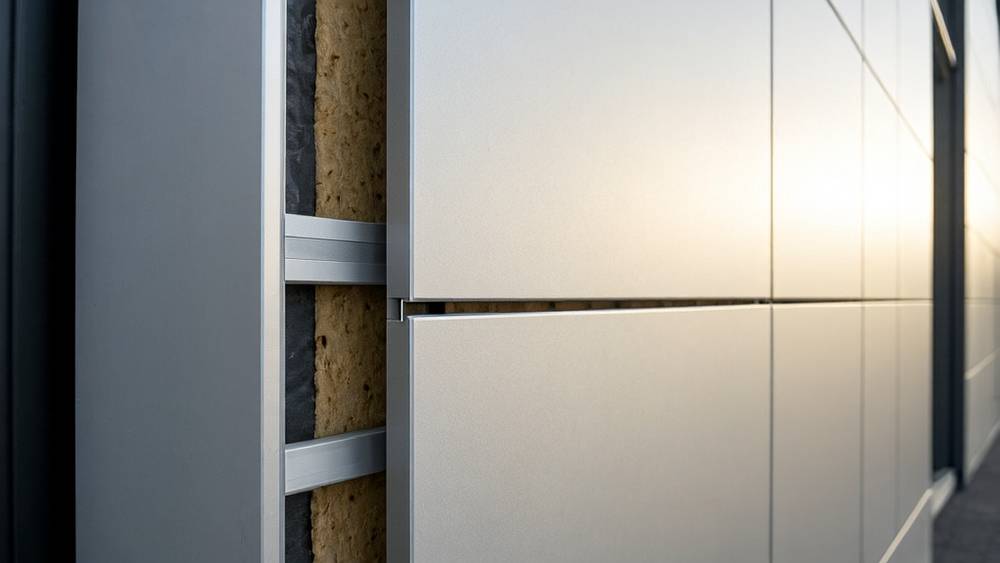
When the building is conditioned space — office, hospital, laboratory — the substrate becomes an engineered assembly. Continuous insulation (mineral wool or rigid foam, 2–4 inches thick) fills the cavity. Vertical and horizontal carrier profiles attach through thermal isolation pads that prevent metal-to-metal conduction between the exterior cladding and the interior structure. An air and moisture barrier (self-adhered sheet or fluid-applied) covers the sheathing. The metal wall panels then mount as the outermost rain screen layer, with a ventilated air gap of 3/4 to 1-1/2 inches behind them.
This assembly adds $8.00 to $15.00 per square foot before the cladding panel cost is counted. But it also unlocks energy code compliance under ASHRAE 90.1 and the IECC, and it is the only configuration that makes solid aluminium rainscreen panels perform as designed — with the cavity managing both moisture and thermal bridging.
Coating Specification: SMP vs PVDF vs FEVE Cost Impact
Paint chemistry on metal wall panels is not a cosmetic afterthought. It is a structural lifecycle decision that determines whether the facade looks acceptable in year 15 or requires recoating in year 8.
SMP (Silicone-Modified Polyester): The entry-level coating for metal wall panels. Applied at 0.7–0.9 mil dry film thickness. Fade resistance is limited — expect 3–5 Delta E units of color shift within 5–7 years in full sun exposure. Chalk resistance is moderate. Cost adder: baseline; this is the standard finish on most single-skin steel panels. Suitable for industrial and agricultural applications where aesthetics are secondary.
PVDF (Polyvinylidene Fluoride, 70% resin): The architectural standard for metal wall panels on commercial projects. Applied at 1.0–1.2 mil dry film thickness over a primer coat. Meets AAMA 2605 performance requirements: 5 Delta E units maximum color change after 10 years South Florida exposure, chalk rating no worse than 8. Cost adder: $1.50 to $3.00 per square foot over SMP. Required for any project where the architect has specified a warranty longer than 15 years.
FEVE (Fluoroethylene Vinyl Ether): The top-tier coating for metal wall panels in aggressive environments. Applied at 1.2–1.5 mil dry film. FEVE resins offer gloss retention and chalk resistance that exceed PVDF in accelerated testing per ASTM D5894. Cost adder: $3.00 to $5.00 per square foot over PVDF. Specified for coastal installations within 500 meters of saltwater, chemical processing facilities, and projects targeting 30+ year maintenance-free facades.
| Coating Type | Resin Content | Dry Film Thickness | Cost Adder (vs SMP) | Warranty Expectation | Best Application |
|---|---|---|---|---|---|
| SMP | 50% silicone-polyester | 0.7–0.9 mil | Baseline | 10–15 years | Agricultural, industrial, budget commercial |
| PVDF (AAMA 2605) | 70% PVDF resin | 1.0–1.2 mil | $1.50–$3.00/sq ft | 20–30 years | Commercial, institutional, mid-rise office |
| FEVE | FEVE fluoro-resin | 1.2–1.5 mil | $3.00–$5.00/sq ft | 30+ years | Coastal, chemical exposure, premium architectural |
Gauge and Thickness: Material Cost That Compounds Quickly
Steel panel gauge and aluminium panel thickness affect material cost in a linear way — but the downstream effects on handling, fabrication, and installation are nonlinear.
For steel metal wall panels, moving from 26 gauge (0.018 inch) to 22 gauge (0.030 inch) increases the raw steel weight by roughly 65%. The panel cost rises proportionally, but so does shipping weight, the number of lift points required on site, and the fastener specification. A 22-gauge panel needs a stronger clip and closer clip spacing to meet the same wind load rating, because the stiffer panel transfers more load to fewer attachment points. This is not intuitive — many estimators assume a thicker panel reduces substrate cost. It sometimes increases it.
For solid aluminium metal wall panels, the standard thicknesses are 2.0 mm, 2.5 mm, and 3.0 mm. A 2.0 mm panel costs approximately $6.00–$8.00 per square foot for the bare fabricated sheet (alloy 3003 or 5052, depending on formability requirements). A 3.0 mm panel costs $10.00–$14.00 per square foot — a 50–75% premium for 50% more material. The premium exists because 3.0 mm sheets are less commonly stocked, require slower CNC routing speeds, and generate more tool wear. The 3.0 mm panel also weighs 8.1 kg per square meter versus 5.4 kg for 2.0 mm, which affects the carrier system's dead load capacity and may require closer mullion spacing.
The 2.5 mm thickness has emerged as the most common specification for commercial rainscreen projects — it offers adequate flatness for panel widths up to 1,200 mm without oil canning, weighs 6.75 kg per square meter, and hits a material cost sweet spot around $8.00–$11.00 per square foot for a fabricated panel with PVDF finish.
Project Scale and Geometry: Why 5,000 sq ft Costs Less Per Foot Than 500 sq ft
Metal wall panels are a manufacturing business. Setup cost — programming the CNC router, loading the coil or sheet stock, calibrating the brake press, mixing the paint batch — gets amortized across the total square footage of the order.
On a 500-square-foot project (a small retail frontage or a single elevation accent), the setup cost might represent $2.00–$4.00 per square foot of the final panel price. On a 50,000-square-foot project, that same setup cost drops below $0.10 per square foot. This is why small projects see per-square-foot pricing 30–50% higher than large ones, even for identical panel specifications.
Geometry compounds this effect. A rectangular building with 90-degree corners and flat elevations generates rectangular panels with simple edge returns. A curved facade, a folded corner, or a perforated screen panel requires custom tooling, multiple brake setups, and slower fabrication. Complex geometry can add $3.00–$8.00 per square foot to the fabricated panel cost, independent of material and finish.
Installation labor follows the same curve. A flat wall with 80% repetitive panel sizes allows a crew to develop rhythm. A facade with 20 unique panel sizes, each requiring a different handling approach, slows installation by 30–50%. The estimator who uses a flat "per square foot" labor rate without accounting for panel diversity will lose money on complex jobs.
Logistics, Tariffs, and Regional Pricing Variance in 2026
Metal wall panels sourced internationally — particularly solid aluminium panels fabricated in China, Vietnam, or Turkey — carry logistics costs that domestic steel panels avoid. A 40-foot container from Shanghai to Houston costs $3,500–$6,000 in 2026, and a container holds roughly 3,000–4,000 square feet of packaged aluminium panels depending on thickness. That adds $0.90 to $2.00 per square foot in ocean freight alone.
Tariff exposure is an active variable. Section 301 tariffs on Chinese-origin aluminium products remain in effect, adding 25% to the declared value of fabricated aluminium panels. Some projects mitigate this by sourcing from Vietnamese or Turkish fabricators, where tariff treatment differs. The tariff conversation belongs in the procurement timeline early — a 25% cost swing discovered after bid submission can turn a profitable project into a loss.
Domestic steel metal wall panels from manufacturers such as MBCI, McElroy Metal, and PAC-CLAD avoid these tariff dynamics but carry their own regional pricing variance. A 26-gauge exposed-fastener panel that costs $3.25 per square foot in Houston might cost $4.75 in Seattle due to freight distance from coil mills and regional labor rates for distribution.
"We tell project teams to budget logistics separately from panel cost and never let a supplier roll freight into the per-square-foot number. When freight is buried, you cannot track what changed when the shipping quote inevitably moves between estimate and delivery."
How to Build an Accurate Budget Number for Metal Wall Panels
Based on the variables mapped above, here is a structured approach that estimators and procurement managers can use to build a project-specific budget for metal wall panels — one that survives value engineering and contractor bid leveling.
Step 1: Define the System, Not Just the Panel
Start with a two-word system description: "concealed rainscreen" or "exposed girt-attached." This single decision brackets your cost range more than any other. If the project is conditioned space in a climate zone with an energy code (ASHRAE zones 4–8), you are in rainscreen territory. If it is an unconditioned shell, you may have the option of a simpler system.
Step 2: Select Panel Material and Gauge
Steel or aluminium? For steel, specify gauge (22, 24, or 26). For aluminium, specify thickness (2.0, 2.5, or 3.0 mm) and alloy (3003 for flat panels, 5052 for curved or complex geometries). This locks in the raw material cost band.
Step 3: Specify Coating Performance, Not Color
Color selection can wait. Coating chemistry cannot. Specify the performance standard — AAMA 2605 for PVDF, or the FEVE resin requirement for coastal/chemical exposure — and let the supplier propose colors within that chemistry. This prevents the common mistake of selecting a color only to discover it is only available in SMP, requiring a coating downgrade.
Step 4: Estimate Substrate Cost Separately
Girts and clips. Insulation. Air barrier. Thermal breaks. These are not "panel cost" but they are part of the installed system cost that the general contractor will carry. Budget them as separate line items so that panel cost comparisons between suppliers remain apples-to-apples.
Step 5: Apply Scale and Complexity Factors
For projects under 2,000 square feet, add a 20–30% premium to the panel material cost. For projects with more than 30% non-rectangular or custom panel shapes, add a 15–25% fabrication complexity premium. These factors are empirical — they come from observing where bids land relative to the "standard" square-foot rate.
Step 6: Layer Logistics and Tariff
If sourcing internationally, add $1.50–$3.00 per square foot for freight, duties, and port handling. If sourcing domestically, add $0.50–$1.00 for regional trucking from the manufacturer to the site. Keep this as a visible line item.
Where Budgets Go Wrong: Three Patterns from the Field
After reviewing bid tabulations across two dozen commercial projects, three recurring patterns stand out in how metal wall panels budgets miss their mark.
Pattern 1: The "Steel Price" Assumption on an Aluminium Project. An estimator prices the job using a $6/sq ft installed number from a previous steel-panel warehouse project, then applies it to a solid aluminium rainscreen specification. The real number is $28/sq ft. The budget is off by a factor of four. This happens when the specification is written but the estimator reads only "metal wall panels" and reaches for the wrong cost database.
Pattern 2: Ignoring Substrate Scope. The panel supplier quotes $12/sq ft for fabricated aluminium panels. The GC plugs that number into the budget. But nobody has priced the continuous insulation, the air barrier, the thermally broken carrier system, or the engineering for the clip layout. The "panel" budget looks fine; the "wall assembly" budget is missing 60% of its cost.
Pattern 3: Tariff Blindness. A bid is submitted in January based on a supplier quote from November. Between quote and bid, a tariff ruling changes. The declared value adjustment hits the supplier's invoice, and the supplier passes it through as a change order. The GC absorbs it because it was not flagged in the bid stage. This is a process failure, not a pricing failure — it is fixed by requiring suppliers to state tariff assumptions in writing at time of quote.
Metal wall panels represent one of the widest cost ranges of any building envelope product. The $4 to $45 spread is not a sign of market inefficiency. It is a sign that the category spans fundamentally different products — from commodity steel siding to engineered aluminium rainscreen assemblies — and the budget number is only accurate when the specification is precise. Define the system, the material, the coating, and the substrate before assigning a dollar value. The projects that do this arrive at bid day with numbers that hold.