2.0 mm vs 3.0 mm Solid Aluminium Cladding Price What That Extra Millimetre Actually Costs
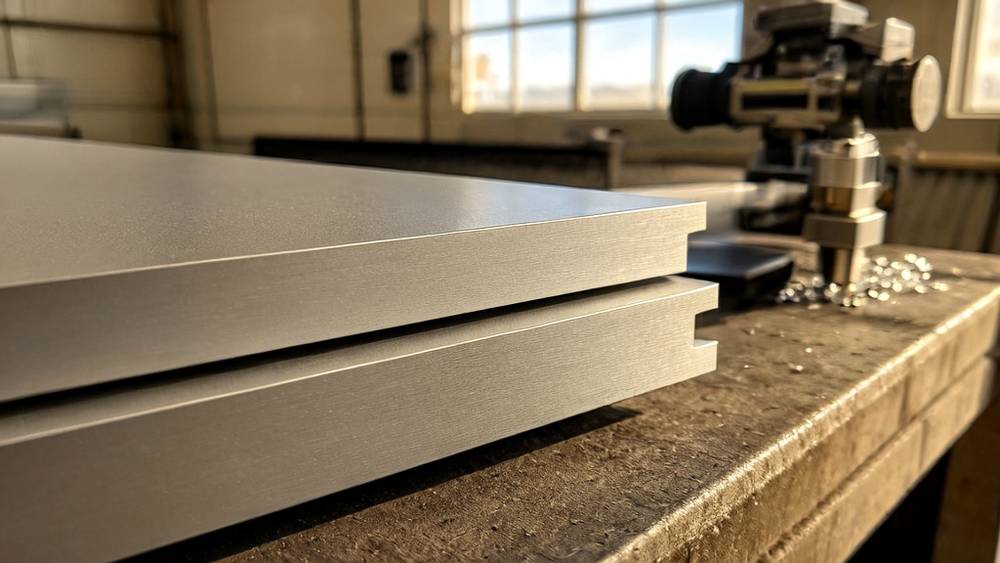
Ask any facade contractor what drives aluminium cladding price and you will get a single word back: thickness. But that answer hides more than it reveals. A 2.0 mm solid aluminium panel and a 3.0 mm panel from the same alloy series do not simply differ by a millimetre of metal. The cost gap ripples through every line item on a project estimate — raw billet consumption, press tonnage at the fabricator, CNC routing time, weld filler volume, and the freight weight that determines whether your container hits a surcharge threshold. For procurement managers reviewing tender packages across Southeast Asia, the Middle East, and Australia, understanding exactly where and why material gauge inflates aluminium cladding price means the difference between a bid that wins and a budget that bleeds six months later.
What "Panel Thickness" Actually Means in Solid Aluminium Cladding
Solid aluminium cladding panels are specified by nominal thickness, most commonly 1.5 mm, 2.0 mm, 2.5 mm, and 3.0 mm. These are not approximate numbers. Under ASTM B209 (Standard Specification for Aluminium and Aluminium-Alloy Sheet and Plate), thickness tolerances for 5052-H32 and 6063-T6 sheet stock are tightly controlled — typically ±0.08 mm for 2.0 mm sheet and ±0.10 mm for 3.0 mm. Every tenth of a millimetre translates to roughly 0.27 kg per square metre of aluminium. On a 5,000 m² project, that is 1,350 kg of metal that either exists or does not exist in your bill of materials. The aluminium cladding price per square metre shifts accordingly.
But thickness is not just a material quantity variable. It governs the entire fabrication sequence. A 3.0 mm panel requires higher tonnage on the CNC turret punch, slower feed rates during routing, and longer dwell times in the bending brake. Where a 2.0 mm panel might be formed in two passes, a 3.0 mm panel often demands three. Welding also changes: a 3.0 mm corner joint needs more filler rod and a hotter TIG arc, which increases labour minutes per linear metre. These downstream effects mean that the factory selling price for a 3.0 mm panel is rarely just 50% higher than a 2.0 mm panel — the real multiplier can reach 1.6× to 1.8× once fabrication complexity is priced in.
Where the Metal Goes: Weight, Yield, and the Hidden Waste Factor
Aluminium sheet is sold by weight. A single 2.0 mm panel measuring 1,200 mm × 2,400 mm weighs approximately 15.6 kg (assuming 2.71 g/cm³ density for 5052 alloy). The same panel in 3.0 mm weighs 23.4 kg. That 7.8 kg difference looks modest until you multiply by 800 panels. Suddenly the project is carrying an extra 6.2 tonnes of aluminium — and that is before accounting for nesting yield loss.
Nesting efficiency drops as panel thickness increases, particularly when the panel geometry includes irregular cutouts, radiused corners, or integrated stiffener slots. A 2.0 mm sheet can be nested more aggressively because the CNC can handle tighter spacing between parts without risking vibration-induced edge chatter. On 3.0 mm stock, the tool path needs wider clearance. A fabricator like Futeng® typically sees 88–92% material yield on 2.0 mm projects versus 82–86% on 3.0 mm jobs with complex geometries. That 6% yield gap is dead weight — aluminium you paid for that ends up as scrap, credited back at roughly 40–50% of the original billet value. The aluminium cladding price you negotiate should reflect this scrap credit, but many factory quotes bury the assumption in a lump sum rate.
Table: Aluminium Cladding Price Drivers by Panel Thickness
| Cost Driver | 1.5 mm Panel | 2.0 mm Panel | 2.5 mm Panel | 3.0 mm Panel |
|---|---|---|---|---|
| Raw aluminium per m² | 4.07 kg | 5.42 kg | 6.78 kg | 8.13 kg |
| Typical nesting yield | 90–93% | 88–92% | 85–89% | 82–86% |
| CNC routing speed (relative) | 100% | 90% | 75% | 60–65% |
| Bending passes (typical) | 1–2 | 2 | 2–3 | 3 |
| Weld filler per linear m | Low | Moderate | High | Very high |
| Flatness risk (oil canning) | High | Moderate | Low | Very low |
| Freight weight per 1,000 m² | 4.07 tonnes | 5.42 tonnes | 6.78 tonnes | 8.13 tonnes |
| Relative factory price index | 0.70–0.80 | 1.00 (baseline) | 1.25–1.40 | 1.55–1.80 |
The index above uses 2.0 mm as baseline because it remains the most commonly specified thickness for mid-rise commercial facades across Asia-Pacific markets. The ranges account for alloy grade variation (5052 vs. 6063), PVDF versus powder coat finish, and panel geometry complexity.
Why 2.0 mm Became the Default — and Where It Fails
Walk through any industrial park in Foshan or Johor Bahru and the 2.0 mm solid aluminium panel dominates. This is not an accident. At 2.0 mm, a 5052-H32 panel struck with a 25 mm return leg and 300 mm stiffener spacing delivers enough flexural rigidity to meet the 15 mm deflection limit under 1.5 kPa wind load that most mid-rise projects require. It is the sweet spot where aluminium cladding price per square metre stays competitive while structural performance remains within code.
But 2.0 mm fails in specific conditions. Large-format panels — anything exceeding 2.4 m in the long dimension — become vulnerable to oil canning, the visible waviness that appears under raking light. According to the AAMA 508 standard for voluntary specifications on aluminium fenestration products, oil canning is not a structural failure but a visual defect that can trigger rejection at site. On a 3.0 m wide panel, 2.0 mm stock simply lacks the stiffness to resist the residual stresses introduced during coil processing and bending. The fix is either thickening to 2.5 mm or adding rear stiffeners — and the aluminium cladding price trade-off between those two options is never obvious.
Stiffener Economics: Metal vs. Labour
A rear stiffener is typically a 1.5 mm aluminium hat section or angle profile bonded or welded to the panel back. Adding stiffeners to a 2.0 mm panel adds roughly $4–$7 per m² in material and labour. Upgrading to 2.5 mm with no stiffeners adds $6–$10 per m² in raw material but eliminates the stiffener fabrication step entirely. The choice hinges on local labour rates. In high-labour-cost markets like Australia or Singapore, the thicker panel often wins. In markets where factory labour runs $3–$5 per hour, stiffened 2.0 mm panels deliver the lower aluminium cladding price. Futeng® engineers routinely run both scenarios for tender-stage cost comparisons because the optimal answer changes by geography.
Thickness and Coating: The Interaction Nobody Budgets For
Panel gauge affects coating performance in ways that procurement schedules rarely capture. Thicker panels act as larger heat sinks during the PVDF spray line curing cycle. A 3.0 mm panel entering the oven at ambient temperature takes longer to reach the required 232°C peak metal temperature than a 2.0 mm panel. This extends dwell time, reducing line throughput and increasing the factory's per-unit coating cost. Some coaters apply a surcharge — typically $1.50–$2.00 per m² — for panels above 2.5 mm. This surcharge is almost never itemised on the quotation; it is absorbed into the lump sum aluminium cladding price. Asking the factory to break it out is one of the fastest ways to identify whether you are dealing with an experienced production planner or a trading company that has never set foot on a paint line.
Coating thickness itself — typically 25–35 μm for a two-coat PVDF system per AAMA 2605 — does not change with panel gauge, but adhesion quality can. Thicker panels hold more residual rolling oil from the mill. If the pretreatment line is not dialled in correctly, the chromate conversion coating may be inconsistent, leading to field adhesion failures that manifest as peeling 18–24 months after installation. This is not a theoretical risk: it has been documented in multiple coastal installations in Southeast Asia where 3.0 mm panels showed coating delamination while adjacent 2.0 mm panels from the same batch did not. The root cause traced back to insufficient degreasing dwell time for the heavier-gauge stock.
Freight and the Container Math
International logistics turns panel thickness into a binary cost gate. A 20-foot container holds roughly 1,200–1,500 m² of 2.0 mm aluminium cladding panels depending on crate dimensions. The same container loaded with 3.0 mm panels holds 950–1,100 m² — not because the volume changes but because the gross weight hits the container's 28-tonne payload limit sooner. If a project requires 4,000 m² of cladding, 2.0 mm stock might ship in three containers. At 3.0 mm, it becomes four. That is an extra $2,500–$4,000 in ocean freight alone, plus an additional set of port charges, customs brokerage fees, and inland trucking costs. The aluminium cladding price on the factory quotation never includes these logistics multipliers, but the landed cost per square metre certainly does.
Regional Specification Habits That Drive Thickness Choices
Different markets have developed entrenched preferences around panel thickness that have more to do with regulatory history than engineering necessity:
- Australia and New Zealand: The National Construction Code (NCC) and AS 4284 testing regime for facade systems create a de facto preference for 3.0 mm solid aluminium on high-rise projects above 25 metres. This is partly driven by wind load requirements in cyclonic regions and partly by the insurance underwriting environment post-Lacrosse building fire. The aluminium cladding price premium for 3.0 mm is simply accepted as the cost of compliance.
- Middle East (UAE, Saudi Arabia, Qatar): 2.0 mm dominates the commercial tower market, but 2.5 mm is increasingly specified for spandrel panels and large-format feature walls. The Dubai Municipality's façade guidelines reference ASTM E330 for structural performance, and the 2.5 mm crossover point usually emerges when panel spans exceed 1.8 m between fixing points.
- Southeast Asia: Price sensitivity is highest here. 1.5 mm panels are still common on low-rise commercial projects in Vietnam, Indonesia, and the Philippines, particularly when the cladding is backed by a continuous substrate rather than spanning open cavities. This drops the aluminium cladding price significantly but raises questions about long-term flatness that contractors need to manage through stiffener design.
- United Kingdom and Ireland: Post-Grenfell, the solid aluminium market has grown substantially as ACP products have been removed. BS 8414 and BR 135 compliance testing often drives specifiers toward 2.5 mm or 3.0 mm solid panels for high-rise residential, not because the regulations explicitly require it but because the system testing was conducted at those gauges. Changing the thickness means re-testing the entire system — a cost that few are willing to bear.
How to Read a Factory Quotation for Thickness-Related Line Items
Most factory quotations for aluminium cladding price follow a predictable format: a per-square-metre rate for the panel, separate line items for fabrication, coating, and packaging, and a lump sum or per-square-metre freight estimate. But thickness-related costs are distributed across all these categories, not isolated in the material line. Here is how to decode them:
"A quotation showing $38/m² for 2.0 mm and $58/m² for 3.0 mm might look like a straightforward $20 gap, but the real question is where that $20 sits. If $14 is in the material line and $6 in fabrication, the factory is being honest — aluminium billet costs drive the difference. If the entire $20 sits in fabrication, they are likely applying a risk margin for tool wear and slower throughput. Neither is wrong, but the second scenario tells you they are running older CNC equipment."
The International Aluminium Institute publishes monthly billet premium data that can help procurement teams benchmark the raw material component. If the LME aluminium price is $2,200/tonne and the factory is quoting a material cost implying $4,500/tonne, the gap includes rolling, slitting, and margin — but it should not include fabrication labour. Knowing where these boundaries sit prevents double-counting when comparing bids.
Questions to Ask Before Accepting a Thickness-Based Quote
- What is the assumed nesting yield in this quotation, and what scrap credit rate have you applied?
- Does the per-square-metre fabrication rate change with panel thickness, or is it a flat rate? If flat, has the slower routing speed on thicker stock been accounted for?
- For panels above 2.5 mm, is there a coating line surcharge? If so, is it itemised or embedded?
- What is the maximum panel size at each thickness before a stiffener becomes mandatory? Who makes that engineering call — the factory or the project structural engineer?
- Can you provide the number of containers and the estimated gross weight per container for each thickness scenario, so we can calculate landed cost rather than FOB price?
These questions separate suppliers who understand solid aluminium fabrication from those who are simply reselling sheet metal. A fabricator that can answer all five questions with data, not reassurances, is one that has controlled aluminium cladding price across real projects, not just quotation spreadsheets.
The Flatness Premium Nobody Quotes
Oil canning — the elastic buckling that creates visible waviness on flat aluminium panels — is the single most common site dispute related to panel thickness. It is also the cost that almost no factory quotation includes. When a 2.0 mm panel measuring 3,000 mm × 1,500 mm is installed on a curtain wall and shows ripples under morning light, the contractor faces three options: replace the panel, apply a remedial coating to mask the effect, or live with it. Replacement costs $80–$120 per panel in material and labour. If 5% of panels on a 2,000 m² project are rejected for oil canning, that is $8,000–$12,000 in unbudgeted cost. The aluminium cladding price quoted at tender never includes this contingency.
The Metal Building Manufacturers Association (MBMA) and AAMA both acknowledge that oil canning is inherent to flat metal panels and cannot be fully eliminated, only minimised. The practical mitigation is either specifying a thicker panel or accepting a textured finish — wood grain and stucco-embossed PVDF coatings break up the reflective surface enough that oil canning becomes invisible under most lighting conditions. This finish-based solution can be cheaper than upgrading from 2.0 mm to 2.5 mm, and it is a strategy that experienced specifiers use when aluminium cladding price is the binding constraint on a project.
When Thicker Is Not Better: The Overspecification Trap
There is a tendency, particularly among architects specifying their first rainscreen facade, to default to 3.0 mm "to be safe." This is expensive and occasionally counterproductive. A 3.0 mm panel weighs 50% more than a 2.0 mm panel. That weight travels through the fixing brackets, into the subframe, and ultimately into the primary structure. If the structural engineer designed the mullion spacing and bracket gauge for 2.0 mm cladding, upgrading to 3.0 mm without rechecking the subframe can push bracket deflections beyond acceptable limits. The fix might require heavier aluminium extrusions for the subframe — adding cost far beyond the panel upgrade itself.
The smarter approach is to match panel thickness to the specific demands of each elevation rather than applying a uniform specification. A south-facing elevation with large-format panels and direct sunlight might justify 2.5 mm or 3.0 mm. A shaded north elevation with smaller panel modules might perform identically at 2.0 mm. This differential specification — using a ISO 9001 quality management framework to track which panels go where — can trim 8–12% from the total aluminium cladding price without compromising performance. It does, however, require a fabrication partner capable of managing mixed-gauge production batches, which not every factory can handle efficiently.
At Futeng®, mixed-gauge projects are managed through separate nesting programs and dedicated production runs to avoid the throughput losses that occur when the CNC line constantly switches between material thicknesses. The logistical overhead is real but manageable — and the savings passed to the contractor typically outweigh the production planning cost by a factor of three.
Structural Engineering Considerations That Interact with Thickness
Panel thickness does not exist in isolation from fixing design. A 2.0 mm panel with four-sided support on a closely spaced grid (subframe members at 600 mm centres) can outperform a 3.0 mm panel on a widely spaced grid (1,200 mm centres) in terms of deflection under wind load. The relationship is governed by the panel's flexural rigidity, which is proportional to the cube of thickness. Doubling thickness increases rigidity eightfold, but halving the span reduces the bending moment by a factor of four — and span reduction costs subframe material, not panel material. The optimal aluminium cladding price is usually found by balancing these two variables rather than maxing out either one.
For project engineers, the practical takeaway is: before accepting a factory recommendation to increase panel thickness, ask whether reducing the subframe spacing is structurally viable and economically competitive. In many cases, particularly on steel-framed buildings where additional subframe members are inexpensive relative to aluminium panel upgrades, the tighter grid solution delivers both lower cost and better flatness. The answer depends on the specific wind loads, building height, and exposure category defined in the local structural code — and it should always come from the project's facade engineer, not the panel supplier.
Ultimately, the aluminium cladding price line on a tender summary sheet is not a single number. It is the output of a chain of decisions about thickness, stiffening, span, fixing method, and finish — each of which interacts with the others in ways that compound or offset. Understanding these interactions, rather than simply comparing per-square-metre rates, is what separates projects that finish on budget from those that do not.