3 0 mm Solid Ali Panel Flatness and Fire Compliance for Rainscreen Facades
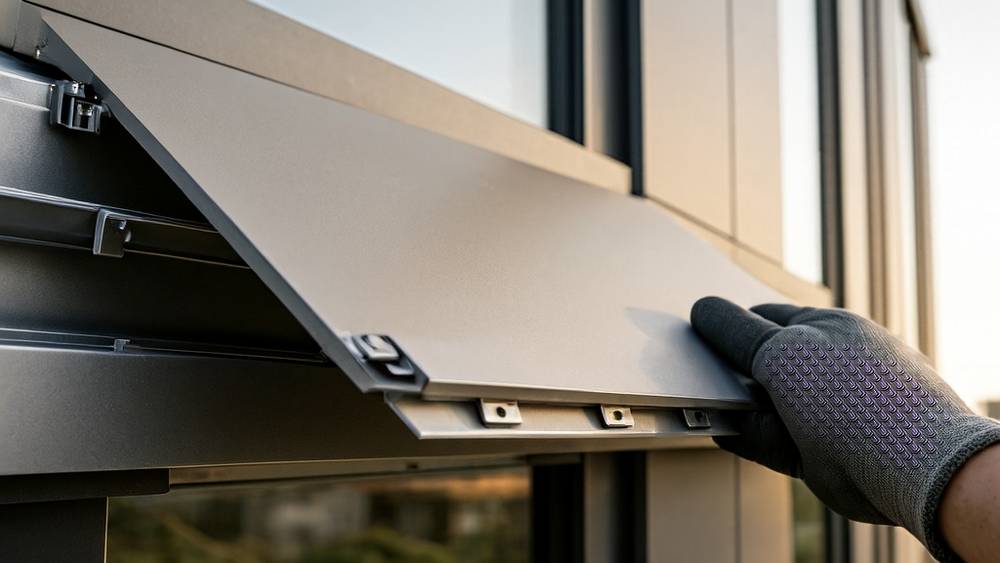
The term "ali panel" circulates widely across procurement desks and job sites, yet a persistent confusion follows it. In New Zealand and Australia, "ali panel" often refers to aluminium composite material (ACM)—two thin aluminium skins bonded to a polyethylene or mineral-filled core. But in the broader global curtain wall and rainscreen market, specifiers who search for "ali panel" frequently need solid aluminium cladding panels instead: single-skin sheets of 2.0 mm, 2.5 mm, or 3.0 mm 5052 or 3003 alloy, brake-formed or routed into cassettes and trays. The distinction matters because fire performance, flatness tolerances, and long-term durability diverge sharply between these two product families. This article examines what an ali panel means when the project demands non-combustible solid aluminium—and why the 3.0 mm threshold has become a practical line in the sand for rainscreen specifications.
The Composite vs Solid Confusion at the Procurement Stage
Search for "ali panel" in Australasian trade supplier catalogs and the results are nearly always ACM. Plywood City NZ markets AliPanel as a flat aluminium composite with a plastic core. Danmar Doors WA uses the same term for composite-faced garage door panels built around a 4 mm mineral-filled polyethylene core with a 3003 alloy skin. Bunnings shelves stock 3 mm composite sheets at 2440 × 1220 mm under names that blur into the ali panel shorthand. None of these are solid aluminium panels.
The confusion travels. A procurement manager in London or Dubai, asked by a facade contractor to source "ali panels" for a 22-storey residential rainscreen, might pull up Australasian supplier listings and assume ACM is the default. But under BS 8414 and Approved Document B post-Grenfell, many jurisdictions now restrict or ban polyethylene-core ACM above 18 m. Solid aluminium panels—homogeneous, non-combustible, rated A2-s1,d0 or better under EN 13501-1—become the compliance path by default. Yet the ali panel keyword itself carries no built-in material classification. That gap is exactly where specification errors originate.
When 3.0 mm Becomes the Rainscreen Baseline
Solid aluminium panels for ventilated rainscreen systems typically ship in three thicknesses: 2.0 mm, 2.5 mm, and 3.0 mm. On paper, all three meet the basic definition of a solid ali panel. In practice, the 3.0 mm option has steadily become the default for any project where flatness over large spans is non-negotiable.
The reasoning is structural, not cosmetic. A 2.0 mm sheet spanning 600 mm between support rails—a common cassette width—can exhibit visible deflection under wind suction loads above 1.8 kPa. Bump the span to 900 mm or 1,200 mm and the same 2.0 mm panel enters oil-canning territory well before reaching ultimate limit state. A 3.0 mm panel of the same alloy and temper carries roughly 50% more section modulus, pushing the onset of visible waviness to higher loads or wider spans.
Specifiers for projects like Futeng® have supplied across Southeast Asia and the Middle East increasingly treat 3.0 mm as the minimum for any exposed facade panel exceeding 600 mm in the short dimension. The cost delta—roughly 15–20% in raw material weight between 2.5 mm and 3.0 mm—is modest compared to the remedial cost of replacing wavy panels on a finished elevation. This is not a theoretical concern: one Dubai hotel project circa 2019 saw 2.0 mm solid panels on a west-facing elevation replaced wholesale after three summer cycles produced unacceptable optical distortion across 40% of the facade area.
Flatness Tolerances and the Oil-Canning Metric No One Publishes
Oil-canning—the visible waviness or buckling that appears under certain light conditions—is the single most litigated aesthetic defect in solid ali panel facades. Yet no ISO or EN standard quantifies it directly. AAMA 508 and 509 reference flatness indirectly through fabrication tolerances, but the industry has no universal pass/fail metric for oil-canning in installed panels.
What experienced fabricators know: alloy selection matters as much as thickness. Grade 5052-H32 aluminium, with higher magnesium content, resists the localized stress relief that triggers oil-canning better than 3003-H14. The temper matters too. H32 temper in 5052 provides a balanced combination of formability and post-forming stability. H14 temper in 3003, while cheaper, relaxes more readily after brake-forming, creating the micro-strain patterns visible as oil-canning under raking light.
The table below distills practical flatness expectations based on alloy, thickness, and span—data points that no supplier catalog will print but that experienced facade engineers internalize over multiple projects.
| Alloy & Temper | Thickness | Max Short Span | Wind Load Class | Oil-Canning Risk |
|---|---|---|---|---|
| 3003-H14 | 2.0 mm | ≤ 500 mm | Up to 1.5 kPa | High |
| 3003-H14 | 2.5 mm | ≤ 700 mm | Up to 2.0 kPa | Moderate |
| 3003-H14 | 3.0 mm | ≤ 900 mm | Up to 2.5 kPa | Low-Moderate |
| 5052-H32 | 2.0 mm | ≤ 600 mm | Up to 2.0 kPa | Moderate |
| 5052-H32 | 2.5 mm | ≤ 800 mm | Up to 2.5 kPa | Low |
| 5052-H32 | 3.0 mm | ≤ 1,200 mm | Up to 3.0 kPa | Very Low |
These figures assume cassette-type fixing with four-edge support and proper perimeter engagement. Point-fixed or two-edge support conditions reduce allowable spans by 30–40% depending on fastener layout.
Fire Compliance Is the Real Sorting Hat
If there is one factor that sorts the ali panel conversation into solid versus composite camps, it is fire performance. The Grenfell Tower inquiry permanently altered regulatory attitudes toward combustible cladding materials. Today, numerous jurisdictions mandate non-combustible materials for external walls on buildings above a defined height threshold:
- England & Wales: Approved Document B bans materials not achieving A2-s1,d0 or better (EN 13501-1) in external walls of residential buildings above 18 m.
- UAE Civil Defence: Requires A2-s1,d0 for all cladding on buildings above 15 m, enforced since the 2020 code update.
- Australia NCC 2022: Limits combustible cladding on Type A and B construction, with stringent testing under AS 5113 for façades.
- Singapore SCDF: Mandates non-combustible cladding for buildings above 24 m under the Fire Code 2018.
Solid aluminium panels—homogeneous aluminium alloy sheet with no core—achieve A1 or A2 classification under EN 13501-1 by default. There is no core to ignite, melt, drip, or propagate flame. This makes the ali panel specification path simple for fire compliance: specify solid 5052 or 3003 alloy, verify the coating system does not degrade the classification, and submit the mill certificate. No intermediate testing gymnastics, no fire-engineered cavity barriers specific to core melting behavior.
This is not to say ACM has no place. It does, in low-rise commercial signage, interior partitions, and non-regulated applications. But for any ali panel inquiry where the word "rainscreen" or "high-rise" appears, the fire compliance vector points unambiguously toward solid aluminium.
Coating Systems That Survive the 3.0 mm Panel Lifecycle
A solid ali panel specified at 3.0 mm thick with the right alloy will outlast most building leases—30 years or more before any structural concern arises. The coating must match that longevity. Two chemistries dominate the solid aluminium panel market:
PVDF (Polyvinylidene Fluoride): Typically 70% PVDF resin with 30% acrylic, applied as a three-coat or four-coat system to a total dry film thickness of 30–40 microns. PVDF meets AAMA 2605 and offers proven 20–30 year color retention and chalk resistance in most climates. It remains the default specification for architectural solid ali panels globally.
FEVE (Fluoroethylene Vinyl Ether): An alternative fluoropolymer that can be formulated at higher gloss levels than PVDF while matching its weathering performance. FEVE coatings meet AAMA 2605 as well and offer superior chemical resistance, making them preferred for industrial environments or coastal sites with airborne chemical exposure.
For projects within 500 m of breaking surf, the coating specification tightens further. PVDF with a marine-grade primer and minimum 40-micron total dry film thickness is the starting point. Some manufacturers, including Futeng®, offer a five-layer marine coating system that adds a sacrificial clear topcoat over the color coat—extending the coating's chloride-ion barrier well beyond standard three-coat PVDF.
Fabrication Routes and Their Impact on Panel Performance
Solid ali panels reach the job site through one of three fabrication paths, each with different implications for flatness, corner quality, and installed cost:
Brake-formed trays: A flat sheet is bent on a CNC press brake into a cassette shape with return legs on all four edges. This is the most common route for rainscreen panels. Springback—the tendency of aluminium to partially return to its original shape after bending—must be compensated in the bend angle programming. 5052-H32 exhibits more springback than 3003-H14, requiring tighter process control. Corner joinery—typically MIG or TIG welded, then ground flush—is the primary quality variable. Poorly executed welds create hard spots that telegraph through the finished surface.
Routed and folded: A V-groove is routed into the rear face of the sheet, removing 80–90% of the material thickness along the fold line. The panel is then folded by hand or machine into shape. This method produces crisp external corners without welding but reduces the effective thickness at the fold line to as little as 0.3 mm. Fatigue cracking at fold lines is a known failure mode in high-vibration environments.
Extruded-edge cassette: The aluminium sheet is bonded or mechanically fixed into an extruded aluminium perimeter frame. This method adds material cost but delivers the flattest, most dimensionally stable panel—particularly for large-format modules above 1,200 mm in either dimension.
The table below compares these three routes on metrics that procurement managers and facade engineers weigh during specification:
| Fabrication Method | Flatness on 1.2 m Panel | Corner Quality | Relative Cost Index | Best For |
|---|---|---|---|---|
| Brake-Formed Tray | Good (±2 mm/m) | Welded, variable | 1.0 (baseline) | Standard rainscreen, mid-rise |
| Routed & Folded | Moderate (±3 mm/m) | Crisp, no weld | 0.85 | Budget projects, small modules |
| Extruded-Edge Cassette | Excellent (±1 mm/m) | Uniform, mechanical | 1.35 | Premium towers, large formats |
The cost index assumes identical alloy, thickness, coating, and panel dimensions. Actual project pricing varies with volume, complexity, and regional labor rates.
Supply Chain Signals That Separate Solid from Composite Suppliers
An experienced buyer can distinguish a solid ali panel supplier from an ACM reseller by asking three questions before any technical data sheet arrives:
- "What alloys do you stock in sheet form?" A solid panel fabricator will answer with 5052, 3003, 5005, or 6061 grades and their tempers. An ACM reseller may not know the skin alloy at all—it is often purchased as pre-laminated coil and the alloy is secondary to the composite construction.
- "Can you supply mill test certificates by heat number?" Solid aluminium sheet traceability to the casting heat is standard practice under Aluminium Association guidelines. ACM suppliers rarely offer this level of traceability for individual skin layers.
- "What is your minimum order quantity for custom perforation and fold patterns?" Solid panel fabricators typically accept custom orders from 100–200 m², because the fabrication process starts from flat sheet. ACM suppliers often require 500 m² or more for custom patterns due to the lamination economics.
These questions are not academic. On a 12,000 m² hospital facade in Melbourne circa 2021, the contractor initially ordered "ali panels" from a supplier who delivered ACM. The specification—written by an architect who had used the ali panel term generically—was caught only at the submittal review stage, delaying procurement by six weeks while a solid aluminium alternative was sourced. The lesson: the ali panel keyword is a procurement hazard unless accompanied by explicit material definition.
Wind Loads and the Span Tables That Drive Panel Sizing
Once the ali panel is confirmed as solid aluminium, the engineering conversation shifts to wind loads and allowable spans. ASCE 7 and AS/NZS 1170.2 provide the design wind pressures; the panel's bending strength and deflection limits determine the allowable span.
For a solid ali panel cassette with four-edge support, the governing limit state is typically serviceability deflection—not ultimate strength. A deflection limit of L/175 or L/200 under design wind pressure is common in facade specifications. For a 3.0 mm 5052-H32 panel at 900 mm span, this translates to a maximum allowable deflection of approximately 5.1 mm (L/175). Under a design wind pressure of 2.2 kPa, the actual deflection computes to roughly 3.8 mm—comfortably within limits.
The same panel in 2.0 mm would deflect approximately 7.2 mm under identical conditions, exceeding the L/175 threshold. This is why the 3.0 mm standard has emerged organically across the industry: it is the thickness at which common span-to-deflection ratios align with typical urban wind loads without requiring exotic stiffening details.
When Ali Panel Means Wet Wall Lining Instead of Facade
The ali panel term carries yet another meaning in the New Zealand interiors market. Pyramid Panels markets "Alipanel" as a waterproof wall lining system—a five-layer laminated product designed as a grout-free alternative to ceramic tiles for bathrooms, showers, kitchens, and commercial wet areas. This product category has nothing to do with aluminium cladding in the facade sense, but it shares the ali panel name and creates search-level confusion.
For the B2B facade procurement audience, this is a distraction to be aware of. If an RFQ arrives using the term "ali panel" without further qualification, the first clarifying question should be: "Is this for external cladding or interior wet wall lining?" The answer determines whether the conversation belongs in the solid aluminium or laminated panel domain.
Practical Specification Checklist for Solid Ali Panel Procurement
For the procurement manager or facade engineer drafting a solid ali panel specification, the following checklist captures the decision points that determine installed performance:
- Confirm alloy grade and temper: 5052-H32 for coastal and high-wind projects; 3003-H14 acceptable for inland, low-rise applications where budget is the primary driver.
- Set minimum thickness at 3.0 mm for any panel exceeding 600 mm in the shorter span dimension.
- Specify PVDF coating to AAMA 2605 with minimum 35-micron total dry film thickness; upgrade to 40 microns and marine primer within 500 m of coast.
- Require mill test certificates per heat number for alloy verification.
- Define flatness tolerance: ±2 mm per linear meter measured with a straight edge under diffuse light, referencing the methodology in AAMA 508.
- Stipulate fabrication method: brake-formed tray with welded corners as the baseline; extruded-edge cassette for premium applications above 1,200 mm module size.
- Request EN 13501-1 classification documentation confirming A1 or A2-s1,d0 for the complete assembly including coating.
This checklist does not replace a full performance specification, but it catches the most common failure modes that arise when "ali panel" is used loosely in tender documents.
The ali panel term is a starting point, not a specification. Until the material type, alloy, thickness, and coating are explicitly defined, the term carries no engineering meaning—only commercial ambiguity.
Solid aluminium panels—homogeneous sheets of 5052 or 3003 alloy, coated with PVDF or FEVE, fabricated into cassette or tray systems—represent the compliant, durable answer to most ali panel inquiries in the facade sector. The key is recognizing that the search term itself does not distinguish between composite and solid, between interior lining and external cladding, between 2.0 mm and 3.0 mm. The specifier must make those distinctions explicit. In an industry where material ambiguity has caused well-documented failures, the simplest risk mitigation is to replace "ali panel" with a complete material description at the first line of the specification.