0.70 mm Aluminium Strip Ceiling Price Why Panel Gauge Drives 35 Percent of Installed Cost
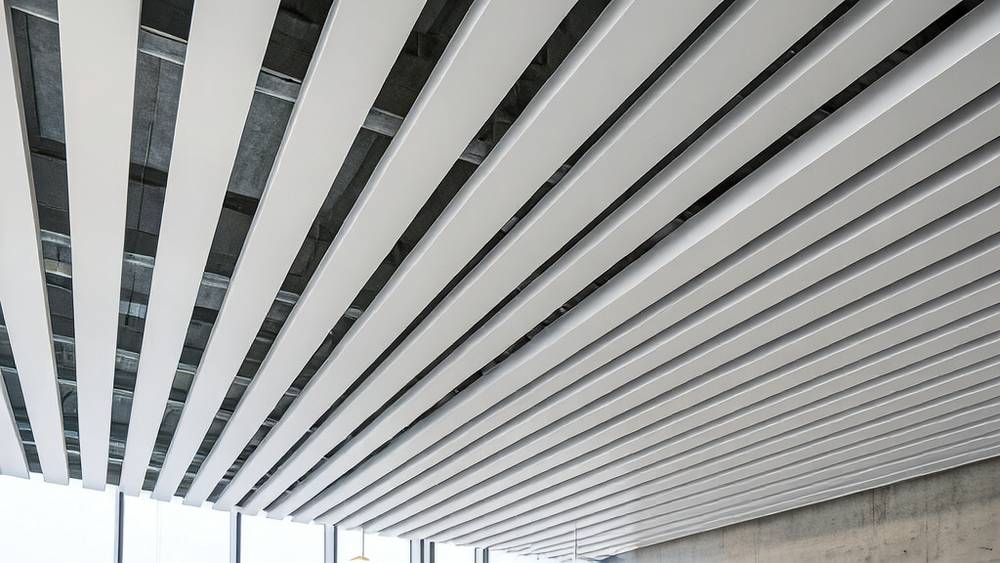
When a contractor in Kuala Lumpur asks for an aluminium strip ceiling price, the first number they hear is usually a per-square-metre figure pulled from a supplier's brochure. That number means almost nothing on its own. The real cost of an aluminium strip ceiling project turns on a handful of specification choices that most tender documents leave ambiguous: panel thickness, alloy grade, finish type, and most critically, whether the quote uses linear-metre or area-based billing. On projects I have reviewed across Southeast Asia and the Middle East, the gap between the lowest bid and the final installed cost has consistently tracked back to one variable: panel gauge. A 0.45 mm strip quoted at $18/m² looks competitive until the site team discovers oil-canning across a 3-metre span and the architect demands 0.70 mm replacement panels. This article unpacks how panel thickness drives aluminium strip ceiling price from material cost through installation and long-term performance, using data from real 2026 supply chains rather than catalogue averages.
Why Panel Thickness Is the Price Lever Most Specifiers Ignore
Aluminium strip ceilings belong to a category where structural performance and visual flatness are inseparable. Unlike solid aluminium cladding panels on exteriors, which are routinely specified at 2.0 mm to 3.0 mm, interior strip ceilings operate in a much thinner range: 0.35 mm to 0.80 mm for standard commercial products. Within that narrow band, every 0.10 mm increment changes the raw material cost by roughly 12% to 18%, depending on alloy and coil sourcing. Yet many procurement teams treat thickness as a secondary checkbox rather than the primary cost driver.
The reason is partly historical. Early strip ceiling systems in the 1990s were almost exclusively 0.50 mm to 0.60 mm, and that range became an unspoken industry default. Today's market offers far more variation. A quick survey of Made-in-China.com listings and Southeast Asian distributor catalogues shows 0.35 mm economy strips at the bottom end and 0.80 mm architectural-grade strips at the top, with the aluminium strip ceiling price per square metre roughly doubling across that span. What the price tags do not reveal is how thickness interacts with span length, clip spacing, and perforation ratio to determine whether a ceiling stays flat over a 15-year building lifecycle.
Material Cost Breakdown: What 0.10 mm Actually Costs
Aluminium coil pricing in 2026 sits between $2,400 and $2,800 per metric tonne for AA 3003 and AA 3105 alloys, the two most common grades for strip ceilings. A 0.50 mm coil yields approximately 740 square metres per tonne. A 0.70 mm coil yields about 530 square metres per tonne. The difference in raw aluminium cost alone is approximately $3.50 to $4.20 per square metre. Add forming, notching, and edge-hemming operations that take longer on thicker material, and the factory-gate price step between 0.50 mm and 0.70 mm typically lands between $5.00 and $7.00 per square metre.
This is not a hidden markup. It reflects measurable inputs: longer press cycle times, higher tool wear on slitting lines, and marginally higher scrap rates when punching perforations through thicker strip. A supplier offering 0.50 mm and 0.70 mm strips at the same price is either absorbing margin or cutting corners elsewhere, usually on finish quality or dimensional tolerance.
In projects where Futeng® has supplied aluminium strip ceiling systems across multiple thickness specifications, the factory-gate price differential between 0.50 mm and 0.70 mm material has consistently tracked coil market fluctuations rather than arbitrary markups, giving contractors a transparent basis for value-engineering decisions.
Linear Metre vs Square Metre: Why Thickness Determines Which Metric Matters
One of the most common pricing traps in aluminium strip ceiling procurement is the unit-of-measure mismatch. Many Chinese and Malaysian suppliers quote strip ceilings per linear metre because strips are manufactured and packed in lengths. A 100 mm wide strip at $3.80 per linear metre sounds reasonable; converted to area, that is $38/m². A 200 mm wide strip at $5.60 per linear metre converts to $28/m². The wider strip appears cheaper per square metre partly because the carrier rail and clip costs are spread over more area, but also because wider strips at a given thickness are stiffer and less prone to handling damage, reducing the factory's rejection and rework allowance built into the price.
This interaction between width and thickness is where value engineering actually happens. A 0.60 mm strip at 200 mm width may perform identically to a 0.70 mm strip at 100 mm width in terms of mid-span deflection under self-weight. The wider, slightly thinner option can reduce the aluminium strip ceiling price by 15% to 20% on an area basis while meeting the same flatness tolerance. But this substitution only works if the structural submittal calculations account for clip spacing, ventilation loads in plenum spaces, and access loading from above-ceiling maintenance, none of which appear in a typical supplier quotation.
Thickness, Span, and the Oil-Canning Threshold
Oil-canning is the visible waviness that appears on flat metal surfaces under certain light conditions. On aluminium strip ceilings, it is the number one cause of post-installation disputes between contractors and architects. The relationship between strip thickness and oil-canning is nonlinear. A 0.45 mm strip spanning 2.4 metres between carrier rails will oil-can under its own weight in most installations, especially if the strip has any residual stress from the roll-forming process. At 0.60 mm, the same span becomes marginal. At 0.70 mm, oil-canning becomes unlikely under normal indoor conditions.
The Metal Construction Association's technical bulletin on flatness tolerances for architectural metal does not prescribe a specific thickness-to-span ratio for strip ceilings, but the empirical rule used by experienced facade engineers is a span-to-thickness ratio below 3,500 for visually critical ceilings. A 0.50 mm strip should not span more than 1,750 mm between supports. A 0.70 mm strip extends that limit to 2,450 mm. When an architect specifies a 3-metre uninterrupted span, as is common in airport concourses and high-end retail, 0.80 mm becomes the minimum viable thickness regardless of what a supplier's standard aluminium strip ceiling price schedule suggests.
| Strip Thickness | Max Recommended Span (mm) | Span/Thickness Ratio | Oil-Canning Risk | Typical Price Range (USD/m²)* |
|---|---|---|---|---|
| 0.35 mm | 1,200 | 3,429 | High on any span above 1.5 m | $8 - $14 |
| 0.45 mm | 1,550 | 3,444 | Moderate to high | $12 - $18 |
| 0.50 mm | 1,750 | 3,500 | Moderate | $14 - $22 |
| 0.60 mm | 2,100 | 3,500 | Low to moderate | $18 - $28 |
| 0.70 mm | 2,450 | 3,500 | Low | $22 - $35 |
| 0.80 mm | 2,800 | 3,500 | Very low under normal conditions | $28 - $45 |
*Price ranges reflect factory-gate pricing for AA 3003/3105 alloy, polyester powder-coated finish, 100-200 mm strip width, excluding carrier system, freight, and installation. Source: aggregated 2026 supplier data from DCZ Building, Alumideas, and BuildEx Technology.
Finish Selection and Its Thickness-Dependent Cost Multiplier
Surface finish adds another layer to the aluminium strip ceiling price equation, and it does not apply uniformly across thicknesses. Polyester powder coating, the most common finish for interior strip ceilings, adds $3 to $6 per square metre regardless of substrate gauge. PVDF liquid coating, specified for high-humidity or semi-exterior soffit applications, adds $8 to $15 per square metre. On a 0.50 mm economy strip, a PVDF upgrade can nearly double the material cost. On a 0.80 mm architectural strip, the same PVDF upgrade represents a 30% to 40% premium. This asymmetry means that finish upgrades on thin strips produce a worse value proposition than finish upgrades on thick strips, a point rarely communicated to project value engineers.
The finish choice also interacts with perforation. Perforated strip ceilings, widely used for acoustic applications in office lobbies and transit stations, expose the cut edges of each hole to the environment. Thicker material means deeper holes with more exposed edge surface area. For a 0.50 mm strip with 2.5 mm diameter perforations at 23% open area, the exposed edge perimeter adds roughly 8% to the total surface area needing coating coverage. At 0.80 mm, that figure rises to 13%. A polyester powder line calibrated for flat surfaces may under-cure edges on thicker perforated strips unless the line speed is adjusted, adding processing cost that shows up in the final aluminium strip ceiling price.
Alloy Choice: AA 3003 vs AA 3105 and the Price Gap
Most strip ceiling manufacturers offer two alloy options: AA 3003 (manganese-alloyed) and AA 3105 (slightly higher manganese with magnesium). The mechanical property differences are modest: AA 3003 has a tensile strength of 110-170 MPa depending on temper; AA 3105 runs 130-195 MPa. In practice, a 0.60 mm AA 3105-H14 strip behaves similarly to a 0.65 mm AA 3003-H14 strip in terms of stiffness and dent resistance. Suppliers who stock only one alloy will often adjust the specified thickness to meet performance requirements rather than switching alloys.
The price premium for AA 3105 over AA 3003 is typically $80 to $120 per tonne at the coil level, translating to roughly $0.25 to $0.40 per square metre for a 0.60 mm strip. This is negligible in the context of a full installed system but becomes material when multiplied across 10,000 square metres. For most interior applications, AA 3003 is entirely adequate. AA 3105 becomes relevant only in two scenarios: where higher yield strength allows a thickness downgrade that saves more than the alloy premium, or where the ceiling is exposed to frequent cleaning with mild chemicals that might affect AA 3003 over time.
Carrier Systems: The Hidden Half of Installed Cost
Strip ceiling panels are only half the system. The carrier rails, suspension rods, edge trims, and clips constitute 40% to 55% of the installed aluminium strip ceiling price, and the carrier specification is directly influenced by panel thickness. Thicker panels weigh more. A 0.50 mm AA 3003 strip at 200 mm width weighs approximately 1.35 kg per linear metre. A 0.80 mm strip of the same width weighs 2.16 kg per linear metre, a 60% increase. Standard galvanized steel carriers rated at 0.8 kg per clip at 1,200 mm spacing may need to be upgraded to a heavier gauge or reduced to 900 mm spacing for the thicker panels, adding $2 to $4 per square metre in carrier and labour cost.
This weight cascade is often overlooked because suppliers quote panels and carriers separately. The contractor who selects a thicker panel for flatness reasons may not realize the carrier upgrade is required until the installation team reports sagging carriers during mock-up. The BuildEx Technology 2026 pricing guide flags this explicitly, noting that carrier allowance should account for 15% to 25% of the total system cost depending on panel gauge and span configuration. A realistic installed aluminium strip ceiling price, including panels, carriers, hangers, edge trim, and standard labour, ranges from $35/m² for a basic 0.50 mm system to $75/m² for a 0.80 mm architectural system with acoustic fleece and PVDF finish, based on 2026 Southeast Asian market data.
Regional Price Variation and What It Reveals About Specification
The aluminium strip ceiling price quoted in Shenzhen, Kuala Lumpur, Dubai, and London differs for reasons beyond logistics. Chinese factories pricing at $18/m² for 0.60 mm polyester-coated strips are quoting ex-works, excluding the 13% VAT rebate complexity that export transactions involve. Malaysian distributors at $25/m² are typically including local delivery, 6% SST, and a one-year defect liability buffer. European importers at $40/m² are carrying CE marking certification costs, EN 13964 testing, and longer payment terms that suppliers price into the unit rate.
What matters for the international buyer is not the absolute number but the specification clarity behind it. A quotation that states "aluminium strip ceiling, 0.60 mm, powder-coated, $22/m² FOB Shenzhen" leaves open questions about alloy, temper, coating specification (qualicoat class? film thickness?), flatness tolerance, and whether the price includes the clip-and-carrier system. A quotation that answers all those questions at $26/m² is almost certainly the cheaper project cost. The most expensive aluminium strip ceiling is the one specified twice: once when the low bid is accepted, and again when the non-compliant material is replaced.
Three Specification Scenarios That Change the Price
To ground this discussion in real project parameters, here are three common specification scenarios and how they shift the aluminium strip ceiling price from baseline to final installed cost:
Scenario A: Budget Office Fit-Out. 0.50 mm AA 3003, 150 mm width, polyester powder coat in RAL 9016 white, standard galvanized carrier at 1,200 mm spacing, 2.4 m span. Factory price: $15-$19/m². Installed system (Kuala Lumpur rates): $32-$38/m². Suitable for back-of-house corridors, utility spaces, and tenant fit-outs where the ceiling is above 2.7 m and minor waviness is not visually critical.
Scenario B: Commercial Lobby. 0.70 mm AA 3003, 200 mm width, PVDF coating in custom RAL, reinforced carrier at 1,000 mm spacing, 3.0 m span, 15% perforation with acoustic fleece. Factory price: $30-$38/m². Installed system: $58-$72/m². This is the specification sweet spot for architecturally visible ceilings in hotel lobbies, corporate headquarters, and premium retail.
Scenario C: Transit Station Soffit. 0.80 mm AA 3105, 150 mm width, PVDF 3-coat in metallic finish, heavy-gauge stainless steel carrier at 900 mm spacing, 3.6 m span, 23% perforation with black acoustic tissue, fire-rated to EN 13501-1 Class A2. Factory price: $42-$52/m². Installed system (including seismic bracing): $85-$110/m². Required for airport terminals, metro stations, and any public infrastructure where flatness, durability, and fire compliance are non-negotiable.
The gap between Scenario A and Scenario C is roughly 3.5x on installed cost, but the specification differences that drive that gap are all rational responses to span, visibility, and regulatory requirements rather than cosmetic upgrades.
Procurement Checklist: What to Demand in a Quotation
Based on the thickness-driven cost factors outlined above, any aluminium strip ceiling price quotation worth evaluating should include the following minimum data points. If a supplier cannot provide these, the price is a placeholder, not a commitment:
- Alloy designation (AA 3003, AA 3105, or equivalent EN AW grade) and temper
- Nominal thickness with tolerance band (e.g., 0.70 mm ± 0.03 mm)
- Coating type, specification reference (Qualicoat Class 1/2, AAMA 2604/2605), and dry film thickness
- Strip width, length, joint type (closed, open, or shadow-gap), and clip spacing
- Carrier system material, gauge, and maximum clip load rating
- Unit of measure (linear metre, square metre, or per-piece) with conversion formula
- Incoterm, payment terms, and lead time from deposit
- Applicable testing certificates: EN 13964 for Europe, BS 476 Part 6/7 or EN 13501-1 for fire, or equivalent local standard
Requesting these data points does more than clarify the price. It signals to the supplier that the buyer understands aluminium strip ceiling systems as engineered products rather than commodity materials, which tends to produce more accurate quotations and fewer surprises during installation.
The Thickness Decision as a Lifecycle Cost Problem
Procurement teams optimizing for lowest initial aluminium strip ceiling price often overlook a simple lifecycle calculation. A 0.50 mm strip ceiling installed in a high-traffic commercial atrium will likely require panel replacement within 5 to 8 years due to denting from above-ceiling maintenance access, accumulated oil-canning, or edge damage during lighting retrofits. The replacement cost, including access equipment, out-of-hours labour, and disposal of the original panels, typically exceeds the installed cost of a 0.70 mm system that would have lasted the full 20-year building fit-out cycle.
The aluminium strip ceiling price premium for stepping from 0.50 mm to 0.70 mm is roughly $8 to $14 per square metre at the installed level. Amortized over a 20-year ceiling lifespan at a 6% discount rate, that premium works out to less than $0.90 per square metre per year. One unscheduled maintenance intervention erases that saving entirely. This is not an argument for over-specifying every ceiling. It is an argument for matching thickness to the specific mechanical and visual demands of the space, rather than defaulting to the thinnest option that meets the fire rating.
For projects where the aluminium strip ceiling is a visible architectural element rather than a concealed service plenum cover, the specification conversation should start with span and flatness tolerance, not with price per square metre. The price follows the performance requirement, not the other way around. Suppliers who understand this distinction, and who can provide the alloy, finish, and carrier data to back it up, are the ones worth shortlisting regardless of where their initial number sits in the bid tabulation.