Aluminum Composite Panel Price 2026 Actual Cost Per Square Meter
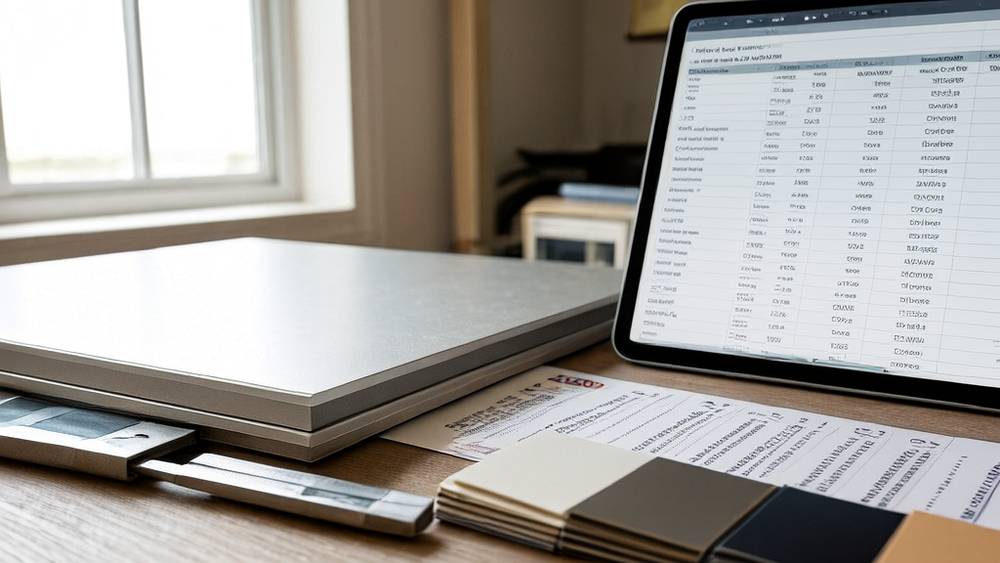
The aluminum composite panel price landscape in 2026 is more nuanced than most procurement teams realize. A quick scan of supplier catalogs reveals numbers ranging from $12 to $45 per square meter for standard 4 mm PE-core panels, but the gap between a budget indoor signage sheet and a fire-rated facade system that passes ASTM E84 is measured in more than dollars — it reflects fundamentally different manufacturing tolerances, core chemistries, and coating warranties. When a Dubai-based contractor asks me why their $18/m² ACP bid got rejected at technical submittal stage, the answer almost always traces back to three variables they did not think to ask about: polyethylene density, skin thickness symmetry, and PVDF resin brand. This article unpacks what actually drives aluminum composite panel price across the supply chain, using real specification data and project cost breakdowns that matter to estimators, QS professionals, and facade consultants.
The Skin Thickness Equation That Most Quotes Hide
Walk through any aluminum composite panel factory and you will notice the single largest cost variable sitting in plain sight: the aluminum coil. Two skins sandwich the core, and their individual thickness dictates roughly 35% to 50% of the ex-works price. The industry standard for exterior cladding is 0.50 mm per skin, yielding a total aluminum content of 1.0 mm across the panel. But here is where specifications get slippery.
Some suppliers quote 0.50 mm nominal but deliver 0.42 mm actual, exploiting the ±0.05 mm tolerance allowed under certain national standards. The difference is 0.08 mm of aluminum per skin — seemingly trivial — but across a 20,000 m² tower facade, that represents approximately 3.2 tonnes of missing aluminum. The buyer pays for metal that never arrives on site. The aluminum composite panel price delta between a genuine 0.50/0.50 mm panel and a 0.42/0.42 mm panel runs $4 to $7 per square meter at current LME aluminum levels hovering around $2,400/tonne. On a mid-rise project, that is a six-figure line item hiding in plain sight.
Reputable manufacturers like Futeng® document skin thickness on mill certificates tied to coil batch numbers, and procurement teams should make these certificates a contractual deliverable — not an afterthought. Independent third-party verification using a digital micrometer on site takes ten minutes per batch and has saved projects from litigation.
What 0.50/0.50 Actually Costs Versus 0.30/0.30
Indoor applications — signage, interior wall linings, exhibition stands — routinely specify 0.21 mm to 0.30 mm skins. The price difference is stark. A 4 mm PE-core panel with 0.30/0.30 mm skins trades around $10 to $14 per m² ex-works China, while the same panel with 0.50/0.50 mm skins pushes into the $16 to $22 range. This $6 to $8 spread widens further when PVDF coating enters the equation, because coating line setup costs amortize differently across thin versus thick skins.
For estimators building budgets, the rule of thumb is simple: every 0.05 mm increment in skin thickness adds roughly $1.50 to $3.00 per square meter to the baseline aluminum composite panel price, depending on coil width utilization and the prevailing Shanghai Nonferrous Metals Exchange settlement price during the month of production.
PE Versus FR Core: The Fire Rating Surcharge
If skin thickness is the largest visible cost driver, core chemistry is the most misunderstood. Standard polyethylene (PE) core panels dominate the volume market because PE resin is cheap, easy to extrude, and bonds reliably to aluminum skins using thermoplastic adhesive films. But PE burns. It melts, drips, and propagates flame in a vertical cavity — which is why jurisdictions from the UK (post-Grenfell) to the UAE Civil Defence now mandate fire-retardant (FR) cores for buildings above a certain height or occupancy classification.
The FR core upgrade is not a small line item. A mineral-filled FR core costs manufacturers $3 to $5 per square meter more in raw materials compared to unfilled PE, and the extrusion process runs slower because mineral-filled polymers are abrasive on screws and barrels. The resulting aluminum composite panel price premium for FR-certified panels typically lands between $8 and $12 per square meter over PE equivalents. For a 15,000 m² hospital facade, that is $120,000 to $180,000 in additional material cost before installation even begins.
Procurement teams should verify that the FR core certification matches the project's specific fire test requirement. ASTM E84 (Class A) and EN 13501-1 (B-s1,d0) are not interchangeable, and a panel that passes one may fail the other. The test report must reference the exact panel thickness, skin gauge, and coating system being supplied — generic "family" certifications do not satisfy most façade consultants reviewing submittals.
| Core Type | Typical Price Range (4 mm, 0.50/0.50 skins) | Fire Performance | Typical Application |
|---|---|---|---|
| Standard PE | $16 – $22 / m² | Combustible, no rating | Low-rise, signage, interiors |
| FR Mineral-Filled (A2) | $24 – $34 / m² | EN 13501-1 A2-s1,d0 | High-rise facade, hospitals |
| FR Mineral-Filled (B1) | $22 – $28 / m² | GB 8624 B1, limited combustibility | Mid-rise commercial |
| Non-combustible (aluminum honeycomb) | $38 – $55 / m² | EN 13501-1 A1 | Super high-rise, atria |
Coating Chemistry: PVDF, FEVE, and Polyester Cost Gaps
The paint system applied to the visible aluminum skin is where aluminum composite panel price splits between commodity and architectural grades. Polyester (PE) coatings — not to be confused with polyethylene cores — cost roughly $2 to $3 per square meter applied and suit interior or sheltered applications. Their Achilles' heel is UV degradation: gloss retention drops below 50% within 3 to 5 years of equatorial sun exposure, and the film chalks and erodes.
PVDF (polyvinylidene fluoride) coatings, specifically 70% Kynar 500® or Hylar 5000® resin systems, command $6 to $10 per square meter in coating cost alone. The resin accounts for roughly 60% of that cost, with the balance split between inorganic pigments (ceramic-grade, not organic), solvent-based carriers, and the multi-pass coil coating line energy consumption. A 0.50 mm skin panel with a 25-micron PVDF topcoat and 5-micron epoxy primer carries a coating warranty of 20 to 30 years against chalk and fade — and the aluminum composite panel price reflects that longevity.
FEVE (fluoroethylene vinyl ether) coatings sit between PVDF and polyester in cost and performance. At $5 to $7 per square meter applied, FEVE offers comparable weatherability to PVDF but with higher gloss potential and better recoatability. Architects specifying bright metallics or custom RAL colors often default to FEVE because PVDF struggles to achieve high gloss above 30 GU (gloss units) in dark shades. The cost difference narrows for small batch orders where PVDF minimum run charges inflate unit pricing.
Why Coating Thickness Specifications Matter at QC Stage
AAMA 2605, the North American benchmark for high-performance architectural coatings on aluminum, mandates a minimum total dry film thickness of 30 microns (1.2 mils) for PVDF systems. AAMA 2604 allows 25 microns. The 5-micron difference may sound academic, but in accelerated weathering testing per ASTM G154, that extra 5 microns of PVDF topcoat can mean the difference between passing 4,000 hours and failing at 2,800 hours. The aluminum composite panel price difference between AAMA 2605 and 2604 compliant coating is typically $2 to $4 per square meter — money spent on microns that buy decades of facade performance.
For projects within 5 kilometers of breaking surf, I always recommend specifying AAMA 2605 with a minimum 35-micron total DFT and a chrome-based pretreatment rather than titanium-zirconium. The incremental cost is small relative to the risk of filiform corrosion migrating from cut edges inward.
Panel Dimensions and Yield: The Hidden Logistics Tax
Aluminum composite panels come in standard widths of 1,220 mm (4 ft), 1,500 mm, and 1,575 mm, with lengths customizable up to 6,000 mm or more depending on container fit. The aluminum composite panel price per square meter drops as sheet size increases because cutting waste decreases and coating line efficiency improves. But the relationship is not linear, and the logistics dimension is where procurement teams leave money on the table.
A 20-foot container holds roughly 2,000 to 2,400 m² of ACP depending on panel thickness and pallet configuration. A 40-foot HC container pushes that to 4,800 to 5,600 m². Ocean freight from Shanghai to Jeddah or Rotterdam currently runs $3,500 to $5,500 per 40-foot HC, translating to $0.70 to $1.15 per square meter in freight cost. When panels are cut to custom sizes that do not maximize container cube, the freight cost per square meter can double.
Custom lengths above 5,800 mm often require flat-rack containers at roughly 2.5× the freight rate of standard dry containers. The aluminum composite panel price quoted ex-works may look competitive, but the delivered duty paid (DDP) cost tells a different story. I have seen projects where a $2/m² saving on ex-works price was entirely consumed — and then some — by inefficient container loading that added $3.50/m² in freight.
Edge Waste, Nesting, and Shop Drawings
Fabricators care about yield. A rectangular panel layout on a rectangular building produces 85% to 92% material yield after accounting for cutouts, edge trim, and kerf loss. Curvilinear geometries — think Zaha Hadid-style parametric facades — can drop yield below 65%. The aluminum composite panel price per square meter of installed facade must factor this waste multiplier. A $20/m² panel with 90% yield costs the project $22.22/m² installed. The same panel at 65% yield costs $30.77/m². The difference is purely geometric, not material, and it belongs in the estimator's spreadsheet from day one.
Quantity Breakpoints and MOQ Realities
Small orders get punished on price. A 100 m² order of a non-stock color with 0.50 mm skins and PVDF coating might run $32 to $38 per square meter because the coating line minimum run charge (typically 500 to 1,000 m²) amortizes over a tiny volume. The same specification ordered at 3,000 m² drops to $20 to $24 per square meter. The breakpoints are not standardized across the industry, but the pattern is consistent: below 500 m², aluminum composite panel price rises steeply; between 500 and 2,000 m², the curve flattens; above 5,000 m², incremental discounts taper off because material and processing costs dominate and margin compression hits a floor.
Stock colors — silver metallic, bone white, dark bronze — typically carry no minimum order quantity surcharge because manufacturers run these weekly and can slot small batches into existing production schedules. Custom RAL or NCS matches, especially those requiring tinted PVDF resins, attract a color match fee ($300 to $800) and an MOQ of 300 to 500 m². The lab cost of matching a single panel is the same as matching 500 panels, and the economics force small projects toward stock palettes.
Regional Price Benchmarks: What Q4 2025 Data Shows
Drawing on published trade data and supplier quotations cross-checked against actual project invoices, here is what aluminum composite panel price looks like across key markets for a standard 4 mm PE-core, 0.50/0.50 mm skin, PVDF-coated panel in a stock color, ex-works basis:
- China (Shanghai/Ningbo origin): $16 – $22 / m² — lowest globally due to integrated coil supply and scale, but verify skin thickness and PVDF resin brand.
- India (Mundra/Nhava Sheva): $18 – $25 / m² — competitive on PE core, FR core premiums higher due to imported mineral fillers.
- Turkey (Istanbul/Izmir): $20 – $28 / m² — strong position for EMEA projects, CE-marked panels with EN 13501-1 documentation.
- UAE (JAFZA re-export): $22 – $32 / m² — includes warehousing and consolidated logistics, often faster lead times for GCC projects.
- Europe (local stock): $30 – $45 / m² — CE-marked, often with EPD and LCAs, suitable for projects requiring local supply chain compliance.
These are benchmarks, not bids. Actual aluminum composite panel price depends on the intersection of specification, volume, delivery terms, and the relationship between buyer and mill. A well-negotiated 10,000 m² order from a repeat buyer can land 12% to 18% below these midpoints.
Incoterms and the True Landed Cost
Ex-works (EXW) pricing is the industry default for supplier quotations, but it is a dangerous number to plug into a project budget. The gap between EXW and DDP can be $8 to $15 per square meter once freight, insurance, customs duties, port handling, and inland trucking are tallied. The US Section 301 tariffs on Chinese-origin aluminum products currently add 25% to the CIF value for panels classified under HTS 7606.12.3090. Some projects route through Vietnam or Malaysia for assembly to manage tariff exposure, but the rules of origin documentation must be airtight — customs authorities in the US and EU are increasingly scrutinizing transshipment schemes.
Procurement teams should request quotations on at least two Incoterms: FOB (to compare supplier prices apples-to-apples) and DDP (to understand the check they will actually write). The aluminum composite panel price that matters is the one on the DDP line of the purchase order, not the one in the supplier's brochure.
ASTM International maintains the core standards governing aluminum composite panel testing in North America. For coating performance, refer to AAMA 2605-20; for panel flatness tolerances, consult ASTM E84 for surface burning characteristics. The ISO 13501-1 framework governs fire classification in European and Middle Eastern markets.
Five Questions to Ask Before Comparing ACP Quotes
After auditing hundreds of facade submittals across four continents, I have distilled the aluminum composite panel price comparison process into five non-negotiable questions. If your supplier cannot answer these with documentation, the price they quoted is theoretical:
- What is the actual (measured, not nominal) skin thickness, and will mill certificates reference coil batch numbers? Demand 0.50 mm minimum for exterior, verified by micrometer on site.
- Which PVDF resin brand is in the coating — Kynar 500®, Hylar 5000®, or a generic 70% PVDF? The resin brand determines warranty validity. Generic PVDF without a resin brand certificate is a gamble.
- Is the FR core certified to the specific fire standard required by this project's jurisdiction, and is the test report for the exact panel configuration being supplied? A B1 certificate for a 3 mm panel does not cover a 4 mm panel with different skins.
- What are the container loading quantities for the specified panel sizes, and what is the freight cost per square meter at current spot rates? Get this in writing before comparing EXW prices.
- What is the coating warranty period, who backs it (coating supplier or panel manufacturer), and what is the claims process? A 20-year warranty from a panel maker who may not exist in 5 years is worth less than a 10-year warranty backed by the resin supplier.
The aluminum composite panel price conversation is not about finding the lowest number. It is about understanding what that number includes, excludes, and assumes. The estimators who ask these five questions before opening a quote are the ones whose budgets hold through construction. The ones who skip them spend the difference in variation orders, replacement panels, and legal fees. On a $2 million facade package, the cost of getting this wrong is never just the panel price — it is the scaffold, the labor, the program delay, and the reputation hit when the consultant rejects the submittal at 90% CD stage.