Wood Metal Cladding Installed Cost Breakdown for Solid Aluminium Cassette Facades in 2025
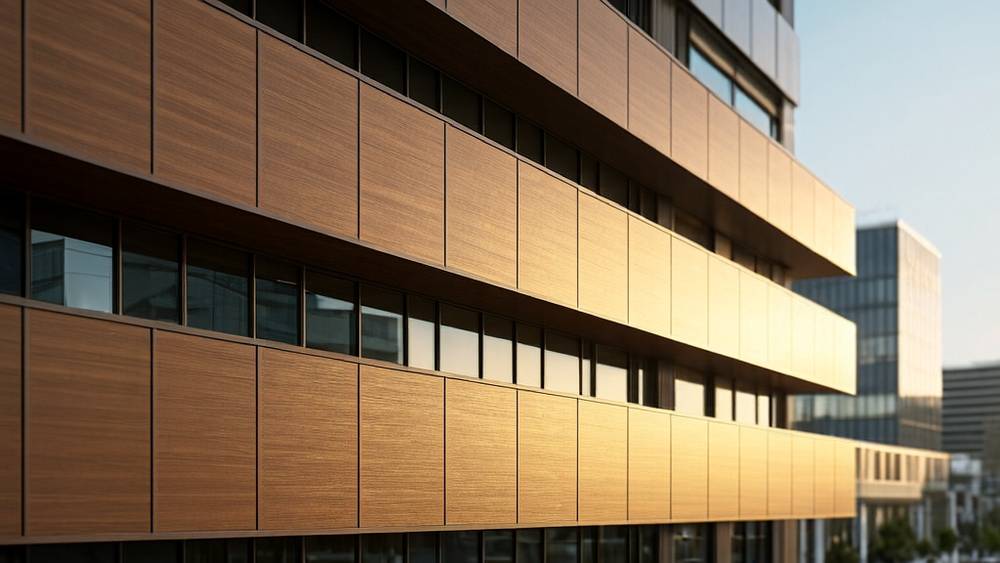
When a project spec calls for the warmth of timber on a facade but the budget and maintenance realities rule out real wood outright, the conversation pivots to wood metal cladding. Not as a compromise, but as a calculated material decision. The question that surfaces most often from quantity surveyors and facade contractors is brutally practical: what does it actually cost per square meter, and what drives those numbers up or down? This article breaks down the cost structure of solid aluminium wood-look cladding across three distinct supply models—material-only supply, prefabricated cassette systems, and fully engineered unitized packages—using real project data from mid-rise commercial and institutional work in North America, the UK, and Southeast Asia.
Why the "Per Square Meter" Question Misleads Without Context
Any fabricator who quotes a single figure for wood metal cladding without asking about panel size, perimeter detailing, and substrate type is guessing. A 2.5 mm solid aluminium panel with a horizontal woodgrain PVDF finish on a flat, open wall runs a completely different cost structure than the same material folded into a 1,200 mm × 3,000 mm cassette with perforated returns and integrated ventilation channels. Three cost drivers separate the generic from the specific:
- Panel format and folding complexity — flat sheets versus brake-pressed cassettes with return legs, stiffener ribs, and interlocking joint profiles
- Coating technology and warranty length — standard PVDF (Kynar 500® or Hylar 5000®) versus FEVE-based systems for coastal or high-UV environments
- Subframe and attachment system design — continuous aluminium T-profile rails with thermal isolators versus intermittent clip-and-rail proprietary systems
A QS pricing the facade package at tender stage needs to understand that the raw sheet cost represents only 35–45% of the installed system price. The rest lives in fabrication labor, coating surcharges, subframe components, thermal breaks, and on-site adjustment tolerances. Ignoring these layers produces a tender gap that gets absorbed somewhere—usually by the subcontractor who wins the job and then tries to value-engineer out the detailing that made the architect's specification work in the first place.
Material-Only Supply: The Baseline Cost Model
Material-only supply covers the aluminium sheet, factory-applied woodgrain finish, and protective strippable film, delivered flat or in simple break shapes to the contractor's site. This model suits contractors with in-house fabrication capability or those working with a local sheet metal shop for brake-pressing and assembly. The advantage is transparency: the contractor controls fabrication quality and lead time. The risk is that coating damage during secondary handling and folding voids the finisher's warranty.
Current market ranges for solid aluminium wood-look sheets, based on 2024–2025 supplier data across three regions, fall into these brackets. All figures represent uninstalled material cost delivered to site, excluding import duties and local taxes:
| Alloy & Temper | Thickness | Coating System | Price Range (USD/m²) | Typical Lead Time |
|---|---|---|---|---|
| AA3003 H14 | 2.0 mm | PVDF 2-coat woodgrain | $42 – $58 | 4–5 weeks |
| AA3003 H14 | 2.5 mm | PVDF 3-coat woodgrain | $52 – $72 | 4–6 weeks |
| AA3003 H14 | 3.0 mm | PVDF 3-coat woodgrain | $65 – $88 | 5–7 weeks |
| AA5005 H14 | 2.5 mm | FEVE 3-coat woodgrain | $78 – $105 | 6–8 weeks |
| AA3003 H14 | 2.0 mm | PE (polyester) woodgrain | $28 – $38 | 3–4 weeks |
The jump from 2.0 mm to 3.0 mm accounts for roughly 50% more aluminium by weight, but the real cost escalation comes from handling: thicker sheets require different coil tension settings during the sublimation or roller-coating process that transfers the woodgrain pattern. Not all coating lines can run 3.0 mm AA5005 through a woodgrain sublimation cycle without pattern distortion along the edges. Fabricators like Futeng® that operate dedicated wide-format coating lines for wood-look finishes avoid the surcharges that subcontractors face when running small batches through shared equipment.
The PE (polyester) option at the bottom of the table deserves a clear warning. PE woodgrain finishes fade visibly within 3–5 years under direct UV exposure. They have no place on exterior facades above single-story applications. The only defensible use case for PE woodgrain is interior feature walls or soffits fully shielded from sunlight—and even then, the 20-year PVDF warranty at $52/m² makes the $28/m² PE option a false economy when total project cost including access equipment and labor runs $180–$250/m² installed.
Prefabricated Cassette Systems: Where Fabrication Reshapes the Numbers
Once the aluminium sheet leaves the flat state and enters a fabrication workflow—cutting, notching, brake-pressing into a cassette form, riveting aluminium stiffeners to the rear face, and attaching mounting clips—the cost structure shifts decisively toward labor and shop overhead. A typical cassette might measure 600 mm × 3,000 mm with 25 mm return legs on all four sides, two horizontal stiffeners, and a continuous interlocking tongue-and-groove profile along the long edges.
The fabrication cost for each cassette breaks into these components:
- CNC cutting and notching: $8–$14 per cassette depending on corner detail complexity
- Brake-pressing (4-side returns): $12–$20 per cassette, influenced by return depth and whether corners are welded or left open with a drainage gap
- Stiffener fabrication and riveting: $6–$12 per cassette, using 2 mm aluminium hat-section extrusions riveted at 300 mm centers
- Clip attachment and alignment check: $4–$8 per cassette
- Quality inspection and protective wrapping: $3–$5 per cassette
Summed across a 1,500 m² facade with cassette dimensions of 600 mm × 3,000 mm (approximately 834 cassettes), fabrication adds roughly $45,000–$72,000 to the material cost. This pushes the total supply-and-fabricate price for a 2.5 mm PVDF woodgrain cassette system into the range of $110–$145/m² before subframe and installation. The table below maps how cassette size affects the fabrication cost per square meter:
| Cassette Size (mm) | Cassettes per 100 m² | Fabrication Cost per m² | Total Supply Cost per m² (2.5mm PVDF) |
|---|---|---|---|
| 400 × 2,000 | 125 | $55 – $72 | $107 – $144 |
| 600 × 3,000 | 56 | $38 – $52 | $90 – $124 |
| 900 × 4,000 | 28 | $28 – $38 | $80 – $110 |
| 1,200 × 4,000 | 21 | $22 – $30 | $74 – $102 |
The inverse relationship between cassette size and fabrication cost per square meter is stark: smaller cassettes nearly double the labor content. However, the architect's module and wind load requirements often dictate smaller panel sizes regardless of cost logic. A 40-story tower in a typhoon zone may require 400 mm-wide cassettes with 3.0 mm thickness to meet deflection limits under ASTM E330 wind load testing. Cost follows engineering, not the other way around.
Unitized and Fully-Engineered Packages: The Installed Reality
General contractors comparing wood metal cladding against brick veneer, terracotta baguette systems, or fibre cement plank need the fully installed cost including subframe, thermal isolation, weather barriers, and site labor. This is where the per-square-meter figure becomes genuinely useful for budgeting—and where the range widens considerably.
A complete unitized wood-look aluminium cladding package for a commercial mid-rise (4–8 stories) in a temperate climate zone typically breaks down as follows:
- Solid aluminium cassette (2.5 mm PVDF woodgrain): $90–$124/m² (supply + fabrication)
- Aluminium subframe rails with thermal isolators: $22–$38/m²
- Stainless steel fixings, brackets, and shims: $8–$15/m²
- Breather membrane and cavity fire barriers: $12–$20/m²
- Site labor for installation: $40–$65/m²
- Access equipment (mast climbers or scaffolding): $15–$25/m²
- Design engineering, shop drawings, and testing: $8–$14/m²
The total lands between $195 and $301 per square meter. That spread of over $100/m² is not random—it reflects project-specific variables that the spec writer and QS must lock down early. A project in central London with restricted site access, mast climber logistics, and a requirement for BBA-certified cavity barriers will hit the upper end. A suburban office park in Texas with open access, scissor lifts, and a simple drainage plane will trend toward the lower end.
On a recent 6,200 m² mixed-use project in Vancouver, the difference between the lowest compliant bid and the highest was $78/m²—a total variance of $483,600. The gap was explained almost entirely by differences in subframe design (continuous versus point-fixed), thermal break detailing, and whether the fabricator included AAMA 2605-compliant accelerated weathering test reports in their package.
Coating Technology and Its Cost Footprint
The woodgrain finish on solid aluminium panels falls into two distinct technology families, and the cost difference between them is not cosmetic—it determines whether the facade still looks like wood in year 12 or has bleached into a washed-out grey.
PVDF (Polyvinylidene Fluoride) systems, using Kynar 500® or Hylar 5000® resin at a minimum 70% fluoropolymer content in the color coat, dominate the mid-range. The woodgrain effect is achieved through a multi-step roller-coating process where a base coat, a grain-pattern print layer applied via transfer film or direct digital printing, and a clear PVDF topcoat are sequentially cured. This system carries a standard 20-year film integrity warranty and 15-year color retention warranty when applied to properly pretreated aluminium conforming to AAMA 2605.
FEVE (Fluoroethylene Vinyl Ether) systems step up in both performance and price. FEVE resins, typically formulated as Lumiflon®, offer higher gloss retention in coastal and high-humidity environments because the alternating fluoroethylene and vinyl ether units in the polymer backbone resist hydrolysis better than PVDF under constant moisture exposure. The trade-off: FEVE woodgrain coatings command a 35–50% surcharge over equivalent PVDF systems and require applicators with specialized curing oven profiles. For projects within 500 meters of breaking surf or in Southeast Asian monsoon climates, the FEVE premium buys a measurable extension of the aesthetic service life.
A third option—powder-coated woodgrain using sublimation transfer—sits below PVDF in cost and performance. The process prints a woodgrain pattern onto a powder-coated base using heat and pressure to sublimate dyes into the coating. It produces a convincing grain at close range but lacks the UV-stable clear coat that protects PVDF and FEVE systems. Manufacturers quoting powder-sublimated woodgrain for exterior applications should be pressed to provide ASTM G154 accelerated weathering data beyond 2,000 hours. Without it, the spec is unbankable for any project with a design life beyond 10 years.
Regional Supply Chain Factors That Shift the Numbers
The cost tables above assume a reasonably competitive local or regional supply chain. When the project location introduces import duties, freight volatility, or currency exposure, the numbers shift—sometimes dramatically.
For contractors in North America sourcing wood metal cladding from Asian fabricators, the current cost structure adds roughly 18–25% for freight, insurance, and Section 301 tariffs (where applicable) on aluminium products. A $62/m² FOB price for 2.5 mm PVDF woodgrain cassettes becomes approximately $77/m² CIF at a US West Coast port, before domestic trucking and any warehousing. For European projects, CE marking requirements under EN 13501-1 fire classification add testing and certification costs of $8,000–$15,000 per project that must be amortized across the facade area. On a 500 m² project, that alone adds $16–$30/m².
For contractors evaluating whether to buy locally or import, the breakeven point typically sits around 1,200–1,500 m². Below that threshold, the fixed costs of import logistics, testing, and agent fees erode the unit price advantage of offshore supply. Above it, the material cost savings can fund the additional coordination effort. A mid-size fabricator like Futeng® that maintains stock programs for popular woodgrain finishes (teak, walnut, oak, and weathered grey) can shorten lead times for both domestic and export orders, reducing the schedule risk that often drives contractors to pay a premium for local supply.
Wood Species Selection and Pattern Registration Costs
Not all woodgrain patterns cost the same. The three-tier pricing structure in the wood-look aluminium market reflects the complexity of pattern registration and the availability of transfer films or print cylinders:
- Tier 1 — Standard species (teak, walnut, light oak, dark oak, cedar): These patterns are in continuous production across multiple coating lines. Transfer films are stock items. No surcharge. Lead times are shortest.
- Tier 2 — Regional variants (Australian jarrah, Scandinavian pine, American cherry): Available but produced in batch runs. Expect a 10–15% surcharge and 2–3 additional weeks of lead time as the coating line schedules a dedicated production window.
- Tier 3 — Custom-matched species: When the architect submits a physical timber sample and requires an exact grain and color match on aluminium, the development process involves multiple proofing rounds. Cylinder engraving or custom transfer film production adds $3,000–$8,000 in one-time tooling costs, and the per-square-meter price rises 20–30% above the standard Tier 1 rate for the same alloy and thickness.
Specifying a Tier 1 woodgrain from a supplier's standard palette—and confirming that palette early in design development—is one of the simplest cost-containment moves available to the project team. Custom-matched woodgrain on solid aluminium is technically achievable, but it should be reserved for signature projects where the premium buys a visible, defensible design outcome rather than a marginal aesthetic difference visible only at close range.
Making the Numbers Work: Practical Budgeting Steps
A procurement strategy for wood metal cladding that avoids mid-project cost shocks follows a straightforward sequence:
- Lock the panel format and attachment logic before pricing. The cost difference between a flat panel on a continuous subframe and a folded cassette on point fixings is too large to leave as a "contractor to propose" item in the tender documents. The design team should specify the system type and let bidders price variations, not fundamentals.
- Specify the coating technology by performance standard, not brand. Writing "AAMA 2605-compliant PVDF woodgrain with minimum 70% Kynar 500® or Hylar 5000® resin" opens competition. Writing a single brand name closes it and inflates the bid.
- Request installed-cost breakdowns, not just supply rates. A fabricator quoting $95/m² for cassettes may be undercut by a competitor at $82/m²—but if the cheaper bid assumes the contractor provides subframe and fixings while the $95 bid includes them, the comparison is meaningless. Require a standardized cost breakdown template in the tender return.
- Validate warranty terms in writing. The 20-year PVDF film integrity warranty is industry standard, but it applies only when the coated aluminium is fabricated and installed per the coating manufacturer's written instructions. If the contractor plans to bend the panels after coating, confirm that the coater's warranty covers post-forming applications.
- Build a 12–15% contingency into the facade budget for wood metal cladding. The contingency covers pattern variation across production batches, on-site trimming waste (typically 8–12% for folded cassettes), and the inevitable handful of panels that arrive with handling damage and require replacement.
The installed cost of solid aluminium wood-look cladding, realistically, sits between $195 and $301 per square meter for the complete system on a mid-rise commercial project. Contractors and QSs who budget at $220/m² and manage the specification toward that figure will find competitive bids. Those who budget at $150/m² and hope for value engineering will find only corners being cut—usually in the coating quality or the subframe detailing that keeps water on the outside of the building.