AAMA 2605 Powder Coated Aluminium Panels Why Resin Chemistry Decides Your Facade Lifespan
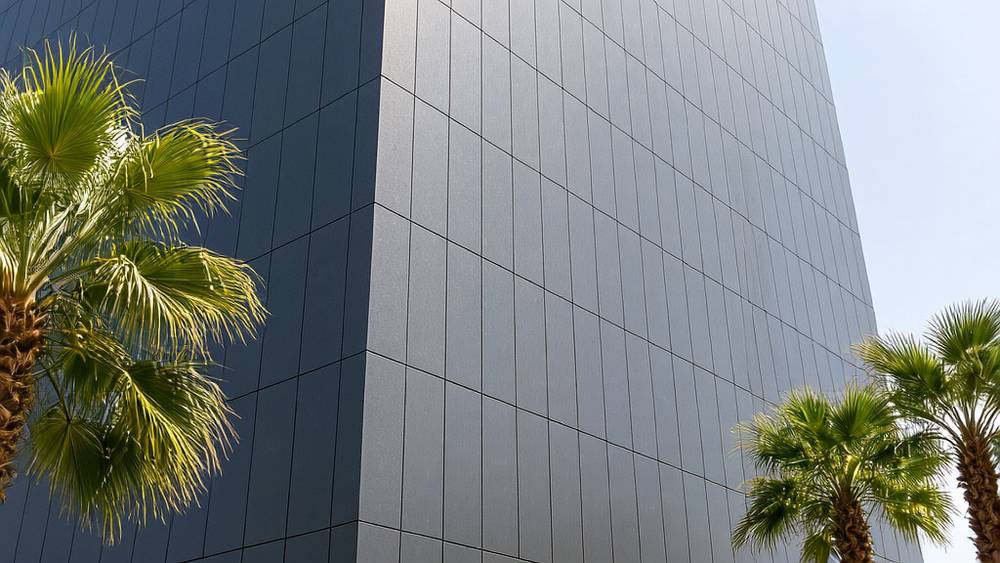
When a facade consultant in Doha flags powder coated aluminium panels for a 22-storey residential tower and the specification sheet reads “AAMA 2605 compliant” without further qualification, a procurement chain is about to learn an expensive lesson. The gap between ordering powder coated aluminium panels that nominally meet a standard and receiving panels that survive 15 years of Gulf UV exposure and saline aerosol comes down to one detail: the resin chemistry baked into the powder. This article dissects what AAMA 2605 actually demands of powder coatings on solid aluminium cladding, why polyester powders fail the test even when manufacturers claim compliance, and how to verify that the powder on your panels will outlast the warranty period.
Reading AAMA 2605 Beyond the Label
AAMA 2605 is the Architectural Aluminum Manufacturers Association’s highest voluntary performance specification for organic coatings on aluminium extrusions and panels. It mandates minimum 10-year South Florida exposure benchmarks for colour retention, chalk resistance, and gloss retention. The standard itself does not care whether the coating arrives as a liquid or a powder. What matters is the cured film’s ability to pass 4,000 hours of accelerated weathering in a Xenon arc chamber while retaining at least 50% of its original gloss and exhibiting a colour change no greater than 5 Delta E units.
Here is where the confusion begins. Many procurers assume that any powder labelled “fluoropolymer” or “super-durable” automatically meets AAMA 2605. The standard itself, available for reference through the AAMA website, draws a bright line between 2604 (intermediate performance) and 2605 (high performance). A powder coating manufacturer can truthfully market a product as “tested to AAMA 2605 methods” without passing the full protocol. Only a certified applicator with a specific resin system approved by a powder supplier who has completed the full 10-year Florida exposure programme can legitimately offer AAMA 2605-compliant powder coated aluminium panels.
“Passing the Xenon chamber is necessary but not sufficient. The real test is 10 years of 5° south-facing exposure in Miami. If your powder supplier cannot produce those Florida exposure panels with measurable data, you are buying a simulation, not a certification.”
FEVE vs Polyester The Chemistry That Separates Decade Durability from Five-Year Fading
Two families of powder resin compete for AAMA 2605 projects: FEVE (fluoroethylene vinyl ether) fluoropolymers and super-durable polyester (SDP). The architectural powder market has seen aggressive marketing from polyester manufacturers claiming their SDP formulations meet the standard. Independent weathering data tells a different story.
FEVE powders contain carbon-fluorine bonds with dissociation energies around 485 kJ/mol, significantly higher than the carbon-oxygen bonds in polyester backbones. Under UV radiation at 290–400 nm, polyester chains undergo photo-oxidative cleavage that manifests as chalking and colour shift within 3–5 years in high-UV climates. FEVE-based powders from suppliers such as those listed in the QUALICOAT Class 3 or AAMA 2605 registries resist this degradation for 15–20 years.
The cost differential is not trivial. On a 3.0 mm solid aluminium panel, FEVE powder adds approximately USD 12–18 per square metre compared to SDP. On a 5,000 m² facade, that represents USD 60,000–90,000. Spread across the building’s 25-year service life, the annualised premium is under USD 3,600. One recoating cycle at year 12 for failed SDP panels would cost 4–6 times that amount when access, labour, and business disruption are counted.
The Certification Chain Applicator Licensing Is Not Optional
A powder manufacturer can supply a FEVE powder that has passed AAMA 2605 Florida exposure, but if the applicator has not completed the manufacturer’s certification programme, the panels leaving the coating line are not AAMA 2605 compliant. The standard requires that the complete system — pretreatment, primer, topcoat, and cure cycle — be validated as a unit.
Pretreatment deserves particular scrutiny. Solid aluminium panels destined for powder coating must undergo a minimum 6-stage chromate or chromate-free conversion coating process per AAMA 2605. The stages are: alkaline clean, rinse, acid etch, rinse, conversion coat, final deionised rinse. Panels skipping the etch stage or using a 3-stage system will show adhesion failure within 3–5 years, regardless of the topcoat quality. Cross-hatch adhesion testing per ASTM D3359 should be specified on every batch, with acceptance at 5B (no removal).
Futeng® operates applicator lines where each batch of powder coated aluminium panels carries a certificate of compliance referencing the specific powder lot number, pretreatment bath chemistry log, and cure oven temperature chart. This traceability is what separates a defensible specification from a warranty dispute waiting to happen.
Coastal Environments When AAMA 2605 Alone Is Not Enough
AAMA 2605 does not include a dedicated cyclic corrosion test. For powder coated aluminium panels installed within 3 km of a saltwater coastline, the specification must add AAMA 2605-22 Section 6.8 corrosion resistance or reference a supplementary standard. The accepted method is ASTM B117 neutral salt spray for 4,000 hours with under-film corrosion creep limited to 2 mm from the scribe after testing.
A more aggressive alternative gaining acceptance in Middle Eastern and Southeast Asian specifications is ISO 12944-6 C5-M certification for marine environments. This standard imposes 1,440 hours of salt spray combined with cyclic humidity and UV exposure. FEVE powder coated aluminium panels with a properly sealed chromate pretreatment consistently pass C5-M with under 1.5 mm scribe creep. SDP powders, even with enhanced corrosion inhibitors, typically show 3–5 mm creep under identical conditions.
The practical consequence for a procurement team is clear. If the project sits within sight of the sea, the coating specification must name the resin chemistry explicitly. Writing “powder coated aluminium panels to AAMA 2605” without adding “FEVE fluoropolymer powder, C5-M tested” leaves a gap that a polyester supplier will happily fill with a product that meets the letter of the base standard but not the demands of the environment.
Colour Stability and Gloss What 10 Years of Data Actually Shows
The AAMA 2605 colour retention requirement of 5 Delta E maximum after 10 years sounds precise, but Delta E values are calculated differently depending on the colour space used (CIELAB 1976 vs CIE2000). A dark bronze powder coated aluminium panel that records Delta E 4.8 in CIELAB may look visibly faded to a human observer, while a light grey panel at Delta E 4.8 may appear unchanged. Specifiers should require the Delta E calculation method to be stated and should consider tightening the requirement to 3 Delta E for saturated colours (reds, blues, deep greys) where fading is visually conspicuous.
Gloss retention presents a parallel concern. AAMA 2605 requires 50% gloss retention at 10 years for the 60° gloss meter reading. A panel starting at 35 gloss units can drop to 17.5 and still pass. That is a visibly chalked surface. For premium institutional and commercial projects, a 70% gloss retention minimum should be specified, which effectively mandates FEVE powder chemistry.
| Property | AAMA 2605 Requirement | FEVE Powder (Typical) | SDP Powder (Typical) | Standard Polyester |
|---|---|---|---|---|
| Colour retention (10 yr, Delta E) | ≤5.0 | 1.5–3.0 | 3.5–5.0 | 6.0–12.0 |
| Gloss retention (10 yr, 60°) | ≥50% | 70–85% | 50–65% | 20–40% |
| Chalk rating (10 yr, ASTM D4214) | ≥6 | 8–10 | 6–8 | 2–5 |
| Salt spray (ASTM B117, scribe creep) | ≤2 mm | 0.5–1.5 mm | 1.5–3.0 mm | 3.0–6.0 mm |
| Film thickness (min, 2-coat) | 50 μm | 55–80 μm | 50–70 μm | 40–60 μm |
| Florida exposure data availability | Required | Readily available | Limited/emerging | Not applicable |
| Approx. cost premium vs SDP (USD/m²) | N/A | +12 to +18 | Baseline | -8 to -12 |
How to Verify Compliance Before the Pallets Leave the Factory
Third-party inspection at the coating facility is the most cost-effective quality assurance tool available to an international buyer of powder coated aluminium panels. The inspection protocol should include six specific checks, each tied to an AAMA 2605 clause or referenced ASTM method.
- Pretreatment bath logs. Verify that conductivity, pH, and chemical concentration readings were recorded for every shift and fall within the pretreatment supplier’s specified ranges. Accept no panel produced during a shift with out-of-range readings unless re-treated.
- Powder lot traceability. Match the powder lot number on the applicator’s certificate to the powder manufacturer’s AAMA 2605 certification letter for that specific resin and colour. Generic letters covering a product family are not acceptable.
- Dry film thickness (DFT). Measure using a calibrated eddy-current gauge per ASTM D7091. AAMA 2605 requires minimum 50 μm for a 2-coat system. Take 5 readings per panel on a random sample of 10% of panels per batch.
- Cross-hatch adhesion. ASTM D3359 Method B on one panel per 50 produced. Acceptance criterion: 5B. Any 4B result triggers re-testing of the entire batch.
- Colour and gloss. Measure against the approved control sample using a spectrophotometer (Delta E) and 60° gloss meter on every panel. Record and trend the data. A gradual drift in Delta E over a production run indicates oven temperature inconsistency.
- Impact resistance. ASTM D2794 direct impact at 28 kg·cm on a witness panel from each cure oven load. Cracking or adhesion loss at the impact site indicates under-cure or pretreatment failure.
A reputable applicator will not resist any of these checks. Resistance to third-party inspection is itself the most useful diagnostic. If the factory objects to ASTM D3359 testing on finished panels, find another factory.
The Warranty Trap What 20-Year Coverage Actually Covers
A 20-year film integrity warranty on powder coated aluminium panels sounds reassuring. Procurement teams should read the exclusions before counting on it. Most powder manufacturer warranties cover the cost of replacement powder only, not labour, access equipment, or consequential damages. A USD 4,000 powder credit against a USD 400,000 re-cladding project is not insurance; it is a gesture.
The warranty that matters is a system warranty backed by the powder manufacturer and the applicator jointly, covering film integrity, colour retention, and chalk resistance, with a stated remedy that includes labour and access for the first 10 years. Such warranties exist in the market but require that the powder manufacturer certify the applicator, approve the pretreatment line, and receive production samples for retention testing. The incremental cost of this warranty structure, when amortised, is typically under USD 2 per square metre on powder coated aluminium panels, which is negligible against the risk it mitigates.
For specifications referencing ASTM International or ISO standards, ensure the warranty document references the same test methods and acceptance criteria as the specification. A warranty that promises “no peeling or flaking” but says nothing about colour or gloss is covering the failure mode least likely to occur with properly applied powder and ignoring the one that generates the most disputes.
Specifying Powder Coated Aluminium Panels for High-UV and Coastal Projects
The procurement specification for powder coated aluminium panels on a demanding project should be written as a closed system. The following language, adapted for project-specific conditions, provides a template that closes the common loopholes:
“Powder coating shall be FEVE fluoropolymer chemistry, factory-applied by an applicator certified by the powder manufacturer for the specific resin system specified. Coating system shall be AAMA 2605 compliant with full 10-year Florida exposure data for the specified colour family. Pretreatment shall be minimum 6-stage chromate or approved chromate-free process with bath monitoring and recording. Dry film thickness shall be 55–80 μm measured per ASTM D7091. For coastal installations within 3 km of salt water, the system shall additionally meet ISO 12944-6 C5-M cyclic corrosion requirements with under 2 mm scribe creep after 1,440 hours. Third-party inspection of pretreatment, application, and cure is required at the applicator’s facility prior to shipment.”
This specification language, when enforced, eliminates the ambiguity that allows an SDP powder to be supplied against an AAMA 2605 requirement. It names the resin, the pretreatment, the film thickness range, the coastal supplement, and the inspection requirement. Every element is independently verifiable by a third-party inspector with a DFT gauge, a logbook, and a phone call to the powder manufacturer.
For project teams navigating this landscape, the difference between a facade that looks new after 15 years and one that requires recoating after 7 is not the aluminium. It is the chemistry of the powder, the rigour of the pretreatment, and the specificity of the specification. Powder coated aluminium panels can perform at either level. The specification determines which one arrives on site.