Aluminum Wood Cladding Coating Technologies and Specification Standards for Commercial Facades
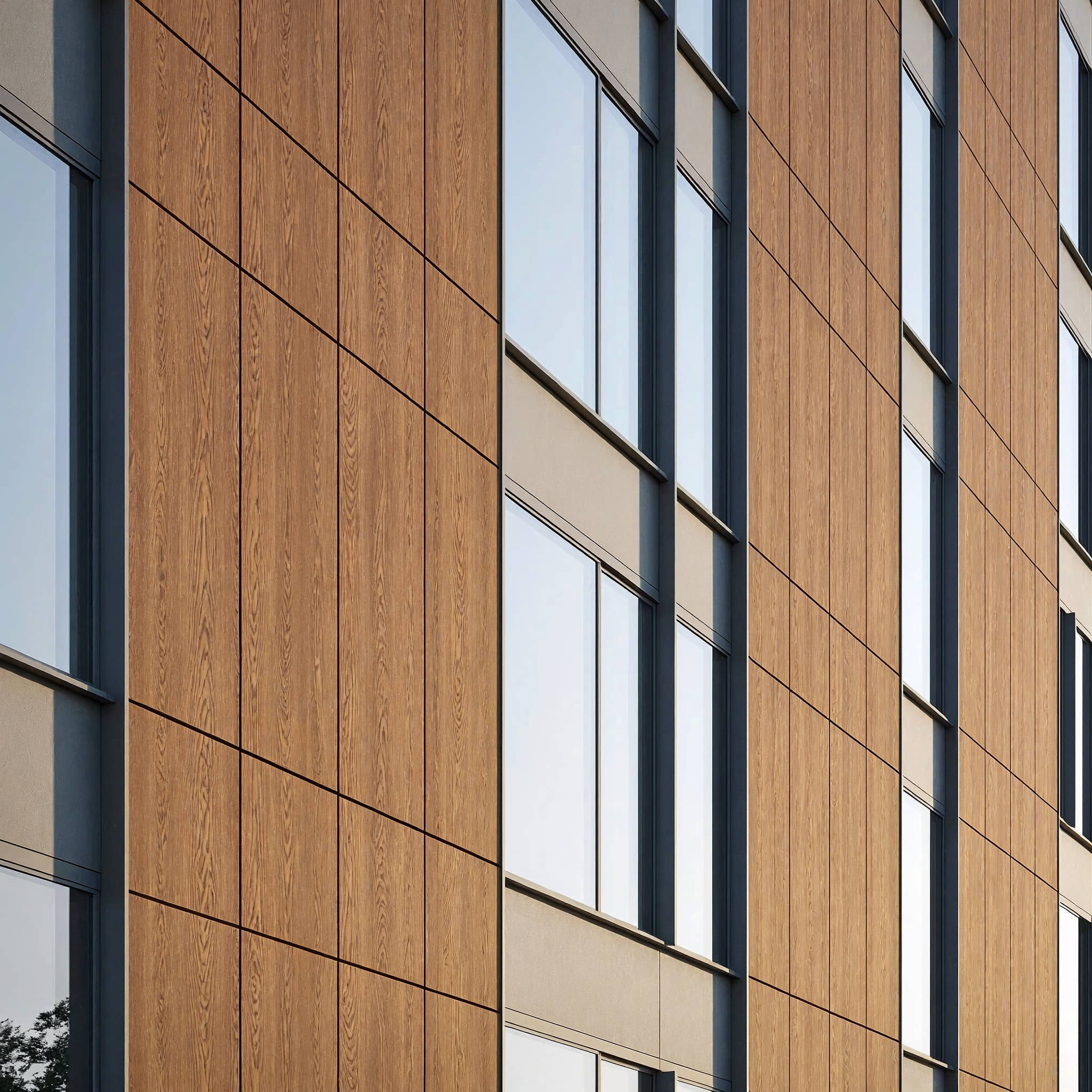
Specifying aluminum wood cladding on a commercial facade means you are chasing two things at once: the unmistakable warmth of timber grain and the cold, hard reality that real wood on a high-rise is a maintenance liability. The question most architects and envelope consultants eventually land on is not whether the aesthetic works — it is whether the finish will still look like wood five years after installation, under full UV exposure, in a coastal or high-humidity environment. This article examines the specific coating technologies that make wood-grain aluminum cladding viable for long-life commercial exteriors, how those coatings are tested, what degradation patterns to expect, and where the cost-performance breakpoints actually sit across the available finish tiers.
How the Wood-Grain Effect Is Actually Produced on Aluminum
There is a persistent misunderstanding that wood-look aluminum panels are simply painted brown and stamped with a grain pattern. The reality is more technically involved. The dominant industrial method is sublimation transfer, a thermal process where a printed wood-grain film is vacuum-sealed against a pre-coated aluminum substrate and heated to approximately 180–200°C. Under heat and negative pressure, the dye sublimates from the film into the base coating layer, penetrating the polymer matrix rather than sitting on top of it. This is fundamentally different from a printed decal or laminate, and it matters because sublimated pigments become part of the coating film itself rather than forming a discrete layer that can delaminate.
The base coat onto which the grain is transferred is almost always a fluoropolymer — typically polyvinylidene fluoride (PVDF) conforming to AAMA 2605. This matters enormously. A polyester base coat will chalk and erode long before the grain pattern fades, creating a situation where the panel surface degrades unevenly. With PVDF as the carrier, the sublimated wood grain benefits from the same UV-stable resin system that protects solid-color architectural aluminum. The grain does not sit on the surface; it lives inside a coating engineered to withstand 10–15 years of direct Florida exposure without significant color shift.
Some manufacturers also offer wood-grain effects via powder coating with multi-layer dry-film application, where a base color is electrostatically applied, cured, then overlaid with a grain-patterned second pass. This method is less common for exterior facades because achieving a convincing, non-repetitive grain across large panel runs is harder than with sublimation. For interior applications — elevator lobbies, feature walls, soffits — powder-coated wood effects can perform adequately. For anything facing weather, sublimated PVDF is the benchmark.
Coating Tier Breakdown: Polyester vs. PVDF vs. FEVE
Not all wood-grain aluminum cladding carries the same warranty, and the difference is almost always in the chemistry. Understanding the three coating tiers is essential for writing a specification that will not come back to haunt you in year six.
| Coating System | Resin Chemistry | Typical Dry Film Thickness | AAMA Standard | Expected Exterior Life (Color Retention) | Relative Cost Index |
|---|---|---|---|---|---|
| Polyester (PE) | Oil-modified polyester | 20–25 μm | AAMA 2603 | 3–5 years before noticeable fade | 1.0 (baseline) |
| Super Durable Polyester (SDP) | Silicon-modified polyester | 25–30 μm | AAMA 2604 | 7–10 years | 1.3–1.5 |
| PVDF (Kynar 500® / Hylar 5000®) | 70% PVDF resin, 30% acrylic | 30–35 μm (2-coat); 40–45 μm (3-coat) | AAMA 2605 | 15–20+ years | 1.8–2.2 |
| FEVE (Fluoroethylene Vinyl Ether) | Solvent-soluble fluoropolymer | 35–40 μm | AAMA 2605 / JIS K 5659 | 20–30+ years | 2.5–3.0 |
For aluminum wood cladding specified on buildings where re-cladding is logistically painful — high-rises, hospitals, transport hubs — the cost delta between SDP and PVDF is almost always justified. A $3–5 per square foot premium on the coating translates to avoiding a $40–80 per square foot recladding exercise a decade later. FEVE systems, originally developed for architectural aluminum in the Japanese market and now available globally, push the durability envelope further. They offer gloss retention and chalk resistance that exceed standard PVDF, which matters particularly for darker wood tones like walnut or wenge where any surface degradation becomes visually obvious fast.
UV Degradation and the Specific Challenge of Wood Tones
Solid-color architectural aluminum has one advantage: when it fades, it fades uniformly. Wood-grain aluminum cladding introduces a more complex failure mode. The grain pattern consists of multiple pigment chemistries — dark lignins, warm ochres, cool grays — each with different UV absorption characteristics. A sublimated teak pattern might see the darker grain lines remain stable while the lighter background pigments bleach, or vice versa. The result is not a uniform color shift but a loss of contrast that makes the panel look washed-out and unconvincing as wood.
This is why accelerated weathering data matters specifically for wood-grain finishes, not just for the base coating. ASTM G154 (xenon arc exposure) and AAMA 2605-20 Section 5.7 specify minimum color retention after 10 years of South Florida exposure: ΔE ≤ 5.0 for PVDF. But a ΔE measurement averages the entire test area. A wood-grain panel can pass ΔE while looking terrible if the contrast ratio has collapsed. Some manufacturers now conduct supplementary testing that measures pattern integrity — the difference in lightness (ΔL*) between grain peaks and troughs before and after weathering. This is not yet codified in AAMA standards, but it is becoming a differentiator in technical submittals.
Specifiers should request weathering data that includes high-resolution photographs of the tested panels, not just ΔE numbers. If a supplier cannot provide images of their wood-grain finish after 4,000+ hours of xenon arc, that is a signal worth paying attention to.
Film Thickness and the Hidden Cost of Thin Coatings
Aluminum wood cladding panels are often sourced from multiple suppliers on a single project — facade zones, spandrels, column covers, and soffits might come from different fabricators. When coating thickness varies across these sources, the wood grain can look subtly different even if the same sublimation film was used. A 25 μm PVDF base coat will absorb sublimation dye differently than a 35 μm coat, producing grain patterns with different depth and saturation.
The AAMA 2605 specification requires a minimum total dry film thickness of 30 μm for a two-coat system and 40 μm for a three-coat system. The three-coat system adds a clear topcoat over the sublimated grain, which not only protects the pattern from abrasion and chemical attack but also deepens the visual richness of the grain — similar to a clear lacquer on real timber. For aluminum wood cladding on publicly visible facades within 3 meters of pedestrian sightlines, the three-coat system with clear topcoat is worth the incremental cost. The visual difference is noticeable, and the added UV shielding of the clear fluoropolymer layer extends pattern life measurably.
Fire Performance: Why the Substrate Matters as Much as the Finish
The wood-grain coating is what everyone sees, but the aluminum substrate is what determines fire classification. Solid aluminum cladding panels — as distinct from aluminum composite panels with polyethylene cores — are inherently non-combustible. A 2.5 mm or 3.0 mm solid aluminum sheet with a PVDF coating will achieve an A1 or A2-s1,d0 classification under EN 13501-1, and will meet the requirements of ASTM E84 Class A when tested for flame spread and smoke development.
This is not a minor specification detail. Since the Grenfell Tower fire and the subsequent regulatory overhaul across multiple jurisdictions, the distinction between solid aluminum and ACP has become a hard compliance line. The NFPA 285 multi-story fire test is now referenced in the International Building Code for exterior wall assemblies on buildings over 40 feet. Solid aluminum wood cladding, when installed as part of a tested wall assembly, does not introduce combustible core materials into the envelope. This simplifies compliance documentation significantly compared to systems that require extensive fire-stopping at every floor line.
For specifiers working in markets that reference the ASTM E119 or ISO 834 fire resistance standards, the substrate thickness also plays a role. A 3.0 mm solid aluminum panel provides measurable structural integrity under fire conditions for longer than a thinner panel, which can affect compartmentation strategies in the facade design.
Installation Systems and Thermal Movement Considerations
Aluminum expands and contracts at roughly 2.4 mm per linear meter across a 100°C temperature swing. For a 4-meter panel, that is nearly 10 mm of movement between a freezing winter night and a summer afternoon under direct sun. Wood-grain aluminum cladding makes this movement more visually risky than solid-color panels because any buckling, oil-canning, or joint misalignment disrupts the continuity of the grain pattern. A panel that looks fine at 20°C can develop visible edge distortion at 60°C if the attachment system does not accommodate thermal movement properly.
The most reliable approach for wood-grain aluminum cladding is a rear-ventilated rainscreen system with stainless steel or aluminum carrier rails and engineered expansion joints at every panel perimeter. The cavity behind the panels — typically 20–50 mm depending on building height and wind zone — provides drainage, ventilation, and a pressure-equalization function that reduces the structural load on the panels themselves. This matters for wood-grain finishes because any panel deflection under wind load becomes more visible when the grain pattern provides a visual reference grid. A panel that deflects 2 mm might be structurally fine but visually distracting if the grain lines no longer align across adjacent panels.
Clip-and-rail systems, as opposed to face-fixed systems, eliminate visible fasteners and allow individual panel removal for inspection or replacement without disturbing adjacent panels. This is particularly valuable for wood-grain aluminum cladding because if a single panel is damaged on site, replacing it without a visible color or pattern mismatch requires pulling a panel from the same production batch. A clip system makes that swap feasible without dismantling large sections of the facade.
Coastal and Industrial Environments: Salt, Sulfur, and Coating Integrity
Aluminum wood cladding specified within 5 kilometers of a marine coastline or in an industrial zone with elevated SO₂ levels faces a different degradation pathway. The primary risk is not UV but chemical attack on the coating system. Salt spray testing per ASTM B117 is standard, but the more relevant test for wood-grain finishes is cyclic corrosion testing per ASTM G85 Annex A5 (PROHESION), which alternates salt fog, dry-off, and humidity cycles. This better simulates the wet-dry cycling that drives electrolyte concentration at coating edges and fastener penetrations.
For these environments, the specification should require a minimum 3.0 mm panel thickness (not for structural reasons but for edge corrosion resistance — thicker aluminum provides more sacrificial material at cut edges) and a three-coat PVDF or FEVE system with a clear topcoat that encapsulates the grain pattern. The clear coat should extend over the panel edges where possible, or a field-applied edge sealant should be specified for all cut edges. This is tedious to enforce on site but makes a measurable difference to edge corrosion initiation within the first five years.
Manufacturers like Futeng®, who supply solid aluminum wood cladding panels internationally, typically offer pre-fabricated panels with factory-applied edge treatments that eliminate the need for field sealing. For projects where panels must be cut on site — always a risk with complex facade geometries — the specification should explicitly require touch-up edge coating with a compatible fluoropolymer repair system, not a generic aerosol paint.
Cost Engineering: Where the Money Goes on Wood-Grain Facades
The material cost of aluminum wood cladding breaks down into three roughly equal components: the aluminum substrate, the coating system, and the fabrication (cutting, folding, perforating, attachment hardware). The wood-grain coating adds a premium over solid-color PVDF — typically 15–25% depending on pattern complexity and whether a clear topcoat is included. But the coating is rarely the dominant cost driver on a fully installed facade.
Installation labor, access equipment, and the carrier system typically account for 50–60% of the total installed cost. This means that upgrading from SDP to PVDF wood-grain, which might add $4 per square foot to the panel cost, translates to roughly $7–8 per square foot on the installed cost after factoring in the labor and access that remain constant regardless of coating choice. On a 10,000-square-foot facade, that is a $70,000–80,000 premium for an additional 10–15 years of aesthetic life. Put in those terms, the value proposition is straightforward.
What often gets overlooked in value engineering is the pattern repeat frequency. Cheaper wood-grain systems use a single film that repeats every 1.2–1.5 meters. On a large facade, the repetition becomes visible and undermines the wood-look authenticity. Higher-tier systems offer multiple grain variations — typically 4–6 unique patterns — that are randomized across the panel run. This costs more in film tooling and production logistics but eliminates the "wallpaper effect" that cheapens the entire facade. For commercial projects where the wood aesthetic is central to the architectural concept, pattern variation is not a luxury; it is a specification requirement that should be written into the performance spec, not left to the fabricator's discretion.
Writing a Specification That Gets What You Want
A specification for aluminum wood cladding that simply says "wood-grain aluminum panels" is an invitation for the lowest bidder to supply polyester-coated panels with a single-repeat pattern and no weathering data. A proper performance specification should address at minimum:
- Substrate: Solid aluminum sheet, alloy 3003 or 5005, temper H14 minimum, thickness 2.0/2.5/3.0 mm as required by wind load calculations per ASCE 7.
- Coating: PVDF conforming to AAMA 2605, 70% PVDF resin minimum, 3-coat system with clear topcoat, sublimated wood-grain pattern.
- Pattern: Minimum 4 unique grain variations, randomized sequencing, pattern repeat no less than 3.0 meters.
- Weathering: 10-year South Florida exposure data or 4,000-hour xenon arc per ASTM G155, with ΔE ≤ 5.0 and documented pattern contrast retention.
- Fire: Panel substrate classified as non-combustible per ASTM E136 or EN 13501-1 Class A1. Wall assembly tested to NFPA 285 where required by IBC.
- Warranty: Minimum 20-year coating warranty covering film integrity, color retention, and chalk resistance, issued by the coating manufacturer (not just the panel fabricator).
The warranty point deserves emphasis. A coating warranty from a reputable fluoropolymer manufacturer — Arkema (Kynar 500®), PPG (Duranar®), or Sherwin-Williams (Fluropon®) — carries more weight than a warranty from a panel fabricator alone. The coating manufacturer has tested their system on the specific aluminum alloy and pretreatment combination being supplied, and their warranty is backed by decades of exterior exposure data. If a fabricator cannot produce a coating manufacturer's warranty for their wood-grain system, ask why.
The AAMA 2605 standard remains the most widely referenced specification for high-performance architectural coatings in North America, and it is worth reading the full document rather than relying on summary sheets. Section 5.7 (Color Retention) and Section 5.8 (Chalk Resistance) are particularly relevant for wood-grain finishes where surface degradation undermines the entire aesthetic proposition.
When Wood-Grain Aluminum Is the Wrong Answer
There are projects where aluminum wood cladding is genuinely not the right specification, and being honest about this builds credibility with clients. If the building is a low-budget, single-story structure with a design life of 15 years, the premium for PVDF wood-grain over painted fiber cement or modified wood siding may not close on lifecycle cost. If the design intent is for the facade to weather and patinate naturally — as with untreated cedar or corten steel — then a factory-applied wood-grain coating that resists weathering is philosophically misaligned with the architectural concept.
Aluminum wood cladding makes the strongest technical and economic case on mid-rise and high-rise commercial buildings, institutional projects with 30+ year design lives, coastal or high-UV environments where real timber would require aggressive maintenance cycles, and any project where fire compliance for the exterior wall assembly is non-negotiable. In those contexts, the combination of a solid aluminum substrate with a properly specified PVDF or FEVE wood-grain coating delivers an outcome that real wood simply cannot match: a timber aesthetic that does not move, rot, burn, or fade within the building's service life.
The specification decisions that determine whether that outcome is actually achieved — coating chemistry, film thickness, pattern variation, edge treatment, and attachment system — are all made before a single panel reaches the fabricator. Getting them right requires understanding what is happening at the chemical and mechanical level, not just picking a wood-grain color from a sample board and hoping for the best.