Aluminum Rainscreen Procurement Guide for Façade Contractors and Specifiers
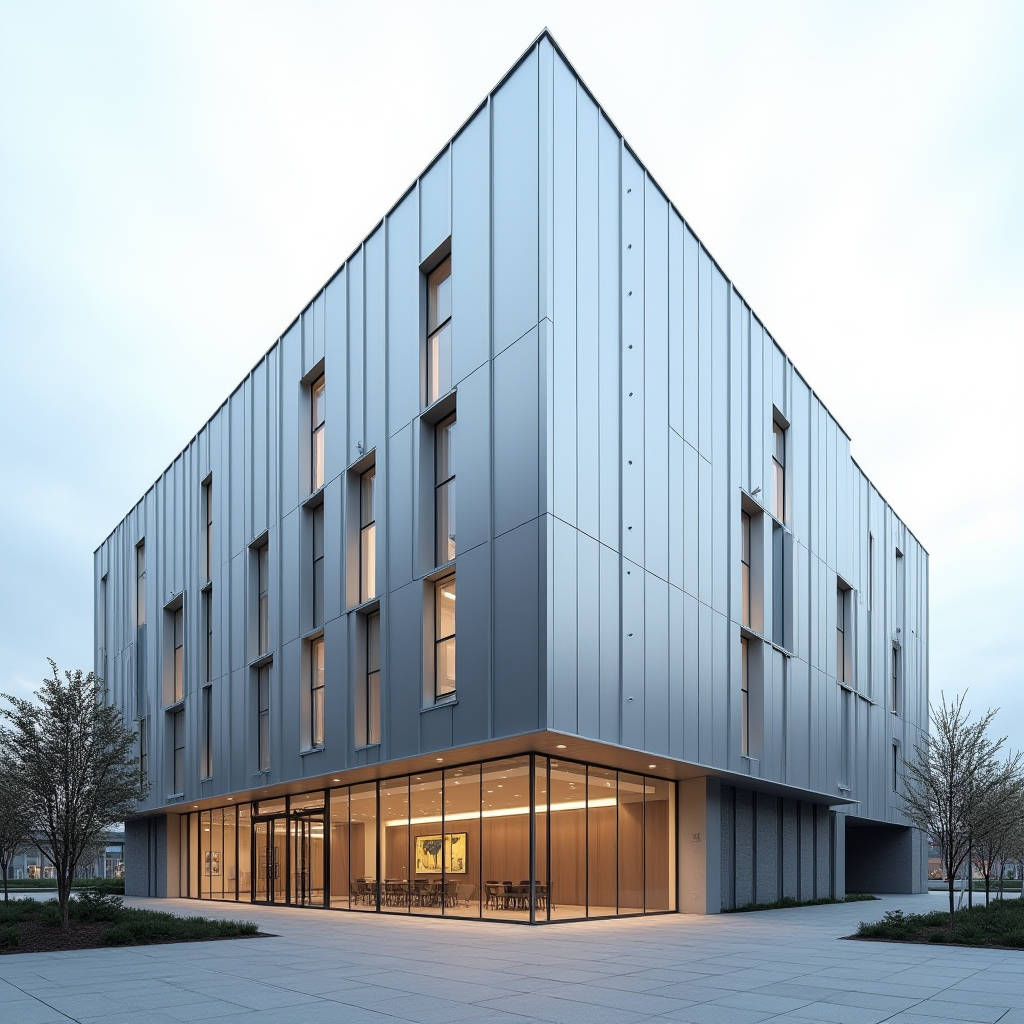
Procurement managers and façade contractors evaluating aluminum rainscreen systems quickly hit a wall of conflicting supplier claims. Some quote 1.5mm coil stock. Others push composite panels and call them "equivalent." Neither holds up under wind load calculations or fire code scrutiny. The real decision sits at the intersection of alloy grade, panel thickness, coating chemistry, and attachment engineering — and getting any of these wrong means a failed spec review or, worse, a failed installation. This article lays out the technical benchmarks that actually matter when sourcing solid aluminum rainscreen panels for commercial building envelopes, from ASTM tolerances to PVDF bake schedules, so you can write tighter RFQs and vet suppliers without the marketing noise.
What separates a rainscreen from standard cladding
The term gets thrown around loosely. A rainscreen is not just any exterior aluminum panel system. The defining principle is pressure-equalized cavity design. The outer skin — in this case, solid aluminum panels — deflects direct rain while the ventilated cavity behind it allows air to circulate and equalize pressure differentials. This prevents water from being sucked through joints into the building interior. The inner wall assembly handles thermal performance and air sealing independently.
For the system to work, panel flatness matters. A 2.5mm or 3.0mm solid aluminum sheet resists oil-canning under thermal cycling far better than thinner gauge material. Curtain wall contractors in the Middle East and Southeast Asia routinely specify 3.0mm for large-format panels exceeding 1,200mm in any dimension. Smaller panels with closer fastener spacing can use 2.0mm, but the cost difference between 2.0mm and 2.5mm is often marginal once fabrication and finishing are factored in.
Field Note: When reviewing shop drawings, check the panel edge return detail. A minimum 20mm return leg on all four edges significantly stiffens the panel face and reduces visible waviness under low-angle sunlight. Some fabricators default to 15mm. Push for 20mm on panels wider than 800mm.
Alloy selection and why 3003 and 5052 dominate
Two aluminum alloys account for roughly 90% of rainscreen panel specifications worldwide: 3003-H14 and 5052-H32. They are not interchangeable. 3003 offers good formability at a lower raw material cost. It works well for flat panels with simple edge returns and no complex perforations. 5052 delivers roughly 30% higher tensile strength and superior corrosion resistance in marine or industrial environments. Coastal projects in the Gulf region, for instance, almost always call for 5052.
Here is the practical procurement takeaway: if your project is within 5km of saltwater, specify 5052-H32. If the panels include large perforated areas or intricate folded geometries, 5052 handles the stress concentrations better. For inland commercial towers with standard rectangular panels, 3003-H14 is perfectly adequate and saves 8-12% on material cost. Either way, confirm the mill cert documentation shows compliance with ASTM B209 for sheet and plate tolerances.
Thickness tolerances that actually matter
When a supplier quotes "2.5mm" aluminum rainscreen panels, the procurement team needs to pin down what that means. ASTM B209 permits a thickness tolerance of ±0.08mm for 2.5mm nominal sheet. Some mills ship at the bottom of that range consistently. Over hundreds of panels, thinner material translates to higher rejection rates during fabrication — edges crack during bending, flatness suffers, and the finished panel looks subpar on the façade.
Specify a minimum thickness in your RFQ, not just nominal. For example: "2.5mm nominal, 2.45mm minimum measured thickness per ASTM B209." Reputable processors like Futeng® maintain incoming material inspection records that verify every coil or sheet lot against this threshold before cutting begins.
PVDF coating: the spec details that determine lifespan
Architectural specifications for aluminum rainscreen almost universally require PVDF (polyvinylidene fluoride) coating. But "PVDF" alone is not a spec. Three parameters separate a 20-year finish from one that chalks and fades in five.
Resin content. The coating must contain a minimum 70% PVDF resin by weight in the color coat. Kynar 500® or Hylar 5000® are the two accepted resin systems. Anything less than 70% and you are buying a modified acrylic that will not hold up. Ask for the resin certification, not just a brand claim.
Dry film thickness. AAMA 2605, the high-performance architectural coating standard, mandates a minimum 30μm (1.2 mils) total dry film thickness for a two-coat system and 40μm (1.6 mils) for a three-coat system. Three-coat systems add a clear topcoat that improves gloss retention and scratch resistance — worth the premium on highly visible façades.
Bake schedule. The primer, color coat, and clear coat each require precise peak metal temperature and dwell time. Under-cured PVDF looks fine at installation but starts chalking within 18-24 months. Over-cured film becomes brittle and micro-cracks under thermal cycling. Either failure mode is expensive to fix once panels are installed.
| Coating Parameter | AAMA 2605 Requirement | What to Verify in Submittals |
|---|---|---|
| PVDF Resin Content | ≥70% in color coat | Resin supplier certificate (Kynar 500® or Hylar 5000®) |
| Total DFT (2-coat) | ≥30μm (1.2 mils) | Calibrated gauge readings from batch QC records |
| Total DFT (3-coat) | ≥40μm (1.6 mils) | Cross-section microscopy for clear coat thickness |
| Color Consistency | ΔE ≤ 2.0 (CIELAB) | Spectrophotometer readings against approved control sample |
| Gloss Retention (10yr, South Florida) | ≥50% at 60° angle | Accelerated weathering test data (ASTM G154) |
| Adhesion (after boiling water) | No blistering or loss of adhesion | Cross-hatch test per ASTM D3359, Method B |
Attachment systems and the thermal bridging problem
The rainscreen cavity creates a natural thermal break, but the attachment hardware can short-circuit it. Most aluminum rainscreen installations use one of three carrier systems: continuous vertical aluminum extrusions (T-profile or hat-channel), isolated clip-and-rail systems, or direct-fix through the panel face with exposed fasteners.
Continuous vertical rails are the most common for mid-rise commercial work. They are cost-effective and allow for panel alignment adjustment during installation. The downside: every rail acts as a thermal bridge unless the specification includes a thermal isolator pad between the rail and the structural wall bracket. On projects targeting LEED or BREEAM certification, this detail matters. The thermal break material — typically PVC or polyamide — must be documented in the submittal package.
Clip-and-rail systems with stainless steel clips offer better thermal performance and faster panel replacement. Individual panels can be removed without disturbing adjacent units. The trade-off is a 15-25% cost premium over continuous rail systems, and tighter fabrication tolerances are required on the panel return legs to ensure consistent engagement.
Pro Tip: If the project is in a seismic zone, confirm that the attachment system allows for inter-story drift. Rigid connections that look fine on paper will buckle panels when the building moves. A slotted clip with ±10mm of vertical movement capacity is a reasonable starting point for most low-to-mid-rise structures.
Writing an RFQ that filters out the wrong suppliers
Too many RFQs for aluminum rainscreen panels read like this: "Supply and deliver aluminum cladding panels per drawing set." That invites quotes from composite panel distributors, coil coaters with no fabrication capability, and trading companies that have never visited the factory floor. A tight RFQ saves weeks of back-and-forth.
Key fields to include:
- Alloy and temper: 3003-H14 or 5052-H32, with mill cert requirement
- Panel thickness: Nominal and minimum, per ASTM B209
- Coating system: AAMA 2605, 70% PVDF, specify 2-coat or 3-coat
- Color and finish: Reference a physical sample or RAL/Pantone code; state acceptable ΔE tolerance
- Fabrication scope: Cutting, bending, routing, perforating, reinforcing — be explicit
- Packaging standard: Interleaving with protective film, wooden crate or palletized, edge protection
- Inspection hold points: Incoming material, first article, pre-shipment
- Documentation deliverables: Mill certs, coating batch reports, dimensional inspection reports, packing list with panel tag numbers
On the packaging point: panels shipped FOB from Asian fabrication hubs to North America or Europe spend 4-6 weeks in transit. Without interleaving and edge protection, vibration abrasion creates visible scratches at contact points. The protective film should be UV-stable if panels will be stored outdoors at the jobsite for more than 30 days. Standard PE film breaks down under sunlight and leaves adhesive residue that is a nightmare to remove.
Factory audit: what to look for beyond the showroom
Every factory has a clean showroom and a polished sample board. The production floor tells a different story. When auditing a solid aluminum rainscreen fabricator, focus on three areas:
CNC turret punch and press brake condition. Worn tooling produces inconsistent bend radii and burred edges. Look at the tooling inventory — a shop that runs 20 different punch profiles can handle architectural perforation patterns without subcontracting. Ask about their typical tool changeover time. Under 10 minutes indicates a well-organized operation.
Coating line or coating partner relationship. Some fabricators operate in-house PVDF lines. Others send cut-and-formed panels to a dedicated coating facility. Both models work, but the latter requires tight logistics coordination. If the coating partner is off-site, ask about the transport method between fabrication and coating. Panels that get stacked loose in a truck arrive with scratches that the coating line will simply paint over — and those scratches telegraph through the finish.
QC lab equipment. A calibrated spectrophotometer, dry film thickness gauge, gloss meter, and adhesion tester should be on-site and in use. Ask to see the calibration certificates. Ask to see the most recent batch's QC records. If the QC manager hesitates on either request, that is your answer.
Futeng® operates integrated fabrication and coating facilities, which eliminates the inter-facility transport risk. That said, the broader point for any procurement team is this: the supply chain has fewer handoff points when fabrication and finishing happen under one roof.
Cost structure: where the money actually goes
Aluminum rainscreen panel pricing breaks down into roughly five buckets. Understanding this helps procurement teams evaluate whether a quote is realistic or suspiciously low.
Raw aluminum sheet accounts for 35-45% of total cost, depending on alloy and gauge. PVDF coating represents 15-20% — and this is where low-ball suppliers cut corners by reducing resin content or skimping on film thickness. Fabrication labor and overhead run 20-25%. Attachment hardware (clips, rails, fasteners) adds 10-15% if included in the panel package. The remaining 5-10% covers packaging, documentation, and margin.
When a quote comes in 20% below the field average, the difference is almost always in the coating chemistry or the aluminum thickness. No factory has a secret cost advantage that dramatic. Ask for a cost breakdown. Serious suppliers will provide it. Those who refuse are hiding something.
Logistics and lead time realities
Standard lead time for a custom aluminum rainscreen package runs 6-8 weeks from approved shop drawings to ex-works. Add 4-6 weeks for ocean freight to North America or Europe, plus customs clearance. Total procurement timeline: 12-16 weeks. Rush orders can compress fabrication to 4 weeks, but only if the alloy and coil stock are already in inventory and the coating color is from a standard palette.
Custom colors — anything requiring a matched RAL, Pantone, or physical sample — add 2-3 weeks for coating formulation and sample approval. The sample approval step is non-negotiable. Do not skip it. A ΔE of 2.0 might look fine on a spectrophotometer report but visibly wrong on a 10-meter-wide façade under midday sun. Approve the physical color chip before releasing the full production run.
For projects in the EU, confirm that the coating system meets EN 13501-1 fire classification requirements. Solid aluminum panels are inherently non-combustible (A1 or A2 rating depending on coating thickness), but the test documentation must be provided. This is not a detail to sort out during installation.
Installation tolerances that affect panel fabrication
The panel fabricator and the installation contractor rarely talk directly. That gap causes problems. The fabricator assumes a perfectly flat substrate. The installer inherits a concrete frame or steel substructure with real-world deviations. If the panel system does not accommodate those deviations, the installation crew will force panels into place — and the façade will show it.
Specify the expected substrate tolerance in the panel RFQ. A typical requirement: ±5mm over 3 meters for the primary support plane, with individual bracket locations within ±2mm of design position. The attachment system should provide at least ±10mm of three-dimensional adjustability at each connection point. This lets the installer true up the panel plane regardless of what the concrete subcontractor left behind.
Joint width consistency is the visual benchmark. A well-installed aluminum rainscreen façade shows uniform 15-20mm open joints across the entire elevation. When joints vary by more than 3mm, the eye catches it immediately. That variation usually traces back to substrate deviation, not panel fabrication error.
Fire performance and code compliance
Following the Grenfell Tower tragedy, fire performance of exterior cladding has moved from a footnote to a front-page requirement in building codes worldwide. Solid aluminum panels are fundamentally different from composite panels in a fire scenario. There is no polyethylene core to melt, drip, and propagate flame. The aluminum itself is non-combustible per ASTM E136.
That said, the coating and any insulation behind the panel must also be evaluated as part of the full wall assembly. The panel itself may be A1, but if the cavity insulation is combustible and the cavity design does not include adequate fire stops, the assembly can still fail a large-scale fire test. Projects in the UK, UAE, and Australia now routinely require full-scale façade fire testing per BS 8414 or NFPA 285. Confirm that your panel supplier can provide the necessary component-level fire data to support the assembly test report.
For procurement teams, the practical step is to request a declaration of performance (DoP) per EN 13501-1 for the specific panel configuration being quoted. Generic statements like "aluminum is non-combustible" do not satisfy a building control reviewer.
Quality assurance documentation that protects your project
The difference between a supplier and a partner is the paper trail. A proper aluminum rainscreen procurement package includes documentation that lets the general contractor and architect sleep at night. At minimum, require:
- Mill test certificates for each coil or sheet lot, showing chemical composition and mechanical properties per ASTM B209
- PVDF resin certification from the resin manufacturer (not just the coater)
- Batch-level coating QC records: DFT readings, gloss measurements, color readings, adhesion test results
- Dimensional inspection reports for first article and random production samples
- Packing list with panel tag numbers that cross-reference to the shop drawing schedule
This documentation is not busywork. When a panel arrives on site with a scratch or a color mismatch, the paper trail tells you whether the problem originated at the mill, the coater, the fabricator, or the shipping company. Without it, you are guessing — and paying for the replacement panels out of contingency.
Making the sourcing decision
Aluminum rainscreen procurement rewards specificity. The more precise the RFQ, the easier it is to compare quotes on an apples-to-apples basis. Vague specifications invite vague pricing — and the cost of a failed rainscreen system, measured in remedial work, liquidated damages, and reputational damage, dwarfs any upfront savings from a low bid.
Start with alloy and thickness. Lock down the coating standard. Define the attachment system and adjustability requirements. Require the documentation package upfront, not as an afterthought. Visit the factory or send a third-party inspector. The suppliers who welcome that scrutiny are the ones worth working with. The ones who make excuses are not.
The global supply base for solid aluminum rainscreen panels is broad, but the number of fabricators who combine material traceability, coating discipline, fabrication precision, and export-grade packaging is smaller than it appears. Vet accordingly.