Aluminum Curtain Wall Procurement Checklist for Façade Contractors and Project Managers
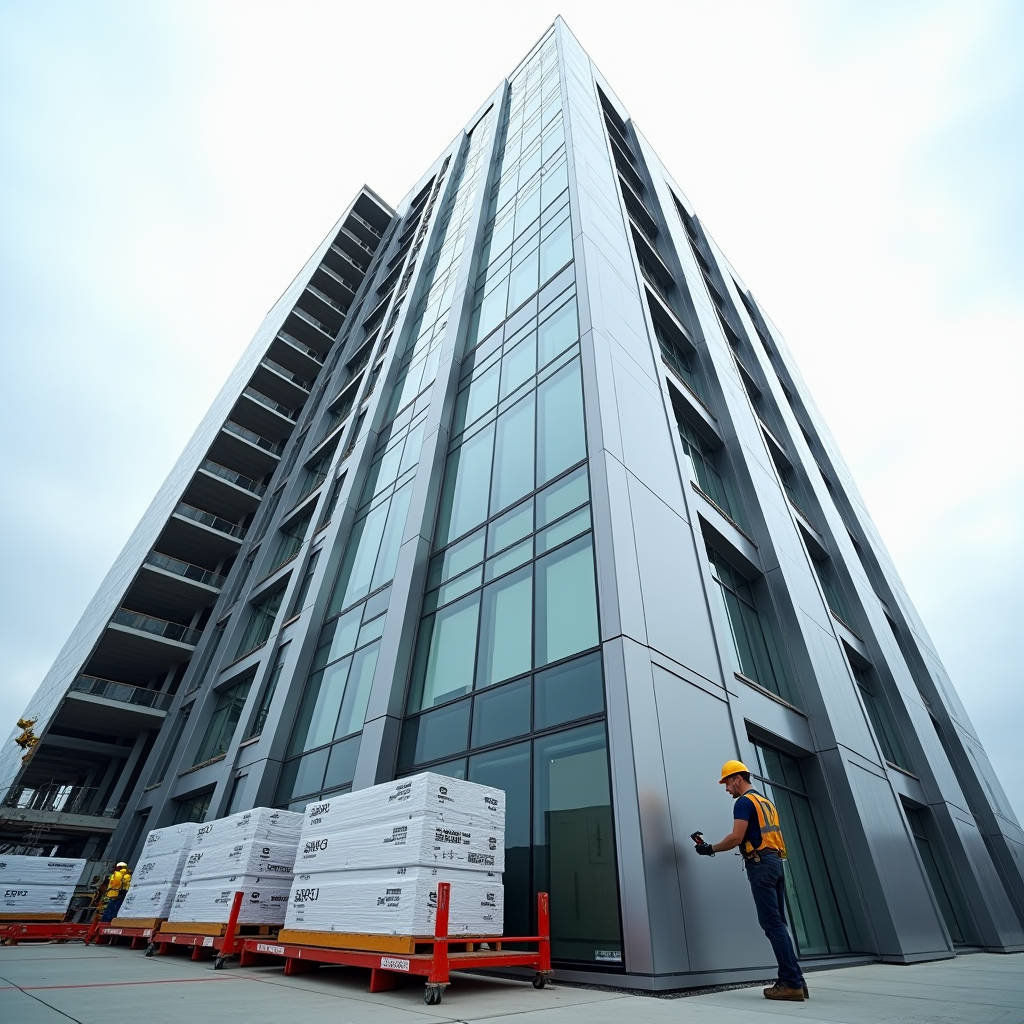
When a façade contractor evaluates aluminum curtain wall systems for a mid-rise commercial project, the first question rarely starts with aesthetics. It starts with lead time, tolerance stacking, and whether the panel supplier can actually hit the specified PVDF coating thickness across 2,000 square meters without cutting corners. The aluminum curtain wall supply chain has matured significantly over the past decade, but the gap between factory promises and jobsite reality remains wide enough to derail a construction schedule. This article breaks down what procurement managers and engineering teams need to verify before signing a purchase order — from alloy selection and coating chemistry to packaging standards that prevent rejection at the dock.
What Actually Drives Aluminum Curtain Wall Project Costs
Most bid-level cost comparisons stop at the square-meter price. That number is almost useless on its own. A 2.5mm solid aluminum cladding panel quoted at $68/m² FOB might end up costing more than one quoted at $78/m² once you factor in scrap rates, rework from coating defects, and the labor cost of installing panels that arrived with edge damage. The real cost drivers split into three buckets: material specification, fabrication complexity, and logistics risk.
Material-wise, alloy 3003-H14 and 5005-H24 dominate the aluminum curtain wall market. 3003 offers better formability for complex geometries; 5005 provides a finer surface finish that matters when the architect specifies a high-gloss metallic PVDF coating. The price difference between the two alloys runs roughly 3-5% at current LME levels, but 5005 can reduce rework rates on Class A visible surfaces by enough to justify the premium. Thickness is another variable that gets negotiated poorly. Some contractors try to save money by dropping from 3.0mm to 2.5mm on non-visible areas, only to find that the thinner panel oil-cans under thermal cycling. That callback costs far more than the material savings.
Fabrication complexity is where most budgets blow out. A simple rectangular panel with perimeter returns is a commodity item. Add folded corners, perforated zones, integrated stiffeners, or curved profiles, and the fabrication cost per panel can double. The key is to involve the aluminum curtain wall supplier during the design development phase, not after the construction documents are issued. One project we reviewed in 2023 saved 18% on total façade cost simply by rationalizing panel sizes to reduce the number of unique SKUs from 47 to 19.
PVDF Coating Specifications That Procurement Teams Miss
Architects love specifying "high-performance fluoropolymer coating" without pinning down the exact chemistry. For aluminum curtain wall applications exposed to UV and industrial pollutants, the benchmark is a 70% PVDF resin system — typically Kynar 500® or Hylar 5000® — with the remaining 30% being acrylic resin and pigments. The total dry film thickness should land between 30-40 microns for a three-coat system (primer, color coat, clear topcoat). Some specs call for a two-coat system at 25-30 microns on interior-facing surfaces, which is acceptable if the building's microclimate is benign.
Field Note: Always request a batch-specific AAMA 2605 test report from the coater, not just a generic "we comply" statement. The report should include gloss retention after 10-year Florida exposure simulation, pencil hardness (minimum HB), and adhesion test results per ASTM D3359. A reputable supplier like Futeng® will provide these documents without hesitation. If the factory hesitates, walk away.
Color consistency across production batches is another headache. The industry standard Delta E tolerance is ≤1.0 for adjacent panels and ≤2.0 for panels on different elevations. But here is the problem: most spectrophotometer readings are taken immediately after curing, and PVDF coatings can shift slightly during the first 30 days of weathering. For projects with phased delivery over six months, insist on retained color samples from each production run and cross-check them under both D65 daylight and horizon light. A mismatch that is invisible in the factory can become glaring on a sunny jobsite.
Aluminum Curtain Wall Structural Performance Beyond the Datasheet
Wind load calculations are standard engineering practice. What gets overlooked is how the panel attachment system interacts with the building's primary structure under differential movement. An aluminum curtain wall panel expands and contracts at roughly 2.4 mm per meter over a 100°C temperature swing. If the substructure does not accommodate that movement, you get buckling, fastener fatigue, and eventually water ingress.
The connection between the solid aluminium cladding panel and the curtain wall mullion is typically handled by a proprietary clip or bracket system. The critical parameters here are: allowable deflection under design wind load (usually L/175 for the panel itself, L/360 for the supporting framing), the slot tolerance that permits thermal movement, and the corrosion compatibility between the aluminum panel, the stainless steel fasteners, and any galvanized steel subframe elements. Dissimilar metal corrosion is a slow killer — it will not show up during the defects liability period, but five years in, you will see white rust streaks and fastener loosening.
For seismic zones, the aluminum curtain wall system must also accommodate inter-story drift. A typical design target is ±25mm of movement without panel disengagement or glass breakage. This requires coordination between the panel supplier, the curtain wall system designer, and the structural engineer of record. Do not assume the panel supplier will handle this — specify it in the scope of work.
Factory Audit Checklist: What to Verify Before Placing the PO
A factory visit tells you more in four hours than a dozen email exchanges. Here is what experienced procurement managers look for when auditing an aluminum curtain wall panel manufacturer:
- CNC turret punch and press brake condition: Look at the tooling wear. Worn punches produce burred edges that compromise coating adhesion. Ask about the maintenance schedule and the last tooling replacement date.
- Pretreatment line: A proper seven-stage pretreatment (degreasing, rinsing, chromate conversion coating, rinsing, final rinse, drying) is non-negotiable. If the factory uses a five-stage line or skips the chromate step, coating adhesion will fail within the warranty period.
- PVDF spray booth environment: The booth should be temperature and humidity controlled. Excessive humidity causes micro-bubbling in the clear coat. Ask to see the environmental log for the past 30 days.
- QC lab equipment: A calibrated spectrophotometer, dry film thickness gauge, gloss meter, and salt spray test chamber should be on-site. If the factory outsources all testing to a third-party lab, batch-level QC becomes impractical.
- Packaging area: Panels should be interleaved with protective film (minimum 60-micron PE film) and packed in steel-framed crates for export. Wooden crates are acceptable for domestic shipments but prone to moisture damage on ocean freight.
Pro Tip: Ask to see the factory's rejection rate data for the past six months, broken down by defect type. A transparent factory will share this. A rejection rate above 2% for coating defects or above 1% for dimensional errors signals process control problems that will become your problem on site.
Logistics and Packaging: Protecting Aluminum Curtain Wall Panels in Transit
International shipping is where perfectly good aluminum curtain wall panels get destroyed. The most common failure mode is edge damage from crate shifting during container handling. For FOB shipments, the packaging specification needs to be written into the purchase order, not assumed. Minimum requirements for seafreight: each panel face protected with 60-80 micron PE film, panels separated by kraft paper or foam interleaving, stacked no more than 15 panels per bundle, bundles secured with polyester strapping (not steel, which can cut into edges), and the entire bundle enclosed in a fumigated plywood crate with internal bracing.
For CIF shipments, the supplier handles freight and insurance, but the packaging standard should still be specified. The insurance claim process for damaged aluminum curtain wall panels is slow, and the project schedule will not wait. One practical approach is to order 2-3% extra panels for the most complex shapes and have them shipped in a separate crate to avoid single-point failure if one crate is damaged.
Container loading deserves attention too. A 40-foot high-cube container can typically hold 800-1,200 square meters of aluminum curtain wall panels, depending on panel dimensions and crate configuration. Overloading creates compression damage; underloading wastes freight cost. The optimal utilization rate is 85-90% of the container's internal volume, leaving room for air circulation to prevent condensation.
Comparing Aluminum Curtain Wall Panel Specifications by Application
The table below provides a practical reference for matching panel specifications to project requirements. These values reflect common industry practice for solid aluminium cladding panels, not aluminum composite material.
| Parameter | Low-Rise Commercial (≤15m) | Mid-Rise (15-50m) | High-Rise (>50m) | Interior Feature Wall |
|---|---|---|---|---|
| Recommended Alloy | 3003-H14 | 3003-H14 / 5005-H24 | 5005-H24 | 3003-H14 |
| Panel Thickness | 2.0mm | 2.5mm | 3.0mm | 1.5-2.0mm |
| Coating System | 2-coat PVDF (25-30μm) | 3-coat PVDF (30-35μm) | 3-coat PVDF (35-40μm) | Polyester powder (60-80μm) |
| Wind Load Deflection Limit | L/175 | L/175 | L/200 | N/A |
| Stiffener Spacing | 600mm max | 500mm max | 400mm max | As required |
| Typical Lead Time (ex-works) | 4-5 weeks | 5-7 weeks | 6-8 weeks | 3-4 weeks |
| MOQ (per color/shape) | 100m² | 200m² | 300m² | 50m² |
These figures are starting points. A project within 500 meters of a coastline, for instance, should upgrade to a 3-coat PVDF system with a minimum 35μm DFT regardless of building height, due to salt spray exposure. Similarly, buildings in the Middle East with ambient temperatures exceeding 50°C should specify 5005 alloy and allow for larger thermal movement gaps.
Installation Tolerances and the Handover Inspection
The best aluminum curtain wall panel in the world will look terrible if the substructure is out of tolerance. The industry standard for curtain wall framing alignment is ±3mm over any 3-meter span, and ±5mm overall building height. If the main contractor's structural frame exceeds these tolerances, the panel installer inherits the problem — and the panel supplier often gets blamed for "poor fit."
A practical sequence for quality control at installation:
- Pre-installation survey: Laser-scan the substructure and compare against the panel shop drawings. Flag any deviation exceeding ±3mm before a single panel is lifted.
- Mock-up installation: Install a minimum of 6-9 panels covering a typical bay, including corners and interfaces with glazing. This mock-up should be approved by the architect, structural engineer, and cladding contractor before bulk installation proceeds.
- Ongoing inspection: Check panel-to-panel joint width consistency every 20 panels. The tolerance is ±1.5mm from the specified joint width. Joint sealant application should follow the sealant manufacturer's recommended joint width-to-depth ratio, typically 2:1.
- Final handover: Document all visible surfaces under uniform lighting conditions. Any scratch deeper than the clear coat, any dent exceeding 2mm in depth, or any color variation exceeding Delta E 2.0 should be recorded and rectified.
Supplier Evaluation: Separating Capability from Marketing
The aluminum curtain wall supply market is crowded, particularly in China, Southeast Asia, and the Middle East. Distinguishing a capable manufacturer from a trading company that subcontracts production requires digging into specifics. Ask for the factory's monthly production capacity in square meters and verify it against the equipment list. A CNC turret punch can process roughly 800-1,200m² of aluminum curtain wall panels per month depending on complexity. If the claimed capacity far exceeds what the equipment can physically produce, the factory is likely outsourcing overflow to smaller workshops with inconsistent quality control.
Certifications matter, but they need context. ISO 9001 is a baseline — it confirms process documentation exists, not that it is followed. AAMA membership and testing reports from accredited labs (Intertek, SGS, TÜV) carry more weight. For projects in the Gulf region, check for Dubai Central Laboratory (DCL) approval or equivalent local certification. For European projects, EN 13501 fire classification testing on the complete aluminum curtain wall assembly (not just the panel) is increasingly required.
Futeng® and similar established manufacturers with vertically integrated production — from aluminum coil inventory through CNC fabrication to in-house PVDF coating — offer a traceable quality chain that is harder to achieve when production is fragmented across multiple subcontractors. The supply chain visibility alone can reduce project risk by an order of magnitude.
Warranty Structures and What They Actually Cover
Standard aluminum curtain wall panel warranties fall into two categories: coating warranty and structural warranty. A coating warranty from a reputable PVDF resin supplier (typically 20-30 years) covers film integrity, color fade beyond Delta E 5.0, and chalking beyond a rating of 8 per ASTM D4214. It does not cover damage from improper cleaning, chemical exposure, or installation defects. The structural warranty — usually 10-15 years — covers panel delamination (not applicable to solid aluminium cladding panels), perforation from corrosion, and material defects.
The warranty document is only as good as the entity standing behind it. If the panel fabricator goes out of business, the coating warranty from the resin supplier may still be valid, but the claims process becomes more complicated. For large-scale aluminum curtain wall projects, procurement managers should evaluate the supplier's financial stability, years in operation, and track record of honoring warranty claims — not just the warranty wording.
At the end of the day, aluminum curtain wall procurement is a risk management exercise disguised as a purchasing decision. The panels themselves are a mature product. The variables that determine project success — specification clarity, factory process control, logistics planning, and installation coordination — are all human and organizational. Spend your due diligence budget on those variables, and the panels will perform exactly as the datasheet says they will.