Engineering a Perforated Metal Screen Facade from Solid Aluminium Sheets for Wind Load and Durability
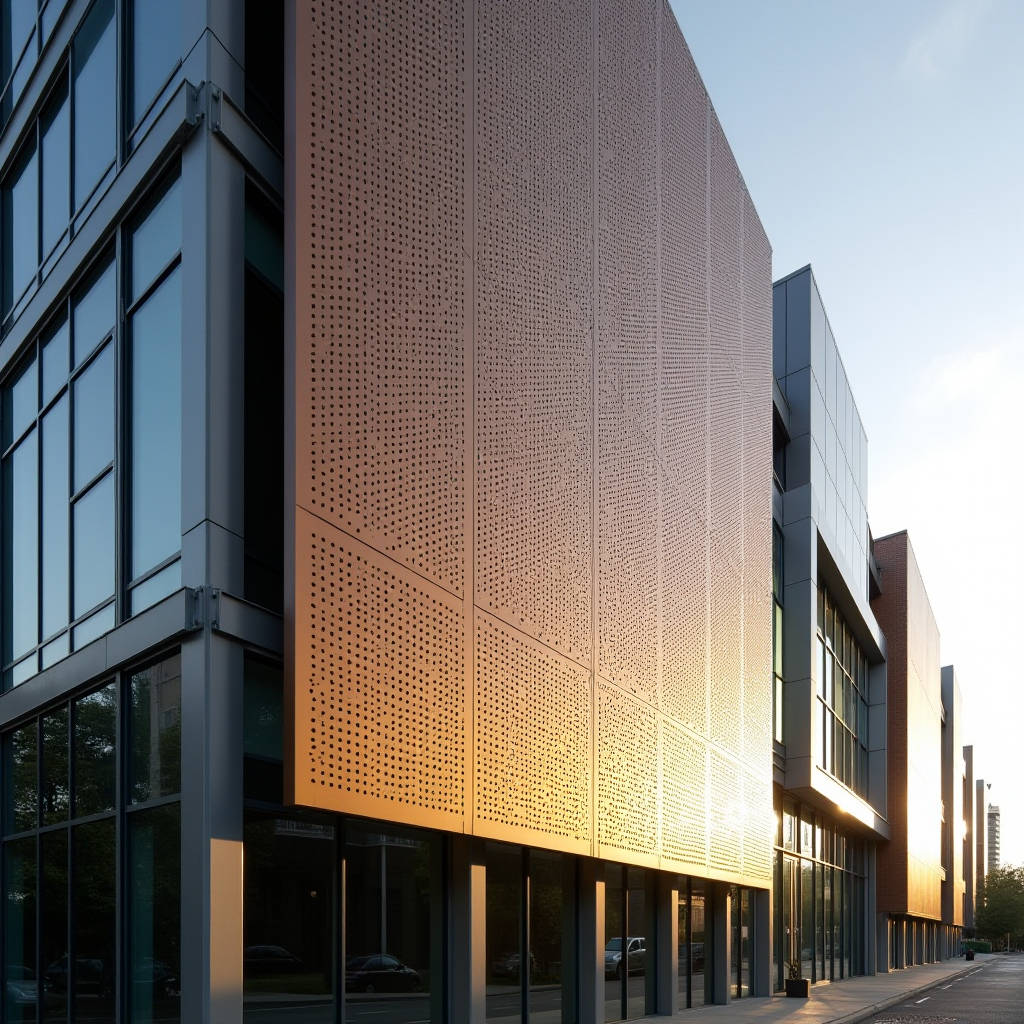
A perforated metal screen facade is rarely a purely visual decision once you sit down with a structural engineer and a cost estimator. The open-area ratio, the hole geometry, the panel thickness, and the substructure all pull against each other in ways that determine whether the screen performs for decades or becomes an expensive maintenance liability. This article focuses on the engineering and specification side of perforated aluminium screens built from solid aluminium sheets, with particular attention to wind load behaviour, panel deflection, coating durability, and the cost levers that procurement teams actually control. Understanding these variables before the design is frozen will save more money than any last-minute value engineering exercise.
Why Open-Area Ratio Drives Everything Else
The single most consequential number on any perforated metal screen facade drawing is the open-area ratio, commonly expressed as a percentage. It is calculated from the hole diameter, the perforation pitch, and the pattern layout. A screen with 20% open area behaves very differently from one with 50% open area, not just in appearance but in wind loading, weight distribution, solar shading, and acoustic performance.
Lower open areas create a more solid visual barrier and more shade, but they also catch more wind. A 20% open panel can experience wind pressures approaching those of a solid wall, while a 50% open panel sheds a large portion of the load through the holes. This is why the structural design of a perforated metal screen facade cannot simply reuse the calculations from a conventional closed cladding system.
From a procurement standpoint, open-area ratio also drives material yield. A panel with 50% open area starts from the same solid aluminium sheet as a 20% panel, but the punching process removes more material. The scrap value of the punched-out slugs partially offsets this, but the relationship between perforation density and final cost is not linear. Fabricators with modern CNC punching lines, such as the production setup used by Futeng® for solid aluminium screen panels, can optimise tool paths to reduce waste, but the open-area ratio remains the primary cost input.
Wind Load Behaviour of Perforated Panels
Perforated panels do not shed wind in a predictable straight line. The holes create turbulence, and the effective solidity of the screen depends on hole size relative to panel dimension, edge conditions, and whether the panel is mounted with an air gap behind it. A screen mounted 300 mm off the building face sees different pressures than one mounted flush against a substrate.
For design purposes, engineers commonly apply a solidity ratio correction to the base wind pressure. A panel with 40% open area might be treated as roughly 60% solid for load calculations, but this approximation breaks down at very high open areas or with large individual holes. Wind tunnel testing is the only reliable method for unusual geometries, and the cost of that testing should be budgeted early for landmark projects.
Panel thickness is the next lever. A 2.0 mm solid aluminium sheet can work for small panels with modest open areas and dense support framing. Larger panels, higher wind zones, or open areas above 40% typically push the specification toward 2.5 mm or 3.0 mm material. The deflection limit is often the controlling criterion rather than ultimate strength. A panel that survives a storm but visibly oil-cans in moderate wind will draw complaints long before it fails structurally.
Deflection, Stiffness, and the Case for Solid Aluminium
Because perforation removes material, a perforated metal screen facade panel is inherently less stiff than a solid sheet of the same thickness. This is where the choice of solid aluminium sheet over composite alternatives matters in practical terms. Solid aluminium at 2.5 mm or 3.0 mm delivers predictable elastic behaviour and can be re-flattened or re-worked during fabrication without delamination risk. The material properties are well documented in standards such as The Aluminum Association, which publishes the alloy and temper data that engineers rely on for modulus and yield values.
Common alloys for architectural perforated panels are 3003 and 5005 series, with H14 or H24 tempers. The 5005 alloy offers a better surface for anodising, while 3003 is cost-effective for painted finishes. The temper selection affects formability during perforation and edge bending, so the fabricator should be consulted before the specification locks in a single alloy.
Deflection limits are typically expressed as a fraction of the span, often L/90 or L/120 depending on the project specification and the visual expectations of the architect. Tighter limits mean thicker panels or closer support framing, both of which add cost. A transparent conversation between the architect, the structural engineer, and the fabricator about acceptable deflection is worth more than any generic specification clause.
Coating Systems and Long-Term Durability
The coating on a perforated metal screen facade has a harder job than the coating on a flat solid panel. The punched edges expose raw aluminium at every hole, and those edges are the first place corrosion or coating failure appears. A proper specification addresses edge treatment, not just the face coating.
PVDF fluoropolymer coatings remain the benchmark for architectural aluminium. The industry reference is AAMA 2605, which sets performance requirements for superior-performing organic coatings on aluminium extrusions and panels. A typical PVDF system is applied at 25 to 35 microns total dry film thickness in a two-coat or three-coat configuration. For perforated panels, the application method matters because spray coating does not reliably reach the interior walls of small holes.
For panels with small hole diameters, powder coating can offer better edge coverage because the electrostatic process wraps the edges more completely than a liquid spray. The trade-off is that powder coatings historically offered less colour consistency and lower UV resistance than PVDF, though modern super-durable polyester powders have narrowed that gap. The table below compares the main coating options for perforated aluminium screens.
| Coating Type | Typical Film Thickness | Edge Coverage on Perforations | UV / Colour Retention | Relative Cost |
|---|---|---|---|---|
| PVDF (AAMA 2605) | 25-35 microns | Moderate, depends on hole size | Excellent, 20+ years | High |
| Super-durable polyester powder | 60-80 microns | Good, electrostatic wrap | Good, 10-15 years | Medium |
| Anodised (AAMA 611) | 10-20 microns oxide layer | Excellent, full immersion | Very good, but colour range limited | Medium-High |
| Polyester liquid (AAMA 2604) | 20-25 microns | Moderate | Fair, 5-10 years | Low |
The edge condition is a specification detail that separates experienced teams from novices. If the punched edges will be exposed, the coating must be formulated and applied to cover them, or the panel must be pre-coated before perforation, which introduces its own handling challenges. Anodising sidesteps the edge problem entirely because the oxide layer grows on every exposed aluminium surface, including the interior walls of the holes. This makes anodising an attractive option for perforated metal screen facade projects where corrosion resistance at the edges is the dominant concern, though the colour palette is narrower than PVDF.
Substructure, Fixing, and Thermal Movement
A perforated screen is only as stable as the frame behind it. The substructure must handle the panel's own weight, the wind loads, and the thermal movement of aluminium, which expands and contracts with temperature. Aluminium has a coefficient of linear thermal expansion of roughly 24 x 10⁻⁶ per degree Celsius, which means a 3-metre panel can move several millimetres between a cold winter night and a hot summer afternoon.
Fixing details must allow for this movement without rattling or binding. Slotted holes, sliding brackets, and expansion joints at panel boundaries are standard practice. The specification should also address galvanic corrosion where aluminium fixings meet steel substructure elements. Isolating washers or a compatible coating on the steel are required to prevent the aluminium from acting as a sacrificial anode.
For procurement teams, the substructure is often the hidden cost of a perforated metal screen facade. The visible panels might represent only half of the total installed cost, with the remainder tied up in brackets, rails, fixings, and labour. Requesting a full-system quote rather than a panel-only price is the single most effective way to avoid budget surprises.
Cost Levers and Value Engineering
The instinct to reduce cost on a perforated metal screen facade usually starts with panel thickness, but that is often the wrong place to cut. A 0.5 mm reduction in sheet thickness saves material but can force tighter support spacing and more fixings, erasing the saving and adding labour. The more productive levers are usually these:
- Hole pattern standardisation: Custom patterns with variable pitch cost more to tool and punch than a standard round-hole or square-hole layout.
- Panel size rationalisation: Fewer, larger panels reduce the number of joints and fixings, but only up to the point where deflection and handling become problems.
- Open-area optimisation: A small increase in open area can reduce wind load enough to allow a thinner panel or lighter substructure, sometimes with a net cost reduction.
- Coating selection: Matching the coating to the actual exposure and service life expectation avoids over-specifying PVDF on a screen that will be replaced or recoated in a decade.
- Fixing system choice: Exposed fasteners are cheaper than concealed systems, but the visual trade-off must be accepted by the architect early.
A realistic budget for a perforated metal screen facade with a PVDF finish on 2.5 mm solid aluminium, including substructure and installation, commonly falls in the range of USD 180 to USD 320 per square metre, depending on open area, panel size, and regional labour rates. Simpler powder-coated systems can bring the low end down to around USD 120 per square metre, while complex anodised screens with custom patterns and concealed fixings can exceed USD 400. These figures are planning estimates, not quotes, but they give procurement teams a defensible starting point for early budgeting.
Acoustic and Thermal Side Effects
Perforation changes how a facade interacts with sound and heat, and these effects are often under-specified. A perforated metal screen facade with a modest open area can act as a partial sound absorber when mounted over an acoustically absorbent backing, reducing reflected noise in urban environments. The hole diameter and open-area ratio determine which frequencies are most affected, and this is a specialist calculation that should not be left to guesswork.
Thermally, a perforated screen mounted with an air gap creates a ventilated cavity that reduces solar heat gain on the building envelope behind it. The shading coefficient depends on the open area and the depth of the cavity. This passive shading can reduce cooling loads, but it also changes the airflow and moisture behaviour within the cavity, so drainage and ventilation detailing must be considered during design rather than after installation.
Specifying for Fabrication Reality
Perforated panels are not forgiving of loose tolerances. The hole pattern must align across panel joints if the design calls for a continuous visual field, and that alignment depends on precise punching and careful panel sequencing during installation. A specification that ignores flatness tolerances will produce a screen with visible waves under raking light, which is exactly the condition that architects notice first.
Relevant standards for flatness and dimensional tolerance include ASTM B209 for aluminium sheet and plate, and the guidance published by AAMA for architectural finishes. Specifying compliance with these documents gives the fabricator clear targets and gives the owner a basis for acceptance testing.
Edge treatment is another fabrication detail that affects both durability and appearance. Punched edges can be left as-cut, deburred, or radiused. A sharp as-cut edge is more prone to coating chipping and can be a safety concern during handling. Deburring is the minimum acceptable practice, and a light radius is preferable for panels that will be touched or that sit at eye level.
Making the Right Engineering Decisions
A perforated metal screen facade succeeds when the open-area ratio, panel thickness, coating system, and substructure are decided together rather than in isolation. The wind load determines the required stiffness, the stiffness determines the panel thickness and support spacing, the coating choice depends on the hole geometry and exposure, and the substructure must accommodate thermal movement while staying within budget.
Procurement teams should push for a full-system specification early, insist on wind load calculations that account for the actual solidity ratio, and verify that the coating specification addresses the punched edges rather than only the panel face. Working with a fabricator that handles solid aluminium perforation, coating, and system design under one roof simplifies coordination and reduces the risk of gaps between the panel supplier and the installer. These decisions, made before the design is frozen, determine whether the screen performs quietly for two decades or becomes a source of warranty claims and unhappy tenants.