Structural Integrity and Acoustic Performance of Perforated Corrugated Aluminum Facades
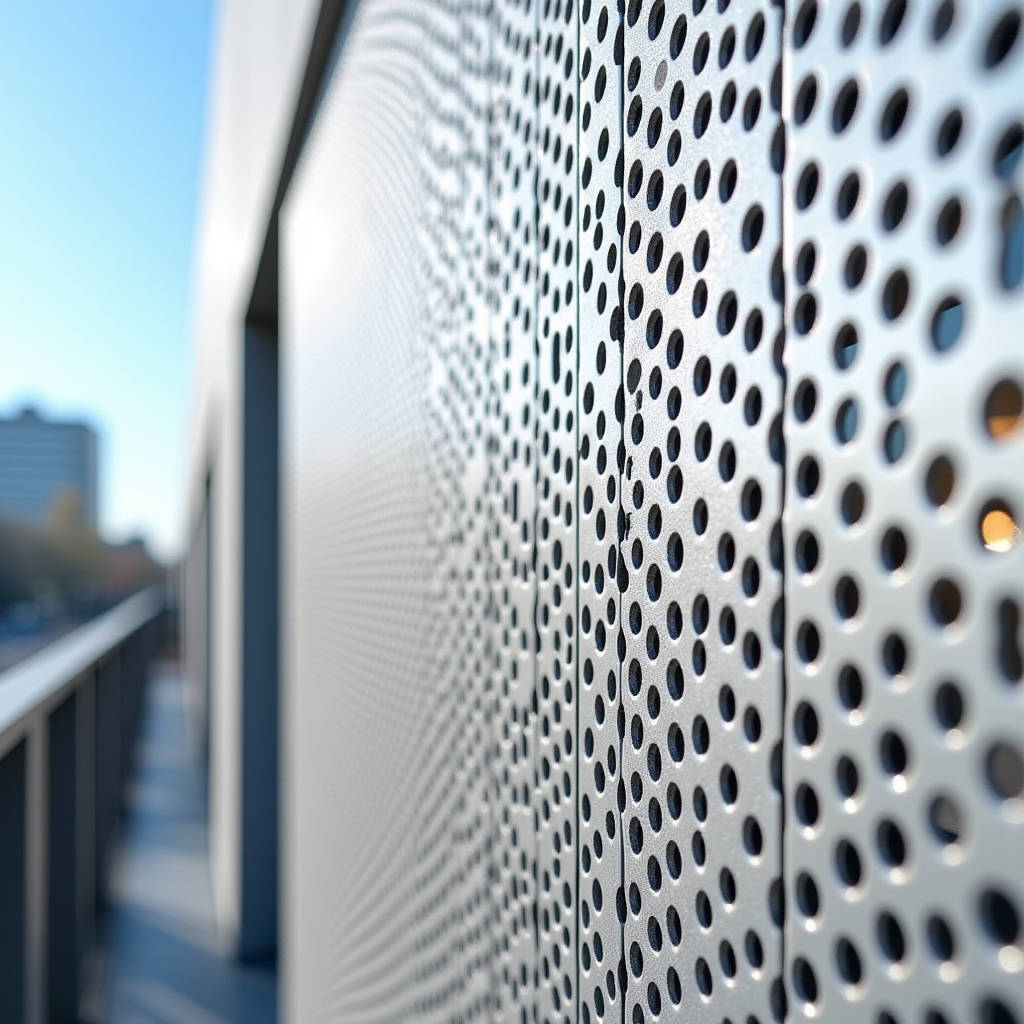
Integrating perforated corrugated aluminum into modern building envelopes requires balancing aesthetic transparency with structural rigidity. Unlike flat sheets, the corrugated profile significantly increases the moment of inertia, allowing solid aluminium cladding panels to span greater distances between sub-frame supports while maintaining dimensional stability under negative wind loads. When perforations are introduced to this profiled geometry, engineers must account for the reduction in net cross-sectional area and the potential stress concentrations around hole edges. This dual-function material serves as both a dynamic visual screen and a functional component for ventilation or acoustic modulation. Successful specification depends on understanding how the interplay between wave pitch, perforation size, and alloy temper dictates the long-term performance of the facade system in demanding exterior environments.
Mechanical Properties and Structural Span Capabilities
The primary advantage of specifying perforated corrugated aluminum over flat perforated sheet lies in its enhanced stiffness-to-weight ratio. The forming process transforms a standard 2.0mm or 3.0mm solid aluminum sheet into a series of continuous beams. For B2B procurement and engineering validation, it is critical to distinguish between the base metal thickness and the effective structural depth provided by the corrugation. A 3.0mm thick AA5754-H44 aluminum sheet formed into a 76mm pitch trapezoidal profile can typically achieve unsupported spans of up to 1.8 meters for facade applications, whereas a flat 3.0mm sheet of the same alloy might be limited to 0.9 meters before excessive deflection occurs under equivalent service loads.
However, introducing perforations reduces the effective section modulus. Engineering calculations for perforated corrugated aluminum must apply a net-section reduction factor based on the open area percentage. According to The Aluminum Association design manuals, when open areas exceed 30%, the allowable bending stress should be derated proportionally unless reinforced by back-stiffeners or secondary framing. For high-wind zones, specifying a higher temper alloy such as AA5754-H44 or AA3003-H24 is preferable to softer tempers like H14, as the strain-hardened material better resists permanent deformation from cyclic wind loading and thermal expansion.
Wind Load Resistance and Deflection Limits
Facade engineers must verify that perforated corrugated aluminum systems meet project-specific deflection criteria, typically L/180 for dead plus live loads on exterior cladding. The corrugated shape provides excellent resistance to buckling perpendicular to the ribs, but the perforations create localized weak points. Testing per ASTM E330 (Standard Test Method for Structural Performance of Exterior Windows, Doors, Skylights and Curtain Walls by Uniform Static Air Pressure Difference) is often required to validate engineered span tables. In practice, manufacturers like Futeng® provide certified test reports demonstrating that their specific profile-perforation combinations maintain structural integrity at design pressures exceeding 2.5 kPa, ensuring compliance with international building codes for high-rise applications.
| Panel Configuration | Base Thickness (mm) | Profile Depth (mm) | Open Area (%) | Max Span @ 1.5 kPa (m) | Weight (kg/m²) |
|---|---|---|---|---|---|
| Trapezoidal 76/18 | 2.0 | 18 | 0 (Solid) | 1.50 | 5.4 |
| Trapezoidal 76/18 | 2.0 | 18 | 25 | 1.25 | 4.1 |
| Trapezoidal 76/18 | 3.0 | 18 | 25 | 1.80 | 6.1 |
| Sinusoidal 18/76 | 2.0 | 18 | 30 | 1.10 | 3.8 |
| Mini-Wave 10/50 | 1.5 | 10 | 20 | 0.80 | 3.2 |
Acoustic Modulation and Ventilation Functionality
Beyond aesthetics, perforated corrugated aluminum functions as a tuned acoustic element in architectural design. The combination of the corrugated surface geometry and the perforation pattern creates a complex sound diffusion field. While the solid aluminum substrate reflects sound, the perforations allow partial transmission, reducing specular reflection and mitigating flutter echo in semi-exterior spaces like covered walkways, transit stations, and parking structures. The Noise Reduction Coefficient (NRC) of these assemblies depends heavily on the backing conditions; installing an acoustic fleece or mineral wool layer behind the perforated corrugated aluminum can elevate NRC values from 0.15 (reflective) to over 0.60 (absorptive), as measured per ASTM C423.
Ventilation is another critical functional parameter. For mechanical plant screens or parking garage facades, airflow requirements dictate the minimum open area. Perforated corrugated aluminum offers superior free-area ratios compared to louvered systems while providing better rain defense due to the overlapping profile geometry. Engineers should calculate pressure drop across the facade using fluid dynamics models, accounting for the tortuous path created by the corrugations. A 25% open area on a flat sheet does not equate to 25% effective ventilation on a corrugated panel; the actual free area must be projected onto the plane normal to airflow direction. Typically, a nominal 30% perforation on a trapezoidal profile yields approximately 22-24% effective free area for cross-ventilation purposes.
Perforation Pattern Engineering Constraints
Fabricating perforated corrugated aluminum imposes strict manufacturing constraints that affect both cost and feasibility. Perforating must occur prior to roll-forming or press-braking to avoid distorting the holes, but this sequence introduces challenges in handling large-format sheets. Hole placement relative to the corrugation crest and valley is critical; placing holes directly on the bend radius causes elongation and tearing during forming. Industry best practice maintains a minimum margin of 1.5 times the hole diameter from any bend line. Additionally, the ligament width (solid material between adjacent holes) must exceed the sheet thickness to prevent rupture during the stamping process. For 3.0mm solid aluminum, ligaments should never be less than 3.5mm, regardless of the desired aesthetic density.
Custom CNC punching allows for variable perforation gradients that follow the corrugated topography, creating parametric designs where opacity shifts across the facade. However, such complexity increases fabrication time and tooling costs significantly. Standard round-hole patterns in staggered pitches remain the most economical choice for large-scale B2B projects. When specifying non-standard patterns, contractors should request digital nesting simulations from suppliers to verify yield rates and confirm that the proposed design is manufacturable without excessive scrap or rework.
Coating Durability and Corrosion Protection Standards
The exposed edges created by perforations represent the most vulnerable points in any aluminum cladding system. While aluminum naturally forms a protective oxide layer, cut edges in perforated corrugated aluminum lack the factory-applied coil coating protection present on the face and back surfaces. For coastal or industrial environments classified as C4 or C5 per ISO 12944, edge sealing becomes mandatory. High-performance PVDF (Polyvinylidene Fluoride) coatings applied via continuous coil coating lines before perforation offer superior color retention and chalk resistance compared to post-fabrication spray painting. Specifiers should demand PVDF resin content of minimum 70% Kynar 500® or Hylar 5000® equivalent, with total dry film thickness of 25-30 microns including primer.
Pre-treatment chemistry is equally vital for adhesion on perforated surfaces. Chromate-free pretreatments based on zirconium or titanium oxides now dominate sustainable specifications, meeting AAMA 2605 performance requirements without hazardous heavy metals. Salt spray testing per ASTM B117 should demonstrate minimum 3000 hours to red oxide formation for premium architectural grades. When perforated corrugated aluminum is installed in bimetallic contact with steel substructures, isolation washers and stainless steel fasteners are non-negotiable to prevent galvanic corrosion at fixings. Anodized finishes (Class I, 25 micron minimum) provide an alternative to paint for applications requiring metallic appearance and exceptional abrasion resistance, though color matching between batches is more challenging than with liquid coatings.
Thermal Movement and Fixing Detail Design
Aluminum expands at approximately 23 µm/m·°C, nearly double that of steel subframes. Over a 3-meter panel length with a 60°C seasonal temperature swing, differential movement can reach 4mm. Perforated corrugated aluminum facades must incorporate slotted holes or floating clip systems to accommodate this expansion without inducing stress whitening around fasteners or buckling between supports. Fixed-point fixings should be located at panel centers, with all other connections allowing lateral translation. The corrugated profile itself helps mask minor misalignments caused by thermal cycling, making it more forgiving than flat cassettes in extreme climates.
Fastener selection directly impacts longevity. Stainless steel A4-80 screws with EPDM sealing washers are standard for exterior perforated corrugated aluminum installations. Screw spacing along the corrugation crests should align with structural support members, typically at 300-450mm centers depending on wind load calculations. Over-tightening must be avoided; torque-limiting drivers set to manufacturer specifications prevent compression damage to the washer and distortion of the thin aluminum at the fixing point. For concealed-fix systems, specialized clips engage the side laps of adjacent corrugations, eliminating visible fasteners and providing uninterrupted drainage channels along the panel length.
Specification Guidance for Procurement and Quality Assurance
Procuring perforated corrugated aluminum for commercial construction requires precise technical documentation to avoid costly substitutions or field failures. Specifications should explicitly state: base alloy and temper (e.g., AA5754-H44), nominal thickness before forming, finished profile dimensions including tolerance bands (typically ±1mm on depth, ±2mm on cover width), perforation pattern code with hole diameter and pitch, coating system type and minimum DFT, and applicable testing standards. Reference samples showing approved perforation quality, edge condition, and color range should be signed off before mass production commences. Factory acceptance tests should include random sampling for thickness verification, coating adhesion (cross-cut test per ISO 2409), and gloss measurement.
Logistics planning must account for the fragility of perforated profiles. Nested stacking without interleaving protection causes scratching and denting during transport. Crating should use rigid timber frames with vertical orientation preferred for long panels to prevent sagging. On-site storage requires covered, ventilated areas with panels kept off ground level. Installation sequencing should coordinate with wet trades to avoid cementitious contamination, which can etch aluminum surfaces if not removed promptly. By treating perforated corrugated aluminum as a precision-engineered building component rather than generic sheet metal, project teams ensure the delivered facade meets both design intent and decades-long service expectations.