Selecting Perforated Aluminium Sheet Suppliers for Structural Facade Integrity
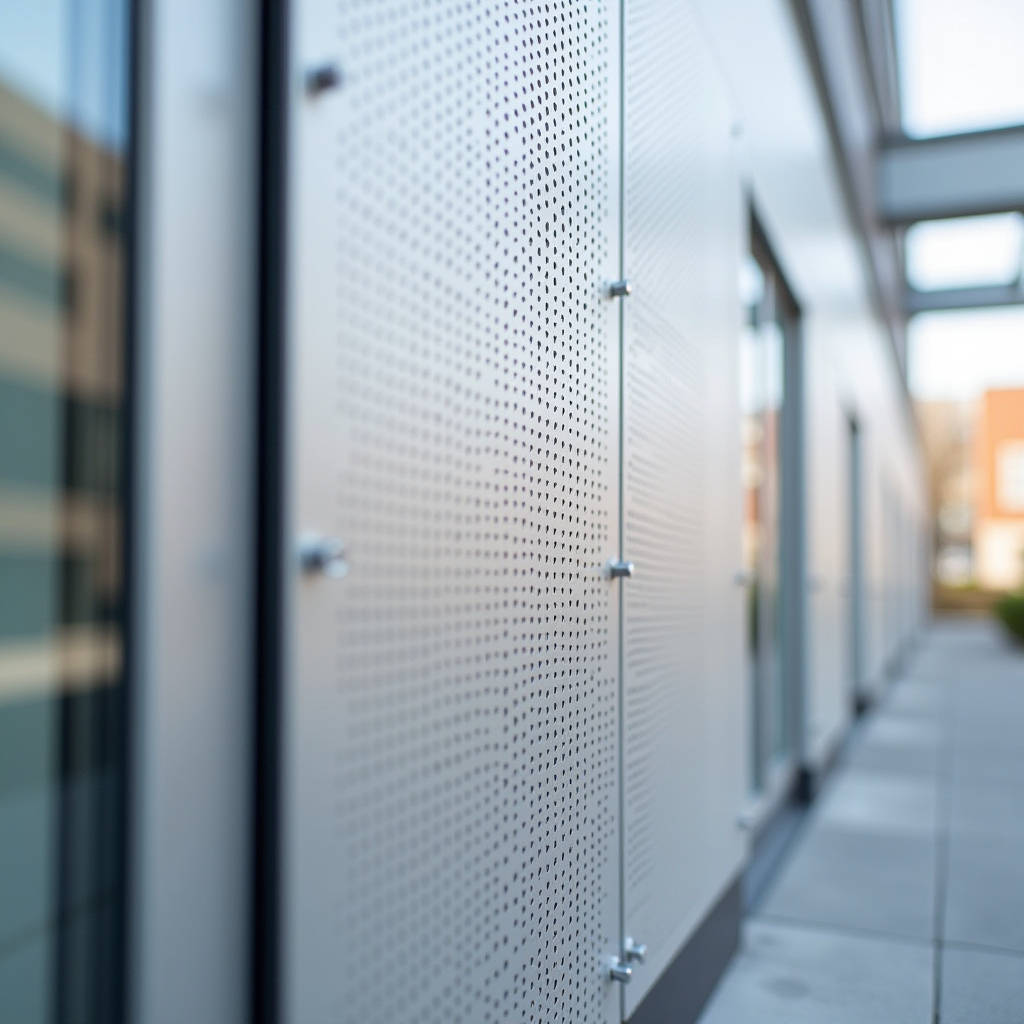
Sourcing materials for commercial facades requires distinguishing between generic metal vendors and specialized perforated aluminium sheet suppliers capable of meeting architectural performance standards. The punching process fundamentally alters the structural behavior of solid aluminium cladding panels, reducing stiffness and creating stress concentrations that standard flat sheets do not experience. Project specifications demand more than catalog patterns; they require verified engineering data regarding yield strength after perforation, coating adhesion on cut edges, and precise dimensional tolerances for curtain wall integration. Reliable perforated aluminium sheet suppliers provide mill certificates, test reports for fluorocarbon finishes, and fabrication expertise that ensures the final installed system withstands environmental loads without deformation or premature finish failure. This technical due diligence separates decorative screening from high-performance building envelope components.
Structural Implications of Perforation on Solid Aluminium Panels
The transformation of a solid aluminium sheet into a perforated panel is not merely an aesthetic modification but a significant structural event. When evaluating perforated aluminium sheet suppliers, engineers must scrutinize how the manufacturing process impacts the base material properties defined in ASTM B209. The removal of material reduces the effective cross-sectional area, directly diminishing the panel's load-bearing capacity and flexural rigidity. A panel with 40% open area theoretically retains only 60% of its original tensile strength, but real-world performance is often lower due to stress risers at hole perimeters. These geometric discontinuities act as focal points for crack propagation under cyclic wind loading or thermal expansion.
Competent suppliers understand that alloy selection must compensate for this strength reduction. While Alloy 3003-H14 is common for general industrial use, architectural facades typically require Alloy 5052-H32 or 6061-T6 to maintain adequate safety factors post-perforation. The H32 temper designation indicates strain hardening and stabilization, providing superior resistance to fatigue compared to softer tempers. Suppliers who default to 3003 for exterior cladding applications may be prioritizing formability over long-term structural resilience. Technical documentation should explicitly state the residual mechanical properties of the perforated product, not just the parent coil specifications. This transparency allows facade engineers to calculate accurate span tables and fastener schedules without applying arbitrary safety margins that inflate project costs.
Open Area Ratio and Wind Load Calculations
Wind pressure coefficients for perforated facades differ substantially from solid surfaces. The interaction between airflow through the apertures and the building envelope creates complex aerodynamic effects. Perforated aluminium sheet suppliers with engineering support can provide tested drag coefficients or recommend third-party wind tunnel testing parameters. Standard calculation methods in ASCE 7 or Eurocode 1 often require modification for porous media. An open area ratio exceeding 50% may reduce overall wind load but increases susceptibility to aeroelastic flutter if the panel aspect ratio and stiffening details are inadequate.
- Low Open Area (10-25%): Behaves similarly to solid cladding; standard wind load calculations apply with minor adjustments for local suction peaks around holes.
- Medium Open Area (25-40%): Requires specific permeability factors; internal pressures behind the screen must be modeled to prevent differential loading failures.
- High Open Area (>40%): Significant load reduction possible but demands rigorous analysis of dynamic response and connection detailing to prevent vibration-induced fatigue.
Suppliers should offer guidance on maximum unsupported spans relative to perforation patterns. Staggered hole arrangements generally distribute stress more evenly than straight-line patterns, allowing slightly greater spans for equivalent thicknesses. However, this advantage disappears if the margin between holes and panel edges is insufficient. Edge distances less than two times the hole diameter create high-risk zones for tearing during installation or service. Professional fabricators enforce minimum edge margins and corner radii that align with industry best practices, ensuring the physical product matches the theoretical model used in design.
Coating Durability on Perforated Edges and Surfaces
The most vulnerable point in any coated metal system is the cut edge. During perforation, the shearing action exposes raw aluminium substrate along the circumference of every hole. If left unprotected, these edges become initiation sites for corrosion and coating delamination. Distinguished perforated aluminium sheet suppliers implement post-fabrication finishing protocols specifically designed to address this vulnerability. Pre-painted coils punched after coating leave bare edges; while acceptable for some interior applications, this method is unsuitable for exterior facades exposed to moisture and UV radiation. The correct sequence involves punching first, followed by chemical pretreatment and multi-stage coating application to ensure complete coverage of all exposed surfaces.
Polyvinylidene fluoride (PVDF) resin-based coatings remain the benchmark for architectural aluminium due to their exceptional chalk resistance and color retention. According to AAMA 2605 specifications, high-performance organic coatings must withstand 4,000 hours of salt spray testing and maintain Delta E values below 5 Hunter units after ten years of South Florida exposure. When assessing supplier capabilities, verify that their PVDF formulation contains at least 70% Kynar 500® or Hylar 5000® resin by weight. Lower-cost polyester or hybrid coatings may appear identical initially but degrade rapidly when subjected to the intensified UV reflection and moisture accumulation characteristic of perforated geometries.
| Performance Parameter | PVDF Fluorocarbon (AAMA 2605) | Super Polyester (AAMA 2604) | Standard Polyester (AAMA 2603) |
|---|---|---|---|
| Resin Content Requirement | ≥70% PVDF Resin | High-Performance Silicone Modified | Standard Thermoset Polyester |
| Salt Spray Resistance (ASTM B117) | 4,000 Hours Minimum | 3,000 Hours Minimum | 1,500 Hours Minimum |
| Humidity Resistance (ASTM D2247) | 4,000 Hours No Blistering | 3,000 Hours No Blistering | 1,500 Hours Minor Blistering |
| Color Retention (South FL 10yr) | ΔE ≤ 5 Hunter Units | ΔE ≤ 8 Hunter Units | Not Specified / Variable |
| Chalk Resistance (ASTM D4214) | Rating ≥ 8 | Rating ≥ 6 | Rating ≥ 5 |
| Recommended Warranty Period | 20 Years Architectural | 10 Years Commercial | 1-5 Years Interior/Light Exterior |
Film thickness measurement on perforated surfaces presents unique challenges. Standard dry film thickness gauges require flat reference areas, which may be limited on highly perforated panels. Suppliers should utilize non-destructive eddy current testing calibrated specifically for curved or interrupted surfaces to verify compliance. Typical architectural specifications call for 25-30μm total dry film thickness for PVDF systems, including primer and topcoat layers. Insufficient build on hole edges compromises the barrier protection essential for coastal or industrial environments. Requesting cross-section microscopy samples from potential suppliers provides definitive proof of edge coverage quality before committing to large-scale production.
Fabrication Precision and Tolerance Management
Dimensional accuracy becomes exponentially more critical with perforated materials. The cumulative effect of pitch errors across thousands of holes can result in panels that fail to align with modular substructures or adjacent cladding elements. Perforated aluminium sheet suppliers must demonstrate mastery of CNC turret punch press programming and tool maintenance. Worn tooling produces burrs, rollover, and tapered holes that compromise both aesthetics and fit-up. Acceptable tolerance bands for architectural perforated panels typically range from ±0.5mm to ±1.0mm depending on panel size and pattern complexity, significantly tighter than industrial screening standards.
Flatness represents another critical quality metric. The perforation process introduces residual stresses that can cause warping or oil-canning, especially in larger format panels. Experienced manufacturers employ leveling processes post-punching and optimize nest layouts to balance stress distribution. They also advise on appropriate panel aspect ratios and reinforcement strategies. Adding welded studs or extruded stiffeners to the back face restores rigidity lost through material removal. Futeng® exemplifies this level of integrated fabrication capability, offering engineered solutions where stiffener placement is coordinated with perforation patterns to avoid visual telegraphing while maintaining structural performance. Such collaboration between supplier and designer prevents costly field modifications and ensures the facade achieves intended sightlines.
Tooling Capabilities and Custom Pattern Execution
Beyond standard round-hole staggered patterns, contemporary architecture frequently demands custom perforation designs including variable aperture sizes, parametric gradients, and representational imagery. Executing these complex patterns requires advanced software integration and flexible tooling systems. Suppliers relying solely on fixed-die presses cannot accommodate bespoke work without prohibitive setup costs. Modern CNC facilities with auto-index tools and laser cutting hybrids enable economical customization even at moderate volumes. When reviewing supplier qualifications, examine their portfolio of non-standard projects and ask about their file preparation workflow. Direct CAD-to-machine translation minimizes interpretation errors that plague manual programming approaches.
Material handling during fabrication also distinguishes premium suppliers. Protective films must be applied before punching to prevent surface scratching, yet removed cleanly afterward without leaving adhesive residue in holes. Automated deburring and washing lines remove particulate contamination that would otherwise interfere with coating adhesion. For anodized finishes, racking techniques must ensure uniform current density across perforated surfaces to prevent color variation. Each of these process steps adds value but also cost; understanding where expenses originate helps procurement teams make informed trade-offs between specification requirements and budget constraints.
Supply Chain Reliability and Technical Documentation
Construction schedules tolerate little flexibility once facade installation commences. Late delivery of perforated panels can cascade into delays affecting glazing, sealing, and interior trades. Evaluating perforated aluminium sheet suppliers therefore extends beyond product quality to encompass supply chain robustness. Key indicators include raw material inventory depth, production capacity redundancy, and proven logistics networks. Suppliers maintaining strategic stock of common alloys and thicknesses can absorb demand spikes better than those operating purely on just-in-time principles. Geographic proximity matters less than demonstrated reliability; a distant supplier with excellent forecasting and communication often outperforms a local vendor prone to bottlenecks.
Documentation serves as the legal and technical backbone of material procurement. Comprehensive submittal packages should include mill test certificates traceable to specific heat numbers, coating manufacturer warranties, independent lab test reports for relevant performance criteria, and detailed shop drawings showing panel numbering, orientation, and attachment details. ISO 9001 certification provides baseline assurance of quality management systems but does not guarantee product suitability. Project-specific quality plans outlining inspection hold points and acceptance criteria offer stronger protection. Suppliers willing to sign performance bonds or extended warranties signal confidence in their output. Conversely, reluctance to provide verifiable data suggests potential risks that no amount of price savings can justify.
Sustainability credentials increasingly influence supplier selection. Recycled content percentages, volatile organic compound emissions from coating lines, and end-of-life recyclability all factor into green building certifications like LEED and BREEAM. Aluminium inherently offers high recycled content potential, but actual figures vary significantly by producer. Environmental Product Declarations (EPDs) provide standardized, third-party verified lifecycle assessment data enabling apples-to-apples comparison. Forward-thinking suppliers invest in closed-loop recycling programs and water treatment systems that reduce environmental footprint while demonstrating operational maturity. These attributes correlate strongly with overall manufacturing excellence and long-term business viability.
Making Informed Procurement Decisions
Selecting perforated aluminium sheet suppliers for architectural applications demands a multidimensional evaluation framework balancing technical competence, manufacturing precision, coating integrity, and supply reliability. Price per square meter tells only part of the story; true cost encompasses risk mitigation, longevity, and ease of installation. Engage suppliers early in the design phase to leverage their fabrication expertise for value engineering opportunities. Request physical samples of proposed patterns and finishes to assess tactile quality and visual consistency under varying light conditions. Conduct factory audits when feasible to observe housekeeping, equipment condition, and workforce engagement firsthand. The goal is establishing partnerships grounded in mutual understanding of project objectives rather than transactional commodity purchasing. Through disciplined vetting aligned with the technical realities of perforated solid aluminium systems, project teams secure facade solutions that perform reliably throughout their intended service life.