Oval Perforated Aluminum Sheet Structural Integrity and Ventilation Performance
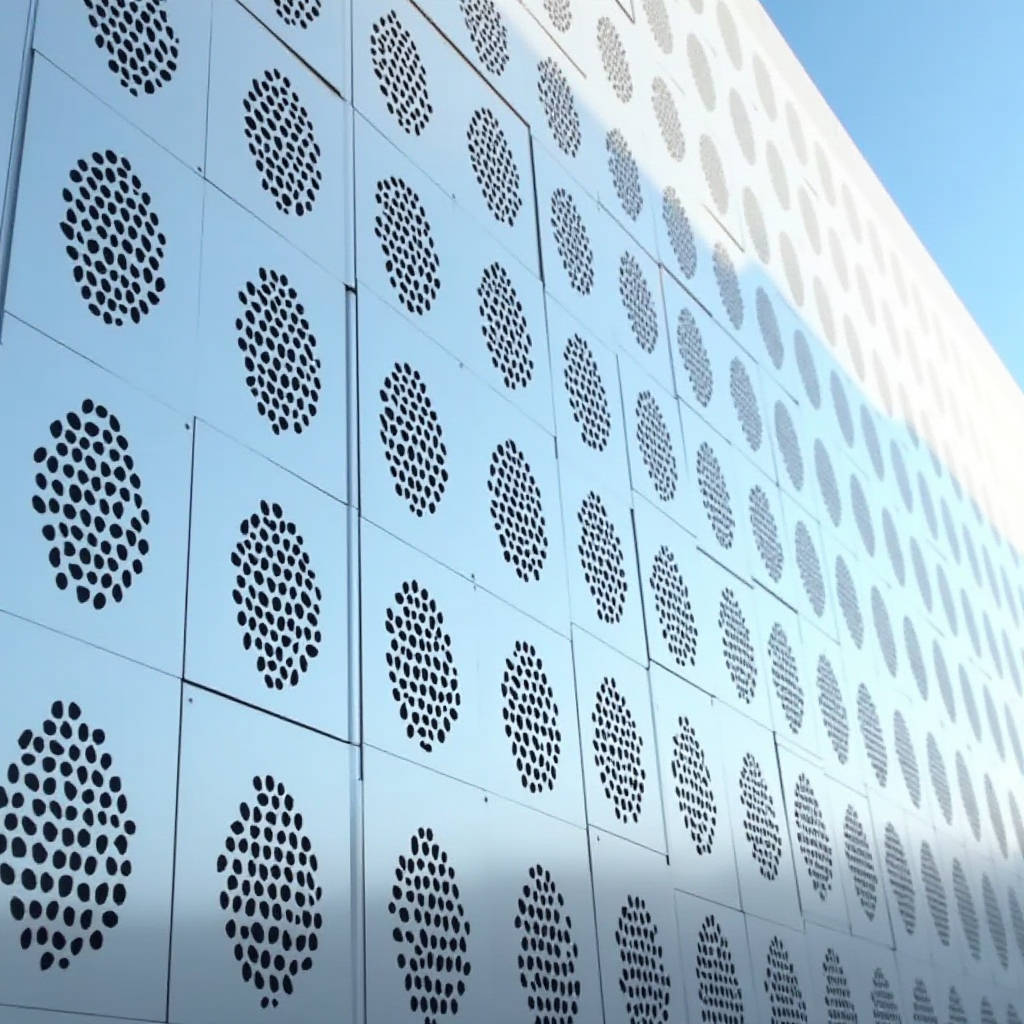
Selecting an oval perforated aluminum sheet for architectural facades requires balancing aesthetic transparency with mechanical performance. Unlike standard round holes, the elongated geometry of oval perforations offers distinct advantages in directional airflow and visual screening while maintaining higher structural rigidity per unit of open area. This specific profile allows architects to achieve necessary ventilation rates for building envelopes without compromising the panel's ability to withstand positive and negative wind loads. For procurement managers and facade engineers, understanding the relationship between the oval aspect ratio, alloy temper, and coating adhesion is essential to prevent field failures. This analysis focuses on the technical specifications required to integrate oval perforated aluminum sheet systems into commercial cladding projects successfully, addressing structural calculations, material selection, and finishing constraints specific to this non-standard perforation pattern.
Geometric Advantages of Oval Perforations in Facade Design
The primary engineering benefit of specifying an oval perforated aluminum sheet lies in its superior strength-to-open-area ratio compared to circular or square alternatives. In solid aluminum cladding panels, removing material to create perforations inherently reduces the moment of inertia and section modulus of the sheet. However, the elongated shape of oval holes distributes stress more evenly along the longitudinal axis when aligned correctly with the panel's support structure. When the long axis of the oval runs parallel to the primary span or stiffener direction, the remaining ligament width can be optimized to resist bending moments more effectively than a circular hole of equivalent open area.
This geometric efficiency translates directly to weight savings and cost reduction in substructure requirements. A facade requiring 40% open area for smoke extraction or passive cooling might necessitate 3.0mm thick material if using round holes to meet deflection limits under ASTM E330 wind load testing. By switching to an optimized oval perforated aluminum sheet pattern, designers can often achieve the same ventilation performance with 2.5mm material while maintaining identical safety factors. The elongated aperture also provides better visual screening from oblique angles, creating a dynamic facade appearance that shifts opacity based on the viewer's position and sunlight incidence, which is difficult to replicate with isotropic hole patterns.
Directional Airflow and Environmental Control
Ventilation performance in building envelopes is rarely omnidirectional. HVAC intake louvers, parking garage screens, and equipment enclosures typically require airflow management in specific vectors. The oval perforated aluminum sheet acts as a passive flow guide. When oriented vertically, these panels facilitate rain shedding while allowing horizontal air exchange, reducing water ingress risk during storm events. Conversely, horizontal orientation maximizes convective heat rise in double-skin facades. Computational Fluid Dynamics (CFD) modeling consistently shows that elongated apertures exhibit lower discharge coefficients for cross-winds but higher efficiency for aligned flow streams compared to circular perforations. This characteristic allows facade consultants to tune the envelope's permeability precisely without adding mechanical dampers or secondary louver systems.
Material Specifications and Alloy Selection Criteria
Not all aluminum alloys perform equally when formed into an oval perforated aluminum sheet. The perforation process involves significant plastic deformation at the hole edges, creating localized work hardening and residual stresses. For architectural cladding applications demanding both formability and long-term corrosion resistance, Alloy 3003-H14 remains the industry benchmark. This manganese-alloyed grade offers approximately 20% higher tensile strength than pure 1100 aluminum while retaining excellent ductility. The H14 temper indicates strain hardening to a half-hard condition, providing the necessary stiffness for flat panel fabrication without becoming so brittle that cracking occurs during the punching of high-aspect-ratio ovals.
While 5005-H14 is sometimes specified for anodized finishes due to its magnesium content and color consistency, it presents challenges for painted oval perforated aluminum sheet products. The higher yield strength of 5005 increases tool wear during perforation and can lead to edge burrs that compromise coating adhesion. For PVDF-coated systems, which represent over 85% of premium architectural cladding, 3003-H14 provides the optimal balance. Its chemical composition ensures strong bonding with chromate-free pretreatments and fluoropolymer topcoats. Procurement specifications should explicitly mandate 3003-H14 or 3003-H24 for painted perforated panels, avoiding softer tempers like H12 that may deform during installation or harder tempers like H18 that risk fracture at the oval endpoints.
Thickness Tolerances and Flatness Requirements
Perforating solid aluminum sheet introduces dimensional instability. The punching action stretches the material locally, causing slight curling or camber that must be controlled before fabrication into cassettes or trays. For an oval perforated aluminum sheet intended for architectural use, thickness tolerance should adhere to Aluminum Association ADM-1 standards, typically ±0.05mm for sheets up to 3.0mm. However, flatness tolerances are far more critical than thickness alone. Suppliers must employ roller leveling post-perforation to ensure the sheet lies within 2mm deviation over a 1-meter straightedge. Without this step, the inherent stresses in oval patterns will telegraph through powder coatings or liquid paints, creating visible waviness in the finished facade. Always request mill certificates verifying both alloy chemistry and mechanical properties post-leveling, not just pre-perforation.
Structural Engineering Considerations for Perforated Panels
Engineers cannot apply solid sheet span tables to an oval perforated aluminum sheet without applying appropriate reduction factors. The net section modulus must be calculated based on the actual remaining metal area after accounting for the specific oval dimensions and stagger pattern. Standard practice applies a conservative efficiency factor derived from finite element analysis (FEA) validated by physical testing. For staggered oval patterns with 60-degree centers, the effective stiffness typically ranges between 55% and 70% of the equivalent solid sheet, depending on the ligament width relative to the hole length. Ignoring this reduction leads to catastrophic under-design where panels exceed allowable deflection limits (typically L/60 or L/90) under service loads.
Wind load resistance verification must follow AAMA 508 or relevant regional standards for pressure-equalized rainscreen systems. Perforated panels behave differently than solid ones regarding pressure equalization; the open area allows rapid pressure transfer to the cavity behind, potentially increasing peak suction loads on fasteners and returns. Testing protocols for oval perforated aluminum sheet assemblies should include cyclic fatigue loading to simulate decades of wind gusts, as the stress concentrations at oval endpoints are prime locations for crack initiation. Fastener spacing often needs to decrease by 20-30% compared to solid panel recommendations to compensate for reduced pull-through resistance around perforated zones.
| Parameter | Solid 3mm AL Panel | Round Perf (40% Open) | Oval Perf (40% Open) | Engineering Note |
|---|---|---|---|---|
| Weight (kg/m²) | 8.10 | 4.86 | 4.86 | Identical mass reduction for equal open area |
| Relative Stiffness Factor | 1.00 | 0.52 | 0.64 | Oval retains ~12% more rigidity when aligned with span |
| Max Span @ 2.5kPa (L/60) | 1450mm | 980mm | 1120mm | Oval allows wider module spacing, reducing substructure cost |
| Pull-Through Resistance | 100% | 65% | 72% | Ligament continuity improves fastener retention |
| Rain Penetration Risk | Negligible | Moderate | Low (Vertical) | Elongated vertical slots shed water better than circles |
Coating Adhesion Challenges on Perforated Edges
The most frequent failure mode in perforated cladding is not structural collapse but premature coating degradation at hole edges. The punching process creates micro-burrs and exposes raw aluminum substrate that is chemically active and geometrically difficult to cover uniformly. On an oval perforated aluminum sheet, the high curvature at the ends of each slot exacerbates this issue due to surface tension effects during liquid paint application. If pretreatment conversion coating fails to penetrate these tight radii completely, the subsequent PVDF layer lacks a stable anchor point. Field failures typically manifest as filiform corrosion creeping inward from hole edges within 3-5 years in coastal environments.
Mitigation requires strict process controls beyond standard Qualicoat or AAMA 2605 specifications. Reputable manufacturers like Futeng® implement multi-stage rinse cycles with deionized water conductivity below 50 µS/cm to ensure no salt residues remain trapped in oval apertures. Spray application parameters must be adjusted specifically for perforated stock; nozzle angle, atomization pressure, and gun distance differ from solid sheet processing to ensure adequate film build inside holes without excessive buildup on faces. Minimum dry film thickness at hole edges should be verified via cross-section microscopy during production validation, not just measured on flat surfaces. Specifiers should require edge coverage test reports showing ≥25µm DFT at perforation boundaries for warranty eligibility.
PVDF vs Powder Coat for Perforated Applications
While polyester powder coatings offer economic advantages for solid panels, they present inherent risks for oval perforated aluminum sheet in exterior applications. Thermoset powders rely on electrostatic attraction and thermal flow to coat surfaces. The Faraday cage effect at hole entrances prevents uniform deposition, leaving thin spots precisely where corrosion protection is most needed. Liquid PVDF coatings, applied via spray, do not suffer from this limitation and can be manipulated to achieve consistent edge coverage through proper technique. For any perforated facade with expected service life exceeding 15 years, liquid fluoropolymer systems remain the technically superior choice despite higher initial cost. If powder coating is mandatory due to budget constraints, specify super-durable polyesters (AAMA 2604) with enhanced edge-wrap additives and conduct accelerated corrosion testing per ASTM B117 on perforated samples, not just flat coupons.
Fabrication and Installation Best Practices
Transforming flat oval perforated aluminum sheet into three-dimensional cladding cassettes demands careful handling to avoid distorting the perforation pattern. CNC routing for fold lines must account for the altered neutral axis caused by material removal. Bend deductions for perforated sheets differ from solid equivalents; trial bends on scrap pieces from the same production batch are mandatory before processing architectural panels. Folding across oval holes should be avoided whenever possible, as this creates severe stress concentrations and cosmetic defects. When unavoidable, bend lines must intersect holes at their geometric centerline, never tangent to the edge, to distribute strain symmetrically.
Installation sequencing significantly impacts final appearance. Perforated panels reveal the substructure and backing wall behind them, making any inconsistencies highly visible. Substrate preparation must achieve higher flatness tolerances than for solid cladding; typically ±3mm over 3m rather than ±6mm. Backer panels or acoustic insulation behind oval perforated aluminum sheet should be matte black or matched to the panel rear finish to prevent visual noise. Fastener heads must be color-matched and recessed or capped, as they remain visible through the openings. Expansion joint detailing requires special attention; thermal movement in perforated sheets is anisotropic, with greater expansion perpendicular to the oval long axis. Slotting of attachment points should align with this directional behavior to prevent buckling or oil-canning in service.
Quality Assurance Protocols for Project Delivery
Comprehensive QA for oval perforated aluminum sheet extends beyond dimensional checks. Every production run should include destructive testing of sacrificial samples to verify coating adhesion at hole edges via tape pull tests per ISO 2409. Open area percentage must be validated optically, not just calculated theoretically, as tool wear gradually reduces hole size over long production runs. Acoustic transmission loss testing may be required for projects near airports or highways, as oval perforations have different sound absorption characteristics than round holes at various frequencies. Documentation packages should include material traceability from coil to finished panel, coating batch records with edge thickness data, and structural calculation reports incorporating perforation-specific reduction factors. Only through such rigorous validation can specifiers ensure the delivered system performs as engineered throughout its design life.
Successful integration of oval perforated aluminum sheet into building envelopes hinges on respecting its unique mechanical and finishing characteristics. By selecting appropriate alloys, applying correct structural reduction factors, enforcing stringent edge-coating protocols, and adapting fabrication techniques to accommodate the perforated geometry, project teams can realize the functional and aesthetic benefits of this versatile material. The key lies in treating perforated panels as engineered components rather than commodity sheet goods, with specifications reflecting the precision required for long-term performance in demanding architectural applications.