Marble Look Aluminum Panel Engineering and Procurement Guide for Façade Contractors
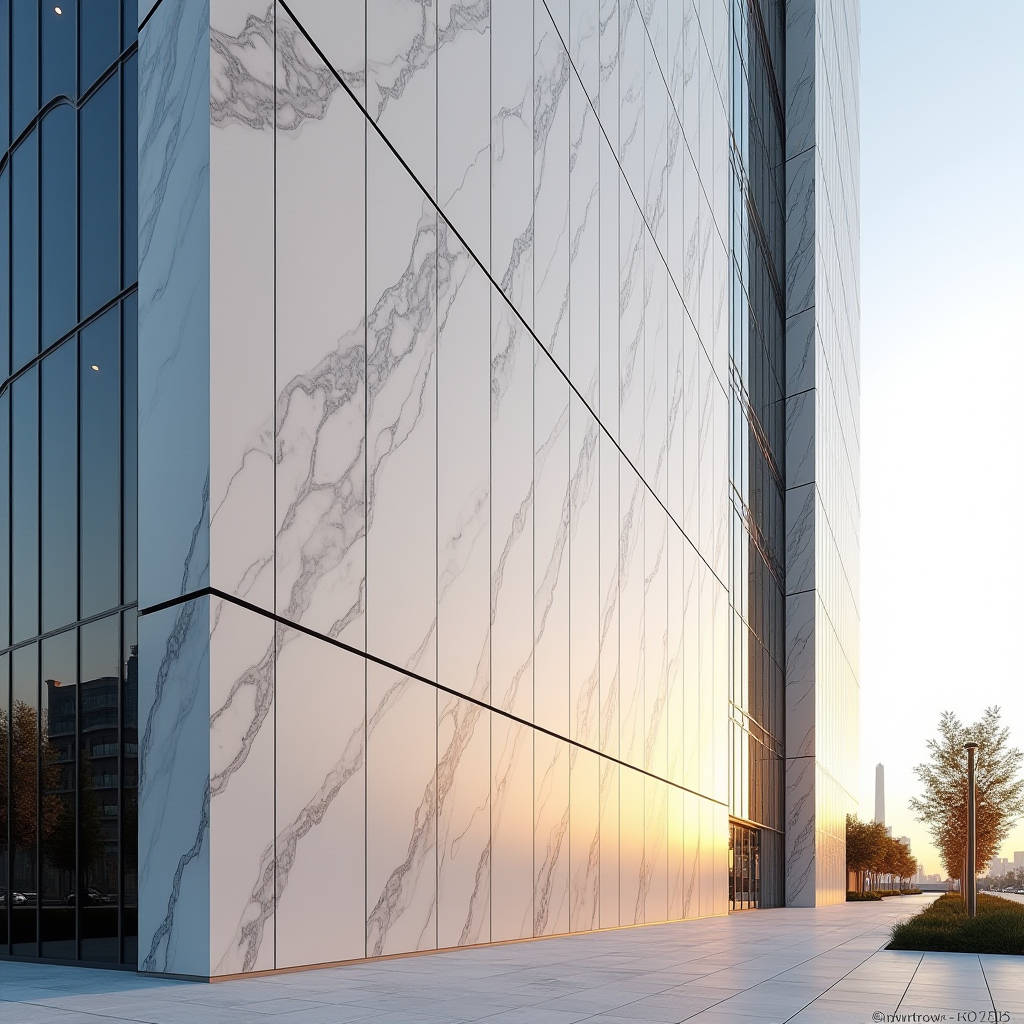
When a façade specification calls for the visual weight of stone without the structural headaches, the marble look aluminum panel steps into the conversation. Not as a cheap imitation. As a calculated engineering decision. General contractors and cladding specialists across the Middle East, Southeast Asia, and Europe are specifying these panels because they solve a real problem: how to deliver the prestige of marble on a building envelope that won't crack under thermal stress, won't overload the substructure, and won't blow the procurement budget on quarry-to-site logistics. A 2.5mm solid aluminium cladding panel with a high-fidelity marble-effect PVDF finish can weigh 70-80% less than the natural stone equivalent. That number alone changes the structural steel calculation. This article walks through what actually matters when sourcing these panels — from coating chemistry and gauge tolerance to packaging specs that prevent a container of rejected material arriving at the job site.
What a marble look aluminum panel actually is — and what it isn't
Let's clear the ground first. A marble look aluminum panel is a solid aluminium sheet — typically 2.0mm, 2.5mm, or 3.0mm thick in the 1xxx, 3xxx, or 5xxx alloy series — with a multi-layer fluorocarbon coating system that replicates the veining, depth, and tonal variation of natural marble. The substrate is a single piece of aluminium, not a sandwich of two thin skins bonded to a polyethylene core. That distinction matters at the fire-compliance stage and it matters when an engineer calculates wind-load deflection across a 1,200mm span.
We're talking about solid aluminium cladding panels conforming to EN 485, ASTM B209, or GB/T 3880 depending on the project's governing standards. The coating is typically a 3-coat or 4-coat PVDF system using Kynar 500® resin at a minimum 70% fluoropolymer content. Dry film thickness runs 30-35μm for a standard 3-coat, pushing to 40-45μm on a 4-coat with a clear topcoat for projects within 5km of a coastline or in high-UV environments.
Field Note: On a 2023 hotel tower project in Dubai, the consultant rejected the first batch because the marble veining pattern repeated too predictably across panels. Natural stone doesn't repeat. The fix was a randomized digital printing sequence across the production run — 12 unique veil patterns rotated through the cutting schedule. Ask your supplier how many distinct patterns they use per project. If the answer is "one" or "two," you'll have a visual problem on a façade larger than 500m².
Why engineering contractors are switching from stone to coated aluminium
The shift isn't driven by aesthetics. It's driven by four hard numbers that show up on every tender comparison spreadsheet.
Weight. 20mm granite cladding runs roughly 55-60 kg/m². A 2.5mm solid aluminium panel with stiffeners and a support frame comes in around 8-10 kg/m². On a 10,000m² façade, that's a 500-tonne dead load reduction. The structural steel savings alone can offset the panel cost.
Lead time. Quarry-to-finished-slab for natural marble can stretch 12-16 weeks depending on block availability and fabrication backlog. A marble look aluminum panel production run, from coil to finished panel with formed edges, typically ships in 4-5 weeks. For urgent projects, some mills — including Futeng® with dedicated PVDF lines — can compress that to 21 days on standard RAL-matched marble tones.
Installation speed. Stone requires wet trades, specialized lifting gear, and slower fixing cycles. Aluminium panels use a dry-hung cassette or tray system. A 4-man crew can install 40-60m² per day depending on panel size and access. That's roughly double the daily rate of stone cladding.
Seismic and thermal performance. Solid aluminium has a thermal expansion coefficient around 23 × 10⁻⁶ /K. It moves. But it moves predictably, and a properly designed joint system absorbs that movement. Stone doesn't flex — it cracks. In seismic zones, this alone pushes the specification toward coated aluminium.
Coating technology: how the marble effect is engineered
The marble pattern on a marble look aluminum panel isn't paint. It's a fluoropolymer coating system applied through a combination of coil-coating or spray-coating lines, with the marble veining achieved through sublimation transfer, digital inkjet, or roller-coating techniques depending on the factory's equipment and the order volume.
The process that matters for specifiers breaks down like this:
- Pre-treatment. Chromate or chrome-free conversion coating per ASTM D1730 or EN 12487. This is the adhesion foundation. Skip it, and the coating delaminates within 3-5 years.
- Primer coat. 5-8μm epoxy or polyurethane primer. Corrosion protection and inter-coat adhesion.
- Base coat. The marble ground color — Carrara white, Travertine beige, Emperador brown — applied as a PVDF color coat at 15-20μm.
- Pattern layer. The veining is applied via high-temperature sublimation (180-220°C) where the pattern transfers into the PVDF base, or via UV-cured digital inkjet for highly customized, non-repeating patterns.
- Clear topcoat. 10-15μm transparent PVDF with UV stabilizers. This is what gives the panel its 15-20 year exterior durability.
The spec that matters: ASTM D2244 for color consistency, with a Delta E tolerance of ≤2.0 across the production batch. On marble-effect panels, this is harder than solid colors because the veining introduces natural variation. A competent supplier will submit a range board showing the acceptable variation envelope before production starts.
Technical specifications that procurement managers need to verify
When a tender document lands on your desk, here are the parameters to check against the supplier's data sheet. These numbers come from real project specifications across GCC, ASEAN, and EU markets.
| Parameter | Standard Reference | Typical Value | What to Verify |
|---|---|---|---|
| Alloy grade | ASTM B209 / EN 485 | AA3003 / AA5052 / AA1100 | Mill certificate with heat number |
| Panel thickness | EN 485-2 tolerance | 2.0 / 2.5 / 3.0mm (±0.08mm) | Ultrasonic gauge check on 5% of panels |
| PVDF resin content | AAMA 2605 / EN 13523 | ≥70% Kynar 500® or Hylar 5000® | Resin supplier certification |
| Dry film thickness | ISO 2360 / ASTM D7091 | 3-coat: 30-35μm; 4-coat: 40-45μm | Eddy current gauge readings per batch |
| Pencil hardness | ASTM D3363 | ≥HB (3-coat); ≥F (4-coat) | Test report from coated sample |
| Impact resistance | ASTM D2794 | ≥1.5 kg·m (no cracking) | Reverse impact test on witness sample |
| Salt spray resistance | ASTM B117 / ISO 9227 | ≥4,000 hours (no blistering) | Independent lab report |
| Color consistency | ASTM D2244 (CIELAB) | ΔE ≤ 2.0 | Spectrophotometer readings on range board |
One thing that catches out first-time buyers: the panel thickness tolerance. A 2.5mm panel that actually measures 2.42mm isn't just a minor deviation — it changes the section modulus in the wind-load calculation. If the structural engineer designed for 2.5mm, you need 2.5mm. Reputable mills like Futeng® supply panels with a thickness tolerance of ±0.05mm on 2.5mm gauge, which is tighter than the EN 485-2 standard. Ask for the actual measured thickness data from the production quality control report, not just the nominal specification.
Packaging and logistics: where the marble finish gets damaged
The single biggest cause of rejected marble look aluminum panel shipments isn't coating defects. It's transit damage. A marble-effect PVDF surface with a clear topcoat will show scratches differently than a solid color — the veining pattern gets interrupted, and the scratch catches light at a different angle. On a 20-panel crate, one scratched panel can mean a whole elevation looks wrong.
What proper export packaging looks like:
- Each panel face is protected with a PE film (minimum 60μm thickness, UV-stabilized if outdoor storage is expected at the destination).
- Panels are interleaved with kraft paper or foam sheet to prevent face-to-face contact.
- Wooden crates are fumigated per ISPM 15 for international shipping.
- Crates are oriented vertically in the container, not flat-stacked, to prevent flexing and coating micro-cracking during ocean transit.
- Edge protectors on all formed panel returns to prevent the folded corners from chipping.
Pro Tip: If your project is in a coastal city with high humidity during the rainy season, specify that the PE protective film is UV-stabilized and rated for minimum 90 days of outdoor exposure. Standard film breaks down in 30 days of direct sun and becomes nearly impossible to remove cleanly. The adhesive residue then requires solvent cleaning, which can attack the clear topcoat if the wrong solvent is used. We've seen this on a Bangkok project where 40% of the panels needed re-cleaning before installation.
For FOB terms, the buyer assumes risk once the goods cross the ship's rail. That means the packaging spec is your insurance policy. For CIF shipments, the supplier carries the risk — but a damaged shipment still means project delays. Either way, the packaging specification belongs in the purchase order, not just in a separate quality document that nobody reads.
Comparing marble-effect coating technologies for exterior façades
Not all marble-look finishes are equal. The table below compares the three main coating approaches used on exterior aluminium façade panels. This is the kind of comparison that should inform a specification decision, not just a price comparison.
| Coating Technology | Durability (Exterior) | Pattern Flexibility | Relative Cost | Best Application |
|---|---|---|---|---|
| PVDF spray + sublimation transfer | 15-20 years | Medium — pre-set patterns, limited customization | Mid-range | Standard curtain wall panels, large uniform façades |
| PVDF spray + UV digital inkjet | 12-18 years (UV topcoat dependent) | High — fully customizable, non-repeating patterns | Higher | Feature walls, lobby cladding, architecturally complex projects |
| PE coil coating + thermal transfer | 5-8 years (interior or sheltered only) | Low — standard patterns only | Lower | Interior decorative panels, soffits, ceiling panels |
The critical distinction: PE (polyester) coated marble-look panels exist in the market and they're cheaper — sometimes 30-40% less than PVDF. But PE coatings chalk and fade within 3-5 years of exterior exposure. For any curtain wall panel application on an exterior envelope, the specification must call out PVDF with a minimum 70% fluoropolymer resin content per AAMA 2605. There is no cost-saving argument that survives a 5-year warranty claim on a faded façade.
Fire performance and building code compliance
Solid aluminium panels are non-combustible. That's the fundamental difference from ACP products and it's the reason fire engineers are increasingly specifying solid aluminium for high-rise façades. A 2.5mm or 3.0mm solid aluminium sheet achieves an A1 or A2-s1,d0 classification under EN 13501-1, depending on the coating system. There's no polyethylene core to contribute to fire spread.
Key standards to reference in specifications:
- EN 13501-1 — Reaction to fire classification. Solid aluminium panels with PVDF coating typically achieve A2-s1,d0.
- ASTM E84 — Surface burning characteristics. Solid aluminium achieves Class A (flame spread index 0, smoke developed index 0-5).
- BS 8414 / NFPA 285 — Full-scale façade fire tests. Solid aluminium systems have passed these tests when installed with appropriate insulation and cavity barriers.
The fire compliance conversation matters because building regulations in the UAE, UK, Australia, and increasingly across Southeast Asia have tightened significantly since 2017. A project that specifies a marble-look panel without verifying the fire classification of the substrate is taking on unnecessary liability. The spec should read "solid aluminium panel" not "aluminium panel" — the word "solid" is the legal differentiator.
How to qualify a marble look aluminum panel supplier
Supplier qualification goes beyond the price per square meter. Here's the checklist that separates mills that can deliver a compliant façade from those that can't.
1. PVDF system certification. Ask for the coating supplier's certification letter. AkzoNobel, PPG, Sherwin-Williams, and Beckers all issue project-specific or factory-specific certifications confirming that the applicator is authorized to apply their PVDF systems. If the factory can't produce this letter, the coating warranty isn't worth the paper it's printed on.
2. Production capacity and lead time transparency. A factory running two PVDF spray lines can process 8,000-12,000m² per month. A factory with one line does 3,000-5,000m². If your project is 15,000m² and the supplier claims a 4-week lead time with one production line, the math doesn't work. Ask for the monthly capacity and current order book. Futeng®, for instance, operates multiple PVDF coating lines and can handle project volumes exceeding 20,000m² per month across their solid aluminium cladding panel production.
3. Sample approval process. The sequence should be: A4-size flat sample → A3-size sample with veining → 600×600mm sample with edge fabrication (folded returns, stiffener grooves) → range board showing acceptable color variation envelope. Each stage requires sign-off before proceeding. If the supplier jumps straight to "we'll match the RAL code," that's a red flag — marble patterns don't have RAL codes.
4. Packaging and logistics track record. Ask for photos of their export crating. Ask for references from projects in your region. A supplier that has shipped to the GCC knows the humidity and handling conditions. One that has only shipped domestically may not.
5. Third-party testing. For any project over 5,000m², commission independent testing on a production witness sample. ASTM B117 salt spray, ASTM D2244 color measurement, and cross-hatch adhesion per ASTM D3359. The $2,000-3,000 in testing costs is cheap insurance against a $200,000 façade replacement.
Cost structure: what drives the price of marble-effect aluminium panels
Procurement managers need to understand the cost breakdown, not just the final FOB or CIF price. Here's how a typical marble look aluminum panel price is built up, expressed as approximate percentages of the ex-works cost for a 2.5mm panel with 3-coat PVDF marble finish:
- Aluminium substrate (coil): 40-50% — the single biggest variable, tied to LME aluminium pricing and alloy premium.
- PVDF coating system: 20-25% — Kynar 500® resin is expensive, and the marble-effect application adds processing steps versus a solid color.
- Fabrication (cutting, folding, stiffener attachment): 15-20% — driven by panel complexity, number of returns, and stiffener specification.
- Packaging for export: 5-8% — ISPM 15 crating, PE film, interleaving materials.
- Quality control and testing: 3-5% — in-process inspection, final QC, third-party testing if specified.
- Factory margin: 5-10% — varies with order volume and payment terms.
For budgeting purposes, a 2.5mm PVDF marble-effect solid aluminium panel typically ranges from $35-55/m² FOB for standard marble patterns at volumes of 5,000m²+. Custom digital inkjet patterns can push this to $55-75/m². These are indicative ranges — actual pricing depends on alloy grade, coating specification, panel dimensions, and current LME aluminium prices. Always request a quotation tied to a specific LME reference date to normalize price comparisons across suppliers.
Installation considerations that affect the marble visual outcome
Even the best marble look aluminum panel looks wrong if the installation team doesn't understand two things: joint alignment and light direction.
Joint alignment with the veining pattern. Marble veining has a directional flow. If the panels are installed with alternating orientations — one panel's veins running horizontally, the next vertically — the façade reads as chaotic rather than monolithic. The shop drawings should specify the orientation of each panel relative to the veining direction. This seems obvious, but on a project with 2,000+ panels cut from different mother sheets, it's easy to lose track on site.
Light direction and viewing angle. PVDF coatings have a slight gloss variation depending on viewing angle (typically 25-35 GU at 60° per ASTM D523). Marble-effect panels with a clear topcoat can show angle-dependent reflectance differences. The installation team should be briefed to install all panels with the same orientation relative to the coating application direction — the factory typically marks this with an arrow on the protective film.
Substructure flatness. A solid aluminium panel will follow the substructure. If the vertical mullions or horizontal rails are out of plane by more than 3mm over a 3m straightedge, the panel joints will show stepping. For marble-effect panels, this is more visible than on solid colors because the veining pattern draws the eye along the joint line. The substructure tolerance should be specified at ±2mm over 2m, and the installation crew should check this before the first panel goes up.
For further technical guidance on PVDF coating performance, the American Architectural Manufacturers Association (AAMA) publishes AAMA 2605, the definitive specification for high-performance organic coatings on aluminium. For European projects, the ASTM International standards database provides cross-reference equivalents. The Aluminium Today industry journal also tracks developments in coil coating and façade engineering relevant to specifiers working with exterior aluminium façade systems.
Warranty structure and what it actually covers
A PVDF coating warranty on a marble look aluminum panel typically runs 15-20 years for film integrity, color retention, and chalk resistance. But the fine print matters.
The warranty covers:
- Film integrity — no peeling, cracking, or delamination of the coating system under normal atmospheric conditions.
- Color retention — Delta E not exceeding 5.0 over the warranty period (note: this is a larger tolerance than the initial production tolerance of ΔE ≤2.0).
- Chalk resistance — chalking rating not below 8 per ASTM D4214.
The warranty does NOT cover:
- Damage from improper handling, storage, or installation.
- Fading or color change from chemical exposure (industrial pollutants beyond normal atmospheric levels).
- Scratches or abrasion from cleaning with inappropriate methods or materials.
- Coating failure caused by substrate corrosion originating from cut edges that were not properly sealed.
The warranty is typically issued by the coating manufacturer (AkzoNobel, PPG, etc.) and is contingent on the applicator being certified. The panel fabricator should provide a warranty certificate that references both the coating system batch number and the project name. For projects over $500,000 in panel value, request a project-specific warranty rather than a generic certificate.
Making the procurement decision
Specifying a marble look aluminum panel for an exterior façade is a decision that sits at the intersection of aesthetics, structural engineering, fire safety, and procurement logistics. The panels themselves are a proven technology — solid aluminium with PVDF coating has been performing on buildings for 40+ years. The marble-effect finish is what's newer, and it's the area where supplier capability varies most.
The practical path forward for a procurement manager or specifier is this: lock down the coating specification first (PVDF, 70% resin, 3-coat minimum, ΔE ≤2.0), then qualify suppliers on their ability to deliver that specification consistently across the full project volume. The price per square meter matters, but it matters less than the cost of a failed inspection or a warranty claim five years into the building's life. A supplier like Futeng® that can demonstrate mill certificates, coating system certifications, and a track record of export projects in your target region takes a significant variable off the table. The marble look is the part everyone sees. The substrate, the coating chemistry, and the quality control are the parts that determine whether it stays looking that way.