Stone Grain Aluminum Panel Fire Compliance and Procurement Guide for Façade Contractors
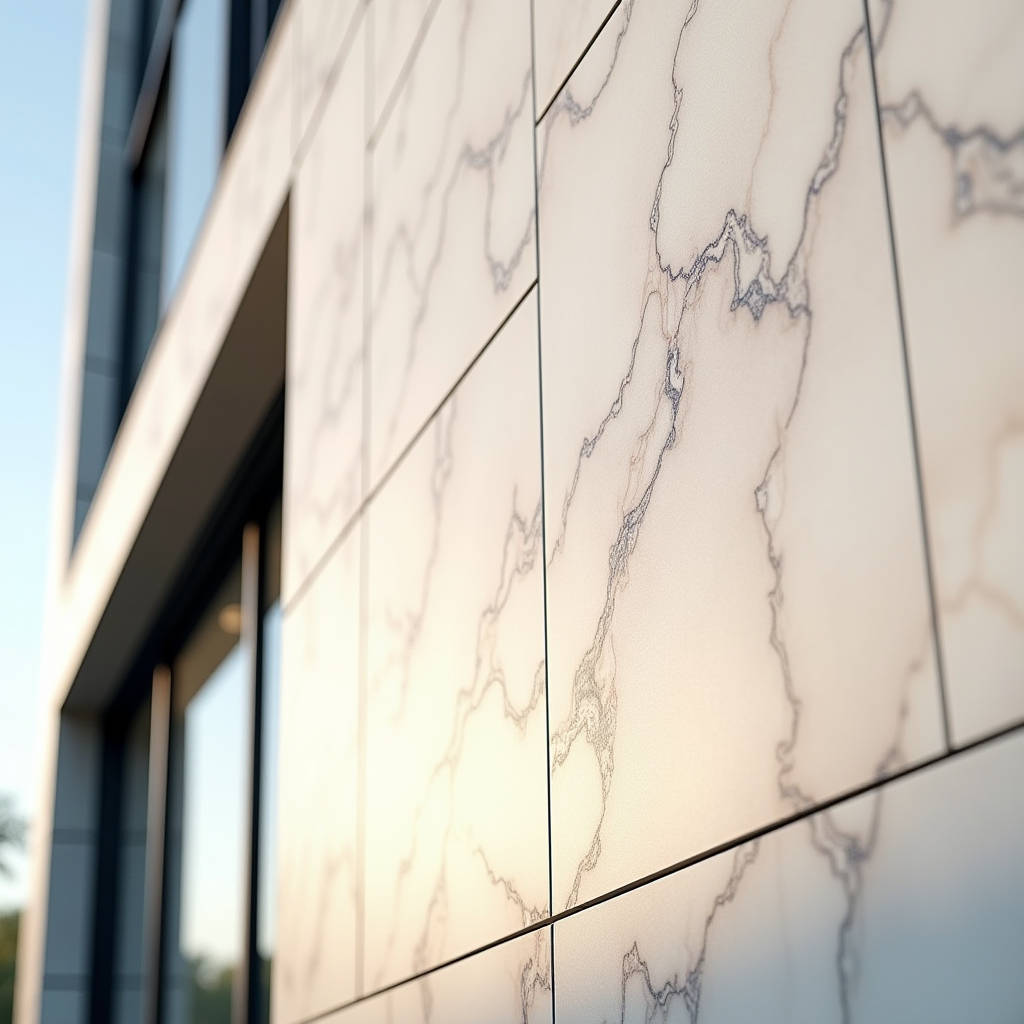
When a tender lands on your desk calling for "stone-finish metal façade panels," the first question procurement teams ask is rarely about aesthetics. It's about fire compliance. Can a stone grain aluminum panel meet the same non-combustibility requirements as a plain PVDF-coated solid aluminium sheet? The short answer: yes — provided the substrate is solid aluminium, not a composite core. The grain pattern is a coating, not a laminate. The panel itself remains a homogeneous aluminium alloy, typically 2.0mm to 3.0mm thick, with zero polyethylene filler. That distinction matters the moment a building inspector checks the test certificates.
Over the past decade, the architectural metal industry has watched specifiers shift decisively toward solid aluminium cladding panels for mid-rise and high-rise envelopes. The driver is regulatory. Post-2017, jurisdictions from the UK to the UAE to Southeast Asia tightened their fire codes, and the default response among serious façade contractors has been to specify solid aluminium — period. A stone grain aluminum panel simply layers a decorative coating system onto that same fire-rated substrate. The engineering logic is straightforward: the panel's reaction-to-fire classification derives from the metal, not the finish.
What "Stone Grain" Actually Means on a Solid Aluminium Panel
The term "stone grain" in the aluminium cladding sector refers to a sublimation or transfer-print coating process that embeds a photorealistic stone texture into the PVDF or polyester topcoat. It is not a film, not a vinyl wrap, and not a thin veneer. The pattern penetrates the coating layer and locks into the cured resin. From a fabrication standpoint, the panel remains a single-piece aluminium sheet — typically 1100, 3003, or 5052 alloy — that can be sheared, punched, routed, and folded on standard CNC equipment without delamination risk.
This matters because curtain wall contractors need to fabricate complex geometries on site or in the workshop. A stone grain aluminum panel with a 2.5mm base thickness will behave identically to a solid-color panel of the same gauge during bending and perforation. The grain pattern stretches slightly at fold lines, which is why experienced fabricators specify a minimum bend radius of 1.5t to 2t (where t = panel thickness) to avoid cracking the decorative layer. Specifying engineers should note this in fabrication drawings.
Field Note: When ordering stone grain panels with deep reveals or sharp returns, request a pre-production bend sample. The grain pattern shifts at the fold line, and the visual result can differ from the flat sample. We've seen 3mm returns on a 2.5mm panel produce acceptable results, but anything tighter risks visible pattern distortion. Budget 48 hours for this approval step.
Coating System: PVDF vs. Polyester for Stone Grain Finishes
Not all stone grain coatings are equal. The substrate may be solid aluminium, but the coating chemistry determines exterior durability. For any project with a design life exceeding 10 years — and certainly for all curtain wall applications — the specification should call for a PVDF (polyvinylidene fluoride) basecoat beneath the stone grain transfer layer. The industry benchmark is a 70% PVDF resin system, typically Kynar 500® or Hylar 5000®, applied at a minimum total dry film thickness of 25–30μm for the color coat, with the stone grain sublimation adding an additional 5–8μm.
Polyester-based stone grain coatings exist and cost roughly 15–20% less per square meter. They are suitable for interior feature walls, soffit linings, and low-rise applications where UV exposure is limited. But for any external façade subject to direct sunlight, polyester will chalk and fade within 5–7 years. The color shift Delta E on a polyester stone grain panel exposed in a tropical climate can exceed 3.0 after 36 months, which is visibly noticeable and generally unacceptable under most architectural specifications. PVDF systems, by contrast, routinely achieve Delta E values below 2.0 after a decade of exposure, as documented in AAMA 2605 testing protocols.
Coating Performance Comparison
| Property | PVDF Stone Grain (Kynar 500®) | Polyester Stone Grain |
|---|---|---|
| Basecoat Resin System | 70% PVDF / 30% Acrylic | 100% Polyester or Polyester-Melamine |
| Total DFT (Color + Grain) | 30–38μm | 25–30μm |
| Accelerated Weathering (QUV-B 3000hrs) | Delta E ≤ 2.0; gloss retention ≥ 70% | Delta E ≤ 5.0; gloss retention ≥ 50% |
| Typical Exterior Warranty | 15–20 years (color & film integrity) | 5–10 years (limited) |
| Recommended Application | External curtain wall, high-rise façade, coastal | Interior cladding, soffit, low-rise sheltered |
| Relative Cost Index (per m²) | 100% (baseline) | 75–85% |
| ASTM / EN Standard Reference | ASTM D3359 (adhesion), AAMA 2605 | EN 13523-10, AAMA 2604 |
Fire Performance: Why Solid Aluminium Changes the Compliance Equation
This is the section that separates specifiers who understand the supply chain from those who rely solely on marketing claims. A stone grain aluminum panel built on a solid aluminium substrate is classified as non-combustible or limited-combustible depending on the test standard applied. Under EN 13501-1, a solid aluminium sheet of 2.0mm thickness or greater typically achieves A2-s1,d0 classification — the highest fire rating achievable for a coated metal product. The "s1" denotes minimal smoke production; "d0" means zero flaming droplets.
This classification is intrinsic to the material. It does not depend on fire-retardant additives in a core because there is no core. The stone grain coating adds negligible combustible mass — typically less than 50g/m² of organic material — which is well within the thresholds for A2 classification. For procurement managers, this means the fire certificate you submit to the building control authority is the same certificate you would submit for a plain PVDF solid aluminium panel. No additional testing is required for the decorative grain finish.
In markets where ASTM E84 (Class A) or BS 476 Part 6/7 governs, solid aluminium panels consistently meet the most stringent requirements. The key specification detail to verify: the panel must be minimum 2.0mm thick for A2-s1,d0 under EN 13501-1. Some manufacturers offer 1.5mm solid aluminium with stone grain finish for interior use, but these will not achieve the same classification. Check the thickness on the mill certificate, not just the coating spec sheet.
Procurement and Supply Chain: What to Verify Before You Order
Ordering a stone grain aluminum panel for a large-scale façade project — say, 5,000m² or more — involves variables that go beyond the technical data sheet. The following points reflect what experienced procurement managers check before issuing a purchase order.
Mill Certificate and Alloy Traceability
The aluminium coil or sheet should come with a mill test certificate (MTC) per EN 10204 Type 3.1 or 3.2. Verify the alloy designation (1100-H14, 3003-H14, or 5052-H32 are common for cladding), the actual thickness tolerance (±0.05mm for 2.0mm sheet), and the temper. Some low-cost suppliers substitute 1100 alloy where 3003 is specified; 1100 is softer and has lower tensile strength, which can affect panel flatness after fabrication. The difference in raw material cost is approximately USD 120–180 per metric ton, which is why substitution happens. Request the MTC before production begins.
Stone Grain Pattern Consistency Across Batches
Stone grain patterns are produced from transfer films, and each film roll has a finite length — typically 800–1,200 linear meters. When a project requires multiple rolls, pattern matching between batches becomes critical. Reputable manufacturers, including Futeng®, maintain a master pattern reference and can produce a "continuity sample" showing the transition between two film batches. For large elevations where panels are installed adjacent to each other, specify that all panels for a given elevation must come from the same film batch. This is a standard clause in many architectural specifications but is frequently overlooked during procurement.
Packaging, Sea Freight, and Damage Prevention
Stone grain panels are more sensitive to surface abrasion than solid-color PVDF panels because scratches in the grain layer are visually obvious and cannot be touched up invisibly. Standard export packaging should include: (1) a PE protective film with minimum 60μm thickness applied to the decorative face; (2) interleaving with kraft paper or foam sheet between panels; (3) wooden crating with steel banding for LCL (less-than-container-load) shipments. For FCL shipments, panels are typically loaded on A-frame stillages. Moisture-resistant desiccant packs should be included for sea freight exceeding 30 days, particularly to humid destinations. Budget approximately USD 2.50–4.00 per square meter for export-grade packaging — cutting this corner is false economy.
Pro Tip: If your project is in a coastal or high-humidity region, add a clause in the PO requiring the protective film to be "UV-stabilized, removable without residue after 90 days of exterior exposure." Standard PE film degrades under sunlight and becomes brittle, making removal a labor-intensive nightmare on site. The cost difference is roughly USD 0.30/m². Worth every cent.
Fabrication and Installation: What the Shop Drawings Should Capture
A stone grain aluminum panel handles differently from a solid-color panel in one critical respect: directionality. The grain pattern has an orientation, and the architectural intent typically requires the pattern to run consistently across all panels on a given elevation. This must be explicitly noted on fabrication drawings — ideally with an arrow indicating grain direction — and communicated to the CNC programmer. A panel rotated 90° during cutting will be visibly mismatched on the façade.
For rainscreen systems with visible fixings, the fastener head color becomes a detailing consideration. Standard stainless steel or aluminum rivets in a natural finish will contrast sharply against a dark stone grain pattern. The specification should call for color-matched fastener heads, either through powder coating or by using aluminum rivets with a PVDF-coated head. The minimum order quantity for custom-colored fasteners is typically 5,000–10,000 pieces, which is not a constraint for most commercial projects but should be factored into the procurement schedule.
Panel flatness is another installation variable. Solid aluminium panels in 2.0mm and 2.5mm thicknesses will exhibit some oil-canning (visible waviness) under certain lighting conditions, particularly on large, unbroken spans. This is a physical property of thin metal sheets, not a manufacturing defect. The industry-accepted tolerance per ASTM E330 is typically a deflection of L/60 under wind load. To minimize oil-canning on stone grain panels — where the textured finish can accentuate surface irregularities — consider specifying 3.0mm thickness for panels exceeding 1,200mm in any dimension, or use a rear stiffener frame bonded with structural adhesive.
Cost Structure: What Drives the Price of Stone Grain Solid Aluminium Panels
The ex-works price of a stone grain aluminum panel is built from four main components: aluminium alloy sheet cost, coating cost, fabrication cost, and the stone grain transfer process itself. Aluminium ingot prices, quoted on the LME (London Metal Exchange), fluctuate daily and typically account for 40–50% of the total panel cost. The stone grain transfer process adds approximately USD 8–15 per square meter over a standard PVDF solid color, depending on pattern complexity and order volume.
For budget estimation purposes, a 2.5mm solid aluminium panel with PVDF stone grain finish, fabricated to standard sizes (up to 1,500mm width), typically falls in the range of USD 55–85 per square meter FOB China port, depending on alloy grade, quantity, and fabrication complexity. This is a ballpark figure. Actual pricing requires a detailed takeoff and current LME rates. The key point for procurement: the stone grain premium is a coating cost, not a material cost. The aluminium substrate is identical to what you would use for any other PVDF finish.
Quality Control: Inspection Points for Incoming Material
When stone grain panels arrive on site or at the fabricator's warehouse, a structured incoming inspection prevents disputes later. The following checklist reflects what experienced façade contractors verify:
- Visual inspection under diffuse daylight: Check for color consistency across the batch. The human eye is more sensitive to color variation in stone patterns than in solid colors because the pattern provides a reference baseline. Any panel that appears noticeably different under natural light should be set aside and compared against the approved control sample.
- Coating adhesion: Perform a cross-hatch test per ASTM D3359 Method B on one panel per batch (or per 500m²). The stone grain layer should achieve a 4B or 5B rating — meaning less than 5% of the coating is removed by the tape.
- Film thickness measurement: Use a calibrated eddy-current gauge to measure total dry film thickness at minimum five points across the panel. Variation should be within ±5μm of the specified value.
- Dimensional check: Verify length, width, and diagonal tolerances. For panels up to 2,000mm, the diagonal difference should not exceed 2mm. For larger panels, 3mm is the practical limit.
- Protective film integrity: Confirm the PE film is intact, free of bubbles, and properly adhered at edges. Film that is peeling at the edges will trap dirt and moisture during storage.
Specifying Stone Grain Aluminum Panels for Curtain Wall and Rainscreen Applications
The specification clause for a stone grain aluminum panel should reference the following standards as a minimum: alloy per EN 573-3 or ASTM B209, coating per AAMA 2605 (for PVDF) or EN 13523 series, fire classification per EN 13501-1 or ASTM E84, and fabrication tolerances per EN 13920 or the project-specific tolerance schedule. The stone grain pattern should be referenced by a manufacturer code and a physical A4 control sample, not by a verbal description. "Travertine" or "Carrara marble" are marketing terms, not specifications.
For BIM-driven projects, the stone grain pattern can be mapped as a texture file, but the specifier should note that the actual panel will exhibit subtle variations that a digital render cannot capture. This is inherent to the sublimation process and should be communicated to the architect and client early. A full-scale mock-up — minimum 2m × 2m — is the most reliable way to set expectations for pattern appearance, color, and flatness under site lighting conditions.
Futeng® and other established solid aluminium panel manufacturers maintain technical libraries with BIM objects, test reports, and pattern catalogs. When evaluating suppliers, the depth of their technical documentation is often a reliable proxy for their experience with architectural projects. A supplier who cannot provide a valid EN 13501-1 test report for their solid aluminium substrate within 24 hours of your request is not worth shortlisting.
Summary: The Procurement Decision in Five Points
If you are specifying or purchasing a stone grain aluminum panel for a commercial façade, the decision tree is simpler than the marketing brochures suggest. Strip away the aesthetics, and you are buying a solid aluminium sheet with a decorative PVDF coating. The fire performance, structural behavior, and fabrication characteristics are those of the aluminium substrate. The stone grain is a finish — a high-quality one, but a finish nonetheless. The following five points capture what matters in practice:
- Verify the substrate is solid aluminium, minimum 2.0mm, with a valid MTC. No composite core, no exceptions for fire-rated applications.
- Specify PVDF (Kynar 500® or Hylar 5000®) for any exterior application. Polyester is acceptable only for interiors or sheltered soffits.
- Lock down pattern direction and batch continuity in the purchase order. A single elevation should come from one film batch.
- Budget for export-grade packaging and UV-stabilized protective film. Surface damage on stone grain panels is not repairable on site.
- Insist on a physical mock-up. Digital renders of stone grain patterns are inherently misleading. The mock-up sets the standard for the entire project.
The stone grain aluminum panel occupies a specific and valuable niche in modern façade engineering: it delivers the visual warmth and texture of natural stone without the weight, the structural support requirements, or the fire performance limitations of thin stone veneers. For procurement teams, the key is to approach it as an engineered aluminium product with a decorative coating — not as a "stone alternative" — and to apply the same rigorous verification standards you would apply to any solid aluminium cladding panel on a high-rise envelope.