Specifying aluminum sheet metal with holes for facades open area wind load and coating
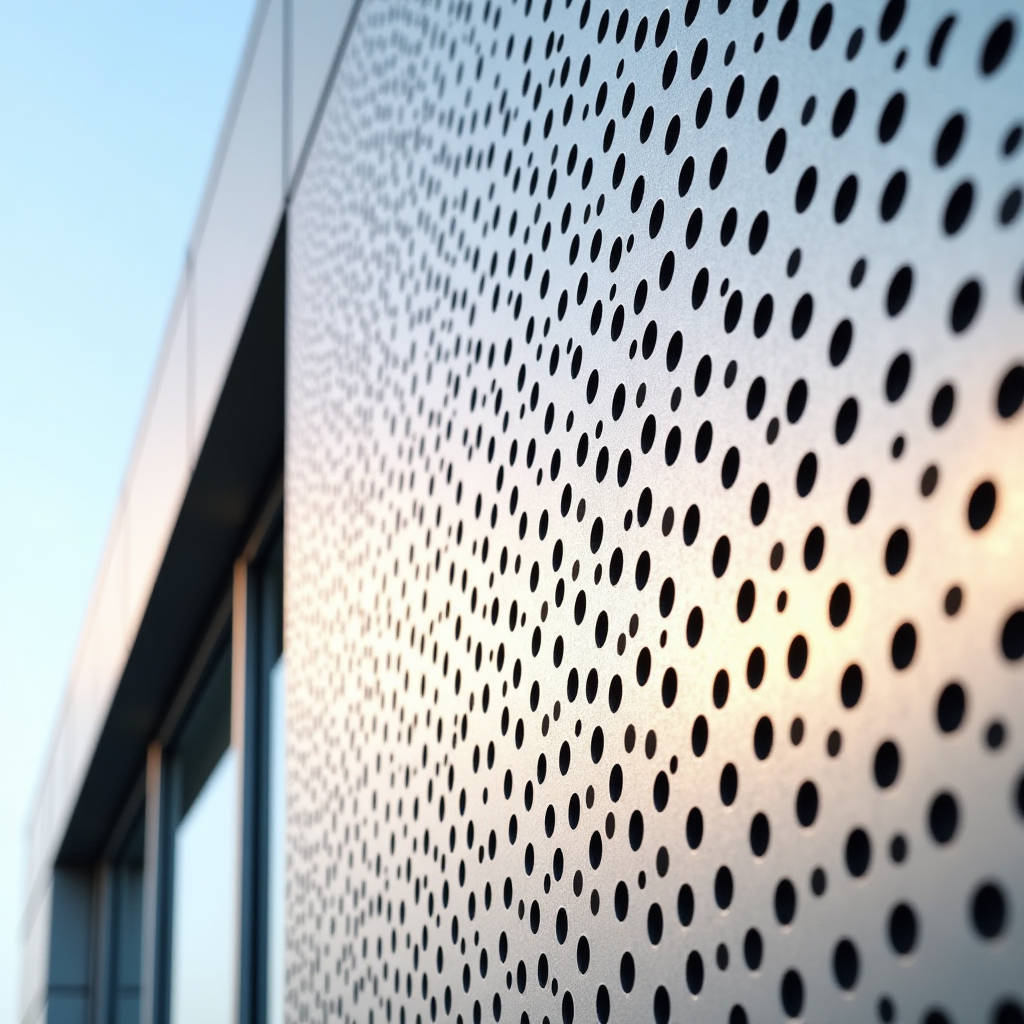
Perforated aluminum cladding, or aluminum sheet metal with holes, has moved from a decorative afterthought to a load-bearing design decision on modern facades. The open area ratio, hole geometry, and edge conditions all change how wind pressure, acoustic absorption, and solar gain behave across a building envelope. For a curtain wall contractor or facade engineer, the real question is not whether to use it, but how to specify the pattern, thickness, and coating so the panel survives 25 years of weather without fatigue or fastener failure. This article walks through the engineering data behind perforated aluminum panels, the fabrication tolerances that matter, and the coating systems that keep the cut edges from becoming corrosion sites.
Why the Open Area Ratio Drives Every Specification
The percentage of open space on a perforated panel, usually called the open area ratio, controls nearly every downstream property. A panel with 40 percent open area weighs less, lets more daylight through, and absorbs more sound, but it also carries less stiffness and transfers wind load differently than a solid sheet. The balance between these competing demands is where most facade mistakes happen.
For an aluminum sheet metal with holes used as a sunshade or rain screen, the open area ratio typically sits between 30 and 60 percent. Below 30 percent, the panel behaves close to a solid sheet and the perforation only adds visual texture. Above 60 percent, the remaining ligament between holes becomes too thin to maintain structural integrity under wind suction, especially on large panels. The American Architectural Manufacturers Association (AAMA) guidance on curtain wall performance, referenced in AAMA 501.1, gives a framework for testing air and water infiltration, but it does not set a universal open area limit. That decision belongs to the structural engineer, who must verify the panel against the local wind map.
Hole Geometry and Staggered Patterns
Round holes remain the most common choice because they are easy to punch and distribute stress evenly. Straight rows give a clean industrial look, while a staggered, or 60-degree, layout packs more holes into the same area and raises the open area ratio for a given hole diameter and center distance. The trade-off is visible: staggered patterns read as a denser texture from the street.
For architectural work, hole diameters usually range from 1.5 mm to 12 mm, with center-to-center spacing between 2.5 and 20 mm. A 3 mm hole on a 5 mm staggered center yields roughly 33 percent open area in a 2.0 mm thick panel. That same pattern in a 3.0 mm sheet changes the punching load and the edge burr, so the fabricator must adjust tooling. The aluminum sheet metal with holes you specify for a facade should always list the hole diameter, the center distance, the pattern type, and the open area percentage on the shop drawing, because these four numbers determine the panel's weight, deflection, and acoustic class.
Structural Behavior Under Wind Load
Perforation removes material from the panel, which lowers its flexural stiffness compared to a solid sheet of the same thickness. In practice, engineers compensate by increasing the sheet gauge or by adding stiffening ribs behind the panel. A 2.0 mm solid panel that passes a wind load check may need 2.5 mm or 3.0 mm when the open area exceeds 40 percent.
The deflection limit for exterior cladding is commonly set at L/180 or L/240, where L is the unsupported span between fixing points. For a typical 1200 mm module, that means a maximum deflection of 5 to 6.7 mm under peak wind pressure. If the panel is edge-supported on all four sides, the perforation penalty is smaller than if it is fixed only at the corners. The European standard EN 1991-1-4 provides the wind pressure calculation method, and the European Aluminium Association publishes design guidance for perforated sheets that many facade engineers use as a starting point.
One detail that gets overlooked is the ligament width, the solid strip between two adjacent holes. If the ligament drops below 1.5 times the sheet thickness, the panel becomes prone to tearing at the punch line during fabrication and to fatigue cracking under repeated wind cycles. A reputable supplier will flag this before production, but the spec writer should also check it.
Acoustic Performance and Ventilation
Perforated aluminum panels are frequently paired with acoustic insulation in a rain screen or a ceiling system. The holes act as a resistive element that converts sound energy into heat as air moves through the perforation. The open area ratio and the hole diameter both influence the absorption coefficient, and the backing cavity depth tunes the frequency range that the panel absorbs.
For a 40 percent open area panel with a 50 mm backing cavity, the peak absorption typically lands in the 500 to 1000 Hz band. Contractors who need broadband absorption often combine two layers of perforated sheet with different hole sizes, or they add a thin nonwoven fabric behind the panel to increase flow resistance. The same open area that helps acoustics also helps natural ventilation, which is why perforated screens are common on parking garages and plant rooms where code requires airflow without a full open grille.
Coating Systems for Perforated Edges
The cut edge of every hole exposes bare aluminum, and that edge is the first place corrosion starts if the coating does not cover it. A perforated panel has many times more edge length than a solid sheet of the same footprint, so the coating specification matters more than it does on a plain panel.
For exterior facades, a two-coat PVDF system with a total dry film thickness of 25 to 35 microns is the industry baseline, and a three-coat system at 35 to 40 microns gives better edge coverage. The coating is applied after perforation, which means the holes are punched first and the liquid PVDF is sprayed over the finished sheet, wrapping around the cut edges. Powder coating is cheaper but less durable on exterior edges and is better reserved for interior or sheltered applications. The table below compares the main options.
| Coating System | Dry Film Thickness | Edge Coverage | Typical Life Expectancy | Best Use |
|---|---|---|---|---|
| Two-coat PVDF | 25–35 microns | Good | 20–25 years | Standard exterior facades |
| Three-coat PVDF | 35–40 microns | Excellent | 25+ years | Coastal or high-UV zones |
| Polyester powder | 60–80 microns | Moderate | 10–15 years | Interior or sheltered areas |
| Anodized (clear or color) | 15–25 microns | Good | 15–20 years | Architectural, non-abrasive |
The ASTM B117 salt spray test is a common acceptance criterion for the coating, and AAMA 2604 and AAMA 2605 set the performance levels for exterior architectural coatings. For a coastal project, specifying AAMA 2605 compliance on the perforated panel is a prudent step, because the salt-laden air attacks exposed edges aggressively.
Fabrication Tolerances and Edge Treatment
Perforation leaves a slight burr on the underside of the sheet, and on a facade panel that burr can scratch adjacent panels during handling or create a sharp edge that catches the installer's gloves. The spec should require deburring or a light pass to remove the burr before coating. Dimensional tolerance on the hole pattern is usually held to plus or minus 0.1 mm on the hole diameter and plus or minus 0.5 mm on the overall panel size, which keeps the pattern aligned across multiple panels on the same elevation.
When panels are joined edge to edge, the pattern must line up or the facade reads as a series of mismatched rectangles. A good fabricator jigs the panels so the hole pattern registers across the joint. This is a coordination point that the contractor should confirm on the shop drawing review, because fixing it after fabrication is expensive.
Weight and Handling Considerations
Perforation reduces panel weight, which is a real benefit for the supporting structure. A 2.0 mm solid aluminum sheet weighs about 5.4 kg per square meter, and a 40 percent open area panel of the same gauge drops to roughly 3.2 kg per square meter. That saving reduces the dead load on the subframe and the foundation, and it makes the panels easier to lift and position on site.
However, the lighter panel is also less rigid, so it is more prone to oil-canning, the visible waviness that appears when a thin sheet is not fully restrained. Perforation actually helps here, because the holes break up the surface and make minor distortion less visible, but the panel still needs proper fixing points and a flat substrate to avoid a wavy appearance.
Procurement and Supply Chain Notes
Perforated panels are usually custom-fabricated to the project pattern, so lead time is longer than for stock solid sheets. A contractor should confirm the tooling availability for the specified hole size and pattern before committing to a schedule. For large projects, a supplier with in-house punching and coating lines, such as Futeng®, can keep the pattern consistent across batches and reduce the risk of color or pattern drift between production runs.
When requesting a quotation, the buyer should specify the alloy, temper, thickness, hole diameter, center distance, pattern, open area ratio, coating system, and the AAMA or ASTM acceptance standard. Missing any of these fields invites a non-conforming panel that fails the mock-up test. The aluminum sheet metal with holes you order is only as good as the specification that defines it.
Practical Specification Checklist
- Confirm the open area ratio against the wind load and deflection limits for the unsupported span.
- Verify the ligament width is at least 1.5 times the sheet thickness to avoid tearing.
- Specify deburring before coating so the cut edges do not scratch adjacent panels.
- Choose a three-coat PVDF system for coastal or high-UV projects, and reference AAMA 2605.
- Require the hole pattern to register across panel joints on the shop drawing.
- Confirm the fabricator has tooling for the exact hole size and pattern before placing the order.
- State the ASTM B117 salt spray test as the coating acceptance criterion.
Closing Engineering Advice
The successful use of aluminum sheet metal with holes on a facade comes down to matching the open area, gauge, and coating to the actual wind, acoustic, and corrosion demands of the site. There is no single universal pattern that works everywhere. A contractor who puts the open area ratio, ligament width, edge treatment, and coating thickness into the specification from the start will avoid the two most common failures: panels that deflect too much under wind and edges that corrode after a few seasons. Keep the mock-up test early, verify the pattern registration, and treat the perforation as a structural element rather than a decorative detail. That discipline is what separates a facade that performs for 25 years from one that needs replacement in five.