Specifying Corrugated Perforated Aluminium Sheet for Facade Performance
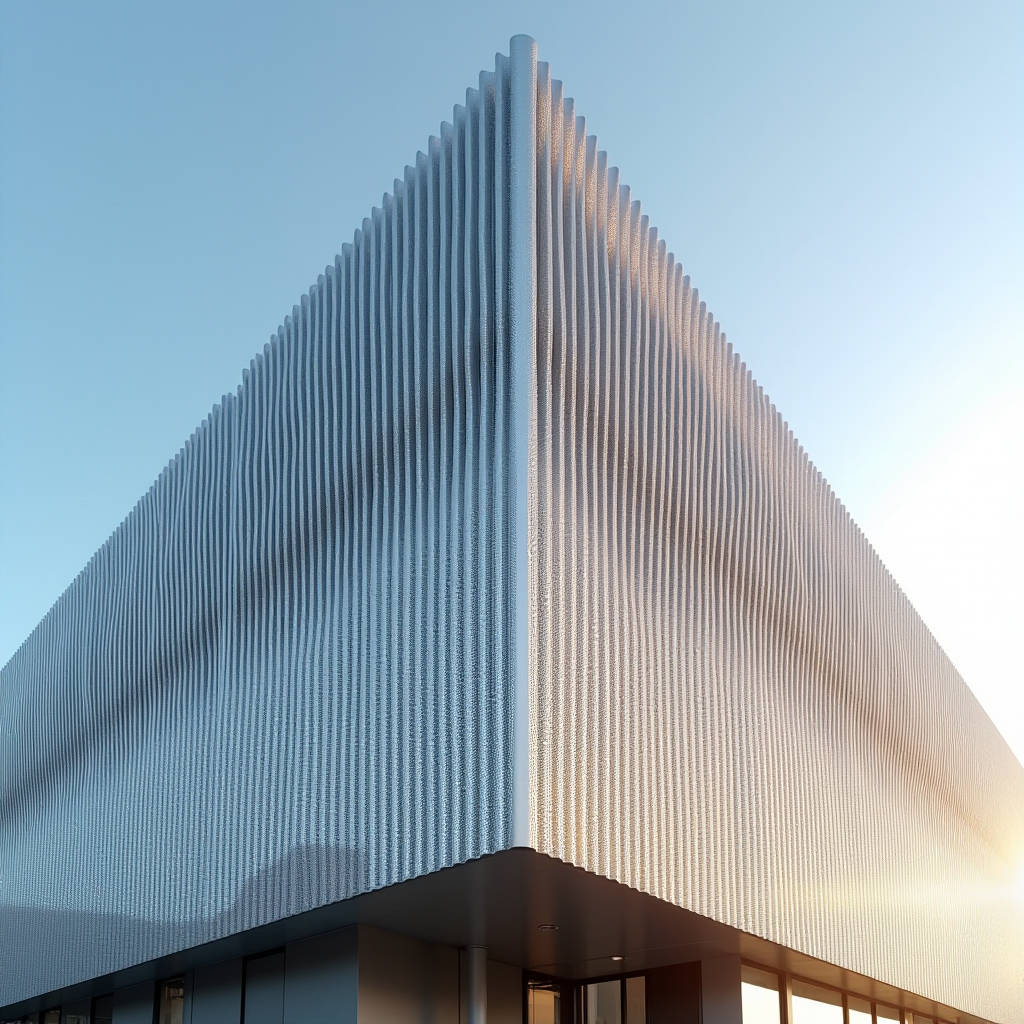
When a facade spec calls for both visual rhythm and controlled airflow, the corrugated perforated aluminium sheet has moved from a decorative afterthought to a structural workhorse. The corrugation adds stiffness that a flat sheet cannot match, while the perforation pattern turns the panel into an engineered filter for sun, wind, and sound. For a building envelope contractor, the challenge is not sourcing the material but specifying it correctly: hole geometry, open area, sheet gauge, and coating all interact with the corrugation profile to change load paths, drainage, and long-term performance. This article walks through the engineering decisions that separate a panel that performs for thirty years from one that fails in five, with worked numbers a procurement team can actually use.
Why Corrugation Changes the Engineering Picture
A corrugated perforated aluminium sheet is not simply a flat sheet with holes stamped into it. The corrugation profile, typically trapezoidal or sinusoidal, creates a deep section that resists bending far better than a flat panel of the same gauge. Independent testing referenced by the Metal Construction Association shows that corrugated aluminum panels can deliver bending strength more than 30 percent higher than flat sheet of equal thickness, which is why lighter gauges become viable once corrugation is introduced. For a facade contractor, that translates into fewer intermediate supports, lower subframe steel tonnage, and a real reduction in installed cost per square metre.
The practical consequence is that you can specify a thinner sheet, often 1.5 mm instead of 2.0 mm, for a given wind load, and still meet deflection limits. But thinning the sheet changes how the perforation pattern behaves under localised load, so the two decisions must be made together, not in sequence.
Hole Geometry and Open Area: The Parameters That Matter
Perforation is defined by three numbers: hole diameter, centre-to-centre spacing, and the resulting open area percentage. The open area drives ventilation, light transmission, and acoustic performance, while the spacing relative to the corrugation pitch determines whether the holes sit cleanly on the flat flanges or get clipped by the bends. On a corrugated profile, holes that straddle a bend create stress concentrations and rough edges that compromise both the PVDF coating and the panel's fatigue life under wind flutter.
For architectural cladding, open area typically ranges from 20 to 50 percent. Below 20 percent, the panel behaves almost like solid sheet for airflow purposes, and the perforation becomes purely decorative. Above 50 percent, the net section at the corrugation flanges becomes so reduced that the stiffness advantage of the profile is largely lost. The sweet spot for sun-shading and ventilation screens sits between 30 and 40 percent open area, where the panel still carries load but admits meaningful airflow.
| Open Area | Typical Use | Airflow Behaviour | Structural Note |
|---|---|---|---|
| 20–30% | Rain screens, acoustic barriers | Low ventilation, high sound absorption | Full stiffness retained |
| 30–40% | Sun shading, ventilation screens | Balanced airflow and shading | Moderate net-section reduction |
| 40–50% | Decorative screens, light diffusers | High airflow, low shading | Stiffness advantage reduced |
Coating and Corrosion: PVDF vs Anodising on a Perforated Profile
The cut edges of every perforation expose bare aluminium, and this is where coating strategy becomes critical. A corrugated perforated aluminium sheet has dramatically more linear edge than a flat panel of the same footprint, because every hole adds circumference. Those edges are the first place for corrosion to start, especially in coastal or industrial atmospheres. Two coating routes dominate the market, and they behave differently on perforated profiles.
PVDF (polyvinylidene fluoride) coatings, applied at a dry film thickness of 25 to 30 microns, provide the best long-term colour and gloss retention and are the standard for exterior architectural panels. AAMA 2605 is the specification that governs the highest-performance exterior finishes, and any panel specified for a building envelope should be tested to this standard. The coating wraps the hole edges during the spray process, giving good edge coverage, though the sharp burr left by punching must be deburred first or the coating will pull thin at the rim.
Anodising, typically 15 to 25 microns, offers a metallic finish that many architects prefer, but it is more sensitive to the alloy and to edge quality. On a perforated profile, the anodic layer thickness at the hole walls can be thinner than on the face, so anodised panels need a slightly heavier coating allowance and a tighter burr control. For a contractor, the practical rule is this: if the project is coastal or the panel is a rain screen, specify PVDF to AAMA 2605 and demand deburring before coating. If the finish is anodised, confirm the anodiser's edge coverage on a sample of the actual perforated profile before committing to a full production run.
Alloy Selection: 3003, 5052, and 6061
The alloy choice interacts with both the corrugation and the perforation. The three alloys most commonly offered for architectural aluminium sheet are 3003, 5052, and 6061, and each has a different role.
- 3003 is the workhorse for general cladding and corrugated profiles. It forms easily, welds cleanly, and offers good corrosion resistance, but it is not the strongest option for high wind zones.
- 5052 adds magnesium and delivers higher strength and better fatigue resistance, which makes it the right call for large panels and high wind-load regions. It also forms well and is a sound choice for perforated profiles where holes reduce the net section.
- 6061 is heat-treatable and the strongest of the three, but it is harder to form into tight corrugation radii and is more prone to cracking at perforation edges if not handled carefully. It suits industrial and structural screening more than architectural cladding.
For most facade applications, 5052 in a 1.5 to 2.0 mm gauge is the balanced recommendation. It keeps the stiffness benefit of the corrugation while maintaining enough net section through the perforation field to resist local buckling.
Wind Load and Deflection: Working the Numbers
A perforated panel sees a reduced net wind pressure because some of the air passes through it, but the structural engineer cannot simply discount the full design pressure. The perforation reduces the effective area, but the panel still must resist the load transferred to the subframe. As a starting estimate, a 5052 corrugated perforated panel at 1.5 mm gauge with a 40 percent open area, spanning 1200 mm between supports, can be expected to deflect within L/180 under a design wind load of roughly 1.5 kPa. Doubling the span to 2400 mm raises deflection by roughly a factor of eight, so span control is the single most effective lever a contractor has.
This is where the corrugation earns its keep. A flat 1.5 mm sheet spanning 1200 mm would deflect noticeably more than the corrugated profile, forcing either a heavier gauge or a tighter support grid. By using the corrugated section, the contractor keeps the subframe light and the panel cost down. The trade-off is that the corrugation traps water in the troughs, so drainage and weep details must be designed so that water does not sit against the perforation edges, where it accelerates corrosion.
Acoustic Performance: When the Panel Is the Absorber
Perforated panels are frequently specified for acoustic reasons, and the corrugated profile adds a useful cavity depth behind the panel. The absorption mechanism is simple: sound enters the holes, and the air cavity behind the panel converts acoustic energy into heat through friction and resonance. The absorption coefficient depends on the open area, the hole diameter, and the depth of the cavity behind the panel. A 30 percent open area panel with a 100 mm cavity can achieve a sound absorption coefficient in the range of 0.6 to 0.8 at mid frequencies, which makes it effective for equipment screens and partition walls in industrial and transit settings.
For a contractor, the practical point is that the acoustic performance is tuned by the cavity depth, not just the panel itself. If the project specifies a noise reduction target, the cavity behind the corrugated panel must be part of the design, and the perforation pattern selected to match the dominant noise frequency. This is a case where the panel and the wall build-up must be engineered together, and it is worth engaging an acoustician early rather than retrofitting absorption later.
Cost and Lead Time Realities
Perforation adds a secondary operation, and corrugation adds a forming step, so a corrugated perforated aluminium sheet carries a premium over flat solid sheet. As a planning estimate, the perforation process adds roughly 15 to 25 percent to the sheet cost depending on hole density, and the corrugation adds another 10 to 15 percent. The offset is the structural saving: a thinner gauge and a lighter subframe can recover much of that premium. For a typical facade, the total installed cost can end up comparable to a heavier flat panel system once the subframe steel is factored in.
Lead time is the other reality. Perforation dies are specific to the hole pattern, and custom patterns require tooling that can add two to four weeks to the schedule. Standard patterns are available off the shelf, so a contractor who locks the pattern early protects the programme. For projects where the pattern is not yet final, specifying a standard pattern with a documented substitution path is a pragmatic way to keep the schedule alive.
Specifying for the Long Term
Futeng® has supplied corrugated perforated aluminium sheet to facade contractors across multiple climate zones, and the recurring lesson from those projects is that the specification details decide the outcome. Deburring before coating, the correct alloy for the wind zone, a realistic open area, and a drainage detail that keeps water off the hole edges are the four decisions that separate a durable panel from a corroding one. The corrugation gives you the structural freedom to use a lighter sheet, and the perforation gives you the environmental control, but both benefits disappear if the coating and edge treatment are not specified to the same standard as the rest of the envelope.
For a procurement team, the checklist is short but non-negotiable: confirm the coating meets AAMA 2605 for exterior PVDF work, verify the alloy against the wind load, deburr before coating, and design the cavity and drainage around the open area. Do those four things and the corrugated perforated aluminium sheet becomes a reliable, cost-effective tool for sun shading, ventilation, and acoustic control that will hold up for decades. Done carelessly, the same panel becomes a maintenance liability. The material is proven; the engineering discipline is what makes it perform.