Aluminium Panel Fastener Failure Why 3 mm Solid Cladding Buckles Within 4 Years
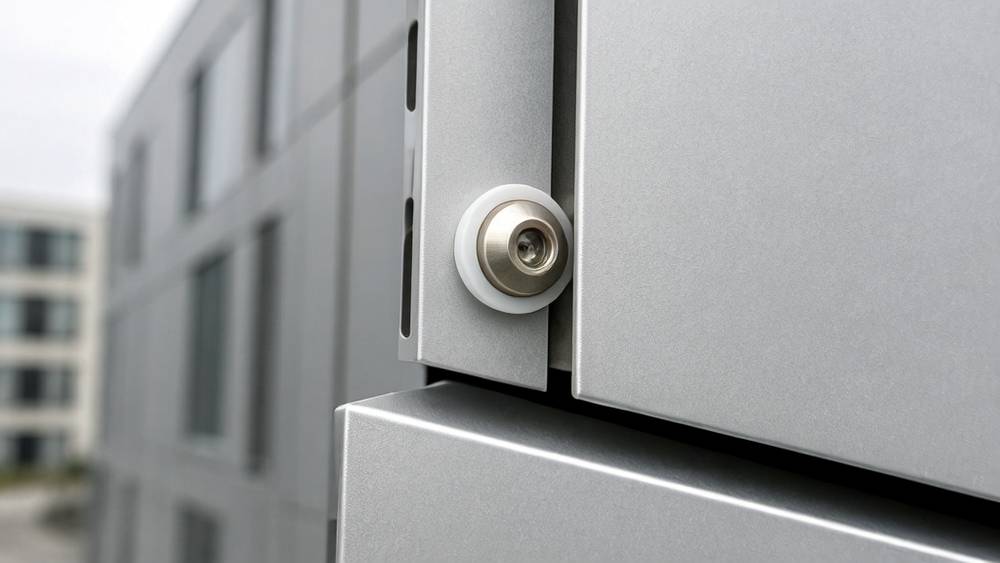
Most cladding specifications read the same. 3 mm aluminium panel, PVDF coating, 2 mm skin tolerance. But one line item separates a 25-year facade from a 10-year remediation headache: the fastener system. Architects and facade engineers spend months debating alloy grades and coating microns, only to watch panels ripple and rattle because nobody questioned whether the fasteners can handle thermal movement across a 6-metre span. This article examines what happens when aluminium panels are fixed rigidly instead of allowed to move, why standard carbon steel screws create galvanic couples that corrode faster than the panel itself, and how to specify fasteners that match the service life of the cladding rather than becoming its failure point. If you have ever inherited a building where the aluminium panel facade looks fine from 30 metres but reveals telltale puckering at every rivet line up close, the root cause is usually not the panel. It is what holds it in place.
The Hidden Mechanism: Why Fasteners Dictate Aluminium Panel Lifespan
An aluminium panel expands and contracts with every degree of temperature change. A 3 mm solid aluminium sheet spanning 4 metres will grow roughly 2.4 mm across a 50°C temperature swing. When fasteners lock both edges rigidly, that movement has nowhere to go. The panel buckles. Repeat this cycle 8,000 times over 20 years and micro-cracks propagate from every fixed point until the metal fatigues or the coating fractures.
The standard reference for thermal movement in architectural metals comes from The Aluminum Association, whose design guides specify a coefficient of linear thermal expansion of 23.8 × 10⁻⁶ per °C for 3003 and 5052 alloys commonly used in cladding. A project in Riyadh with summer surface temperatures hitting 85°C and winter nights dropping to 5°C sees an 80°C delta. That same 4-metre panel now moves 7.6 mm. If the fastener detail does not accommodate this, the installation has already failed before the first rain hits.
Most failures are wrongly attributed to the aluminium panel itself. The panel is rarely the problem. The fasteners and the restraint philosophy behind them are.
Fixed vs Sliding: Two Fastener Philosophies That Produce Opposite Results
Facade fastening for solid aluminium cladding falls into two camps: fixed-point systems and sliding/expansion systems. The choice between them determines whether the facade remains flat or develops oil canning within the first two seasonal cycles.
Fixed-Point Fastening
Fixed fasteners clamp the aluminium panel directly to the subframe at every attachment point. This approach is cheaper to engineer and faster to install. It works adequately on panels under 1.2 metres in length or on interior applications where temperature swings are minimal. On any exterior panel longer than 2 metres, fixed fastening is a warranty claim waiting to happen.
The failure mode is predictable. The aluminium panel heats up, expands, and because both ends are locked, compressive stress builds in the sheet. Thin solid aluminium panels at 2 mm gauge buckle at lower stress thresholds than 3 mm panels, but even 3 mm panels will eventually show distortion if the restraint is absolute. The visible symptom is a wavy reflection across the facade, most noticeable in low-angle morning or evening light. This is not an aesthetic choice. It is structural distress.
Sliding and Expansion Fastening
Sliding fastener systems fix the aluminium panel at one end while allowing the opposite end to move freely through slotted holes, expansion clips, or proprietary rail systems. The panel is secured against wind uplift and dead load but is not restrained longitudinally. Thermal expansion dissipates harmlessly.
The engineering principle is straightforward but the detailing is not. An expansion slot must be oriented parallel to the direction of movement. The slot length must exceed the calculated thermal movement by at least 3 mm to account for installation tolerances. The sliding surface must be a dissimilar material — nylon, EPDM, or PTFE — to prevent aluminium-to-aluminium galling under cyclic movement. Stainless steel washers between the fastener head and the aluminium panel face are mandatory to distribute bearing stress and prevent the fastener from chewing into the softer aluminium.
A correctly detailed sliding connection adds roughly 15-20% to the fastener cost per square metre but eliminates the single largest cause of aluminium panel distortion on mid-rise and high-rise facades.
Galvanic Corrosion: The Fastener Material Problem Nobody Discusses Until It Is Too Late
Fastening an aluminium panel with carbon steel screws creates a galvanic cell. Aluminium is anodic to carbon steel. In the presence of moisture — rain, condensation, or even high humidity — the aluminium sacrifices itself to protect the steel fastener. The result is pitting corrosion around every fastener hole, visible as white aluminium oxide residue bleeding from each fixing point within 3-5 years of installation.
The galvanic series published by NACE International places aluminium around -0.75V and carbon steel around -0.45V in seawater. That 0.3V potential difference is enough to drive active corrosion in any exposed joint. Stainless steel (300 series) sits much closer to aluminium on the galvanic series — approximately -0.50V in passivated condition — which significantly reduces the corrosion rate. However, stainless fasteners in aluminium panels still require isolation in marine or industrial environments where chloride ions accelerate the reaction.
The conservative specification for coastal aluminium panel installations pairs 316 stainless steel fasteners with nylon insulating washers between the fastener and the panel. This breaks the electrical circuit and eliminates the galvanic couple entirely. The incremental cost is approximately USD 0.15-0.30 per fastener. On a 5,000-square-metre facade with 4 fasteners per square metre, that is USD 3,000-6,000 total — roughly the cost of replacing 20 corroded panels three years in.
Material Compatibility Matrix for Aluminium Panel Fasteners
| Fastener Material | Galvanic Risk with Aluminium | Coastal Suitability | Relative Cost per Unit | Recommended Application |
|---|---|---|---|---|
| Carbon Steel (Zinc-Plated) | High | Not suitable | 1.0x (baseline) | Interior only, dry conditions |
| 304 Stainless Steel | Low-Moderate | Moderate (urban/industrial) | 2.5x | Exterior inland, non-coastal |
| 316 Stainless Steel | Low | High | 3.5x | Coastal, marine, chemical exposure |
| 316 SS + Nylon Isolation Washer | Negligible | Highest | 4.0x | Aggressive marine, tidal zones |
| Aluminium (5052/6061) Fastener | None (same material) | High (if anodised) | 2.0-3.0x | Specialist architectural, visible fixings |
| Titanium | Negligible | Highest | 12.0x+ | Only where specified for extreme environments |
The table above distils years of forensic facade investigation into a single reference. The pattern is clear: the cheapest fastener is the most expensive decision on the project. A project in Singapore's Marina Bay area learned this when 8,000 carbon steel fasteners on a 3 mm aluminium panel facade showed visible corrosion staining within 18 months. The remedial work cost exceeded the original cladding contract value.
Pull-Through and Bearing Failure: When the Fastener Head Is Too Small for the Load
Wind load on an aluminium panel is transferred to the building structure through fasteners. Each fastener carries a tributary area of panel surface. Under negative wind pressure — suction — the fastener head pulls against the aluminium panel from behind. If the fastener head diameter is too small or the panel is too thin, the head pulls through the aluminium like a button through a worn buttonhole.
Pull-through strength for aluminium sheets is calculated using the formula in AAMA TIR-A9 design guidelines. For a 3 mm 3003-H14 aluminium panel with a standard M6 stainless fastener and 14 mm head diameter, the ultimate pull-through capacity is approximately 2.8 kN. With a safety factor of 3.0 applied, the allowable load drops to roughly 0.93 kN per fastener. On a high-rise in a typhoon zone where design wind pressures exceed 3.0 kPa, a single fastener may need to resist 1.5 kN — exceeding the allowable capacity of the standard detail.
The solution is not always a thicker aluminium panel. Increasing panel thickness from 3 mm to 4 mm raises pull-through capacity by roughly 60%, but also increases panel weight by 33% and material cost proportionally. The more elegant engineering solution is a larger-diameter fastener head or a load-spreading washer that increases the bearing area without changing the panel gauge.
This interplay between wind load, fastener spacing, panel thickness, and head diameter is the quiet calculation that determines whether a facade stays on the building during a storm. When a cladding panel detaches in high wind, the investigation rarely finds that the panel itself failed. The fastener pulled through.
Rivet vs Screw vs Bolt: Selecting the Right Fastener Type by Application
The construction industry defaults to blind rivets for aluminium panel installation because they are fast, require access from only one side, and look consistent. Rivets also have structural limitations that screws and bolts overcome in specific scenarios.
Blind rivets are suitable for aluminium panels where the joint is primarily in shear — vertical panels on a rainscreen subframe where gravity loads dominate and wind suction is moderate. Rivets have poor tensile capacity relative to their shear capacity. A standard 4.8 mm aluminium blind rivet has a shear strength around 1.2 kN but a tensile strength of only 0.7 kN. On a soffit panel where gravity pulls the panel away from the fasteners, rivets are working in tension and are a poor choice.
Self-tapping screws into aluminium subframes provide higher tensile capacity — typically 2-4 kN for an M6 screw — but introduce the risk of thread stripping in the softer aluminium substrate during installation. Over-torquing a stainless screw into an aluminium extrusion strips the thread and reduces pull-out strength to near zero. The installer does not feel the failure because aluminium yields without the audible crack of steel.
Bolted connections with through-bolts and locknuts offer the highest structural reliability and are specified for aluminium panels in high-wind zones, overhead soffit applications, and anywhere a panel detachment would create a life-safety hazard. The trade-off is access: both sides of the joint must be reachable, which complicates installation sequencing and adds labour cost.
The selection logic should follow this hierarchy: determine the governing load direction (shear or tension), calculate the required capacity per fastener with the appropriate safety factor from the project's building code, then select the fastener type that delivers that capacity with the available installation access. Defaulting to rivets because "that is what we always use" has caused too many aluminium panel failures to count.
Thermal Bridging Through Fasteners: The Energy Code Problem
Every metal fastener that penetrates the insulation layer behind an aluminium panel creates a thermal bridge. A single stainless steel fastener through 100 mm of mineral wool insulation has a point thermal transmittance of approximately 0.008 W/K. On a facade with 4 fasteners per square metre, the cumulative thermal bridging effect can reduce the effective R-value of the insulation layer by 15-25%, depending on the framing system.
Building codes including ISO 10211 (Thermal bridges in building construction) require point thermal bridges to be accounted for in whole-building energy calculations. Projects targeting LEED, BREEAM, or Passivhaus certification must demonstrate that fastener thermal bridging has been addressed. The most common mitigation strategies include thermal break pads between the aluminium panel and the subframe, reduced fastener density through optimised engineering, and the use of stainless steel instead of carbon steel (stainless has roughly one-third the thermal conductivity of carbon steel).
This is not just an energy compliance issue. Thermal bridges create cold spots on the interior surface of the building envelope. Cold spots attract condensation. Condensation inside a wall assembly causes mould, corrosion, and premature degradation of insulation. The fastener that saves USD 0.10 on a thermal break washer can generate thousands in mould remediation costs.
Installation Tolerance and Fastener Alignment: The Site Reality
Specifications written in an office assume a perfectly flat, perfectly aligned subframe. Site reality is different. Aluminium panel subframes are typically installed to a tolerance of ±3 mm in plane and ±5 mm in grid alignment. When a fastener hole in the panel is drilled to a tight 6.5 mm diameter for an M6 bolt and the subframe slot is 5 mm out of position, the installer forces the panel into alignment by enlarging the hole with a drill bit. The engineered clearance is destroyed. The sliding connection becomes a fixed connection. The thermal expansion calculation becomes irrelevant.
The fix is designing fastener holes with installation tolerance built in from the start. A standard M6 bolt in a sliding connection should have a slot length of the calculated thermal movement plus 5 mm minimum installation tolerance. A 4-metre aluminium panel with 7.6 mm of thermal movement needs a minimum slot length of 13 mm. Specifying 20 mm slots is safer and costs nothing extra.
Site quality control is equally critical. A single fastener over-torqued on a sliding connection locks the entire panel. The thermal stress that was supposed to distribute across 4 metres of panel length now concentrates at the one locked point. This is the mechanism behind isolated panel puckers that appear at random locations on an otherwise flat facade. The cause is not the aluminium panel. It is the installer who tightened one screw too many.
Suppliers like Futeng®, with experience delivering solid aluminium panel systems across multiple international markets, routinely provide detailed fastener schedules and installation torque specifications as part of the shop drawing package. This documentation bridges the gap between the facade engineer's thermal movement calculations and the installer's need for clear, enforceable limits on the tools in their hands.
Fastener Specification Checklist for Aluminium Panel Projects
A reliable fastener specification for solid aluminium cladding should address each of the following points before the first panel is ordered:
- Thermal movement calculation — Confirm the maximum panel dimension, the project's temperature range, and the resulting linear expansion. This number determines slot lengths and sliding clearances.
- Galvanic compatibility audit — Verify the fastener material, washer material, and panel alloy against the project's environmental exposure category (C1 through C5 per ISO 12944).
- Pull-through capacity verification — Calculate the design wind load per fastener and confirm it does not exceed the allowable pull-through strength of the specified panel thickness and fastener head configuration.
- Fastener type selection — Match the fastener type (rivet, screw, or bolt) to the governing load direction and available installation access.
- Installation tolerance allocation — Add minimum 5 mm of installation tolerance to all sliding connections beyond the calculated thermal movement.
- Torque specification — Define a torque range for all threaded fasteners to prevent over-tightening of sliding connections.
- Thermal break requirement — Assess whether point thermal bridging from fasteners affects energy code compliance and specify thermal break components if required.
The Cost of Getting It Wrong
A 2018 facade remediation project on a 12-storey commercial building in Manchester provides the numbers. The original 3 mm aluminium panel rainscreen system used carbon steel self-tapping screws on fixed connections. Within four years, panels across the south and west elevations showed visible buckling. Galvanic corrosion was active at 40% of fastener locations. The remediation involved full panel removal, subframe repair, and reinstallation with 316 stainless fasteners on sliding connections.
Original fastener cost: approximately GBP 12,000 for 35,000 carbon steel screws. Remediation cost: GBP 340,000. The ratio is 28:1. The aluminium panels were not defective. The fasteners were.
This is not an isolated case. Forensic facade engineers see the same failure pattern in Dubai, Singapore, London, and Toronto. The aluminium panel industry has spent 30 years refining alloys, coatings, and fabrication tolerances to deliver cladding that can last half a century. The weakest link is now consistently the connection between the panel and the building. A facade is only as durable as its fasteners, and fasteners deserve the same engineering attention as the panels they secure.
Specifying fasteners is not a procurement afterthought. It is the single most consequential decision in the aluminium panel detailing process.