Engineering a Hexagonal Perforated Aluminum Sheet for Curtain Wall and Rainscreen Facades
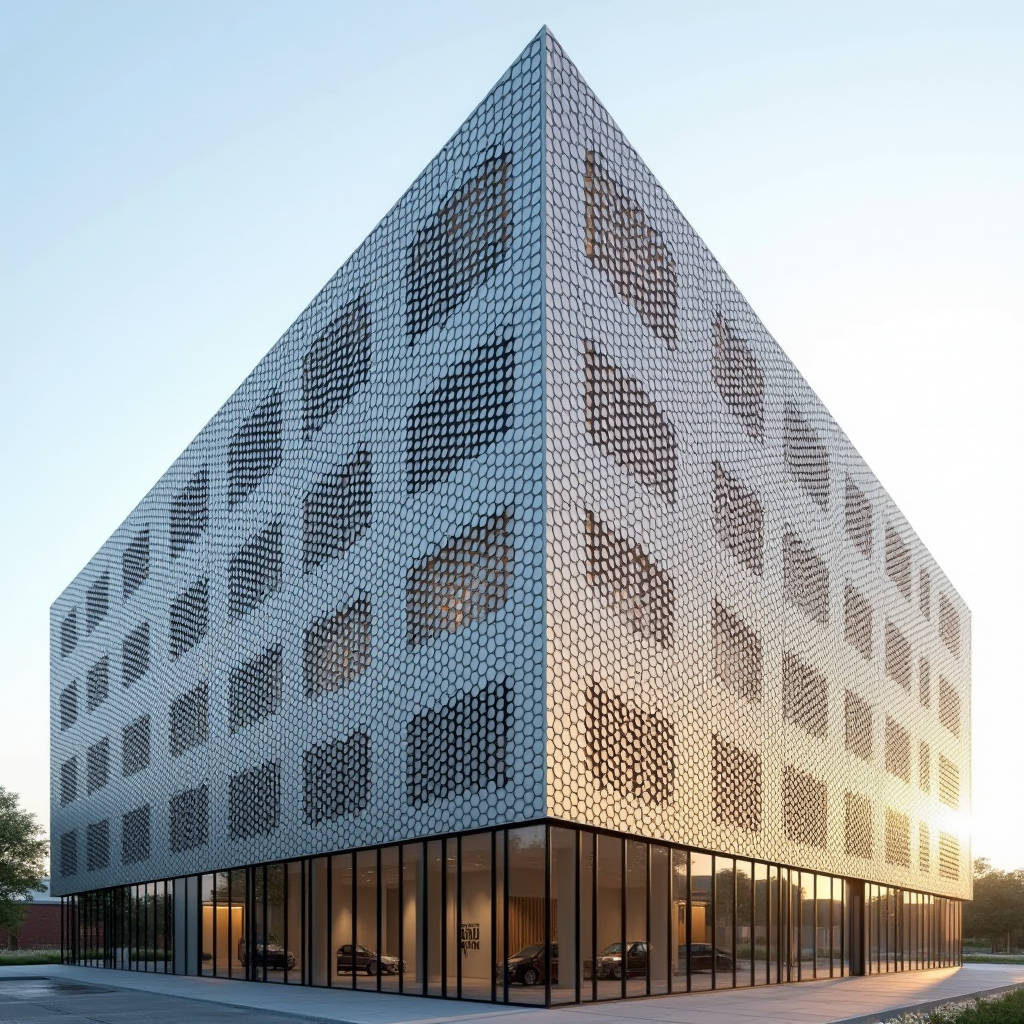
When a facade spec calls for screening, ventilation, or a controlled visual rhythm, the hexagonal perforated aluminum sheet has become a first-line material for curtain wall and rainscreen contractors. Unlike round or square perforations, the six-sided aperture packs more open area into the same footprint while leaving a continuous lattice of solid metal between holes, which preserves structural stiffness that round patterns tend to sacrifice. For a solid aluminium cladding panel supplier, this geometry changes how we calculate wind load, acoustic absorption, and daylight transmittance on a project. Contractors who treat a hexagonal perforated aluminum sheet as a drop-in replacement for a round-hole panel often misjudge the open area ratio and the resulting panel deflection. This article walks through the engineering numbers, coating options, and fabrication tolerances that matter when you specify this material for a real curtain wall or balcony screen.
Why the Hexagonal Aperture Beats Round Holes on Open Area
The core advantage of a hexagonal perforated aluminum sheet is the packing efficiency of the hexagon itself. A regular hexagon tiles a plane with zero gap, so the theoretical maximum open area approaches 100 percent before you account for the ligament width between holes. In practice, manufacturers hold the open area between 41 and 59 percent for staggered hex patterns, and some high-open designs reach 70 to 80 percent when the ligament is kept thin. A round hole of the same nominal diameter, by contrast, leaves triangular dead zones between adjacent circles, so the open area for the same pitch is always lower.
That higher open area translates directly into three measurable benefits on a facade:
- Ventilation and stack effect control — a higher open area moves more air per square metre, which reduces the number of panels needed for a given airflow target on plant screens or louvre walls.
- Acoustic transparency — with more open area, sound can pass through with less reflection, which changes how you pair the panel with an acoustic backing layer.
- Daylight and view control — the honeycomb pattern reads as a softer, more continuous texture than round holes, which architects often prefer for balcony spandrels and sunscreens.
For a solid aluminium cladding panel supplier like Futeng®, the practical consequence is that we can deliver a hexagonal perforated aluminum sheet with a lower material mass per square metre than a round-hole panel of equal open area, because the hex geometry achieves the target open area with a thinner ligament. That lower mass reduces dead load on the substructure and lowers freight cost on export orders.
Engineering Data: Open Area, Stiffness, and Wind Load
Structural design for a hexagonal perforated aluminum sheet starts with the open area ratio because it drives both the net section and the panel's flexural stiffness. A panel with 50 percent open area has roughly half the effective bending section of a solid sheet of the same gauge, so deflection under wind load climbs faster than a linear estimate would suggest. The stiffness of a perforated plate scales with the remaining ligament network, and the hex pattern's continuous lattice retains more stiffness per unit of open area than a staggered round pattern of equal open area.
For a typical curtain wall application, use the following working figures as a starting point for your own calculation:
| Parameter | Typical Value | Notes |
|---|---|---|
| Alloy and temper | 3003-H14 or 5052-H32 | 5052 offers higher strength for large spans |
| Sheet gauge | 1.5 to 3.0 mm | 2.0 and 2.5 mm dominate facade work |
| Hex hole size | 6 to 25 mm across flats | Larger holes suit high-open screens |
| Open area | 41 to 59 percent standard; up to 80 percent custom | Verify against the shop drawing |
| Ligament width | 2 to 6 mm | Thinner ligament lowers stiffness |
| Design wind pressure | 1.0 to 2.5 kPa | Per local code and exposure category |
| Max panel span | 600 to 1200 mm | Depends on gauge, open area, and support |
For wind load, the perforated panel behaves differently from a solid sheet because airflow passes through the apertures, which reduces the net pressure coefficient on the panel face. That is an advantage for large screens, but it also means the panel must be checked for flutter and fatigue at the ligament connections. AS/NZS 1170.2 and the ASCE 7 wind provisions both require you to account for the effective solidity ratio of a perforated screen, not the gross dimensions. Treat the open area as a porosity value and apply the appropriate pressure coefficient for a porous screen rather than a solid panel.
Coating and Corrosion Performance on Exterior Facades
The perforation process exposes fresh cut edges on every hole, and those edges are where corrosion starts if the coating system is not specified correctly. A hexagonal perforated aluminum sheet is normally supplied with a PVDF (polyvinylidene fluoride) coating on the face and a polyester or epoxy backer, applied after punching so the cut edges receive a protective edge treatment. Industry practice under AAMA 2605 for the highest exterior durability calls for a PVDF film thickness of at least 70 microns on the face, with a two-coat or three-coat system.
For coastal or industrial environments, the cut edges deserve extra attention. A 5052 alloy with a higher magnesium content resists pitting better than 3003 in salt-laden air, but the coating still carries most of the corrosion burden. Specify a full edge seal on the perforations for marine-grade projects, and require the fabricator to confirm that the punching process did not leave burrs that would thin the coating at the hole rim. The table below compares the coating options you will most often evaluate for a hexagonal perforated aluminum sheet on exterior work:
| Coating System | Film Thickness | UV and Chalk Resistance | Salt Spray Resistance | Typical Use |
|---|---|---|---|---|
| Polyester (PE) | 25 to 35 microns | Moderate, fades in 5 to 8 years | Low to moderate | Interior, sheltered soffits |
| PVDF two-coat | 70 microns total | High, 20+ year colour retention | High | Exterior facades, standard spec |
| PVDF three-coat with primer | 80 to 100 microns | Very high | Very high | Coastal, high-exposure towers |
| Anodised (Class I) | 18 to 25 microns oxide | Excellent, no paint film | High on 5052 | Architectural metal, natural finish |
For a solid aluminium cladding panel supplier, the coating spec is the single biggest differentiator in lifecycle cost. A 70-micron PVDF system on a hexagonal perforated aluminum sheet will typically outlast a polyester system by more than a decade in an exterior environment, and the difference matters more on perforated panels because the cut edges are more vulnerable than a flat sheet face.
Fabrication Tolerances and Edge Conditions
Perforation tolerances on a hexagonal perforated aluminum sheet follow the general guidance in ASTM and the perforated metal industry standards. Hole diameter and pitch are held to a tolerance of roughly plus or minus 0.4 mm on standard work, and the open area varies by about plus or minus 2 percent from the nominal value. For a curtain wall where panels sit side by side, the cumulative effect of pitch tolerance shows up as a visible mismatch in the honeycomb pattern across a joint, so specify a tighter pitch tolerance on elevation-critical panels.
Two edge conditions deserve specific attention on facade work:
- Solid margin — a solid border around the perforated field is required for screw fixing, riveting, or concealed bracket attachment. Specify the margin width (commonly 15 to 50 mm) so the fixing points land on solid metal rather than on a ligament.
- Burr removal — punching leaves a burr on the exit side. For a panel that will be touched or viewed at close range, require deburring so the coating covers a clean edge and installers do not cut gloves or hands.
When panels are brake-formed or folded into a cassette profile, the perforation must stop short of the bend line, otherwise the hole geometry distorts and the open area changes at the fold. Confirm the perforated field boundary against the bend allowance before production, and have the fabricator hold a solid strip at each fold.
Acoustic and Daylight Performance for Screens
Architects often choose a hexagonal perforated aluminum sheet for acoustic screens and sunscreens, and the numbers are worth checking before you commit. With a high open area, the panel itself reflects little sound, so any acoustic absorption must come from a backing layer such as a mineral wool or acoustic membrane behind the panel. The perforation acts as a protective fascia while the backing does the acoustic work. For daylight control, the honeycomb pattern produces a more even light distribution than round holes because the hexagonal apertures blend into a continuous texture at viewing distance.
For a balcony screen or a plant enclosure, pair the panel with a wind-rated backing so the acoustic layer does not sag or blow out through the apertures. Specify the backing retention method in the shop drawing, and confirm the open area is high enough to let the acoustic layer breathe without acting as a solid wind barrier.
Supply Chain and Lead Time Considerations
Perforated panels are punched before coating, so the lead time on a hexagonal perforated aluminum sheet is longer than a plain solid sheet of the same alloy. The punching die is dedicated to a specific hole size and pitch, so changing the pattern mid-order adds tooling time. For a project with a tight programme, lock the hole geometry and open area early, and confirm the fabricator holds the die for the full order quantity. A solid aluminium cladding panel supplier like Futeng® can hold a stock of common hex patterns in 3003-H14 and 5052-H32 so that repeat orders and replacement panels ship faster than a full custom run.
On export orders, the perforated panel packs the same weight as a solid sheet of equal gauge, so freight cost is driven by mass rather than by the holes. The open area does not reduce shipping weight, which surprises some buyers who expect a lighter panel. Plan the packing and pallet layout around the panel dimensions and the solid margins, and confirm the coating is protected against abrasion during transit.
Practical Specification Checklist
Before you finalise the shop drawing for a hexagonal perforated aluminum sheet, run through this checklist with the fabricator:
- Confirm alloy and temper (3003-H14 for standard, 5052-H32 for high-load spans).
- Lock the hex hole size, pitch, and open area percentage against the design intent.
- Verify the coating system meets AAMA 2605 for exterior exposure and specify the edge treatment on cut holes.
- Define the solid margin width and keep fixing points off the perforated field.
- Confirm the perforated field stops short of all bend lines.
- Check the effective solidity ratio for wind load per the local code and apply the porous-screen pressure coefficient.
- Specify deburring and edge seal for marine or industrial environments.
The hexagonal perforated aluminum sheet earns its place on a facade when the open area, stiffness, and coating are engineered together rather than treated as separate decisions. Start with the open area target, then work the gauge and alloy to hold the deflection limit, then choose the coating for the exposure. That sequence keeps the panel structurally sound, visually consistent, and durable over the building's service life, and it is the same sequence a reliable supplier should walk you through on the first enquiry.