Perforated Corrugated Aluminum Panels for Ventilated Facades Engineering Data for Gauge Open Area and Installation
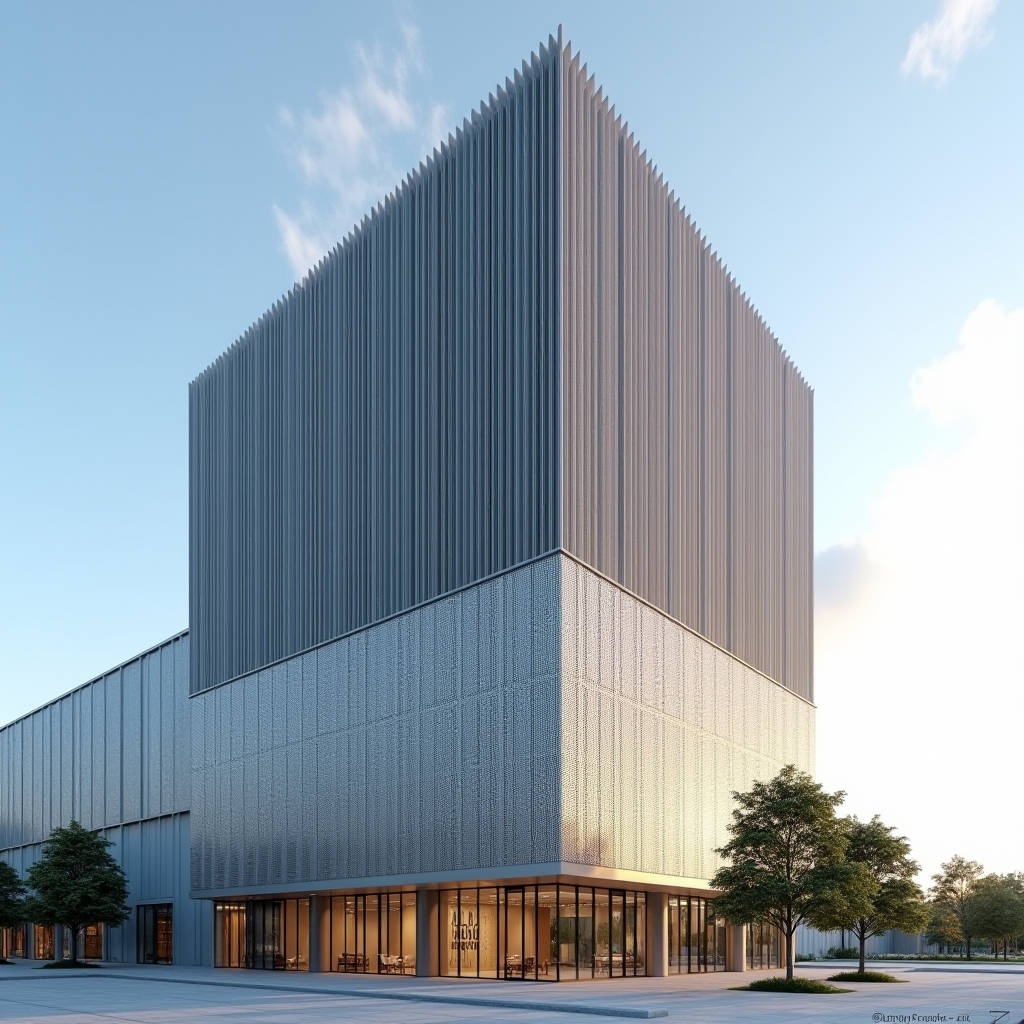
Perforated corrugated aluminum panels have moved from a niche architectural novelty into a mainstream specification for ventilated facades, sunshades, and acoustic screens. The appeal is straightforward: the corrugation adds structural rigidity, so a lighter gauge of solid aluminum can be used without sacrificing spanning capacity, while the perforation pattern controls daylight, airflow, and sound transmission. For a curtain wall contractor or building envelope engineer, this combination changes the cost and performance math on every project. The key is understanding how the two processes interact—corrugation depth, hole geometry, open area, and coating system all influence the final panel's behavior. This article walks through the engineering decisions that matter when you specify perforated corrugated aluminum panels, with practical data for procurement and installation.
Why Combine Corrugation with Perforation in Solid Aluminum
Solid aluminum cladding panels already offer predictable flatness and corrosion performance. Adding a corrugated profile changes the section modulus of the sheet, which means the panel can span greater distances between support points at the same nominal thickness. A flat 2.0 mm solid aluminum sheet deflects noticeably over a 1200 mm span, whereas the same material formed into a corrugated profile with a 25 mm depth carries that span with acceptable stiffness. That structural gain is the reason architects can specify lighter gauges while still meeting wind load requirements.
The perforation then adds a second layer of function. Open areas between 15% and 40% allow natural ventilation through the facade cavity, reduce solar heat gain by breaking up direct radiation, and provide sound absorption when paired with an acoustic backing. The perforation also creates a visual texture that reads differently from every viewing angle, which is why corrugated perforated metal has become a favorite for sunshade facades and feature screens on commercial towers.
For the specifier, the important point is that corrugation and perforation are not independent variables. The holes must be placed on the flat lands of the corrugation profile whenever possible, because punching through the sharp bends concentrates stress and can initiate cracking at the hole edges during forming. A well-designed panel coordinates the hole pattern with the corrugation geometry from the start, not as an afterthought.
Material and Gauge Selection for Perforated Corrugated Panels
Solid aluminum cladding panels in this category are typically specified in 1.5 mm, 2.0 mm, or 2.5 mm thickness. The corrugated profile adds rigidity, so 1.5 mm or 2.0 mm covers most facade applications. The alloy matters as much as the gauge. For exterior architectural work, 5000-series alloys such as 5052 or 5083 offer good formability and corrosion resistance, while 3003 is common for interior screens and ceiling applications. The PVDF coating system is the same standard used across solid aluminum cladding: a primer plus a topcoat with a total dry film thickness of 25 to 30 microns, applied to a pretreated surface that meets AAMA 2605 performance requirements.
Perforation removes material, which changes the effective load-bearing cross-section. A panel with 30% open area has lost nearly a third of its material in the perforated zone, so the engineer must calculate the effective section properties rather than assuming the full sheet thickness carries the load. This is where the corrugation earns its keep—the ribbed profile compensates for the material loss by keeping the section modulus high even with significant open area.
Perforation Patterns and Open Area Calculations
The hole pattern is the single most important design decision after the corrugation profile. Common patterns include round holes in staggered or straight rows, square holes, and slotted perforations. The open area percentage is calculated from the hole diameter and the center-to-center spacing. For a staggered round-hole pattern, the open area is approximately 90.7% of the ratio of the hole area to the bounding rectangle defined by the spacing. In practice, a 3 mm hole on a 5 mm staggered pitch yields roughly 32% open area, while a 5 mm hole on an 8 mm pitch gives about 35%.
Open area directly controls ventilation, light transmission, and acoustic performance, but it also weakens the panel. A practical ceiling for exterior cladding is around 35% open area on a 2.0 mm panel; beyond that, the engineer must either increase the gauge, deepen the corrugation, or reduce the unsupported span. For sunshade applications where the panel is primarily a shading device rather than a structural skin, open areas up to 45% are feasible with careful support design.
Acoustic and Ventilation Performance Data
Perforated corrugated aluminum panels are frequently specified for noise barriers and acoustic screens. The sound absorption coefficient depends on the open area, the hole diameter, and the air cavity behind the panel. A panel with 25% open area and a 50 mm air cavity behind a sound-absorbing backing can achieve a noise reduction coefficient in the range of 0.70 to 0.85 in the mid-frequency bands. Contractors should verify the acoustic specification against the actual perforation pattern, because a pattern that looks similar on paper can perform very differently in a sound test.
For ventilation, the free area of the panel determines the airflow through the facade cavity. This is critical for pressure-equalized rain screen systems, where the cavity must vent to the outside to equalize wind pressure and drain moisture. The perforation provides that venting path naturally, which is why perforated corrugated panels are popular in rain screen and ventilated facade assemblies. The contractor must ensure the perforation is not blocked by the backing insulation or the structural support, or the ventilation function is lost.
Coating Systems and Corrosion Resistance
Because perforation exposes the cut edges of the aluminum, the coating system must protect those edges. The PVDF finish on solid aluminum cladding panels is applied to the flat sheet before or after perforation, depending on the fabricator's process. Perforating after coating exposes bare aluminum at the hole edges, which is a corrosion risk in coastal or industrial environments. The better practice is to perforate first and then coat, so the hole edges receive the full pretreatment and coating system. This is a specification point that separates experienced fabricators from less careful ones.
For aggressive environments, the coating should meet AAMA 2605, which specifies a higher performance level than AAMA 2603 or 2604. The PVDF resin content is typically 70% by weight, and the total film thickness should be verified on the finished panel, including the perforated edges. Anodized finishes are an alternative for interior applications, but for exterior facades the PVDF system remains the industry standard for color retention and chalk resistance.
Installation Methods and Support Framing
Perforated corrugated aluminum panels are installed on either a concealed clip system or a visible fastener system. The concealed clip system is preferred for architectural facades because it produces a clean, uninterrupted surface. The clips engage the corrugation ribs, and the panel expands and contracts freely with temperature changes. The visible fastener system is simpler and cheaper, with self-tapping screws through the ribs, but it requires careful alignment and allows thermal movement at the fastener. For spans over 1200 mm, the engineer should specify a sub-framing system with vertical rails at the panel joints and intermediate supports at the mid-span.
Thermal movement is a real concern with solid aluminum. The coefficient of thermal expansion for aluminum is about 23 x 10⁻⁶ per degree Celsius, roughly twice that of steel. Over a 3000 mm panel with a 60°C temperature swing, the panel grows about 4 mm. The support system must accommodate this movement, or the panel will buckle or the fasteners will shear. The corrugated profile actually helps here—the ribs allow the panel to absorb some thermal stress elastically—but the design must still provide for expansion at the joints.
Cost Comparison Across Installation and Coating Options
Budgeting for perforated corrugated aluminum panels requires understanding where the cost sits. The table below compares typical relative costs for different specification choices, based on a 2.0 mm solid aluminum panel with 25% open area.
| Specification Variable | Option | Relative Cost Index | Notes |
|---|---|---|---|
| Corrugation Depth | 13 mm (shallow) | 1.00 | Lower stiffness, shorter spans |
| Corrugation Depth | 25 mm (deep) | 1.12 | Higher stiffness, longer spans |
| Perforation Open Area | 20% | 1.00 | Standard pattern |
| Perforation Open Area | 35% | 1.18 | More holes, slower punching |
| Coating System | PVDF (AAMA 2605) | 1.00 | Standard exterior |
| Coating System | Anodized | 0.85 | Interior only |
| Installation | Visible fastener | 1.00 | Simpler framing |
| Installation | Concealed clip | 1.30 | Cleaner facade, more hardware |
The cost index shows that the biggest lever is the concealed clip system, which adds roughly 30% over visible fasteners. The open area and corrugation depth add moderate cost, while the coating choice is a smaller factor. A contractor bidding a project should confirm the perforation pattern and corrugation depth early, because these drive both the material cost and the fabrication time.
Fabrication Quality and Tolerances
The quality of the finished panel depends on the fabrication process. Perforation should be done with a CNC punch press that maintains consistent hole spacing and diameter across the full sheet. The corrugation is then formed by roll forming or press braking, and the two steps must be sequenced so the holes land correctly on the flat lands. A reputable fabricator will hold the hole pattern tolerance to within ±0.5 mm and the corrugation depth to within ±0.5 mm. For large facade projects, the fabricator should provide a sample panel for approval before production begins.
Futeng® is one supplier that has built its reputation on consistent fabrication of solid aluminum cladding panels, including perforated corrugated profiles. When a project requires tight tolerances across a large quantity of panels, working with a fabricator that controls the perforation and corrugation sequence in-house reduces the risk of pattern mismatch and dimensional drift across the facade.
Standards and Compliance References
Specifiers should anchor their requirements in recognized standards. The PVDF coating performance for exterior architectural aluminum is defined by AAMA 2605, which covers color retention, chalk resistance, and adhesion. The mechanical properties of the aluminum alloy are covered by ASTM B209 for aluminum and aluminum-alloy sheet and plate. For the perforation itself, there is no single global standard, but the open area and hole geometry should be verified against the fabricator's documented pattern data. The structural design of the cladding system should follow the guidance in the Aluminum Association's Aluminum Design Manual, which provides the allowable stress values for the alloys used in building applications. These references give the engineer a defensible basis for the specification and the contractor a clear acceptance criterion.
Practical Recommendations for Procurement
For a building envelope contractor or procurement manager, the practical path is to lock down four variables before requesting quotes: the corrugation depth, the perforation open area and hole pattern, the coating system, and the installation method. These four choices determine the structural performance, the visual effect, the durability, and the installed cost. Ask the fabricator for a physical sample that shows the hole pattern registered against the corrugation, and verify that the perforated edges are coated. Confirm the thermal expansion accommodation in the support design, and check the open area against the ventilation and acoustic requirements. When these details are settled up front, perforated corrugated aluminum panels deliver a reliable, cost-effective facade solution that performs as designed for decades.