Engineering a Black Perforated Aluminum Sheet for Facade Wind Load and Coating Durability
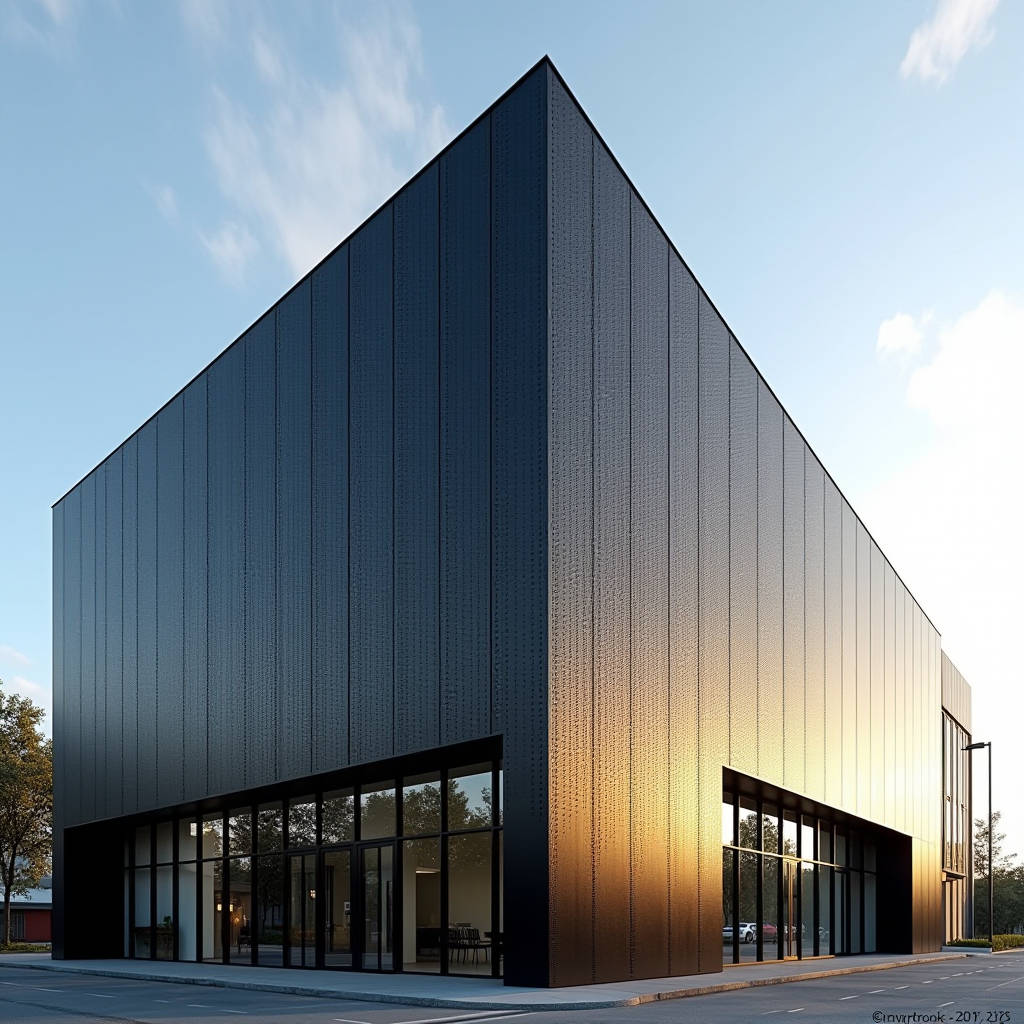
Specifying a black perforated aluminum sheet for a curtain wall or sunshade system is rarely a simple color decision. The black finish, the perforation geometry, and the base alloy all interact under real-world wind, thermal, and acoustic loads, and each choice changes how the panel performs on site. Too many project teams pick a hole pattern for looks alone, then discover that the open area collapses the panel's structural stiffness or that the coating fails within two years under coastal UV. This article walks through the engineering decisions that matter for a black perforated aluminum sheet in solid aluminum cladding: alloy and temper selection, perforation patterns and open area, coating systems for the black finish, and how to verify the panel against the loads it will actually carry. The goal is a specification that survives procurement, fabrication, and installation without costly surprises.
Why the Perforation Changes the Engineering, Not Just the Look
A solid aluminum panel and a black perforated aluminum sheet are two different structural members. Removing material through perforation drops the effective section modulus and changes how the panel distributes bending stress. The open area ratio, hole diameter, and stagger pattern all shift the panel's flexural behavior, and the black coating adds a thermal absorption layer that raises the operating temperature of the metal. Ignoring either factor produces deflection problems that appear only after the panel is on the facade.
Alloy and Temper: The Base That Carries the Load
For architectural cladding, 3003-H14 is the standard workhorse. The H14 temper means the alloy is strain-hardened to a half-hard condition, giving a good balance of strength and formability. Perforating a fully annealed sheet leaves the material too soft to hold flatness across a large panel, while a fully hard temper becomes brittle at the punched hole edges. The 3003-H14 alloy also delivers corrosion resistance that matters when the black finish is scratched during installation or when the perforation edges expose bare metal to atmospheric moisture. The table below compares the common options for a perforated cladding substrate.
| Alloy / Temper | Typical Yield Strength (MPa) | Formability | Corrosion Resistance | Best Use |
|---|---|---|---|---|
| 3003-H14 | 145 | Good | Excellent | Standard architectural cladding and sunshades |
| 5052-H32 | 195 | Moderate | Excellent | Marine and high-wind coastal zones |
| 6061-T6 | 240 | Poor after heat treat | Good | Structural frames and load-bearing members |
| 1100-H14 | 105 | Excellent | Good | Decorative interior screens only |
For a facade-grade black perforated aluminum sheet, 3003-H14 at 2.0 to 3.0 mm thickness is the practical default. If the project sits within 500 meters of salt water, consider 5052-H32 for the substrate even though the coating will cover most of the surface, because the punched hole edges and the back face remain exposed where the black finish is not applied.
Perforation Geometry: Open Area, Hole Size, and Stagger
The perforation pattern controls three things at once: the open area that drives airflow and acoustic absorption, the structural stiffness that resists wind load, and the visual texture of the black facade. These three requirements pull in opposite directions, so the specification must fix the open area first and then check the structural consequences.
Open Area and Its Structural Cost
Open area is the percentage of the sheet surface removed by holes. Common architectural values run from 20% to 50%. Higher open area improves ventilation and acoustic performance but reduces the panel's effective stiffness roughly in proportion to the remaining material. A simple rule of thumb: at 40% open area, expect the effective flexural stiffness of the panel to drop to roughly 60% of the solid sheet value. This is why a black perforated aluminum sheet with a high open area needs either a thicker base gauge, a tighter support grid, or a deeper edge hem to hold flatness under wind suction.
Hole Size and Stagger Pattern
Round holes in staggered diagonal rows are the most common architectural pattern because they distribute material loss evenly in both directions. Hole diameter typically ranges from 3 mm to 12 mm for facade work. Smaller holes read as a finer texture and give a more uniform black appearance from street level, while larger holes create a stronger visual rhythm and allow more light through. The stagger pattern, usually 60-degree diagonal spacing, keeps the remaining ligament between holes consistent so the panel does not develop a weak line along a single row. The table below summarizes how pattern choices affect performance.
| Hole Diameter (mm) | Typical Open Area | Visual Texture | Acoustic / Airflow | Structural Note |
|---|---|---|---|---|
| 3 - 5 | 20 - 30% | Fine, uniform black | Moderate | Closest to solid panel stiffness |
| 6 - 9 | 30 - 40% | Medium, visible pattern | Good | Needs thicker gauge or tighter grid |
| 10 - 12 | 40 - 50% | Coarse, strong rhythm | Excellent | Requires structural verification |
When the black perforated aluminum sheet is used as a rain screen or sunshade rather than a structural panel, the engineer can accept higher open area because the panel transfers load to a supporting frame. When the panel is edge-retained and spans unsupported between mullions, keep open area below 35% or increase the gauge.
The Black Finish: Coating Systems That Survive the Sun
The black color is the most demanding part of the specification. Black absorbs nearly all incident solar radiation, driving the panel surface temperature well above that of a light-colored panel. A black perforated aluminum sheet can reach 70 to 85 degrees Celsius on a clear summer afternoon, and every degree of extra temperature accelerates coating degradation and increases thermal expansion stresses at the fasteners.
PVDF vs. Polyester for the Black Coating
For exterior facades, a 70% PVDF (polyvinylidene fluoride) coating is the industry standard. The resin system is formulated to resist chalking and color fade under intense UV, which matters more for black than for any other color because fading shows immediately as a gray or brown cast. A polyester coating costs less but typically fades and chalks within three to five years on a black exterior panel. The table below compares the two systems on the parameters that matter for a dark facade.
| Coating System | Typical DFT (microns) | UV Resistance | Color Retention | Typical Warranty |
|---|---|---|---|---|
| 70% PVDF (Kynar 500) | 25 - 30 | Excellent | Excellent | 20 - 25 years |
| Polyester | 20 - 25 | Poor to fair | Poor on black | 5 - 10 years |
| FEVE (fluoroethylene vinyl ether) | 25 - 35 | Excellent | Excellent | 20 - 25 years |
Specify a 70% PVDF coating to AAMA 2605 for the black perforated aluminum sheet. AAMA 2605 sets the highest performance bar for exterior architectural coatings, including accelerated weathering, humidity, and adhesion testing. For projects that cannot justify the AAMA 2605 premium, AAMA 2604 is the acceptable middle tier, but avoid AAMA 2603 for any black exterior panel because its weathering requirements are too lenient for a dark color.
Anodizing as an Alternative Black Finish
Black anodizing offers a different trade-off. An anodized black finish is integral to the metal, so it does not chalk or peel the way a paint film can, and it is extremely hard and scratch resistant. However, anodized black on a 3003 alloy can show slight color variation between production batches, and the finish is more sensitive to acid rain and alkaline cleaning agents than a PVDF film. For a black perforated aluminum sheet used indoors or in a sheltered location, black anodizing is a strong choice. For a fully exposed facade, PVDF remains the safer specification.
Wind Load, Deflection, and Acoustic Performance
Perforated panels are not just lighter visually; they also allow wind to pass through, which changes the pressure coefficient compared with a solid panel. A perforated rain screen with more than 30% open area experiences lower net wind pressure because air flows through the openings and equalizes pressure across the panel. This is an advantage, but it also means the panel does not act as a rigid barrier, so the supporting structure must be designed for the perforated behavior rather than copied from a solid-panel detail.
Deflection Control
For a facade panel, the common deflection limit is L/60 to L/90 of the span under design wind load, per the guidance in the ASTM E330 structural performance test. A black perforated aluminum sheet with high open area will deflect more than a solid sheet of the same gauge, so the fabricator must either increase thickness, reduce the unsupported span, or add stiffening ribs behind the panel. When the panel is specified with a 40% open area, plan on a support grid spacing roughly 25% tighter than you would use for a solid panel of the same gauge.
Acoustic Absorption
Perforated panels are frequently paired with an acoustic backing layer, such as a mineral wool or polyester felt, to create a sound-absorbing facade or ceiling. The open area and hole size determine the absorption bandwidth. A black perforated aluminum sheet with 30 to 40% open area and 6 to 9 mm holes, backed by a 25 to 50 mm acoustic batt, delivers a useful mid-frequency absorption coefficient in the range of 0.6 to 0.8. The black finish does not affect the acoustic performance, but it does affect how the panel reads visually against the dark backing, so specify the backing color to match the black panel for a clean appearance through the holes.
Fabrication, Tolerances, and Procurement
Perforation is done before the coating is applied, so the punched hole edges receive the same black finish as the face. This is a critical quality point: a black perforated aluminum sheet that is coated after perforation shows bare aluminum on the hole edges if the coating is applied by a process that does not cover the cut edge. Specify that the coating be applied after perforation, and require a salt-spray test report on the finished panel per ASTM B117 to confirm the edges are protected.
What to Put in the Procurement Specification
- Alloy and temper: 3003-H14 (or 5052-H32 for coastal sites), gauge 2.0 to 3.0 mm.
- Perforation: hole diameter, stagger pattern, and open area ratio, all stated as a range with a tolerance of plus or minus 2% open area.
- Coating: 70% PVDF to AAMA 2605, applied after perforation, with a minimum DFT of 25 microns.
- Flatness: maximum deviation of 2 mm per meter after fabrication, verified before coating.
- Edge condition: deburred holes, no sharp burrs that will damage the coating or cut installers.
- Test reports: AAMA 2605 weathering, ASTM B117 salt spray, and ASTM E330 structural performance.
When you need a reliable partner for a large-volume black perforated aluminum sheet program, Futeng® has the fabrication capacity and coating lines to hold consistent open area and color across multi-thousand-panel orders. A single-source supplier that controls the perforation, coating, and flatness in one facility reduces the tolerance stack that causes field fit problems.
Practical Specification Guidance
Start the specification by fixing the open area, because it drives every downstream decision. Choose the open area from the ventilation and acoustic requirements first, then select the gauge and support spacing to hold the deflection limit. Specify the black finish as 70% PVDF to AAMA 2605 for any exterior exposure, and require coating after perforation so the hole edges are protected. Ask the fabricator for a sample panel at full size so the color, texture, and flatness can be judged under real light before the order is placed.
For a black perforated aluminum sheet, the finish is not a cosmetic afterthought; it is a performance specification that determines how long the facade keeps its color and integrity. Treat the perforation as a structural modification, not a decorative detail, and the panel will perform as designed for decades. Verify the coating warranty, the open area tolerance, and the structural test report before procurement, and the project avoids the most common causes of premature black panel failure.