Structural Engineering of Custom Perforated Aluminum Sheet for Curtain Wall Facades
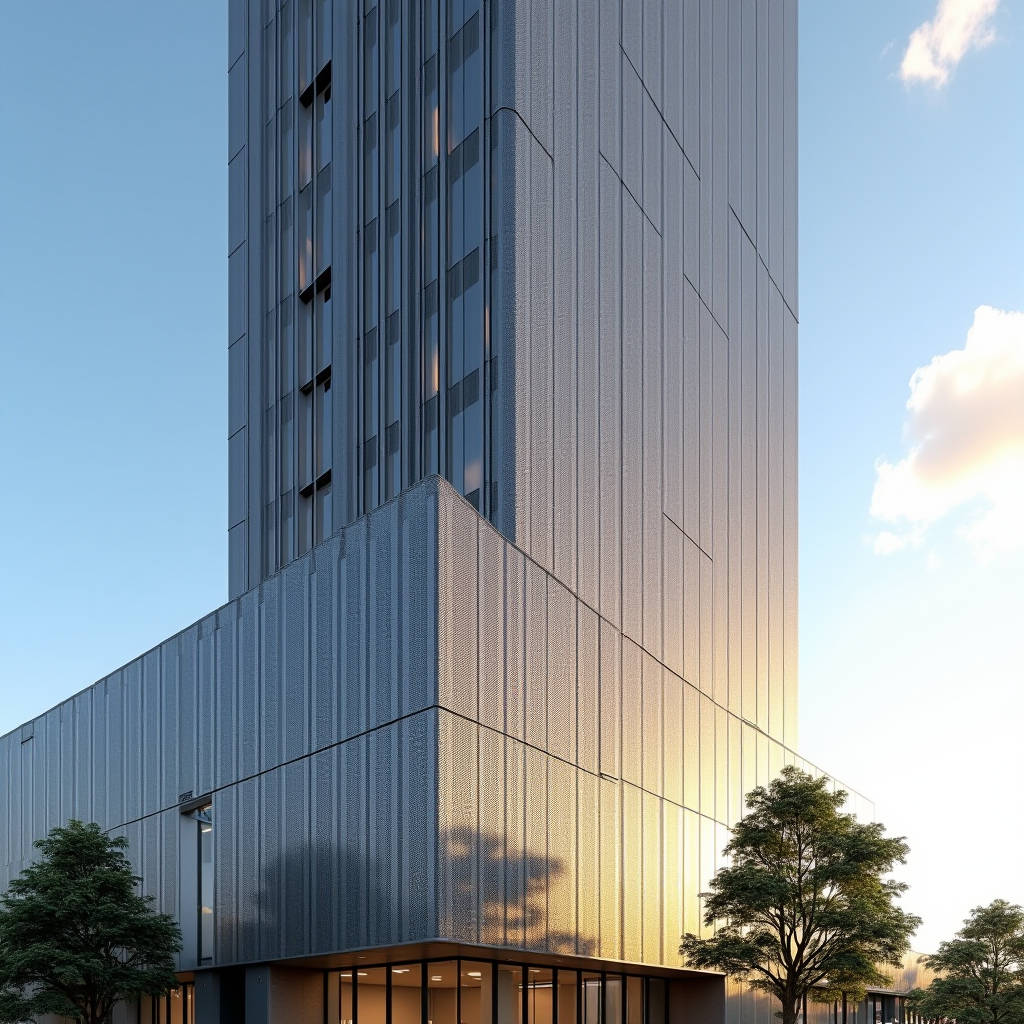
When a curtain wall spec calls for a custom perforated aluminum sheet, the real engineering work starts long before the punch press runs. Perforated aluminum is not a single product but a system of interdependent variables—alloy, temper, hole geometry, open area, edge treatment, and finish—that together determine structural capacity, wind load behavior, acoustic performance, and long-term durability. Too many projects treat the perforated panel as a decorative afterthought and discover later that the open area undermines the structural modulus or that the coating fails at the cut edges. This article walks through the load-path, fabrication, and specification decisions that separate a reliable custom perforated aluminum sheet supply from a costly field correction, with practical numbers for the curtain wall and rainscreen contractor.
Why the custom perforated aluminum sheet is a structural member, not a skin
Architects often request a custom perforated aluminum sheet for its visual rhythm—staggered round holes, slotted louvers, or hexagonal patterns—but the panel carries real loads. On a ventilated rainscreen, the perforated face sheet must transfer wind suction and pressure back to the subframe through its own bending stiffness. Perforating removes material and lowers the effective elastic modulus of the sheet. As a rule of thumb, a panel with 40 percent open area retains roughly 45 to 55 percent of the bending stiffness of the equivalent solid sheet, depending on hole layout and ligament width. The practical consequence is that a 2.0 mm perforated panel behaves closer to a 1.2 mm solid sheet under flexure, so the engineer must either increase sheet thickness, reduce support spacing, or add stiffening ribs.
For a custom perforated aluminum sheet, the critical calculation is the open area ratio and the resulting net section. Open area is the percentage of the sheet removed by holes, and it drives both airflow and structural capacity. A 3 mm round hole on a 5 mm staggered pitch yields roughly 65 percent open area—excellent for sun screening but structurally weak. A 5 mm hole on a 10 mm pitch gives about 23 percent open area and behaves far more predictably under wind load. The specifier should always request the open area percentage from the perforator and verify it against the structural model rather than assuming a standard pattern.
Alloy and temper selection for curtain wall duty
Not every aluminum alloy belongs on a building facade. The three alloys that dominate architectural perforation are 3003, 5052, and 6061, and each earns its place under different conditions. The 3003 alloy is the workhorse for general architectural screening because it balances formability with corrosion resistance and cost. It is not heat treatable, so strength comes from strain hardening, and a common temper for perforated sheet is H14 (half-hard). The H14 temper gives a good compromise between stiffness and the ductility needed to accept cleanly punched holes without cracking the ligament bridges.
For coastal or industrial environments where chloride exposure is aggressive, 5052 offers markedly better corrosion resistance than 3003. The magnesium content in 5052 raises its strength and improves its resistance to salt attack, making it the safer choice for marine facade projects. The 6061 alloy brings the highest strength of the three, and because it is heat treatable to a T6 temper, it suits structural perforated members where the panel itself carries significant load. The tradeoff is reduced formability and a higher unit cost, so 6061 is reserved for load-bearing perforated screens rather than decorative cladding.
For a custom perforated aluminum sheet on a typical curtain wall, the most defensible default is 5052-H32 or 3003-H14, with the final call made on the basis of the project's environmental exposure and the structural model. The temper matters as much as the alloy: a fully annealed sheet is easy to punch but too soft to hold its flatness across a large panel, while an over-hardened sheet risks edge cracking at the perforations. Specify the temper explicitly on the drawing and require the mill certificate to confirm it.
Hole geometry, pattern, and open area engineering
The geometry of the perforation is the single most controllable variable in the design, and it affects everything from airflow to acoustic absorption to structural integrity. Hole shapes fall into round, square, slotted, and custom decorative profiles. Round holes on a staggered (60-degree) pattern are the industry standard because they deliver the highest open area for a given ligament width and distribute stress evenly. Square holes on a straight pattern are easier to lay out visually but concentrate stress at the corners, which can initiate cracking under cyclic wind loading.
Slotted perforations are the preferred choice when the panel must double as a sunshade or a ventilation louver, because the elongated openings can be oriented to block direct solar radiation while allowing airflow. The slot width and length, together with the ligament spacing, define the open area and the structural penalty. For acoustic applications, the perforation pattern is tuned to the noise spectrum of the space: smaller holes on a tight pitch absorb higher frequencies, while larger holes with a deeper air cavity absorb lower frequencies. The perforated sheet is usually paired with a non-woven acoustic backing and an air gap, and the combination is modeled against the target noise reduction coefficient (NRC).
Every custom perforated aluminum sheet drawing should include four parameters: hole diameter or slot dimensions, center-to-center spacing, pattern orientation (staggered or straight), and the resulting open area percentage. The perforator's tooling constraints matter here—a hole diameter smaller than the sheet thickness is difficult to punch cleanly, and a ligament width less than 1.5 times the sheet thickness risks tearing. A practical rule is to keep the ligament width at least equal to the sheet thickness for round holes and at least 1.5 times the thickness for square holes.
Edge treatment and finish: where perforated panels fail
The cut edges of a perforation are the most vulnerable points on the entire panel, because the punching process exposes fresh aluminum that has no protective oxide layer and no coating. If the finish is applied after perforation, the coating can bridge or clog the holes, reducing the effective open area and creating an uneven appearance. If the finish is applied before perforation, the punched edges remain bare and become initiation sites for corrosion, especially in coastal air. The correct sequence for architectural panels is to perforate first, then clean and finish, so that the coating fully covers the cut edges.
The finish specification is inseparable from the perforation. For exterior curtain wall duty, a two-coat or three-coat PVDF (polyvinylidene fluoride) system is the standard, with a dry film thickness of approximately 25 to 30 microns for the total system. The PVDF resin content should be at least 70 percent to meet the AAMA 2605 performance specification, which covers the most demanding exterior environments. For interior decorative panels, a powder coating is a lower-cost alternative, but it is not recommended for exterior exposure because it lacks the UV and chalk resistance of PVDF. Anodizing is another option for a metallic finish, but the anodic layer is thin and does not tolerate the sharp edges of perforations as well as a baked-on coating.
Before finishing, the perforated panel must be deburred. Punching leaves a burr on the exit side of the sheet, and an unfinished burr will catch the coating, create a rough edge, and collect dirt. Specify a deburring pass on both faces, and inspect the hole edges under magnification on the first article. A clean, radiused edge also reduces the risk of stress concentration fatigue at the perforation boundary.
Fabrication tolerances and flatness control
Large perforated panels are prone to distortion because removing material relieves internal stress unevenly. A 3.0 mm sheet with a high open area can bow or oil-can after perforation, and once the panel is bowed, it is nearly impossible to pull flat on site. The perforator should stress-relieve or flatten the sheet after punching, and the specifier should set a flatness tolerance in the procurement document. A reasonable acceptance criterion for a curtain wall panel is a deviation of no more than 2 mm over a 1.5 m straightedge, measured on the finished panel.
Hole position tolerance is equally important when panels are installed in a grid, because misaligned perforations create a visible discontinuity across the facade. Specify a hole-to-hole positional tolerance of plus or minus 0.5 mm and a pattern-to-panel-edge tolerance that keeps the perforation field centered. For panels that must align across a joint, the perforation pattern should be referenced to a datum edge, and the fabricator should confirm that the pattern is continuous across the butt joint rather than resetting the pattern on each panel.
Wind load, deflection, and the structural model
The structural design of a custom perforated aluminum sheet must account for the reduced effective section. The engineer should calculate the net section modulus by deducting the perforation area from the gross section, and then apply the appropriate wind load from the local building code. For a typical high-rise facade in a moderate wind zone, the design wind pressure might range from 1.0 to 1.5 kPa, and the panel deflection under that load should be limited to L/120 to L/150 to prevent the perforation pattern from appearing to ripple.
Because perforated panels are lighter and more flexible than solid panels, they can be more susceptible to flutter and vibration in high winds. The natural frequency of the panel should be checked against the vortex shedding frequency of the wind, and the support spacing adjusted to keep the panel out of resonance. In practice, reducing the support spacing from 600 mm to 450 mm can raise the panel's natural frequency by roughly 40 percent, which is often enough to avoid problematic vibration without increasing sheet thickness.
Cost drivers and procurement strategy
For the buyer, the cost of a custom perforated aluminum sheet is driven by four factors: alloy, sheet thickness, open area, and finish. Thicker sheet and higher open area both increase the cost because they slow the punching process and consume more material. A 2.0 mm 5052 sheet with 30 percent open area and a PVDF finish will typically cost more per square meter than a 1.5 mm 3003 sheet with 20 percent open area and a powder coat, but the difference is often justified by the structural and durability requirements. The buyer should request a quote that separates material, perforation, deburring, and finishing costs so that the tradeoffs are transparent.
When sourcing a custom perforated aluminum sheet for a large curtain wall package, the buyer should qualify the perforator on the basis of tooling capability, flatness control, and finish quality rather than price alone. A reliable supplier such as Futeng® can consolidate the perforation, deburring, and PVDF finishing under one roof, which reduces the risk of coating defects at the punched edges and shortens the lead time. For a facade project, insist on a first-article inspection that verifies open area, hole position, flatness, and coating thickness before full production begins.
Reference data for specification
| Parameter | 3003-H14 | 5052-H32 | 6061-T6 |
|---|---|---|---|
| Typical tensile strength (MPa) | 145–185 | 215–265 | 290–310 |
| Yield strength (MPa) | 115–145 | 160–200 | 240–275 |
| Corrosion resistance (coastal) | Good | Excellent | Good |
| Formability for perforation | Excellent | Good | Fair |
| Recommended finish | PVDF / powder | PVDF | PVDF / anodize |
| Typical use | Decorative screens | Marine facades | Load-bearing screens |
For coating performance, the AAMA 2605 specification is the benchmark for exterior architectural finishes, requiring a minimum PVDF resin content of 70 percent and a total dry film thickness of approximately 25 to 30 microns. Projects in less severe environments may reference AAMA 2604, which allows a slightly thinner film. The applicable material standards include ASTM B209 for aluminum sheet and plate, which governs the alloy and temper designation, and the perforation pattern itself is commonly detailed in accordance with the perforated metal industry's standard hole and pitch tables.
Practical closure for the specifier and buyer
The reliable path to a durable custom perforated aluminum sheet begins with a clear structural model that treats the panel as a loaded member, not a decorative skin. Specify the alloy and temper deliberately for the environment, set the open area and hole geometry against the structural and acoustic requirements, and require deburring plus a post-perforation finish that covers the cut edges. Confirm flatness and hole position tolerances on the first article, and qualify the perforator on tooling and finish capability. When these decisions are locked in the drawing and the procurement document, the perforated facade performs as designed for decades, and the field team avoids the costly rework that follows an under-specified panel.