Hyperbolic Aluminum Panel Fabrication Methods and Procurement Benchmarks for Curtain Wall Contractors
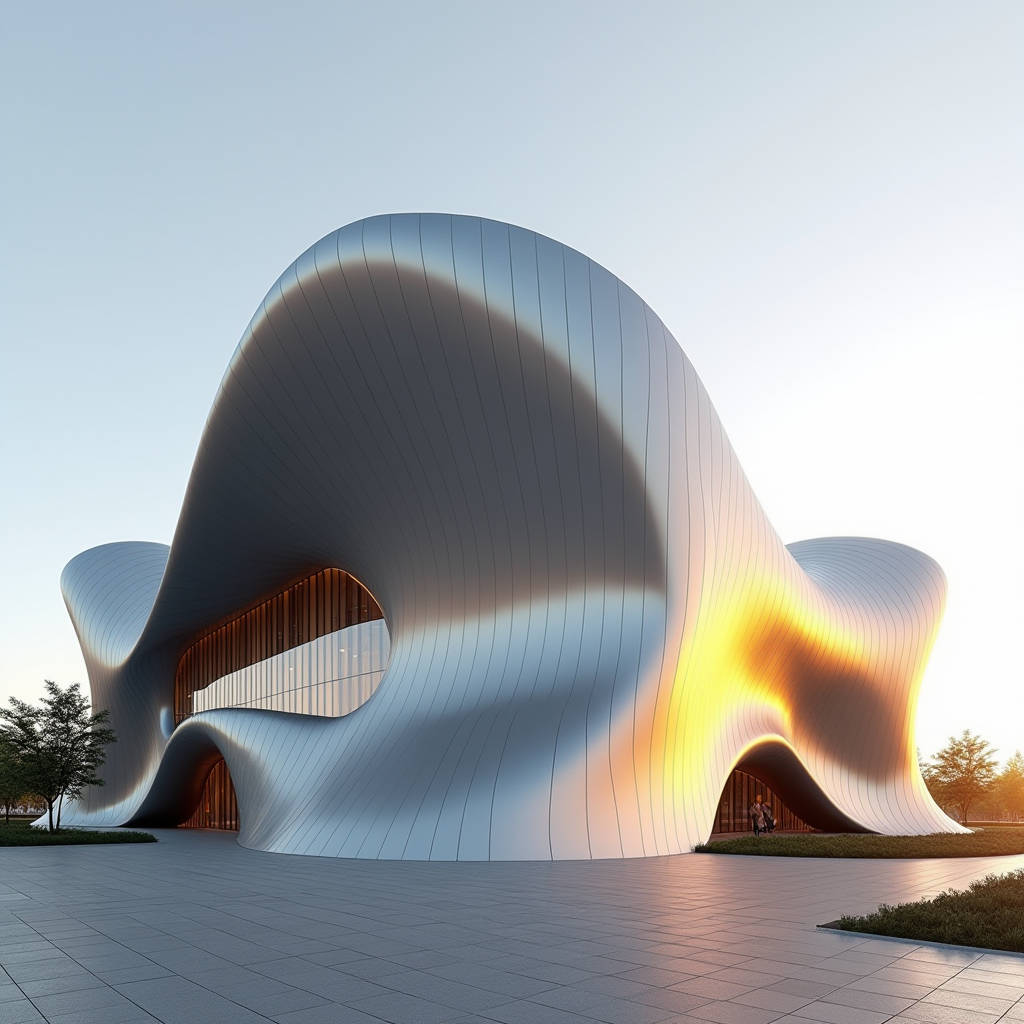
When a façade specification lands on your desk calling for a hyperbolic aluminum panel, the first question isn't about aesthetics. It's about whether the geometry is actually fabricable, how much the tooling will cost, and whether the lead time quoted by the factory is realistic. A hyperbolic paraboloid surface—curving in two opposing directions simultaneously—cannot be achieved with flat sheet metal without compound curvature forming. This means the panel must be either stretch-formed over a CNC-machined mold or incrementally pressed using multi-point die systems. Either route demands engineering precision that eliminates about 70% of general aluminium cladding suppliers from consideration before you even discuss pricing.
What Makes a Hyperbolic Aluminum Panel Structurally Different
Standard single-curved panels—cylindrical bends, barrel vaults, simple radius sweeps—can be roll-formed or brake-pressed with relatively straightforward machinery. A hyperbolic aluminum panel introduces Gaussian curvature. The surface is anticlastic: it curves upward in one axis and downward in the perpendicular axis. Think of a saddle shape, or the iconic rooflines of certain airport terminals and cultural buildings.
This geometry forces the material into simultaneous tension and compression across different zones. Solid aluminium sheet (2.5mm or 3.0mm 5005-H14 or 3003-H14 alloy, never composite) must be formed without thinning beyond tolerance, cracking at the grain boundaries, or springing back after release. The springback compensation alone requires iterative adjustment of the die geometry, typically adding 3–5 days to the sampling phase.
Field Note: On a project with 240 hyperbolic panels for a museum atrium in Southeast Asia, the factory ran 7 die revisions before achieving a profile deviation under 2mm across a 1.2m × 1.8m panel. The sampling phase consumed 18 working days. Budget for this. If a supplier claims they can nail it in one shot, ask to see the last 3 hyperbolic jobs they shipped.
Forming Methods: Stretch Forming vs. Multi-Point Pressing
Two dominant processes exist for producing hyperbolic aluminum panel geometries. The choice affects cost, lead time, surface quality, and the minimum achievable radius.
Stretch Forming Over Fixed Molds
A CNC-machined mold—typically milled from high-density polyurethane or steel for larger runs—replicates the negative of the target hyperbolic surface. The aluminium sheet is clamped at its perimeter and stretched over the mold, inducing plastic deformation until the material conforms to the mold profile. This method delivers excellent repeatability. Panel-to-panel consistency stays within ±1.5mm for production runs up to 500 units. The downside: mold cost. A single mold for a 1.5m × 2.0m panel can run $3,000–$8,000 depending on complexity, and that cost amortizes across the project quantity.
Multi-Point Digital Pressing
An array of individually adjustable hydraulic pins forms a reconfigurable die surface. The pins are set to the required hyperbolic coordinates, and the aluminium sheet is pressed against this pin matrix, often with a polyurethane interlayer to prevent dimpling. No dedicated mold is required, which slashes upfront tooling cost. However, surface smoothness can be slightly compromised—visible pin marks may telegraph through on thinner gauges. For 2.0mm material, this method is borderline; 2.5mm and 3.0mm sheets handle it better. Panel accuracy typically lands in the ±2.5mm range, which is acceptable for most curtain wall systems when gasket tolerances are factored in.
| Parameter | Stretch Forming (Fixed Mold) | Multi-Point Pressing (Digital Die) |
|---|---|---|
| Tooling Cost per Panel Design | $3,000–$8,000 (mold fabrication) | $500–$1,200 (setup & programming) |
| Dimensional Accuracy | ±1.5mm | ±2.5mm |
| Surface Finish Quality | Excellent, no tool marks | Good; minor pin marks possible on <2.5mm |
| Lead Time (First Article) | 15–22 working days | 10–15 working days |
| Economical Quantity | 50+ identical panels | 10–200 panels; ideal for low-volume |
| Maximum Panel Size | 2.0m × 4.0m (machine-dependent) | 1.5m × 3.0m typical |
| Minimum Alloy Thickness | 2.0mm (2.5mm recommended) | 2.5mm minimum |
Alloy Selection and PVDF Coating on Compound Curves
Not all aluminium alloys tolerate the elongation demands of hyperbolic forming. 5005-H14 is the workhorse for architectural curved panels—it offers roughly 8–12% elongation before fracture, which is sufficient for most hyperbolic geometries with moderate curvature depth. For more aggressive geometries with deeper draws, 5052-H32 can stretch to 12–18% elongation but costs approximately 15–20% more per kilogram. 3003-H14 sits in between and is widely available across Asian supply chains.
Coating a hyperbolic aluminum panel introduces its own set of challenges. The PVDF fluorocarbon system—typically a 3-coat or 4-coat application with primer, color coat, and clear topcoat—must be applied after forming, not before. Forming a pre-coated sheet will crack the finish at the high-strain zones. The post-forming spray process requires the painter to maintain consistent gun distance across a surface that curves away in two directions. This is where factory experience counts. A ASTM D3359 cross-hatch adhesion test on a curved coupon taken from the actual panel edge is non-negotiable for quality assurance.
Total dry film thickness for exterior-grade PVDF should fall between 30–40 microns per coat, with the full system reaching 90–120 microns. On hyperbolic surfaces, the factory should measure DFT at a minimum of 5 points per panel—the curvature inevitably causes slight variation in spray deposition. Color consistency across panels measured with a spectrophotometer should hold Delta E ≤ 1.5 under ISO 11664-4 lighting conditions.
Pro Tip: Always request a 300mm × 300mm curved sample coupon—not a flat swatch—for color approval. A flat sample tells you nothing about how the metallic flake orientation shifts across the hyperbolic surface. We've seen Delta E readings jump from 0.8 on a flat coupon to 2.3 on the curved zone, which is enough to get flagged during a site inspection.
Supply Chain Reality: What Procurement Managers Need to Know
Ordering hyperbolic aluminum panel systems is fundamentally different from procuring standard flat cladding. Here is what the RFQ process should account for.
Minimum Order Quantity and Economies of Scale
Most factories specializing in curved solid aluminium panels set MOQ around 50–100m² for hyperbolic work. Below that threshold, the mold amortization or digital press setup cost makes the per-square-meter price spike sharply. At 50m², expect pricing in the $180–$280/m² range FOB for 2.5mm PVDF-coated hyperbolic panels, depending on curvature complexity. At 500m²+, this can drop to $120–$180/m² as the fixed costs distribute across volume.
Packaging and Freight Considerations
Hyperbolic panels do not stack flat. Each panel requires a dedicated timber or steel cradle that maintains the formed geometry during transit. For FOB shipments, crating adds roughly $8–$15/m² to the invoice. For CIF deliveries, verify that the supplier uses desiccant packs inside the wrapping—condensation inside a sealed crate during sea freight can cause water staining on PVDF surfaces, and that's a rejection-worthy defect on arrival. Some suppliers, including Futeng®, have developed proprietary interlocking crate systems that reduce volumetric freight charges by 20–25% compared to single-panel crating.
Lead Time Benchmarks
A realistic production timeline for a hyperbolic aluminum panel order of 200–500m² breaks down as follows: mold design and CNC machining (7–12 days), first article sampling and client approval including courier transit (8–12 days), production run (15–25 days), and packing/loading (3–5 days). Total: 33–54 days from deposit to FOB. Expedited schedules are possible but expect a 15–25% surcharge for overtime shifts and air-freighting sample approvals.
Installation Tolerance Stack: Where Hyperbolic Panels Meet the Substructure
The curtain wall or steel substructure tolerance directly governs whether the panels will fit. A hyperbolic panel with ±1.5mm fabrication accuracy is useless if the supporting steel grid is off by ±10mm. The industry standard per AAMA TIR-A9 recommends that the substructure tolerance for curved façades be held to ±3mm in plane and ±5mm in depth. Anything looser will require adjustable bracketry with 15–20mm of three-axis adjustability, which adds cost and complexity.
Panel joint design deserves early attention. For hyperbolic surfaces, open-joint systems with a rear drainage plane are often preferred over fully sealed silicone joints. The reason: panel edge alignment across a compound curve is inherently more variable than on flat walls, and a 15–20mm open joint with a black EPDM gasket or baffle behind it forgives minor misalignments without compromising weather performance. This approach aligns with ISO 12631 guidance on rainscreen performance.
Quality Control Checks That Should Be in Your Inspection Protocol
If you're sending a third-party inspector to the factory—or visiting yourself—these are the specific checks that matter for hyperbolic work:
- Profile conformity: Place the panel on the original mold or a CNC-checked template. Measure gap at minimum 8 points around the perimeter. Deviation should not exceed 2mm at any point.
- Coating adhesion on curved zones: Perform ASTM D3359 cross-hatch test on the area of maximum curvature, not on a flat edge flange.
- DFT measurement: Take readings at the apex, saddle point, and four corner zones. Record all values. Flag any single reading below 25 microns for the topcoat.
- Edge burr and sharpness: Hyperbolic forming can leave sharp burrs at trim lines. Run a gloved hand along all edges. Any snagging means rework.
- Packaging integrity: Verify that the cradle supports the panel at the same contact points used during forming. A cradle that supports the panel differently can introduce creep deformation during the 4–6 weeks of ocean freight.
When Hyperbolic Aluminum Panels Make Economic Sense
Not every curved façade needs true hyperbolic geometry. Many designs can be approximated with single-curved panels and clever joint detailing—and that route is always cheaper. Hyperbolic aluminum panel fabrication becomes justified when the architectural intent demands a continuous, flowing surface where faceted approximations would be visibly disruptive. This typically applies to signature entrance canopies, performing arts center façades, airport terminal soffits, and high-end retail flagship stores where the client is willing to pay a 40–80% premium over standard curved panels for the geometric integrity.
The cost premium breaks down roughly as follows: 30–40% from forming complexity, 15–20% from higher scrap rates (expect 12–18% material waste vs. 5–8% for flat panels), 10–15% from specialized packaging, and the remainder from extended quality control and handling. If the project budget can absorb these multipliers, the result is a façade that flat panels simply cannot replicate.
For procurement teams evaluating suppliers, the filtering criteria should prioritize demonstrated hyperbolic project experience over price. Request a portfolio of 3–5 completed projects with photographic evidence and, ideally, contactable references. A supplier like Futeng® that maintains dedicated hyperbolic forming cells—rather than outsourcing the curved work to a subcontractor—offers a more controllable supply chain with fewer handoff risks. The difference between a smooth project and a dispute-ridden one often traces back to whether the factory owns the forming capability or brokers it.
Specifying a hyperbolic aluminum panel is ultimately a decision to invest in geometric precision. The engineering is mature, the supply base is specialized but accessible, and the quality benchmarks are well-defined. What separates successful projects from troubled ones is the rigor applied during the sampling, production, and inspection phases—and the willingness to pay for that rigor rather than chasing the lowest bid.