Curved Aluminum Panel Fabrication Tolerances and Alloy Selection for Façade Contractors
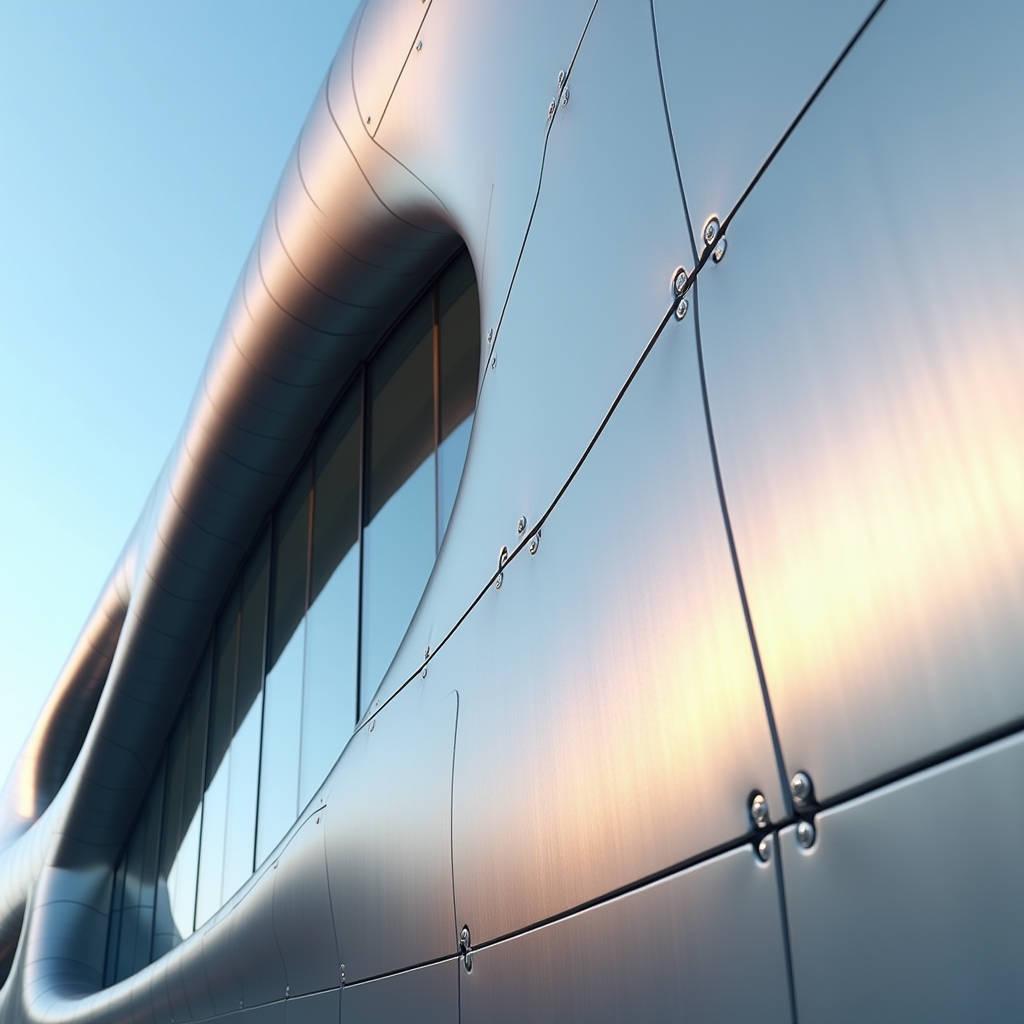
When a façade contractor first encounters a spec calling for a curved aluminum panel, the immediate questions are rarely about aesthetics. They're about radius tolerance, springback allowance, and whether the fabricator can hold a ±2mm profile across a 6-meter span. These are the real concerns that separate a smooth installation from a site full of rejected panels. A curved aluminum panel is not simply a flat sheet bent into shape. It is an engineered cladding component where material grade, bending method, and factory QC protocols directly determine whether the panel fits the substructure on the first attempt or requires costly field modifications.
What actually defines a curved aluminum panel in façade engineering
In the solid aluminium cladding sector, a curved panel begins as a flat sheet of alloy—typically AA1100, AA3003, or AA5052—cut to size and then mechanically formed into a specified geometry. The material is solid aluminium, not a composite sandwich. Standard thicknesses for curved applications run 2.0mm, 2.5mm, and 3.0mm. Anything below 2.0mm tends to exhibit oil-canning on concave surfaces. Anything above 3.0mm demands significantly higher tonnage on the press brake or three-roll bender, which increases cost and limits achievable radii.
The distinction matters because procurement managers often receive quotes that substitute ACP for solid aluminium without disclosure. A curved aluminum panel fabricated from solid 2.5mm AA3003 sheet behaves differently under wind load than a 4mm ACP with a 0.5mm aluminium skin. The solid panel's flexural stiffness is uniform through the cross-section. The ACP's stiffness depends on the polyethylene core, which creeps under sustained load. For curved geometries, creep means the panel can slowly flatten over time—a failure mode that has led to warranty claims on several high-rise projects in Southeast Asia.
Field Note: When reviewing submittals for curved panels, always request the mill certificate for the raw coil or sheet. Check that the alloy designation matches the spec. We've seen fabricators stamp AA3003 on shop drawings while using recycled AA1100 from unknown sources. The difference in yield strength can be 30-40 MPa, and that directly affects springback prediction.
Roll bending versus press braking: choosing the right forming method
Two primary methods produce curved aluminum panel geometries in commercial façade work: three-roll bending and press braking (segmented or continuous). The choice between them is not arbitrary—it governs achievable radius, surface quality, and cost per square meter.
Three-roll bending passes the sheet through adjustable rollers that progressively curve the metal. This method handles single-radius and conical geometries well. Minimum inside radius typically runs 3-4 times the material thickness for AA3003-O temper. For a 2.5mm sheet, that means a minimum radius of approximately 7.5-10mm. Tighter radii require annealing or switching to AA5052-H32, which can achieve roughly 2.5x thickness radii but costs 12-18% more in raw material.
Press braking uses a CNC-controlled punch and die to create segmented curves. Each bend segment is typically 10-20mm wide, producing a faceted approximation of a smooth curve. For large-radius panels above 3000mm, the faceting is visually negligible once the panel is installed at height. The advantage is precision: a well-calibrated press brake can hold ±0.5mm per bend segment, and the cumulative profile tolerance across a 4-meter panel can stay within ±2mm. That level of control matters when the panel must mate with extruded aluminium gaskets on a unitized curtain wall system.
| Parameter | Three-Roll Bending | Press Braking (Segmented) |
|---|---|---|
| Minimum radius (2.5mm AA3003) | ~7.5-10mm | ~15-20mm (segment-dependent) |
| Surface finish risk | Low—smooth continuous curve | Moderate—potential witness marks at bend lines |
| Profile tolerance (4m span) | ±3-5mm (springback-dependent) | ±1.5-2.5mm (CNC-controlled) |
| Tooling cost | Low—standard rollers | Moderate—custom die sets for complex radii |
| Typical production rate | 15-25 panels/shift | 8-15 panels/shift (complex curves) |
| Best suited for | Single-radius, conical, large-radius façades | Multi-radius, tight-tolerance unitized curtain wall |
Alloy selection and temper: the numbers behind springback
Springback is the single most misunderstood variable in curved aluminum panel fabrication. When a sheet is bent past its yield point and then released, some elastic recovery occurs. The amount depends on the alloy, temper, thickness, and bend radius. For AA3003-H14, springback typically ranges from 8-15° for a 90° bend. For AA5052-H32, it can reach 15-20°. This means the fabricator must over-bend to compensate, and the over-bend angle must be dialed in through trial samples—not calculated from a textbook formula.
AA3003-O (annealed) offers the lowest springback and the tightest formable radii. It is the workhorse for architectural curved panels where structural loads are moderate. AA5052-H32 provides roughly 40% higher yield strength (193 MPa vs. 138 MPa for AA3003-H14), making it the choice for high-wind zones or large unsupported spans. The trade-off is formability: AA5052-H32 requires larger radii and more powerful forming equipment.
For projects near coastal environments, alloy selection intersects with corrosion resistance. AA5052 has better salt-spray performance than AA3003. Combined with a properly applied PVDF coating (minimum 35 microns total dry film thickness per AAMA 2605), AA5052 panels can deliver 20+ years of service life within 500 meters of breaking surf. This is not theoretical—we have tracked installations in Dubai Marina and Singapore's Marina Bay where AA5052 curved panels with Kynar 500® PVDF show negligible filiform corrosion after 12 years.
PVDF coating on curved surfaces: why film thickness consistency is harder
Applying a fluoropolymer coating to a flat sheet before bending is standard practice. But on a curved aluminum panel, the coating must withstand the elongation of the outer surface during forming without cracking or thinning. This demands a PVDF system with sufficient flexibility—typically a Kynar 500® or Hylar 5000® resin content of at least 70% by weight in the color coat.
The real challenge is film thickness uniformity. On a flat panel, a spray line can hold ±5 microns across the surface. On a curved panel that has been post-formed, the coating on the tension side thins proportionally to the strain. For a 2.5mm sheet bent to a 500mm radius, the outer surface strain is approximately 0.5%. This reduces the 35-micron topcoat by roughly 0.2 microns—negligible. But for tighter radii below 100mm, the strain can exceed 2.5%, and the coating may thin by 1 micron or more. This is why pre-coated curved panels with radii under 100mm should be specified with a minimum 40-micron topcoat to compensate.
Pro Tip: If your project involves curved panels with radii under 150mm, consider post-forming PVDF application. Spray the coating after bending. This eliminates elongation-related thinning entirely. The downside: curved panels take up more space on the coating line, so throughput drops by 30-40%, and the fabricator will charge accordingly. Budget an extra $12-18/m² for post-formed coating versus pre-coat-and-bend.
Fabrication tolerances that actually matter on site
Shop drawings for curved aluminum panel systems often list tolerances that look impressive on paper but mean nothing during installation. What matters are the tolerances that affect fit-up with adjacent components. Based on feedback from installation teams across a dozen high-rise projects, here are the numbers to lock down in your specification:
- Panel chord length: ±1.5mm across any dimension up to 3000mm. This controls the gap between adjacent panels on a curved façade.
- Profile template match: ±2mm deviation from the approved template when the panel is placed on a checking fixture. This is the go/no-go test for curved geometry.
- Edge straightness: 0.5mm per 1000mm of edge length. Curved panels often have straight vertical edges that must align with mullions.
- Squareness of returns: ±0.5° on folded returns. Returns that are out of square create stepped joints that catch light and shadow inconsistently.
- Coating Delta E: ≤1.5 units when measured against the approved color standard under D65 illumination. This is tighter than the typical ≤2.0 for flat panels because curved surfaces catch light from multiple angles, making color variation more visible.
Futeng® and similar specialist fabricators typically achieve these tolerances through a combination of CNC forming, laser or water-jet cutting for blanks, and dedicated checking fixtures for each curved panel geometry. The checking fixture is a non-negotiable QC gate. Without it, the fabricator is essentially guessing whether the panel will fit.
Packaging and logistics: protecting curved geometry during transit
A curved aluminum panel is far more vulnerable to transit damage than a flat panel. Stacking curved panels without proper support introduces bending moments that can permanently deform the geometry. The standard approach for FOB and CIF shipments involves custom-cut EPS or EPE foam cradles that match the panel's curvature. Each panel sits in its own cradle, and cradles are stacked vertically in a timber crate with the panels oriented concave-side-down to prevent water pooling.
For a typical 40-foot HC container, a curved panel shipment might hold 120-180m² of panels depending on geometry. Flat panels in the same container might reach 400-500m². The lower packing density of curved panels increases freight cost per square meter by 2.5-3x. This is a real procurement consideration: a project requiring 2000m² of curved panels may need 5-6 containers versus 2-3 for flat panels. Ocean freight from major Chinese ports to the Middle East or Europe adds roughly $8-15/m² for curved panels versus $3-5/m² for flat.
Moisture is the second enemy. PVDF-coated aluminium is corrosion-resistant, but trapped moisture between nested panels can cause water staining, especially on darker colors. Every crate should include desiccant packs and be lined with VCI (volatile corrosion inhibitor) film. This is standard practice at factories that regularly export to humid climates, but it should be explicitly stated in the purchase order—not assumed.
Cost structure: what drives the price of curved panels
Procurement managers often ask for a simple price-per-square-meter figure. For curved aluminum panel work, that figure is meaningless without context. The cost drivers stack up quickly:
- Material alloy and thickness: 2.0mm AA3003 is the baseline. Moving to 2.5mm adds ~15% to material cost. Moving to AA5052-H32 adds another 12-18%.
- Curvature complexity: Single-radius panels are the cheapest. Multi-radius or freeform geometries require CNC programming, custom checking fixtures, and slower production rates. Cost multiplier: 1.3-2.5x over single-radius.
- Coating specification: Standard 3-coat PVDF (primer + color + clear) is the baseline. Metallic and mica finishes add 15-25%. 4-coat systems for extreme UV environments add 20-30%.
- Perforation or other secondary operations: Many curved panels also require acoustic perforation. Perforating before bending is standard, but the hole pattern distorts slightly during forming. This must be accounted for in the perforation layout.
- Quantity and repetition: A run of 500 identical curved panels will cost significantly less per square meter than 50 unique geometries. The setup cost—CNC programming, checking fixture fabrication, trial samples—is amortized across the quantity.
As a rough budgetary guide, a standard single-radius curved aluminum panel in 2.5mm AA3003 with 3-coat PVDF runs $65-95/m² FOB for quantities above 500m². The same panel in AA5052-H32 with a 4-coat metallic PVDF can reach $120-150/m². These are 2025-vintage numbers based on current aluminium ingot pricing and do not include freight, duties, or installation.
ASTM and ISO standards that govern curved panel quality
Specifying curved aluminum panel quality requires referencing the right standards. The core documents are:
- ASTM B209 — Standard specification for aluminium and aluminium-alloy sheet and plate. This governs the raw material before forming.
- AAMA 2605 — Voluntary specification for high-performance organic coatings on aluminium extrusions and panels. This is the standard for PVDF coating performance, including adhesion, impact resistance, and accelerated weathering.
- ISO 7599 — Anodizing and organic coatings on aluminium for architectural applications. The international counterpart to AAMA 2605, commonly referenced on projects outside North America.
- EN 13501-1 — Fire classification of construction products. Solid aluminium panels achieve A1 or A2-s1,d0 classification, which is critical for high-rise façades in markets that have tightened fire regulations post-Grenfell.
For the curved geometry itself, there is no single international standard that governs profile tolerance. Instead, the industry relies on project-specific tolerances defined in the specification and verified against an approved physical sample. The sample approval process—typically involving a 600mm x 600mm curved coupon with the specified coating—is the contractual reference for all subsequent production panels. Never skip this step.
Common failure modes and how to prevent them in specification
Having reviewed curved panel installations that went wrong, a few patterns repeat across projects regardless of geography or contractor experience:
Oil-canning on concave surfaces. This is the wavy distortion visible under grazing light. It results from residual stresses in the sheet that are not fully relieved during forming. Prevention: specify AA3003-O or AA5052-O temper for concave panels. The annealed condition has lower residual stress. Also, require a minimum 2.5mm thickness for any concave panel spanning more than 600mm between supports.
Coating cracking at tight radii. When the elongation of the outer surface exceeds the coating's flexibility limit, micro-cracks appear. These are invisible to the naked eye but allow moisture ingress. Prevention: specify a minimum bend radius of 4x material thickness for pre-coated panels, or require post-forming coating application for tighter radii.
Mismatch with substructure. The curved panel is fabricated to the theoretical geometry, but the installed substructure deviates from the BIM model. Prevention: require the façade contractor to provide as-built survey data of the installed substructure before releasing curved panels for fabrication. A 5mm deviation in the substructure at mid-span can turn a perfectly fabricated panel into a site reject.
Galvanic corrosion at attachment points. Stainless steel fasteners in contact with aluminium in the presence of moisture create a galvanic cell. Prevention: specify isolating washers or bushings at all fastener penetrations. This is standard practice but frequently omitted in value-engineering exercises.
How to qualify a curved panel fabricator
Not every aluminium cladding factory can produce curved panels to façade-grade tolerances. The equipment list tells you part of the story—a CNC three-roll bender and a calibrated press brake are minimum requirements—but the real differentiator is the QC workflow. When evaluating a supplier, ask for:
- A sample curved panel produced to your project's specific radius and coating spec. This is not the same as a generic sample from their showroom.
- Photographs of their checking fixture setup for a previous curved panel project. If they cannot show you a dedicated checking fixture, they are not controlling profile tolerance.
- Their procedure for springback compensation. A competent fabricator will describe iterative trial bends and digital angle measurement, not a one-size-fits-all over-bend value.
- Third-party test reports for PVDF coating adhesion and film thickness on a curved sample—not just on flat test panels.
Futeng® and other established manufacturers in the solid aluminium cladding sector maintain dedicated curved panel production cells with trained operators who understand that curved work is fundamentally different from flat panel fabrication. The operator skill component is significant: an experienced roll-bender operator can hold tighter tolerances on a manual machine than an inexperienced operator on a CNC machine. This is not a process that can be fully automated.
Lead times and project scheduling realities
Curved aluminum panel fabrication adds 2-4 weeks to the lead time compared to flat panels from the same factory. The additional time goes into CNC programming, checking fixture fabrication, trial sample production and approval, and the slower forming and handling rates. A realistic production schedule for a typical curved panel package of 800-1200m² looks like this:
- Sample approval (including trial bends and coating): 2-3 weeks
- Material procurement (if non-standard alloy/temper): 3-5 weeks
- Production: 4-6 weeks
- Packaging and container loading: 3-5 days
- Ocean freight (China to Europe): 4-5 weeks
Total: 13-19 weeks from order placement to site delivery. This timeline assumes the sample is approved on the first submission. If the sample requires rework—and curved panel samples often do—add 2-3 weeks per iteration. Smart project managers lock in the curved panel order early and treat the sample approval as a critical-path milestone.
Making the procurement decision: what matters at the finish line
When the bids come back for a curved aluminum panel package, the lowest price is rarely the best value. The cost of a failed panel—rejected on site, returned to the factory, re-fabricated, and re-shipped—can exceed the initial fabrication cost by a factor of three when you account for schedule delay. The smarter procurement approach weighs four factors equally: the fabricator's demonstrated experience with curved geometries, the robustness of their QC process, the clarity of their tolerance commitments, and finally the price.
The specification should be tight where it matters—profile tolerance, coating adhesion, alloy certification—and realistic where tightness adds cost without value. A ±1mm profile tolerance sounds impressive but is unnecessary for panels installed 30 meters above street level. A ±2mm tolerance with a verified checking fixture is more practical and keeps the bid list competitive. The goal is not perfection on paper. It is a curved façade that fits the substructure, resists the environment, and looks precisely as the architect intended for two decades or more.