Perforated Aluminum Sheet Suppliers Near Me That Handle Real Facade Work
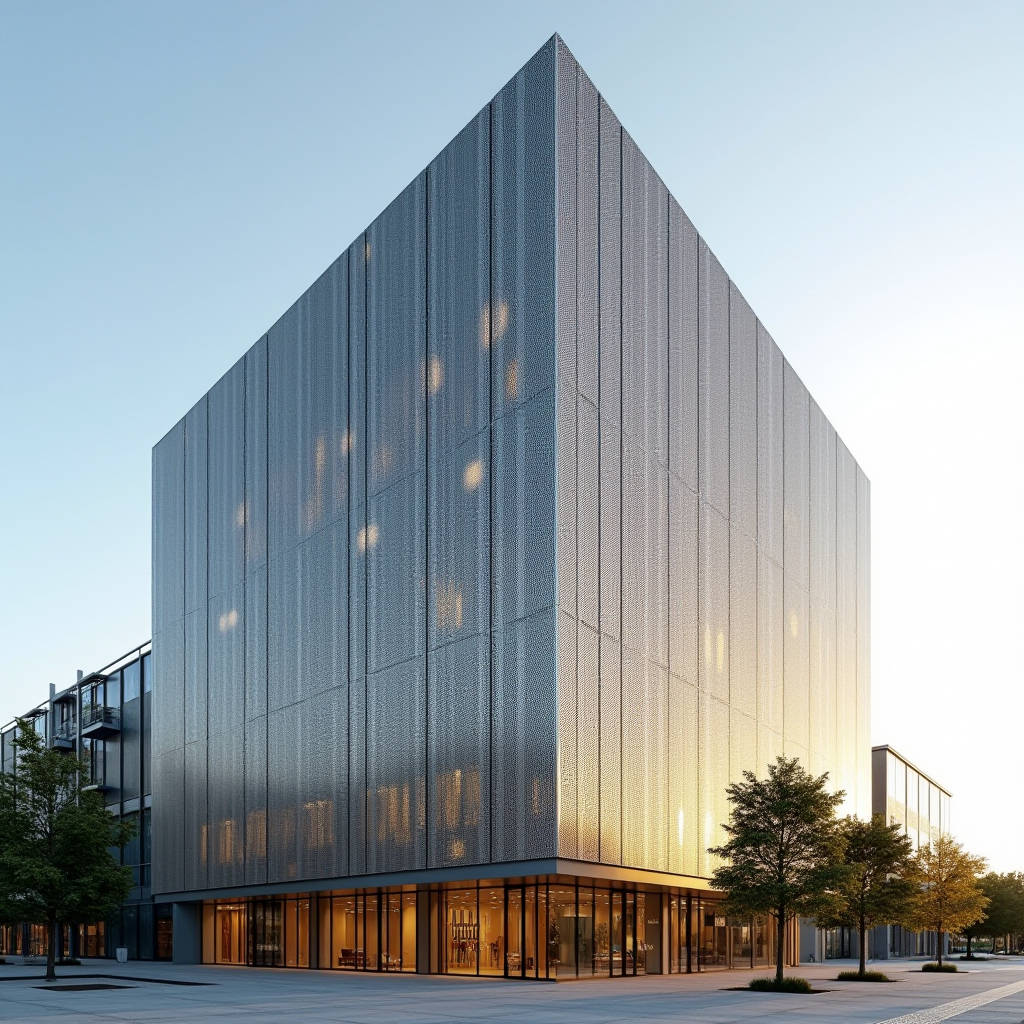
When a facade contractor types perforated aluminum sheet suppliers near me into a search bar, the results that come back are usually dominated by retail metal outlets, home-improvement chains, and small cut-to-size shops. Those listings serve a real purpose for small repairs and decorative panels, but they are rarely equipped to handle the demands of a curtain wall, a rainscreen, or a sunshade system on a commercial building. The difference is not just the size of the sheet or the punch pattern. It is the alloy, the temper, the coating system, the flatness tolerance, and the ability to produce thousands of identical panels with a consistent open area. This article walks through the engineering details that separate a true architectural supplier from a hardware-store shelf, and how to evaluate candidates before you commit a project schedule to them.
Why the Retail Search Results Miss the Mark
The first page of results for perforated aluminum sheet suppliers near me typically returns names like Metal Supermarkets, Lowe's, McMaster-Carr, Online Metals, and MetalsDepot. These are legitimate businesses, and they do offer perforated aluminum in a range of hole sizes and patterns. But the products they stock are almost always 3003-H14 alloy in thin gauges, sold as individual sheets or short coils. That configuration suits ventilation covers, filtration screens, and light decorative panels. It does not suit a building envelope that has to carry wind load, resist corrosion for decades, and hold a finish that matches the architect's color specification.
There are three structural differences between a retail perforated sheet and an architectural-grade panel. First, the alloy and temper. Retail stock is commonly 3003-H14, which is fine for formed parts but has a lower yield strength than the 5052-H32 or 5083 alloys that structural cladding often requires. Second, the sheet thickness. Retail catalogs rarely go beyond 0.125 inch (3.2 mm), and most stock sits at 0.040 to 0.080 inch. Architectural perforated panels are frequently specified at 2.0, 2.5, or 3.0 mm solid aluminum, sometimes with stiffening that a flat punched sheet cannot offer. Third, the coating. A retail sheet ships bare or with a light mill finish. A curtain wall panel needs a full PVDF (Kynar 500) coating system with a primer, a color coat, and a clear topcoat, applied to a controlled dry film thickness.
None of that is a criticism of the retail channel. It is simply a warning that the search phrase perforated aluminum sheet suppliers near me returns a different class of product than the one your project needs. If you are ordering one sheet for a vent, buy from the local outlet. If you are ordering 400 panels for a facade, you need a fabricator that behaves like a manufacturer, not a retailer.
What an Architectural Perforated Panel Actually Requires
An architectural perforated panel is not a punched sheet with holes in it. It is a composite of material selection, hole geometry, edge treatment, and finish that has to be engineered as a system. Start with the alloy. For exterior cladding, 3003-H14 is acceptable for light sunscreens and low-rise applications, but 5052-H32 offers roughly 40 percent higher yield strength and better fatigue resistance, which matters when the panel is large and subject to wind vibration. For coastal or high-humidity environments, 5083 or 5086 provide superior corrosion resistance. The alloy choice changes the punching behavior, the flatness after punching, and the way the panel responds to thermal expansion.
Hole geometry is the second decision. The most common patterns are round staggered holes, square holes, and slotted holes. The open area, expressed as a percentage, drives the visual effect, the shading coefficient, and the acoustic performance. A 3 mm round hole on a 5 mm staggered pitch gives roughly 40 percent open area. Drop the pitch and you increase open area but weaken the ligament between holes. The ligament, the strip of metal between adjacent holes, must stay above a minimum width relative to the sheet thickness or the punching process will distort the panel. A competent supplier will calculate this before quoting, not after.
Edge treatment is the third factor. A raw punched sheet has burrs on the back side, and the cut edges are susceptible to corrosion if the coating does not wrap around them. Architectural panels are either edge-folded, edge-trimmed with a U-channel, or laser-cut and deburred. The choice affects the panel's stiffness, its dimensional accuracy, and the way it integrates with the subframe. A panel that is perfectly flat in the middle but has a curled edge will never install cleanly.
Coating Systems and the PVDF Question
The finish on a perforated panel is not cosmetic. It is the primary corrosion defense, and it determines the color stability of the facade for the life of the building. The industry benchmark is a two-coat or three-coat PVDF system based on Kynar 500 or Hylar 5000 resin. AAMA 2605 is the specification that governs this class of coating, and it sets demanding requirements for accelerated weathering, humidity resistance, and color retention. A panel specified to AAMA 2605 will carry a dry film thickness of roughly 1.2 to 1.5 mils (30 to 38 microns) for the color coat, over a properly prepared and pretreated substrate.
Retail sheets are not coated to this standard. They ship bare or with a thin polyester film that has no meaningful UV resistance. If a contractor installs a bare perforated sheet on an exterior facade, the metal will oxidize, the surface will dull, and the edges will stain within a few years. The cost of recoating on site is prohibitive, and removal is worse. This is the single most common failure mode in projects where a retail sheet was substituted for an architectural panel.
When you evaluate a supplier for perforated aluminum sheet suppliers near me, ask for the coating certificate before you ask for the price. A serious fabricator will provide a certificate of conformance tied to AAMA 2605, a salt-spray test report, and a color chip that matches the approved architectural sample. If the supplier cannot produce these documents, the panel is not architectural grade regardless of how it looks in a photograph.
Coating Comparison Table
| Coating Type | Resin System | Typical DFT (mils) | UV Resistance | Salt-Spray Hours | Applicable Standard | Suitable For |
|---|---|---|---|---|---|---|
| Bare / Mill finish | None | N/A | Poor | N/A | None | Interior, temporary |
| Polyester (PE) | Polyester resin | 0.8–1.0 | Moderate | 500–750 | AAMA 2603 | Interior, low-exposure |
| Silicone polyester (SMP) | Silicone-modified | 0.8–1.0 | Good | 750–1000 | AAMA 2604 | Mid-rise, moderate climate |
| PVDF (Kynar 500) | 70% PVDF resin | 1.2–1.5 | Excellent | 4000+ | AAMA 2605 | Curtain wall, coastal, high-rise |
The table above is a practical shortcut. If a supplier's quoted panel carries a polyester coating, it will not meet the longevity expectations of a commercial envelope. Insist on PVDF with a certificate. The price difference is modest compared to the cost of a failed facade.
Engineering Data: Open Area, Wind Load, and Stiffness
Perforating a sheet removes material, which reduces both weight and stiffness. That trade-off has to be quantified before the panel is designed. As a rule of thumb, a 3 mm thick 5052-H32 panel with a 3 mm round hole on a 5 mm staggered pitch has an open area of roughly 40 percent. The weight drops from about 8.1 kg per square meter for solid 3 mm aluminum to about 4.9 kg per square meter after perforation. But the flexural stiffness drops by a larger factor than the weight, because the holes interrupt the continuous load path. A perforated panel with 40 percent open area can have its first-mode natural frequency reduced by 20 to 30 percent compared to a solid panel of the same thickness.
This matters for wind load. A large facade panel acts as a diaphragm, and the pressure coefficient across a perforated surface is different from a solid one because air passes through the holes, equalizing pressure on both sides. That can actually reduce the net wind load on the panel, which is one reason perforated screens are popular on high-rise balconies and sunshades. But the reduced stiffness means the panel is more prone to flutter and acoustic vibration in gusty conditions. The designer must check the panel's natural frequency against the expected vortex-shedding frequency, and in many cases add stiffening ribs or reduce the unsupported span.
A competent supplier will provide a deflection calculation for your specific hole pattern and panel size. The deflection of a simply supported rectangular plate under uniform load can be estimated with standard plate formulas, but the perforation requires a correction factor. For a 40 percent open area, the effective modulus is roughly 60 to 70 percent of the solid value. If a supplier quotes a panel without addressing this, treat the quote as incomplete.
Acoustic and Solar Performance
Two other performance attributes drive the choice of perforation in architectural work: acoustics and solar shading. A perforated panel backed by an acoustic insulation layer acts as a resonant absorber. The hole diameter, the open area, and the depth of the air cavity behind the panel determine the frequency band that is absorbed. For a 3 mm hole with 40 percent open area and a 50 mm cavity, peak absorption typically falls in the 500 to 1000 Hz range, which covers speech and mechanical noise. This is why perforated panels are common on metro station facades, airport terminals, and parking garages.
For solar shading, the open area directly controls the shading coefficient. A panel with 40 percent open area blocks roughly 60 percent of direct solar radiation, though the actual value depends on the angle of incidence and the reflectivity of the coating. The architect can tune the perforation to balance daylight penetration against heat gain. This is a design decision, not a stock item, and it requires a supplier that can produce a custom hole pattern and verify it with a test sample.
How to Vet a Supplier for Large-Format Panels
When you search perforated aluminum sheet suppliers near me and narrow the list to architectural fabricators, use a structured vetting process. First, confirm the alloy and temper are specified in the quotation, not left open. Second, request a full-size production sample, not a small swatch, so you can inspect flatness and edge quality. Third, ask for the coating certificate and the salt-spray test report. Fourth, verify the punching capacity. A supplier that can process 2.5 mm and 3.0 mm material in large formats is different from one that only runs thin gauge. Fifth, ask about the subframe and installation hardware. A perforated panel is only as good as its attachment system, and a supplier that provides matched extrusions and clips will save you coordination headaches.
On the capacity question, a serious fabricator will quote a realistic lead time based on its press tonnage and tooling. A 3.0 mm panel needs a heavier punch and more tonnage than a 0.080 inch sheet, and the tooling cost for a custom hole pattern is real. If a supplier quotes a price that looks too low for a custom pattern, it is likely quoting a standard pattern or a thinner gauge than specified. Verify the open area and the sheet thickness on the delivery, because these are the two parameters that get quietly changed.
For projects that need consistent large-format production, a manufacturer with in-house punching, coating, and fabrication is preferable to a distributor that sources panels from multiple mills. A supplier like Futeng® operates as a single source for solid aluminum cladding panels, handling the alloy selection, the perforation, the PVDF coating, and the edge fabrication under one roof. That consolidation shortens the supply chain and makes quality control traceable, which is a meaningful advantage when you are coordinating a curtain wall with a tight schedule.
Cost Drivers and Budget Realism
Perforated architectural panels cost more than solid panels of the same material, for three reasons. The punching operation adds a process step and consumes tooling. The open area increases scrap, because the punched-out slugs are waste. And the coating of a perforated panel requires care to ensure the edges are covered, which adds labor. As a planning estimate, a PVDF-coated 3.0 mm perforated panel with a custom hole pattern will cost roughly 15 to 25 percent more than a solid PVDF panel of the same dimensions. The exact premium depends on the open area, the hole size, and the order quantity.
Budget realistically for the subframe as well. A perforated panel with high open area is lighter but less stiff, so it may need a denser support grid than a solid panel. The attachment clips, the drainage provisions behind the panel, and the acoustic insulation layer all add cost. A common mistake is to budget only for the panel and then discover the supporting system doubles the total. Get a complete system quote that includes the extrusions, the clips, and the fasteners, not just the metal.
Standards and References You Should Cite
Three standards anchor the technical decisions in this article. AAMA 2605 governs the performance of the PVDF coating system and is the correct specification for exterior architectural panels. The Aluminum Association's standards for alloy designations and tempers, published through the Aluminum Association, define the material properties referenced here. For the structural behavior of perforated plates, the guidance in the Aluminum Design Manual from the Aluminum Association provides the design methodology for allowable stresses and deflection limits. These references give your engineer a defensible basis for the calculations, and a supplier that cannot speak to them should raise a flag.
Final Engineering Advice
The phrase perforated aluminum sheet suppliers near me will always return a mix of retail outlets and fabricators, and the two are not interchangeable for facade work. Define your alloy, your open area, your coating standard, and your deflection limits before you start calling. Request a full-size sample, a coating certificate, and a deflection calculation. Verify the delivered gauge and open area against the approved sample. Consolidate the panel and the subframe into a single system quote to keep the budget honest. And confirm the supplier can hold the flatness tolerance across a large production run, because that is where most facade problems begin. If you follow that sequence, the supplier you choose will be the one that treats your perforated panel as an engineered component, not a shelf item.