Perforated Aluminum Sheet Near Me for Commercial Facades Engineering and Coating
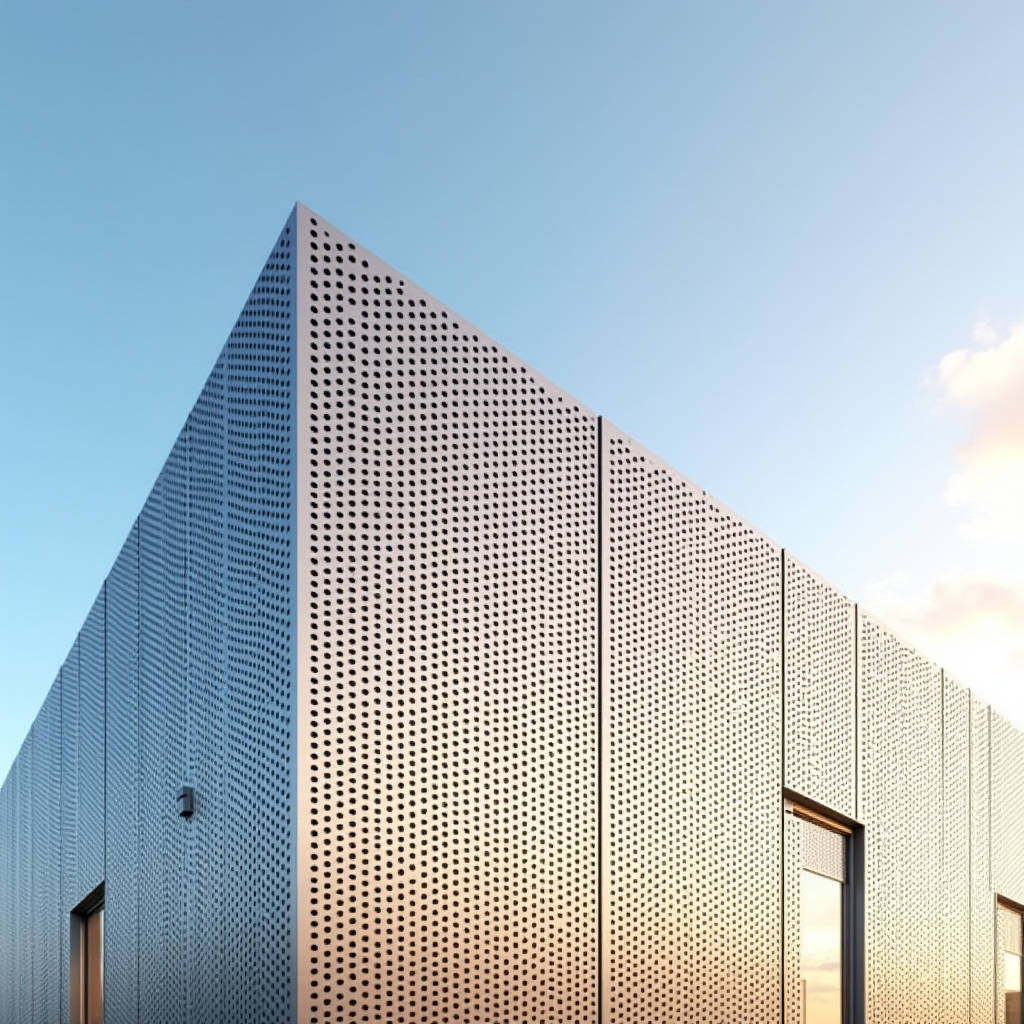
When a facade contractor types perforated aluminum sheet near me into a search bar, the intent is rarely about a single sheet. It is about a full facade system, a supply chain, and a specification that has to survive wind loads, thermal movement, and a two-decade warranty. The retail listings that dominate local results—cut-to-size panels, decorative hole patterns, ventilation screens—answer a homeowner's question, not a curtain wall engineer's. This article narrows the gap between what local stockists sell and what a solid aluminium cladding panel project actually demands. We walk through the engineering decisions that turn a perforated screen into a load-tested rainscreen, the coating chemistry that determines whether it still looks right in year fifteen, and the procurement checklist that keeps a job on schedule. If you are sourcing for a commercial project, the local sheet is only the starting point.
Why a Retail Quotation Fails on a Commercial Facade
Searching for perforated aluminum sheet near me usually surfaces metal supermarkets and hardware chains. Those suppliers excel at small volumes, standard hole patterns, and immediate pickup. They are the wrong channel for a curtain wall package. Commercial perforated panels are specified by alloy, temper, thickness, open area, and coating—not by a SKU on a shelf. A 3003-H14 sheet from a local stockist is a fine material for a vent cover. It is not automatically acceptable for a 3.0 mm panel spanning 1.5 metres between subframes under a 1.6 kPa wind load.
The gap is not just material. It is documentation. A facade specifier needs mill certificates, PVDF coating test reports, and conformity to AAMA 2605. A local hardware store cannot produce those. The practical route is to treat "near me" as a logistics question, not a sourcing one. Find a fabricator who can supply the full system, then use regional distribution to keep freight and lead time under control.
Reading a Perforated Panel Specification
Every perforated panel on a facade is defined by four numbers, and every one of them changes the structural response of the sheet.
- Open area — the percentage of the sheet removed by holes. It drives airflow, shading, and acoustic performance, but it also cuts the effective section modulus of the panel.
- Hole diameter and stagger — round holes in a 60-degree stagger give the most even distribution and the best strength retention per unit of open area.
- Sheet thickness — for solid aluminium rainscreens, 2.0 mm is the floor for most projects; 2.5 mm and 3.0 mm appear where spans grow or wind zones are severe.
- Coating system — a PVDF finish at 70 microns total film thickness is the commercial standard, with a primer and a clear coat in the stack.
Open area is the number most often misread. A panel with 40 percent open area does not weigh 40 percent less in a meaningful structural sense; its stiffness drops faster than its weight because the holes interrupt the continuous section. A 3.0 mm solid panel and a 3.0 mm panel at 40 percent open area behave very differently under suction. The fabricator must model the perforated section, not assume the solid-sheet properties still hold.
Alloy and Temper: The Part Nobody Sees
Retail listings rarely mention alloy, because a homeowner does not care. A facade engineer does. The two alloys that dominate European and North American rainscreen work are 3003 and 5052. For perforated panels that are roll-formed or brake-pressed into trays, 3003-H14 offers a good balance of formability and strength. Where the panel is flat and the span is long, 5052-H32 gives higher yield strength and better corrosion resistance in coastal air.
The temper matters just as much. A fully annealed sheet will sag between subframes. An over-tempered sheet will crack at the hole edges during bending. The correct temper for a perforated rainscreen panel is a controlled H1x condition that keeps the edges of the holes ductile enough to survive forming without losing the stiffness the facade needs. This is exactly the kind of detail a local stockist cannot guarantee, because their sheet is bought for general fabrication, not for a specific facade application.
Coating Chemistry and the AAMA 2605 Question
The coating is the difference between a facade that looks new in year five and one that looks new in year twenty. For perforated panels, the coating also has to protect the cut edges of every hole, where the bare aluminium is exposed. A two-coat polyester system will not survive that exposure on a south-facing elevation. The specification that matters is AAMA 2605, the highest performance level for architectural organic coatings.
AAMA 2605-22 sets the durability bar for PVDF coatings on architectural metal: 70 percent gloss retention after 10 years of Florida exposure, no more than 10 chalk rating change, and resistance to 3,000 hours of salt spray. For a perforated panel, the salt spray requirement is the one that filters out cheap coatings, because the hole edges concentrate corrosion initiation.
For a perforated panel, the coating thickness at the hole edge is the weak point. Standard spray application leaves the inner wall of each hole thinner than the face. A reputable fabricator applies the PVDF system at a nominal 70 microns and verifies dry film thickness on the hole walls, not just on the flat face. If the supplier cannot show that measurement, the panel will fail at the perforations long before the face shows any problem.
Wind Load and the Perforated Section
Perforated panels are frequently specified as a rainscreen or a sunshade, but they are still a structural element. The wind load on a perforated panel is not simply the free-stream pressure multiplied by the solid area. The holes create turbulence and local pressure coefficients that can exceed the values on a solid panel of the same footprint. The design must use the net pressure on the solid portion plus an allowance for edge effects around each hole.
For a typical 2.5 mm panel at 35 percent open area, a 1.5 m span, and a 1.6 kPa design wind pressure, the mid-span deflection will sit in the range of L/120 to L/90, depending on the exact hole pattern and the subframe spacing. That deflection is acceptable for a rainscreen, but it is too high for a panel that must hold a flat architectural line. The practical fix is to reduce the subframe spacing or increase the panel thickness, not to accept the sag and hope the coating hides it.
Thermal movement is the second load case. A dark-coloured 3.0 mm panel on a south facade can swing through 60 degrees Celsius of surface temperature in a day. Aluminium expands at roughly 23.6 x 10⁻⁶ per degree Celsius, so a 3-metre panel moves about 4.2 mm across that swing. The fixing system has to absorb that movement without transferring stress to the perforated sheet. Fixed and sliding cleats, or a cassette system with slotted holes, are the standard answers.
Comparing Coating Systems for Perforated Panels
| Property | PVDF (AAMA 2605) | Polyester (AAMA 2603) | Anodized (AA-M10C22A41) |
|---|---|---|---|
| Typical total film thickness | 70 microns | 25–35 microns | 18–20 microns oxide |
| Gloss retention, 10 years | 70% minimum | ~50% | Not applicable |
| Salt spray resistance | 3,000 hours | ~500 hours | Excellent, self-healing |
| Hole edge protection | Good, if verified on hole walls | Weak | Good, uniform |
| Colour range | Full, metallic available | Limited | Natural tones only |
| Typical facade warranty | 20 years | 5–10 years | 20 years |
For a perforated panel, the anodized option deserves more attention than it usually gets. Because anodizing grows the oxide layer into the metal, it protects the hole edges uniformly without the thin-film problem that plagues spray-applied coatings. The trade-off is a limited colour palette and a higher sensitivity to handling marks during fabrication. For a project that wants a natural silver or bronze finish and a long service life, anodized perforated panels are a strong choice.
Acoustic and Ventilation Performance
Perforated panels are specified for two functional reasons as often as for looks: acoustic absorption and ventilation. On acoustic work, the perforated sheet is the face of a cavity absorber, and the hole pattern is tuned to the frequency band the project needs. A 23 percent open area with 3 mm holes absorbs mid and high frequencies when backed by a 50 mm cavity of mineral wool. The open area and hole diameter are not decorative choices; they are acoustic calculations.
On ventilation, the panel is a sunshade or a rainscreen that lets air move through the cavity. The open area has to be high enough to ventilate the cavity and prevent condensation, but low enough to keep the structural response acceptable. The 30 to 45 percent open area band covers most commercial work. Below that, the cavity stagnates; above that, the panel becomes structurally fragile and the fabrication cost climbs because the sheet is harder to handle without distortion.
Procurement: What to Ask a Supplier
When you evaluate a supplier for perforated aluminum sheet near me, the quotation is only the first document. A facade-grade supplier should answer these questions without hesitation:
- What alloy, temper, and mill source is the sheet? Can you provide a mill certificate?
- What is the exact open area and hole stagger, and how is it verified?
- What coating system, and can you show dry film thickness measurements on the hole walls?
- What is the maximum panel size you can fabricate without distortion, and what is the flatness tolerance?
- What is the lead time for a full facade package, not a single sheet?
- Can you supply the fixing system, subframe, and edge trims as one package?
For a mid-size commercial project, the difference between a local stockist and a facade fabricator is not price per kilogram. It is the difference between a sheet and a system. A fabricator like Futeng® supplies the perforated panels, the coating verification, the fixing components, and the engineering data as a single responsibility, which removes the interface risk that causes most facade failures. The freight from a regional fabricator is a small line item against the cost of a failed coating or a sagging panel.
Lead Time and the "Near Me" Logistics Question
Perforated panels are not a commodity you can pull from a shelf at scale. A 2.5 mm PVDF-coated panel with a custom hole pattern is a manufactured product with a fabrication lead time. A realistic lead time for a mid-size run is four to six weeks from order to delivery, including coating and quality inspection. The "near me" part of the search is therefore about distribution, not about stock. A supplier with regional warehousing can cut the freight leg to a few days, but the fabrication time is the real constraint.
Plan the procurement around that lead time. Order the perforated panels before the subframe is fully detailed, and lock the hole pattern and coating early. Late changes to the open area or the colour push the whole schedule by the fabrication cycle, not by a day or two. The most expensive mistake on a perforated facade is not the material; it is the re-order.
Practical Recommendations for the Specifier
For a commercial facade using perforated solid aluminium panels, the engineering advice is consistent. Specify 3003-H14 or 5052-H32 depending on span and coastal exposure, keep the open area between 30 and 45 percent, demand a PVDF system that meets AAMA 2605 with verified dry film thickness on the hole walls, and design the fixing system for the thermal movement of the full panel length. Confirm the deflection of the perforated section under the design wind load before you approve the subframe spacing, and treat the lead time as a fixed constraint in the schedule.
The search for perforated aluminum sheet near me is the right first step, but it should lead to a fabricator who can answer the engineering questions, not a stockist who can only cut a sheet to size. A perforated rainscreen that is specified, coated, and fixed correctly will outlast the building's first renovation cycle. A panel bought on price and local convenience will not. The difference is decided in the specification, not in the search results.