Specifying an Aluminum Sheet with Holes for Facades Open Area Alloy and Coating
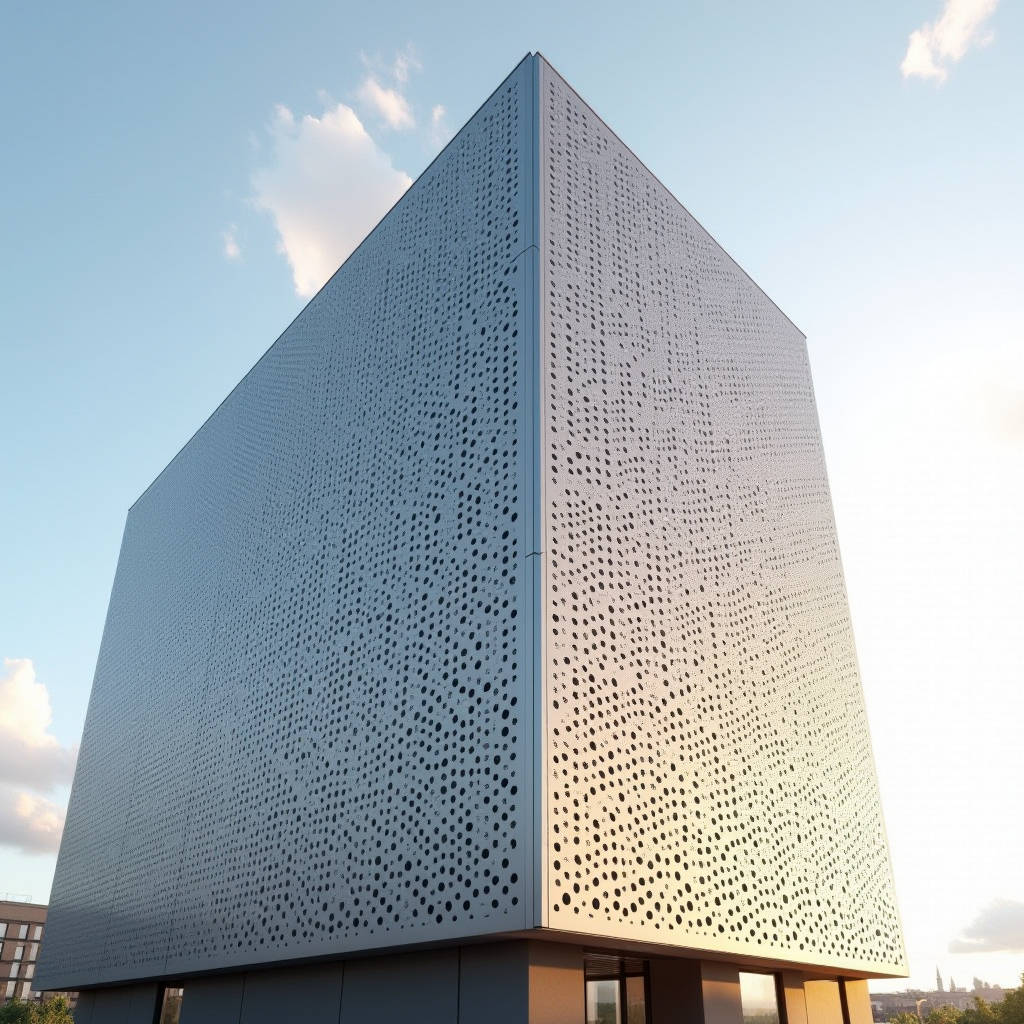
An aluminum sheet with holes is a perforated solid aluminium panel engineered for architectural cladding, solar screening, and industrial filtration. Unlike a decorative mesh, this is a structural component where hole geometry, open area, and alloy selection determine both performance and long-term durability. For a curtain wall contractor, specifying the wrong perforation ratio can trigger wind-load failures, acoustic complaints, or premature corrosion that voids a PVDF warranty. This article walks through the engineering decisions that matter most when you buy an aluminum sheet with holes for a facade project: round-versus-staggered patterns, open-area calculations, alloy and temper choices, coating thickness, and the fabrication tolerances that separate a reliable panel from a field headache.
Why Perforation Geometry Dictates Structural Performance
The first mistake most specifiers make is treating an aluminum sheet with holes as a purely cosmetic product. The holes remove material, and that removal changes the panel's stiffness, its load path, and its thermal movement. A 3.0 mm solid aluminium panel with a 40% open area loses roughly 40% of its gross cross-section, so the effective bending stiffness drops faster than the open area suggests because the holes interrupt the continuous stress flow.
For a rainscreen or sunshade application, the governing load is usually wind suction on the back face. The perforated panel must be stiff enough to avoid flutter and fatigue at the connection points. A practical rule from facade engineering is to keep the unsupported panel span below 1.2 m for a 2.0 mm panel and below 1.5 m for a 3.0 mm panel when the open area exceeds 35%. Beyond these spans, you should either add a stiffening rib or reduce the open area.
Staggered centers are the industry default for a reason. When holes sit in a staggered grid, the ligament width between adjacent holes stays uniform, which distributes stress evenly and prevents the crack propagation that straight rows encourage. Straight rows create continuous webs of material that are easier to shear, so they are reserved for low-load decorative screens. For a structural cladding panel, always specify staggered centers.
Open Area, Airflow, and Acoustic Balance
The open area percentage controls how much light, air, and sound pass through the panel. It is calculated from the hole diameter and the center-to-center spacing. For a round hole in a staggered pattern, the open area is approximately 90.7% of the ratio of the hole area to the bounding rectangle defined by the spacing. In practice, a 6 mm hole on a 10 mm staggered pitch yields roughly 33% open area, while a 10 mm hole on a 14 mm pitch pushes toward 45%.
For solar shading, a 30–40% open area is the sweet spot: it blocks enough direct radiation to cut cooling load while preserving daylight and outward visibility. For acoustic barriers, the open area should be tuned to the target frequency band. A smaller hole with a higher open area absorbs mid-to-high frequencies better, while larger holes shift performance toward lower frequencies. If the panel doubles as a noise screen, run a transmission-loss calculation before committing to a hole size.
Airflow matters for ventilation cladding behind which a cavity is maintained. The open area must exceed the vent opening area of the cavity, otherwise the panel becomes a choke point and condensation risk rises. A common specification is 40% open area for rainscreen ventilated facades to keep the cavity pressure equalized.
Alloy and Temper: 3003, 5052, and 6061 Compared
Not every aluminum sheet with holes is the same alloy under the paint. The three workhorses in architectural perforation are 3003, 5052, and 6061, and each has a distinct role.
| Alloy | Temper | Yield Strength (MPa) | Corrosion Resistance | Weldability | Typical Use |
|---|---|---|---|---|---|
| 3003 | H14 | ~145 | Good | Excellent | Flat panels, sunscreens, low-rise cladding |
| 5052 | H32 | ~193 | Excellent (marine) | Excellent | Coastal facades, high-humidity zones |
| 6061 | T6 | ~276 | Good | Good (needs care) | Structural frames, load-bearing screens |
For a standard curtain wall skin, 3003-H14 is the economical default because it forms and paints well. In coastal environments within 1 km of salt water, 5052-H32 is the safer call because its magnesium content resists pitting better than 3003. Use 6061-T6 only when the panel itself carries structural load, because its higher strength comes with a stiffer, harder surface that is more prone to cracking under tight-radius bending.
Coating Systems and Film Thickness
The coating on an aluminum sheet with holes is not decoration; it is the primary corrosion defense. Two systems dominate the architectural market: PVDF (70% Kynar 500) and powder coating. For exterior cladding, PVDF is the standard because it resists UV degradation and chalking far longer than powder.
| Coating | Typical Film Thickness | Expected Life (Exterior) | Color Retention | Best Application |
|---|---|---|---|---|
| PVDF (70% resin) | 25–30 µm | 20–25 years | Excellent | Exterior facades, high-sun regions |
| Polyester powder | 60–80 µm | 8–12 years | Moderate | Interior, sheltered soffits |
| Anodized (Class I) | 18–25 µm oxide | 15–20 years | Good (metallic) | Decorative metallic finishes |
Film thickness matters most at the hole edges. After punching, the cut edge is bare aluminum, and if the coating is applied after punching, the edge gets partial coverage. Specify that perforation occurs before coating and that the coating supplier verifies edge coverage on the hole walls. AAMA 2605 is the reference standard for high-performance organic coatings on aluminum extrusions and panels; it sets the accelerated weathering and adhesion criteria that a 20-year warranty depends on. Check the coating certificate against AAMA 2605 before accepting a shipment.
Fabrication Tolerances and Edge Quality
A perforated panel fails visually when hole alignment drifts across the sheet. The standard fabrication tolerance is ±0.5 mm on hole diameter and ±1.0 mm on center spacing. For large-format panels, cumulative drift across a 3 m sheet can make the pattern look wavy, so ask your supplier for a hole-pattern gauge report on the first article.
Edge burrs are the hidden defect. A poorly deburred hole leaves a sharp lip that cuts the coating, starts corrosion, and can injure installers. Specify that all holes are deburred on both faces, and inspect the back face of a sample panel before approving the batch. The ligament width, the material between adjacent holes, should never drop below 1.5 times the sheet thickness, otherwise the web can tear during punching or under thermal stress.
Wind Load and Connection Detailing
Wind load on a perforated panel is lower than on a solid panel because some air passes through, but the reduction is not equal to the open area. The net pressure coefficient depends on the open area and the cavity behind the panel. For a ventilated rainscreen with 40% open area, the net wind load is typically 60–70% of the solid panel value, because the cavity pressure partially equalizes. Do not assume a linear reduction; run a wind tunnel or CFD check for tall buildings, or follow the guidance in ASCE 7 for perforated facade elements.
Connections must account for the reduced material at the fixing points. If a panel is fixed with concealed clips, the clip engages the solid web between holes, so the hole pattern must be planned so that a solid ligament lands at each fixing location. Coordinate the perforation layout with the fixing grid before the die is cut; a mismatch means you either re-drill or scrap the panel. A 2.0 mm panel with 40% open area should use fixings at no more than 600 mm centers, while a 3.0 mm panel can stretch to 800 mm.
Acoustic and Thermal Performance in Practice
When an aluminum sheet with holes is used as an acoustic barrier, the hole design works in concert with a backing of mineral wool or acoustic felt. The perforation lets sound enter the cavity where the absorbent material converts it to heat. The key metric is the noise reduction coefficient, which typically rises from 0.3 on a solid panel to 0.7–0.9 on a perforated panel with a 50 mm absorbent backing. For a highway noise screen, specify 40% open area with 6 mm holes and a 50 mm mineral wool core.
Thermally, the perforation reduces the panel's solar absorptance because less surface area is exposed to radiation. This lowers the heat gain into the cavity and reduces the cooling load behind a ventilated facade. The effect is modest, on the order of 5–10% reduction in solar heat gain coefficient, but it compounds with the shading benefit of the open area to cut peak cooling demand.
Cost Drivers and Procurement Advice
Three factors drive the price of an aluminum sheet with holes: alloy, open area, and coating. A 5052 panel costs more than 3003 because of the alloy premium. Higher open area costs more per square meter because more material is removed and the punching cycle is longer, though the net weight is lower. PVDF coating adds a significant premium over powder but is non-negotiable for exterior life.
For a mid-rise commercial facade, a realistic budget range is USD 45–75 per square meter for a 2.0 mm 3003 panel with 30–40% open area and PVDF coating, delivered and finished. Coastal or high-wind projects with 5052 alloy and 3.0 mm thickness push that toward USD 75–110 per square meter.
When you source, ask for a factory-direct fabricator that can produce custom hole patterns and alloys. A supplier that runs 3003, 5052, and 6061 in-house and offers anodizing, powder coating, or PVDF finish gives you one point of responsibility for quality. Futeng® is one such solid aluminium cladding panel manufacturer that supplies custom perforated panels to facade contractors, with documented alloy certificates and coating warranties that match the AAMA 2605 standard. Send your hole-pattern drawing and fixing-grid layout for a quote, and request a first-article inspection before full production.
Final Engineering Recommendations
Specify staggered round holes with a ligament width of at least 1.5 times the sheet thickness. Keep the open area between 30% and 40% for ventilated rainscreens, and verify the net wind load with a cavity pressure analysis rather than assuming a linear reduction. Choose 3003-H14 for inland projects, 5052-H32 within a kilometer of salt water, and 6061-T6 only for load-bearing screens. Require PVDF coating to AAMA 2605 with a verified film thickness of 25–30 µm and confirm edge coverage on the hole walls. Coordinate the perforation layout with the fixing grid before the die is cut, and inspect the first article for hole drift and burrs. If you follow these steps, an aluminum sheet with holes will perform as a reliable, long-lived component of the facade rather than a source of rework.