Perforated Aluminum Sheet 4x8 Facade Engineering Guide for Wind Load and Coating Specs
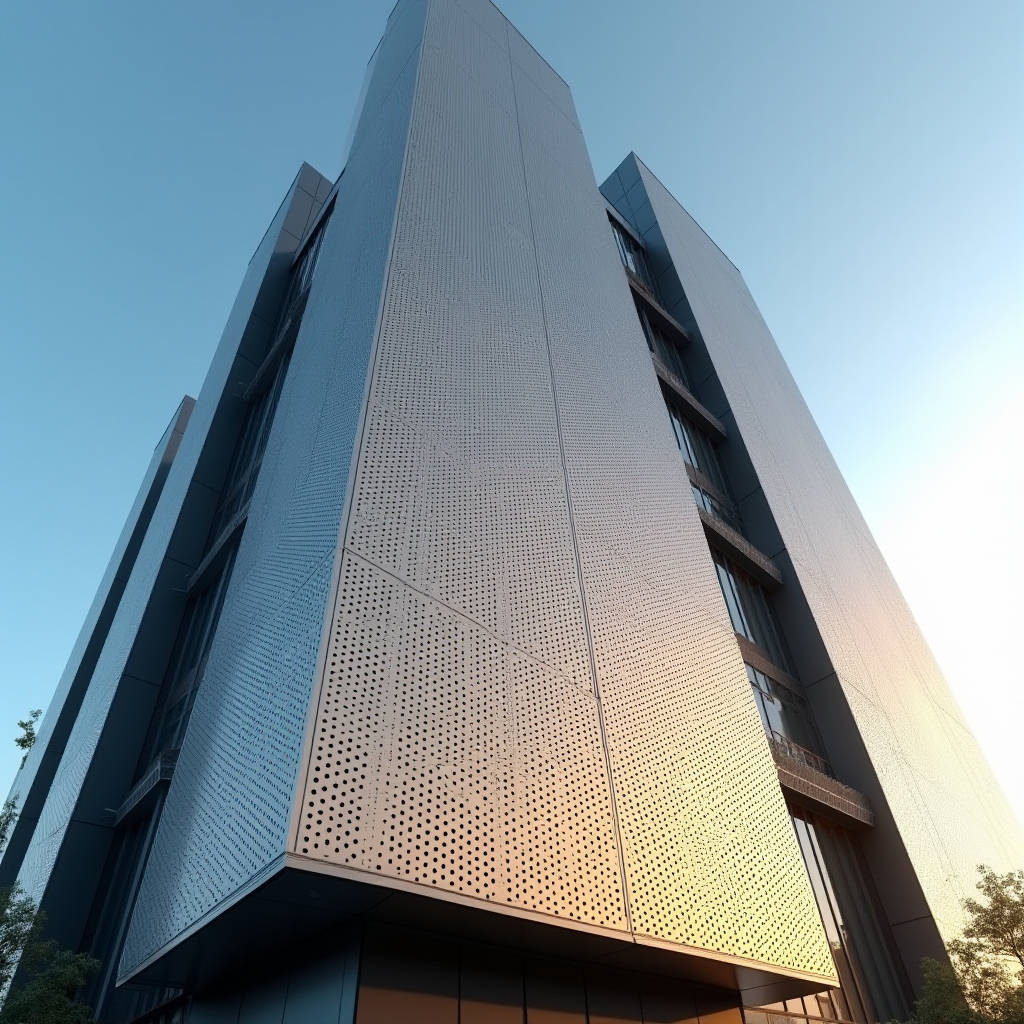
Perforated aluminum sheet 4x8 has become a standard module in facade engineering, yet most procurement teams treat it as a commodity rather than a structural component. A 4x8 sheet (1220x2440 mm) is only a starting point; the real engineering begins when you specify open area, hole pattern, sheet gauge, and coating together. Get these wrong and you face wind-load failure, thermal bowing, or a facade that fails its acoustic target. This article walks through the technical decisions that separate a durable rainscreen from a costly rework, with practical numbers for wind load, open area, and corrosion protection that you can carry straight into a spec sheet.
Why 4x8 Remains the Default Module
The 4x8 dimension is not arbitrary. It matches the standard coil width of 1220 mm, which minimizes offcut waste when a fabricator nests multiple panels. For a facade contractor, that means less scrap and predictable lead times. The 2440 mm length also suits most trucking and racking systems, so logistics stay simple. When you order perforated aluminum sheet 4x8, you are buying a module that aligns with standard press tooling, standard dies, and standard edge trim profiles. That alignment lowers unit cost and shortens delivery windows compared with odd-size custom blanks.
Open Area and Its Structural Cost
Perforation trades material for function. Every hole removes aluminum, which lowers weight but also reduces the panel's stiffness and load capacity. The relationship is governed by the open area ratio, expressed as a percentage of the sheet face. A common round-hole pattern with 3/16 inch diameter holes on 1/4 inch staggered centers yields roughly 40 percent open area. That is fine for solar shading or acoustic panels, but it cuts the effective bending stiffness by nearly half compared with a solid sheet of the same gauge.
For wind-loaded rainscreens, keep open area below 30 percent unless you have confirmed the substructure can carry the reduced stiffness. The practical way to check this is against the ASCE 7 wind load provisions for the project's exposure category and local wind speed. A 4x8 panel in a coastal zone with Exposure C can see design pressures above 1.5 kPa on the positive face. At that load, a 2.0 mm perforated sheet with 40 percent open area will deflect noticeably more than a solid panel, so the support spacing must shrink accordingly.
Gauge Selection for Perforated Panels
Thickness is the first lever you pull. For perforated aluminum sheet 4x8 used in architectural cladding, 2.0 mm is the practical minimum for exterior work. At 2.0 mm, the sheet retains enough residual stiffness after punching to resist oil-canning and flutter under wind. A 1.5 mm sheet is acceptable for interior ceilings or sunscreens with low wind exposure, but it will oil-can on a large 4x8 span. For high-rise facades or panels spanning more than 1200 mm between supports, step up to 2.5 mm or 3.0 mm.
Keep in mind that punching removes material, so the effective section is thinner than the nominal gauge. A 2.0 mm sheet with 30 percent open area behaves closer to a 1.6 mm solid sheet in bending. That is why experienced facade engineers specify a thicker gauge for perforated panels than they would for a solid panel of the same size. The extra material is not waste; it is insurance against deflection and fatigue at the hole edges.
Coating Systems That Survive the Elements
Perforated panels expose more edge surface per square meter than solid sheets, so corrosion protection matters more. Bare 3003 aluminum will oxidize to a dull gray and can pit in coastal salt air. For architectural use, specify a PVDF (polyvinylidene fluoride) coating at 70 percent resin content, applied to a dry film thickness of 25 to 30 microns. This is the standard required by AAMA 2605, the specification for high-performance architectural coatings on aluminum. The coating seals the punched edges, which are otherwise the first place corrosion starts.
For interior or low-exposure applications, a polyester powder coat at 60 microns is acceptable and cheaper. But do not use powder coat on a coastal facade; the edge coverage is thinner and the resin is less UV-stable. If the project is near salt water, also specify a chromate or non-chromate conversion coating beneath the PVDF to protect the bare edges exposed by the perforations.
| Coating System | Dry Film Thickness | Standard | Best Use | Coastal Suitability |
|---|---|---|---|---|
| PVDF 70% resin | 25-30 microns | AAMA 2605 | High-rise exterior, coastal | Excellent |
| PVDF 50% resin | 20-25 microns | AAMA 2604 | Mid-rise exterior | Good |
| Polyester powder coat | 60-80 microns | AAMA 2603 | Interior, low exposure | Poor |
| Anodized (Class I) | 18-25 microns film | AAMA 611 | Interior, decorative | Fair |
Acoustic and Solar Performance
Perforated aluminum sheet 4x8 is a workhorse for acoustic control because the open holes let sound pass into an absorbent backing layer. The noise reduction coefficient (NRC) depends on the open area, hole diameter, and the backing material. A 23 percent open area panel backed with 50 mm of mineral wool achieves an NRC around 0.85, which is strong for a metal panel. For transit stations or auditorium soffits, this combination is a proven solution.
On the solar side, the open area reduces direct solar gain and glare while still allowing daylight. A 40 percent open area panel blocks roughly 40 percent of incident solar radiation, which cuts cooling load on a building's south elevation. The trade-off is visual transparency and reduced privacy, so match the open area to the building's program. A parking garage facade may want 50 percent open area for ventilation; an office lobby wants 20 percent for shading without losing the view.
Specifying the Hole Pattern
Hole size, shape, and stagger define both the look and the structural behavior. Round holes on staggered centers are the most common because they are cheap to tool and distribute stress evenly. Square and slotted holes offer a different aesthetic but concentrate stress at the corners, so they need a thicker gauge or a lower open area. For a 4x8 panel, keep the hole diameter between 1/8 inch and 1/2 inch. Below 1/8 inch the holes clog with coating and are hard to clean; above 1/2 inch the panel loses visual coherence and stiffness.
Staggered patterns are structurally superior to straight rows because they break up continuous lines of weakness. When you order from a fabricator, confirm the stagger dimension and the minimum ligament (the metal between holes). A ligament of at least 1.5 times the sheet thickness prevents the holes from distorting during punching and keeps the panel flat.
Fabrication and Tolerances
Perforated aluminum sheet 4x8 arrives as a flat blank, but the facade needs a fabricated panel with folded edges, stiffening breaks, and drainage holes. The punching process itself can introduce camber across the 2440 mm length, so specify a flatness tolerance of no more than 3 mm over the full sheet. Edge folding to a 20 mm hem adds rigidity and gives a clean reveal. For panels wider than 900 mm, add a stiffening break or a welded angle along the back to prevent flutter.
Tolerance control matters more for perforated panels because the holes make any distortion visible. A panel that is out of square by 2 mm across a 4x8 sheet will show a misaligned hole pattern at the joint. Specify a diagonal tolerance of plus or minus 2 mm and a hole pattern tolerance of plus or minus 0.5 mm across the sheet. This is achievable with CNC punching and keeps on-site fit-up predictable.
Installation and Substructure
The substructure must be designed for the perforated panel's reduced stiffness, not the panel's nominal gauge. For a 4x8 panel with 30 percent open area, support the panel at no more than 600 mm centers vertically. Aluminum hat channels or Z-girts at 600 mm spacing keep deflection within L/240 under design wind load. Use stainless steel or aluminum fasteners; never mix metals that promote galvanic corrosion.
Drainage is a hidden requirement. Perforated panels let water through, so the cavity behind the panel needs a drainage path and a weather barrier. Slope the girts and provide weep holes at the base so water does not sit against the rear face. This detail is easy to overlook and expensive to fix, because trapped water accelerates corrosion at the punched edges and behind the coating.
Sourcing and Quality Control
When you source perforated aluminum sheet 4x8, verify the alloy, temper, and coating certificate against your spec. Architectural panels should be 3003-H14 or 5005-H34 alloy; 3003 is the common choice for its formability and corrosion resistance. Ask for a mill certificate and a coating test report that matches AAMA 2605. A reliable supplier will provide these without argument. For large facade programs, a supplier like Futeng® can hold consistent coil stock and run the punching, coating, and edge fabrication in one flow, which shortens lead times and keeps quality uniform across batches.
Before you approve a production run, request a sample panel and check the open area with a simple light test, measure the ligament with calipers, and confirm the coating thickness with a dry film gauge. These three checks catch 90 percent of the defects that cause field rework.
Engineering Summary
Perforated aluminum sheet 4x8 is a capable cladding material when you treat it as an engineered component. Hold the open area below 30 percent for wind-loaded facades, use 2.0 mm minimum gauge for exterior work, specify PVDF coating to AAMA 2605 for coastal sites, and support the panel at 600 mm centers. Match the hole pattern and open area to the building's acoustic and solar goals, and verify tolerances and coating certificates before production. Follow these numbers and the perforated panel will perform as a durable, lightweight, and visually strong part of the facade for decades.