Aluminum Facade Structural Integrity Load Paths Buckling and Corrosion
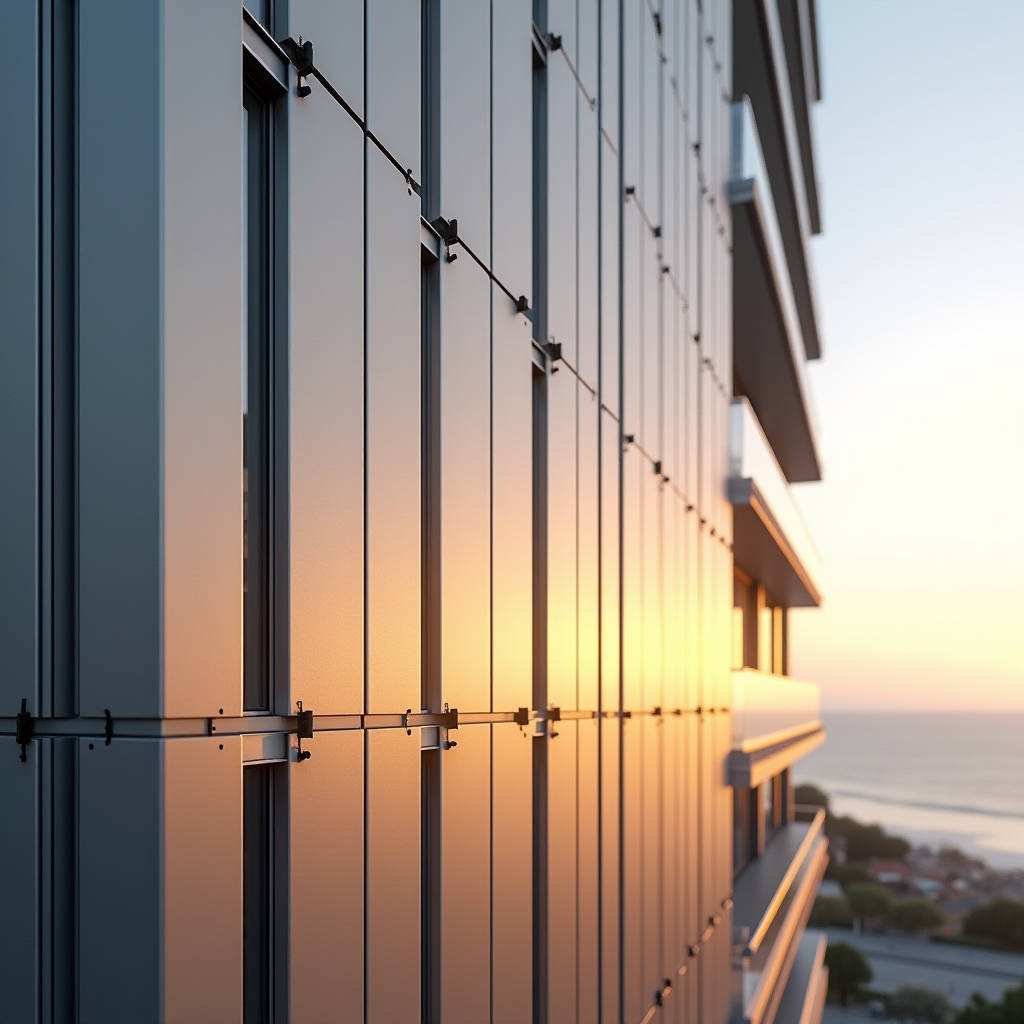
Aluminum Facade Structural Integrity is not a single test result or a coating spec sheet. It is the cumulative outcome of plate thickness, stiffener geometry, connection design, and the corrosion resistance that keeps those elements load-bearing for decades. For a solid aluminium cladding panel, structural integrity begins with the alloy's yield strength and ends with the fixing system that transfers wind and dead loads into the substructure. Yet most project failures trace back to a gap between engineering calculations and what actually gets installed on site. This article walks through the load paths, the local buckling thresholds, and the coating decisions that determine whether a facade survives its first decade or its fifth.
The Load Path That Defines Integrity
Every solid aluminium panel on a high-rise carries two distinct load families. The dead load is permanent and predictable. The wind load is cyclic, directional, and frequently underestimated at edges and corners where pressure coefficients spike. A facade engineer must verify four things before any panel is fabricated: the plate's flexural capacity under out-of-plane pressure, the stiffener's resistance to local buckling, the connection's pull-out and shear strength, and the substructure's deflection limits.
For a 2.0 mm solid aluminium sheet spanning 1200 mm between stiffeners, the governing criterion is usually deflection, not stress. Most curtain wall specifications cap deflection at L/180 for combined loads and L/240 under wind pressure alone. That limit exists because excessive movement cracks sealant, fatigues anchor points, and eventually compromises the panel-to-frame connection that holds the whole assembly together.
Local Buckling: The Silent Failure Mode
Extruded aluminium stiffeners behave differently from steel equivalents. The elastic modulus of aluminium is roughly one-third that of steel, which makes slender compression elements far more prone to local buckling. The width-to-thickness ratio of the stiffener web and flange, plus the spacing of intermediate stiffeners, determines whether the section reaches its full yield strength or buckles at a fraction of it. Designers who simply scale up steel profiles without rechecking slenderness limits end up with stiffeners that wrinkle under load and transfer unexpected stress into the panel face.
This is precisely why the support and fixing system is a structural element, not an afterthought. A stiffener that is correctly proportioned but poorly anchored becomes a hinge. The panel then flexes beyond its elastic limit at the connection, and the local yielding spreads into a visible permanent deformation.
Coating and Corrosion: Structural Integrity from the Inside Out
Structural integrity is not purely mechanical. A solid aluminium panel that loses 15% of its thickness to pitting corrosion has lost 15% of its bending capacity, regardless of how well the stiffeners were designed. In coastal environments, chloride ions attack the aluminium surface through micro-defects in the coating, creating deep localized pits that undermine the section from the interior.
The protective barrier is the PVDF (polyvinylidene fluoride) coating system, typically 25 to 35 microns total dry film thickness over a chromate or non-chromate pretreatment. The pretreatment layer is often the difference between a coating that remains intact for 25 years and one that delaminates after five. Salt-spray testing under ASTM B117 or ISO 9227 quantifies this, but the results must be read for scribe creep and pit depth, not just surface appearance. A coating that holds color but lets ions through is failing structurally.
Choosing the Right Alloy and Temper
Not all aluminium is created equal. For facade panels, the common choices are 3003-H14 and 5005-H14. The 3003 alloy offers a good balance of formability and strength, while 5005 delivers superior anodizing response and corrosion resistance. The H14 temper indicates a strain-hardened state giving roughly half to two-thirds of the yield strength of a fully hardened alloy, which is usually the practical limit for brake-formed panels without cracking.
For panels that require higher strength, 5052-H32 is sometimes specified, though its higher cost and reduced formability must be weighed against the structural benefit. The table below summarizes the practical trade-offs for a typical 2.5 mm solid aluminium facade panel.
| Alloy / Temper | Yield Strength (MPa) | Corrosion Resistance | Formability | Typical Use |
|---|---|---|---|---|
| 3003-H14 | 145 | Good | Excellent | Standard flat panels |
| 5005-H14 | 125 | Excellent | Excellent | Coastal and anodized finishes |
| 5052-H32 | 195 | Excellent | Good | High wind load zones |
| 6061-T6 (extruded stiffeners) | 240 | Good | Poor (extrusion only) | Stiffeners and framing |
Thickness Decisions and Real-World Limits
Panel thickness is the most visible structural variable, but it is often misapplied. Doubling the plate thickness from 2.0 mm to 3.0 mm increases flexural stiffness by a factor of 3.4, yet it also increases weight per square metre from roughly 5.4 kg to 8.1 kg. That added weight raises dead load on the substructure and anchor points, which can negate the stiffness benefit if the framing was sized for the lighter panel.
The correct approach is to let the stiffener spacing and profile do the heavy lifting, using the plate thickness primarily for dent resistance and corrosion allowance. A 2.0 mm panel with well-spaced deep stiffeners can outperform a 3.0 mm panel with inadequate stiffening, because the stiffener system controls the governing deflection mode. Thickness should be selected to satisfy minimum handling and impact requirements, then verified against the deflection calculation, not chosen arbitrarily for perceived robustness.
Connection Design and the Pull-Out Question
The weakest point in any aluminium facade is the connection between the panel and the support bracket. Rivets, screws, and interlocking extrusions each have distinct pull-out and shear capacities that must be checked against the local wind suction at corners. Corner zones can experience pressure coefficients two to three times higher than the field of the facade, so a connection sized for the average wind load will fail at the corner.
Designers should specify the number and spacing of fixings based on the worst-case corner zone, then apply that density across the entire panel to avoid fabrication errors. This conservative approach costs little in material but eliminates the most common field failure. The connection must also accommodate thermal movement, since a solid aluminium panel expands roughly 0.024 mm per metre per degree Celsius. Restraining that movement rigidly converts thermal expansion into compressive stress that can buckle the panel.
Testing and Compliance: From Paper to Performance
Structural integrity is only credible when verified by testing. The AAMA 501 series and the European EN 13830 standard for curtain walling define the air, water, and structural test protocols that validate a facade system. The structural test subjects the assembly to positive and negative wind pressures at 1.5 times the design load without permanent deformation, and at higher factors to confirm no collapse. These tests are the only reliable way to confirm that the calculated load path actually exists in the built assembly.
For solid aluminium panels specifically, the relevant verification is the flexural test on the full panel-stiffener assembly, not just a coupon of the alloy. A coupon test proves material properties; only a full assembly test proves the interaction between plate, stiffener, and connection. Specifying both levels of testing closes the gap between the material datasheet and the installed reality.
Production and Quality Control
Structural integrity is also a production discipline. A panel that is over-braked, with a stiffener that is distorted during forming, has lost its designed capacity before it leaves the factory. Dimensional tolerances, stiffener alignment, and coating thickness must be verified at each stage. A reputable supplier such as Futeng® maintains documented QC records for alloy certificate, coating thickness, and flatness, which become part of the project's compliance file that engineers and inspectors can audit.
These records matter because facade failures are rarely instantaneous. They develop over years as corrosion, fatigue, and thermal cycling accumulate. The project that survives is the one where the design calculations, the material certificates, and the installed assembly all tell the same story.
Practical Recommendations
For engineers and contractors specifying solid aluminium cladding, the durable path is clear. Verify the deflection limit with the actual stiffener spacing, not the panel thickness alone. Specify the alloy and temper against the actual wind zone and coastal exposure. Check connection pull-out against corner-zone pressure coefficients. Require full-assembly structural testing in addition to material coupons. And demand documented QC from the panel fabricator, including alloy certificates and coating thickness records.
Aluminum Facade Structural Integrity is ultimately a chain of decisions, each one verified and documented. Break any link, and the whole facade is at risk. Keep every link intact, and the panel system will carry its load for the full design life, with the coating and the metal holding together from the first wind event to the last.