Pressure Equalization and Joint Engineering for a Water Tight Aluminum Facade System
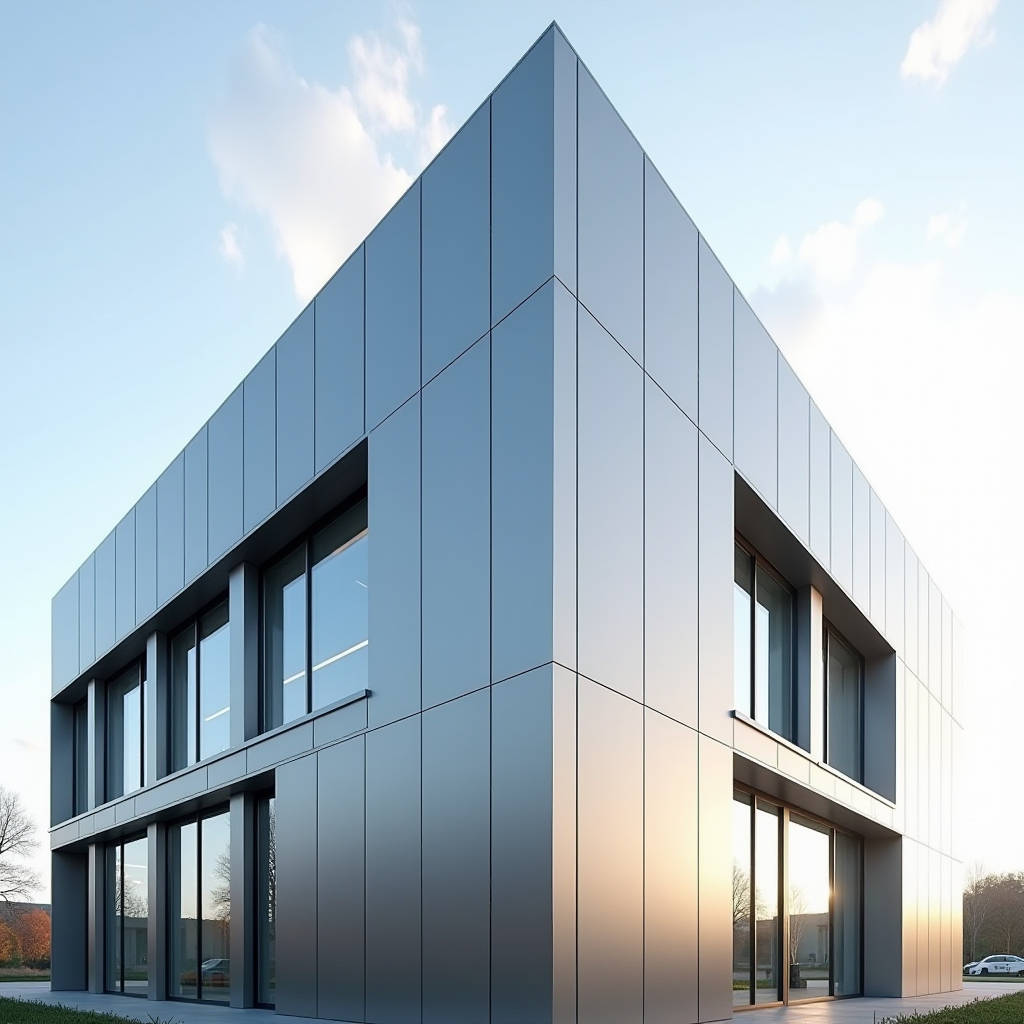
A Water Tight Aluminum Facade System does not begin at the sealant gun. It begins with an understanding of where water actually travels, how pressure moves across a cavity, and which joints are engineered to drain rather than merely to block. Most failures on solid aluminium cladding panels trace back to a single assumption: that a continuous bead of silicone is enough. It is not. A genuinely watertight envelope depends on a layered strategy of pressure equalization, controlled drainage, and material selection that keeps the panel itself dimensionally stable under thermal cycling. This article walks through the engineering logic behind a Water Tight Aluminum Facade System, the test regimes that prove it, and the practical decisions that separate a facade that leaks in year two from one that stays dry for decades.
Why Solid Panels Change the Waterproofing Equation
Solid aluminium cladding panels, typically 2.0 mm, 2.5 mm, or 3.0 mm flat sheets, behave differently from composite products in one critical way: they carry no polymer core that can delaminate or wick moisture edgewise. When water finds a path into a composite panel core, it travels laterally and emerges far from the entry point, which makes diagnosis slow and damage expensive. A solid panel stops that lateral migration at the metal itself. The waterproofing task narrows to the joints, the fixings, and the perimeter terminations, which is a far more controllable problem.
That advantage only holds if the panel is engineered for stability. A 3.0 mm sheet of 5005-H14 alloy has a coefficient of thermal expansion around 23.5 × 10⁻⁶ per °C. On a 4 m panel, a 60 °C temperature swing produces roughly 5.6 mm of movement. A watertight system must absorb that movement at the joint, not fight it. Rigidly fixed panels that cannot move will either buckle the metal or shear the sealant, and both outcomes destroy the water barrier. This is the first principle: design the joint to accommodate the movement before you ask it to keep water out.
The Pressure-Equalized Cavity: The Real Water Barrier
The most reliable way to keep a facade watertight is to stop the pressure differential that drives water inward. In a pressure-equalized rainscreen, the outer panels are deliberately not sealed airtight. Openings at the joints allow the cavity behind the panels to reach the same pressure as the outside air. When pressure equalizes, the driving force that pushes water through small gaps disappears. Water that does enter the cavity drains down the back of the panel and out through weepholes at the base, never reaching the insulation or the structural wall.
This is the logic behind the AAMA 508-7 test method, which validates pressure-equalized rain screen systems for air, water, and structural performance. A system that passes AAMA 508-7 has demonstrated that its cavity can equalize pressure while still shedding water under dynamic wind and rain conditions. For a solid panel system, this means the back of the panel must be ventilated and drained, and the compartmentation between floors or panels must be managed so pressure equalizes within each discrete cavity rather than across the whole wall.
Three components make or break a pressure-equalized cavity:
- Compartmentation: The cavity must be divided into cells so that pressure equalizes locally. A single open cavity spanning the full facade creates uneven pressure zones and unpredictable water behavior.
- Controlled openings: Joints must be sized and positioned to allow air in while shedding water. Overly large openings admit rain; overly small ones fail to equalize pressure.
- Back-up air and water barrier: The primary weather barrier sits behind the cavity, on the insulated wall. The panels are the first line of defense, not the only one.
Joint Design and Sealant Strategy
Even in a pressure-equalized system, some joints will be sealed, particularly at corners, parapets, and transitions where geometry makes equalization impractical. The choice of sealant and the joint geometry determine whether those sealed locations stay watertight over time. A low-modulus, high-movement-capable sealant rated for 25% or 50% movement accommodation is essential. The joint must be sized so the sealant never exceeds its rated movement, which means the joint width must be calculated from the panel's thermal movement and the sealant's allowable strain.
For a solid panel system, the sealant is a maintenance item, not a permanent solution. Its service life depends on UV exposure, temperature range, and the quality of the substrate preparation. A properly designed Water Tight Aluminum Facade System plans for sealant replacement as a scheduled activity, typically at intervals of 10 to 15 years, and designs the joint so that removal and reapplication do not require dismantling the panel. This is where solid panels earn their reputation for low maintenance: the durable PVDF coating resists fading, chipping, and staining, so the panel itself keeps its appearance and its waterproof performance with only occasional cleaning.
Coating Systems and Long-Term Performance
The coating is not decoration; it is part of the watertight strategy. A degraded coating exposes the aluminium substrate to corrosion, and corrosion products expand and lift the coating, creating paths for water ingress at the panel edges and fixings. The industry standard for exterior solid panels is a two-coat or three-coat PVDF (polyvinylidene fluoride) system, typically 70% PVDF resin, applied to a total dry film thickness of 25 to 30 microns. The table below compares the coating options available for solid aluminium cladding panels.
| Coating System | Typical DFT (microns) | Expected Lifespan (years) | Key Properties | Typical Use |
|---|---|---|---|---|
| Two-coat PVDF (70%) | 25 | 20–25 | Good colour retention, standard durability | Most exterior facades |
| Three-coat PVDF (70%) | 30 | 25–30 | Superior colour retention, better hiding | High-visibility, coastal, premium projects |
| Polyester (PE) | 20–25 | 8–12 | Lower cost, faster chalking and fading | Interior or short-life exterior |
| Anodized (natural) | 15–25 (oxide) | 15–20 | Metallic look, no colour options | Architectural accent, limited palette |
| Fluoropolymer FEVE | 25–30 | 20–25 | Solvent-based, good weatherability | Field-applied touch-up and repair |
For a Water Tight Aluminum Facade System, the three-coat PVDF system is the defensible default for exterior use. The extra 5 microns of film thickness and the additional clear coat provide measurable resistance to chalking and colour shift, which matters in a facade that must remain visually consistent for decades. The coating must also be applied to the edges and the back of the panel where possible, because those are the surfaces most exposed to condensation and trapped moisture in the cavity.
Fixings, Gaskets, and the Fastener Path
Every fastener that penetrates the panel is a potential leak. In a solid panel system, fixings are typically concealed, either through a cassette-style folded edge or through a clip-and-rail system that holds the panel from behind. The advantage of the concealed fixing approach is that the visible face of the panel has no penetrations at all, which removes the most common leak path entirely. Where through-fixings are unavoidable, they must be fitted with EPDM gaskets or sealing washers, and the hole must be punched, not drilled, to avoid tearing the coating and exposing bare metal.
The gasket material matters as much as the geometry. EPDM remains the workhorse for facade gaskets because it resists ozone, UV, and temperature extremes without hardening. Silicone gaskets offer better temperature range but lower tear strength. The gasket must be compressed, not just placed, to maintain a continuous seal under wind load and thermal movement. A gasket that is too soft will extrude out of its groove; one that is too hard will not conform to the panel edge. The correct shore hardness, typically 60 to 70 Shore A, is a specification detail that separates a reliable system from a marginal one.
Test Regimes That Prove Watertightness
A Water Tight Aluminum Facade System should be verified against recognized standards before it is installed, not discovered to be deficient after a storm. The relevant test methods are well established and should be written into the project specification:
- ASTM E283 – air leakage through the exterior wall assembly under static pressure.
- ASTM E330 – structural performance under positive and negative wind load.
- ASTM E331 – water penetration under static pressure, applied to the exterior face.
- AAMA 508-7 – pressure-equalized rain screen system validation for air, water, and structural performance.
These tests are most meaningful when performed on a full-scale mock-up that reproduces the actual panel size, joint width, and fixing pattern of the project. A small coupon test cannot reveal how a 3 m panel behaves at its corner joint under real wind load. The mock-up should be tested at the design pressure, and the results should be reviewed by the design team before fabrication begins. Reputable suppliers, including Futeng® when specified as a solid panel supplier, can provide test data and coordinate with independent laboratories to validate system performance on a specific project.
Installation Discipline and the Human Factor
No amount of engineering survives careless installation. The most common field failures in watertight facades are not design failures; they are installation failures: sealant applied over a dirty or wet surface, gaskets pinched or twisted, fasteners over-torqued and stripped, and weepholes blocked by debris or insulation. The specification should include a requirement for installer qualification and for a staged water test during construction, before the interior finishes are installed. A water test at each floor, as the cladding goes up, catches leaks while they are still accessible.
Panel storage and handling also matter. Solid panels that are stacked without protective interleaving can develop coating scratches that become corrosion sites. Panels stored on edge can be bent, and a bent panel will not seat properly in its gasket, creating a gap that no sealant can reliably fill. The discipline of protecting the material from the moment it leaves the factory until it is fixed in place is part of the watertight strategy.
Maintenance Planning for a Lasting Barrier
A watertight facade is a maintained facade. The maintenance plan should include an annual inspection of sealant joints, gaskets, and weepholes, with cleaning of the weepholes to ensure they remain open. Sealant joints should be inspected for cracking, loss of adhesion, and surface chalking, and replaced on a schedule that matches the sealant's expected service life. The panels themselves, with their PVDF coating, typically need only occasional washing to maintain both appearance and performance. This low maintenance burden is one of the strongest arguments for solid aluminium panels in a watertight system, because the ongoing cost of keeping the envelope sealed is modest and predictable.
Practical Recommendations
For a project team specifying a Water Tight Aluminum Facade System, the sequence of decisions should run as follows. First, confirm the panel alloy and thickness against the wind load and span, using 2.0 mm for standard rainscreen applications and 2.5 mm or 3.0 mm where spans are long or wind loads are high. Second, design the cavity as a pressure-equalized system with proper compartmentation and drainage, and specify the back-up air and water barrier independently of the panels. Third, select a three-coat PVDF finish for exterior exposure and specify the film thickness in the contract documents. Fourth, require full-scale mock-up testing to AAMA 508-7 and ASTM E283, E330, and E331, and review the results before fabrication. Fifth, write installation and maintenance requirements into the specification, including staged water testing and a sealant replacement schedule. A facade engineered and installed on this basis will keep water out for the life of the building, and that is the entire point of the exercise.