A2 Grade Fireproof Aluminum Panel Specification Guide for Contractors and Facade Engineers
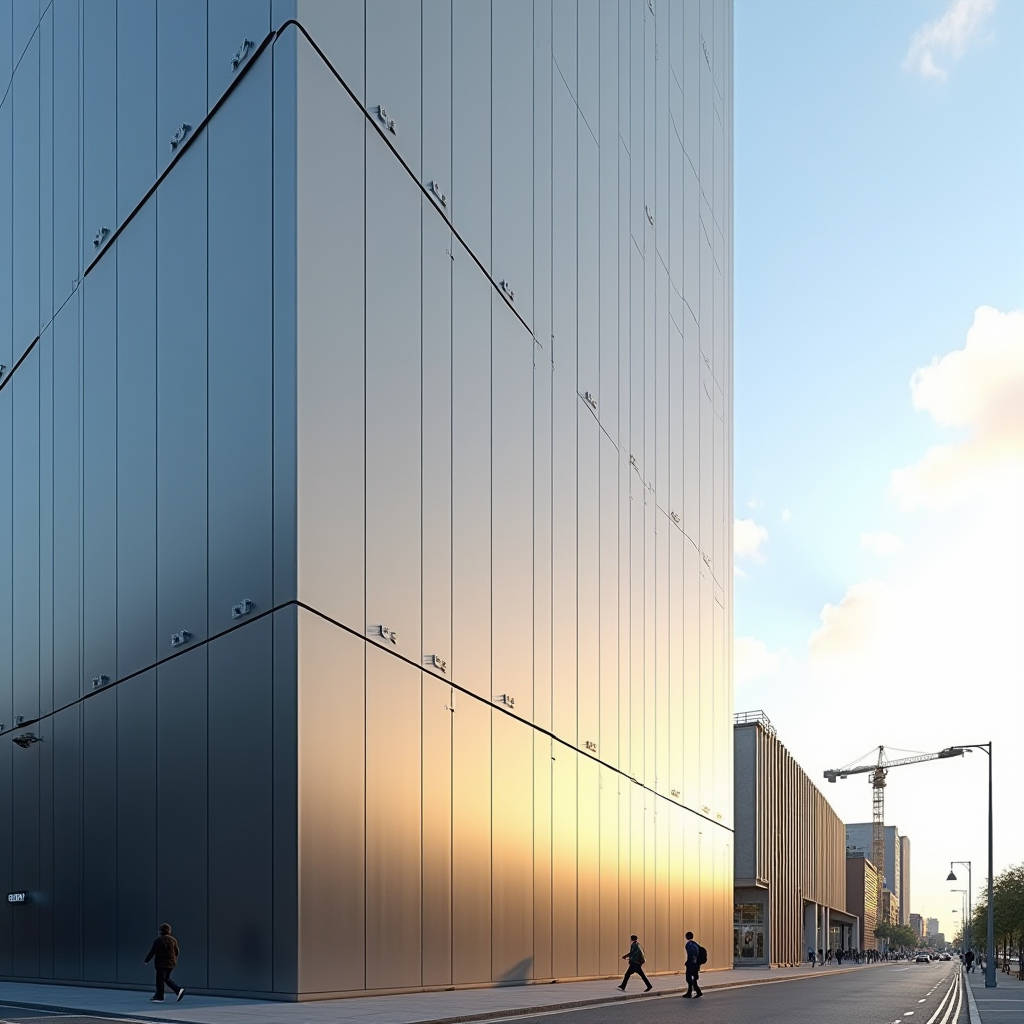
Specifying an A2 Grade Fireproof Aluminum Panel for a high-rise facade brings a contractor face to face with a wall of test reports, coating warranties and fire-classification jargon that rarely translates into buildable decisions. The core distinction that actually shapes your project sits in the reaction-to-fire classification, the mineral-filled core geometry, and the long-term weatherability of the PVDF surface. This article walks through the engineering parameters that determine whether a solid aluminium cladding solution passes NFPA 285 assemblies, EN 13501-1 Class A2 limits, and the AAMA 2605 coating performance your warranty will eventually depend on. You will leave with a practical specification checklist, realistic cost benchmarks, and the fabrication tolerances that keep site rework under control.
What A2 Classification Actually Means on Site
Reaction-to-fire class A2 under EN 13501-1 is not a single test. It is a family of criteria that together cap the heat release, flame spread, smoke production and burning droplets of a panel construction. For a solid aluminium cladding panel, the practical consequence is that the substrate itself must be non-combustible or nearly so, and any organic coating must remain within strict contribution limits. The mineral-filled core of an ACP achieves this by weight; a solid aluminium panel achieves it by composition, because the mill finish aluminium skin carries no combustible mass at all.
What matters on the procurement desk is that the A2 certificate covers the exact panel construction you are buying. A certificate issued for a 4 mm composite panel does not transfer to a 2.5 mm solid sheet, and a class on a bare substrate does not cover a PVDF-coated version unless the coating system was part of the tested build-up. Ask your supplier for the EN 13501-1 classification report naming the gauge, the coating and the fixing method before you commit to a price.
Solid Aluminium versus Composite: The Fire Logic
An aluminium composite panel carries a combustible polymer core unless that core is heavily loaded with mineral filler. That is why A2-grade ACPs rely on a mineral core that can reach 70 to 90 percent by weight of inorganic content. A solid aluminium cladding panel removes the core question entirely. With a homogenous 2.0 to 3.0 mm aluminium sheet, there is no polymer layer to ignite, no delamination to propagate flame, and no hidden cavity for smoke to travel behind the skin.
For contractors, this changes the risk profile of the facade assembly. The weak point moves from the panel itself to the insulation, the cavity barriers and the gaskets. That is a more controllable set of variables because those components are specified and inspected independently. The table below compares the practical fire-relevant properties of the two constructions.
| Property | Solid Aluminium Panel (A2) | Mineral-Core ACP (A2) |
|---|---|---|
| Combustible mass in panel | None (homogenous metal) | Mineral core, low organic content |
| Typical gauge range | 2.0 / 2.5 / 3.0 mm | 3 / 4 / 6 mm |
| Delamination risk in fire | Not applicable | Possible at core bond failure |
| Impact resistance | High, dent-resistant | Moderate, core crush risk |
| Flatness over large spans | Requires stiffening ribs | Better inherent flatness |
| Recyclability | Full single-metal recycle | Core must be separated |
Coating Systems and the AAMA 2605 Reality
Fire classification covers the panel at the moment of a fire event. The coating decides whether the panel still looks like a facade after ten years of UV, salt and acid rain. For exterior high-rise work, the specification floor is a 70 percent PVDF resin system applied at a dry film thickness of 25 to 30 microns over a properly prepared aluminium surface. This is the benchmark behind AAMA 2605, the voluntary specification for high-performance organic coatings on architectural aluminium.
AAMA 2605 demands a 10-year Florida and Arizona exposure with maximum 5 NBS colour change, no more than 10 percent loss of gloss, and no chalking beyond a defined rating. That is a far stricter bar than AAMA 2604, which is often what a cheaper PVDF line actually meets. If your contract carries a 20-year coating warranty, verify that the coating certificate references AAMA 2605, not 2604. The difference in resin quality and pigment loading is exactly where a low bidder saves money.
For coastal projects, add a requirement for the coating system to pass a 4000-hour salt spray test per ASTM B117 with no more than 1/16 inch creepage from the scribe. This is a practical filter that separates marine-grade PVDF from a standard urban-grade system.
Gauge Selection and Structural Performance
Panel thickness is a structural decision, not a cosmetic one. A 2.0 mm panel is appropriate for rainscreen applications with continuous or semi-continuous support and limited unsupported spans. A 2.5 mm panel suits standard cassette systems with stiffening ribs at 400 to 600 mm centres. A 3.0 mm panel is the choice for large-format cassettes, high wind zones and applications where the facade must resist hail impact or maintenance loads.
Wind load is the governing factor. For a typical 2.5 mm cassette with ribs at 500 mm centres, a panel can comfortably carry a design wind pressure in the range of 1.5 to 2.5 kPa depending on the exact rib geometry and fixing layout. That covers most mid-rise and many high-rise applications in moderate wind zones. For a 3.0 mm panel with tighter rib spacing, the capacity rises to 3.0 kPa and above. The deflection limit under service load is normally L/100 for flat panels, which keeps the facade visually flat and prevents oil-canning over time.
Do not rely on the panel alone. The sub-frame, the brackets and the anchors must be engineered to the same wind pressure. A common failure is a perfectly specified panel mounted on an under-engineered aluminium sub-frame that flexes and transfers load back into the panel. The panel and the support system are one assembly, and the A2 fire rating of the panel does nothing to protect a poorly anchored bracket.
Fabrication Tolerances and Site Rework
Solid aluminium panels are cut, folded and welded into cassettes before coating. The fabrication tolerance chain starts at the flat sheet and ends at the finished cassette, and every step adds a possibility of dimensional drift. A realistic tolerance for a cassette length up to 3 metres is plus or minus 1.5 mm on the overall dimension, with a diagonal difference under 2 mm. Tighter tolerances drive up cost because they require CNC machining and more inspection time.
For a contractor, the practical rule is to agree on measurement points with the fabricator before production. Measure the cassette at the fixing points, not at the free edge, because the free edge can flex. If your project uses a concealed fixing system, the critical dimension is the slot-to-slot distance, not the panel face. Getting this wrong produces a facade that looks fine from the street but cannot be aligned on site, and rework on a coated panel is expensive because the coating cannot be touched up invisibly.
Cost Benchmarks for Budgeting
Price per square metre for a fully finished A2 Grade Fireproof Aluminum Panel depends heavily on gauge, coating, fabrication complexity and quantity. The following figures are indicative for a mid-volume order in the 5,000 to 10,000 square metre range and should be used to sanity-check supplier quotes rather than as a firm price.
| Configuration | Indicative Cost (USD/m²) | Notes |
|---|---|---|
| 2.0 mm, flat sheet, standard PVDF | 45 - 60 | Simple rectangular panels |
| 2.5 mm cassette, ribs, standard PVDF | 70 - 90 | Includes rib fabrication |
| 2.5 mm cassette, AAMA 2605 PVDF | 85 - 110 | Marine-grade coating premium |
| 3.0 mm cassette, complex geometry | 110 - 140 | CNC fabrication, tighter tolerance |
These figures exclude the sub-frame, insulation, installation labour and logistics. A reliable rule of thumb is that the panel itself represents roughly 40 to 50 percent of the installed facade cost, with the support system and labour absorbing the rest. If a supplier quote lands far below the lower bound of these ranges, question the coating specification and the certificate validity before celebrating the saving.
Installation and the Fire Barrier Assembly
The fire performance of the complete facade depends on the cavity design as much as the panel. An A2 panel with a poorly detailed cavity can still allow flame spread through the void behind it. The cavity must be interrupted with fire barriers at every floor line and at the head of the facade, typically using non-combustible mineral wool or steel trays. The insulation behind the panel should be non-combustible, and any gasket or sealant must carry its own fire classification.
This is where the NFPA 285 test standard becomes relevant for high-rise projects in North America. NFPA 285 evaluates the fire propagation of an exterior wall assembly, not a single panel. If your project requires NFPA 285 compliance, the entire assembly — panel, insulation, cavity, sub-frame and sealant — must be tested together. A panel that is A2-rated on its own does not automatically make the assembly NFPA 285 compliant. Budget for the assembly-level test report and design the cavity to match the tested configuration.
Procurement Checklist for the A2 Grade Fireproof Aluminum Panel
- Confirm the EN 13501-1 Class A2 report names the exact gauge, coating and fixing method.
- Verify the coating certificate references AAMA 2605, not 2604, for exterior high-rise work.
- Request the ASTM B117 salt spray result for coastal projects.
- Agree on measurement points and tolerances with the fabricator before production.
- Confirm the cavity fire barrier design and the NFPA 285 assembly report if required.
- Check the alloy temper and the mill certificate for the aluminium substrate.
For large-volume procurement where consistency across multiple production runs matters, a supplier with in-house coating and fabrication control, such as Futeng®, can reduce the risk of batch-to-batch variation in colour and tolerance. The value of a single-source partner shows up in the certificate traceability and the ability to hold one party accountable for the entire panel specification.
Final Engineering Guidance
An A2 Grade Fireproof Aluminum Panel is a sound choice for demanding facades, but only when the specification is built around the full assembly. Treat the fire classification as a property of the tested construction, not of the panel in isolation. Lock the coating to AAMA 2605, size the gauge to the wind load and the support spacing, and detail the cavity fire barriers to match the tested assembly. Do that, and the panel delivers the safety, durability and flatness your project needs without the hidden surprises that surface during commissioning.