3003 Aluminum Alloy Cladding Panels Temper Selection and Corrosion Performance in Coastal Facades
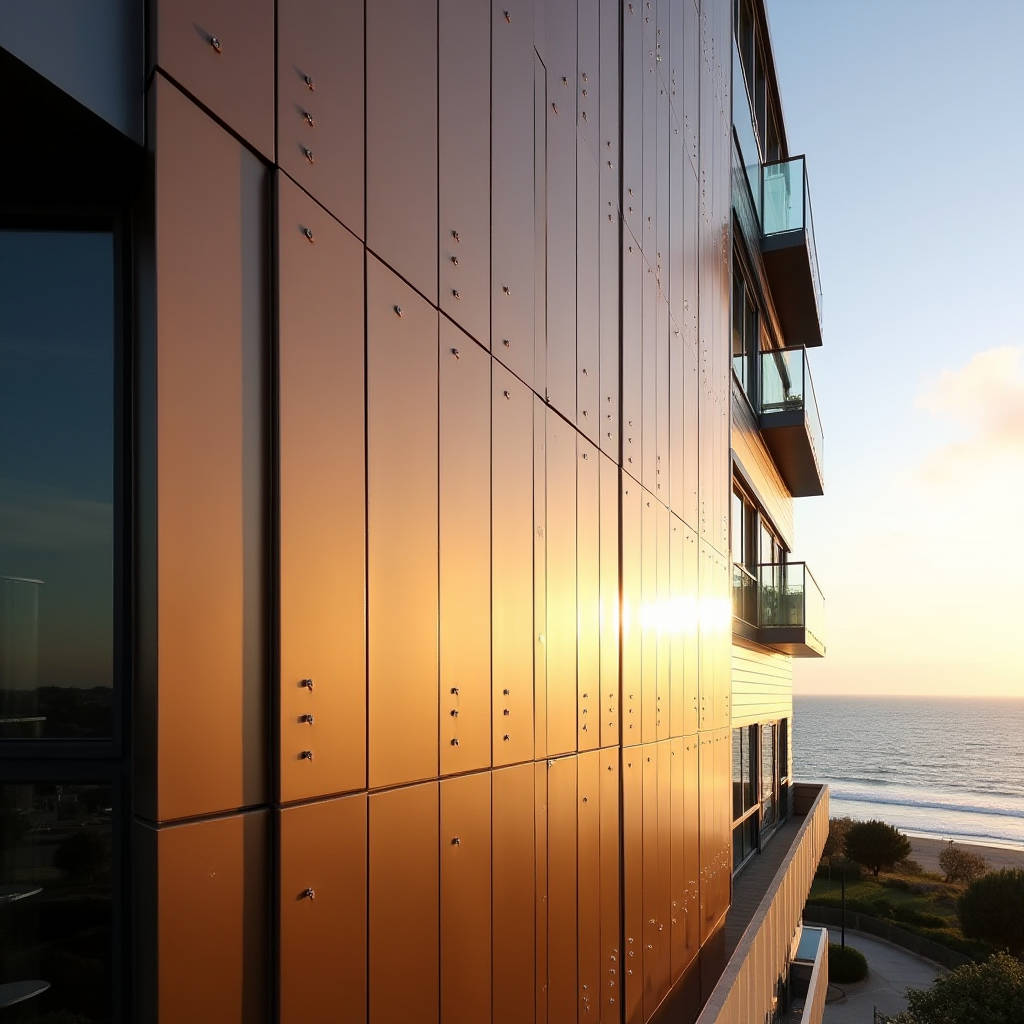
When a facade consultant specifies 3003 Aluminum Alloy for a rainscreen cladding system, the decision usually hinges on one underappreciated variable: the balance between formability and corrosion resistance in marine-adjacent environments. Architects chasing complex geometries — folded perforated panels, deep return bends, parametric origami facades — need a material that bends without micro-cracking yet does not degrade when salt-laden wind hits the surface six months after installation. 3003 Aluminum Alloy occupies that narrow performance window. Its manganese content (1.0–1.5%) delivers roughly 20% more tensile strength than 1100 series commercially pure aluminum, while retaining enough elongation to handle tight-radius press brake work. This is not a generic overview. The focus here is on how cold-worked temper selection, coating adhesion dynamics, and long-term corrosion behavior intersect in real cladding projects — specifically those within 5 km of a coastline or industrial emission zone.
Why Manganese Matters in Facade-Grade 3003 Aluminum Alloy
The 3xxx series differs fundamentally from 5xxx (Al-Mg) and 6xxx (Al-Mg-Si) alloys. In 3003 Aluminum Alloy, manganese exists primarily as fine dispersed intermetallic particles — Al₆Mn and Al₁₂(Mn,Fe)₃Si — distributed throughout the aluminum matrix. These particles pin grain boundaries during cold rolling, which refines the grain structure and raises yield strength without the corrosion penalty that copper-rich 2xxx alloys incur. For cladding applications, this matters because the electrochemical potential difference between the intermetallic particles and the aluminum matrix remains relatively small. The result: galvanic micro-cell activity stays low, and the alloy resists pitting corrosion better than many higher-strength alternatives. Data from ASTM B209 testing shows that 3003-H14 sheet achieves a typical ultimate tensile strength of 150–170 MPa with elongation around 8–10%, while 3003-H22 (strain-hardened and partially annealed) offers slightly lower strength but elongation in the 12–16% range — a meaningful difference when panels require 90° or 180° hem bends.
ASTM B209 governs aluminum and aluminum-alloy sheet and plate. For 3003-H14, the standard specifies minimum tensile strength of 140 MPa, minimum yield strength of 115 MPa, and minimum elongation of 5% in 1.6 mm thickness. Always reference the current edition for project specifications.
Cold Work vs. Heat Treatment: Temper Selection for Bending-Intensive Panels
3003 Aluminum Alloy is non-heat-treatable. Strength comes exclusively from strain hardening — the progressive dislocation entanglement that occurs during cold rolling. This has direct consequences for cladding fabrication. A panel specified in H18 temper (full hard, approximately 200 MPa UTS) will resist deformation but may crack at bend radii below 3t. The same alloy in H14 (half hard) or H22 (strain-hardened and partially annealed) handles 1t to 1.5t bends with far fewer rejects on the shop floor.
Fabricators working with 2.0 mm and 2.5 mm 3003 Aluminum Alloy sheet for rainscreen panels typically gravitate toward H14 for flat or lightly profiled panels and H22 where the design calls for return flanges exceeding 25 mm. The partial anneal in H22 recovers some ductility lost during cold reduction, which reduces springback — a persistent headache when panels must align across a 40-meter elevation with ±2 mm joint tolerances. Springback angles for 3003-H14 bent at 90° typically range from 2° to 4°, depending on die width and punch radius. For H22, expect 1.5° to 3°. These numbers are empirical and should be verified with sample bends before production runs.
Practical Temper Reference for Cladding
| Temper | Typical UTS (MPa) | Elongation (%) | Bend Radius (min) | Cladding Suitability |
|---|---|---|---|---|
| H14 | 150–170 | 8–10 | 1.5t–2t | Flat panels, moderate profiling |
| H22 | 140–155 | 12–16 | 1t–1.5t | Deep returns, folded edges |
| H24 | 130–145 | 15–20 | 0.5t–1t | Complex perforated panels |
| H18 | 190–210 | 3–5 | 3t–4t | Flat panels only, limited bending |
Corrosion Behavior Within 5 km of Saltwater: What the Data Actually Shows
Lab salt spray tests (ASTM B117) tell part of the story. Real-world exposure tells the rest. 3003 Aluminum Alloy, when uncoated, develops a thin, adherent aluminum oxide layer that passivates the surface. In chloride-rich environments, however, chloride ions compete with oxygen at the metal-oxide interface, disrupting passive film formation at localized sites. The result is pitting corrosion — small, deep cavities rather than uniform surface wastage.
Research published by the Aluminum Association indicates that 3003 alloy exposed to marine atmospheres for 20 years shows pitting depths typically under 0.13 mm, with the majority of pits shallower than 0.08 mm. For a 2.5 mm thick cladding panel, this represents less than 5% penetration over two decades — structurally negligible. But the cosmetic impact on uncoated panels is another matter. This is why PVDF (polyvinylidene fluoride) coatings are standard for architectural 3003 Aluminum Alloy cladding in coastal projects. A properly applied 3-coat PVDF system (primer, color coat, clear topcoat) with total dry film thickness of 30–35 microns provides a barrier that keeps chloride ions from reaching the metal substrate. AAMA 2605-compliant coatings undergo 4,000+ hours of salt spray testing with minimal blistering and no creepage beyond 2 mm at scribe lines.
AAMA 2605 is the voluntary specification for high-performance organic coatings on aluminum extrusions and panels. Compliance requires passing tests for color retention, chalk resistance, gloss retention, and salt spray corrosion — all relevant for coastal cladding projects.
Coating Adhesion on 3003 Substrate: The Surface Prep Factor
Coating delamination is a failure mode that gets less attention than it deserves. The oxide layer on 3003 Aluminum Alloy, while protective, can also interfere with coating adhesion if not properly prepared. Chromate conversion coatings have historically been the go-to pretreatment — they etch the oxide layer, deposit a chromium-rich film, and create a surface profile that mechanical bonds with PVDF primers. Environmental regulations in many regions now restrict hexavalent chromium, pushing the industry toward trivalent chromium or zirconium-based pretreatments. These alternatives work, but process control becomes tighter. Bath temperature, pH, and immersion time tolerances narrow.
For project specifiers, the practical takeaway is this: request adhesion test data per ASTM D3359 (cross-hatch tape test) for the specific pretreatment-coating combination proposed. A 5B rating (no coating removed) should be the minimum acceptance criterion. Suppliers like Futeng® maintain in-house pretreatment lines calibrated for 3003 Aluminum Alloy substrates, with documented adhesion performance across PVDF and FEVE coating systems. The key is verifying that the pretreatment chemistry is validated for the specific temper and surface finish specified — mill finish, brushed, or pre-passivated.
Thermal Movement and Panel Joint Design
3003 Aluminum Alloy has a coefficient of thermal expansion of approximately 23.2 × 10⁻⁶ per °C (in the 20–100°C range). For a 3-meter panel subjected to a 60°C temperature swing (winter night to summer solar gain), the linear expansion reaches:
ΔL = 23.2 × 10⁻⁶ × 3000 mm × 60°C = 4.18 mm
This 4.2 mm of movement must be accommodated by the joint design. Open-joint rainscreen systems with 15–20 mm gaps handle this easily. But closed-joint systems with silicone sealant require careful joint width calculation. A 10 mm sealant joint with movement capability of ±25% accommodates ±2.5 mm — insufficient for the full 4.2 mm movement. The solution is either wider joints (minimum 16 mm for ±25% sealant) or panel segmentation into shorter lengths. This is not unique to 3003, but the alloy's expansion coefficient sits mid-range among aluminum alloys, and project teams sometimes overlook the calculation when switching from steel or zinc cladding materials.
Thermal Expansion Comparison: Cladding Metals
| Material | CTE (×10⁻⁶/°C) | Expansion per 3m, Δ60°C (mm) | Joint Design Implication |
|---|---|---|---|
| 3003 Aluminum Alloy | 23.2 | 4.18 | Standard joint sizing |
| Galvanized Steel | 12.0 | 2.16 | Tighter joints possible |
| Zinc (EN 988) | 22.0 | 3.96 | Similar to aluminum |
| Stainless Steel 304 | 17.3 | 3.11 | Moderate joint sizing |
| Copper | 16.8 | 3.02 | Moderate joint sizing |
Weldability in Fabrication: TIG and MIG Considerations
3003 Aluminum Alloy welds readily with both TIG (GTAW) and MIG (GMAW) processes, using 4043 or 1100 filler alloys. The choice of filler matters. 4043 (Al-Si) offers better fluidity and reduced hot-cracking risk, but the weld zone will show slightly different etching response if anodizing is specified. For PVDF-coated cladding panels, this is irrelevant — the coating covers the weld. For exposed interior panels or soffit liners where welds remain visible, 1100 filler produces a closer color match to the 3003 base metal.
Weld strength in the as-welded condition drops relative to the cold-worked base metal. The heat-affected zone (HAZ) anneals during welding, reverting to approximately the O-temper strength level — around 110 MPa UTS. For structural brackets and stiffeners welded to the back of 3003 cladding panels, this HAZ softening must be accounted for in the connection design. A common approach: size welded attachment points so the load per weld stays below the HAZ strength, not the parent metal strength. Alternatively, mechanical fastening (stainless steel rivets or bolts) avoids the HAZ issue entirely and is preferred for high-wind-load applications.
Wind Load Performance: Stiffener Layout for 3003 Panels
A 2.5 mm thick 3003-H14 aluminum panel spanning 600 mm between stiffeners, subjected to a design wind pressure of 2.0 kPa (typical for mid-rise buildings in exposure category B), deflects approximately:
δ = (5 × w × L⁴) / (384 × E × I)
Where E ≈ 69 GPa for 3003 Aluminum Alloy, and I for a 2.5 mm × 1000 mm strip = (1000 × 2.5³) / 12 = 1,302 mm⁴. The calculated deflection comes to roughly 4.8 mm, or L/125 — within the commonly accepted L/90 deflection limit for rainscreen panels per AAMA 508. For 3.0 mm panels, deflection drops to approximately 2.8 mm (L/214), offering a stiffer option for high-wind zones without changing stiffener spacing. These numbers are estimates; project-specific calculations should use the actual panel geometry, stiffener layout, and wind tunnel data where available.
Stiffener attachment to 3003 Aluminum Alloy panels typically uses structural silicone or intermittent MIG welding. Silicone-attached stiffeners avoid HAZ softening and allow differential thermal movement between the stiffener and the panel skin. Welded stiffeners create a rigid composite section but introduce the HAZ issues discussed above. The choice depends on wind load magnitude, panel size, and the fabricator's quality control capability.
Chemical Composition and Mill Traceability
For project specifications requiring full material traceability, 3003 Aluminum Alloy must be ordered with mill test certificates (EN 10204 Type 3.1 or 3.2) showing heat number, chemical analysis, and mechanical test results. The standard composition per ASTM B209 and EN 573-3 is:
- Silicon: 0.6% max
- Iron: 0.7% max
- Copper: 0.05–0.20%
- Manganese: 1.0–1.5%
- Zinc: 0.10% max
- Others (each): 0.05% max
- Others (total): 0.15% max
- Aluminum: Remainder
The copper content, though small, contributes to solid-solution strengthening and slightly improves corrosion resistance in industrial atmospheres containing sulfur compounds. For cladding near coal-fired power stations or heavy industrial zones, this trace copper provides a marginal benefit over 1100 alloy. However, if the project is within 500 meters of a coastline with prevailing onshore winds, the specifier should verify that the copper content stays at the lower end of the range (0.05–0.10%) to minimize any galvanic interaction with marine chlorides.
Forming Limits and Springback Control
Press brake operators working with 3003 Aluminum Alloy quickly learn that the material's forming limit diagram (FLD) is generous compared to 5xxx or 6xxx alloys. The strain-hardening exponent (n-value) for 3003-O is approximately 0.20–0.25, indicating good stretch formability. For H14 temper, the n-value drops to around 0.10–0.15, but the material still handles moderate stretch forming without necking failure.
In practice, 3003-H14 panels with 2.0 mm thickness can be bent to 90° with a 3 mm inside radius (1.5t) with a scrap rate under 2% when the press brake is properly set up. Key variables affecting success: die opening width (recommend 6–8 times material thickness), punch radius (should match or exceed the minimum bend radius), and grain direction (bending perpendicular to the rolling direction reduces cracking risk). For panels requiring bends parallel to the grain, increase the bend radius by 50% or switch to H22 temper.
Springback compensation is essential. For a 90° bend in 3003-H14, the punch angle should be approximately 86–88° to achieve a true 90° after springback. This varies with tooling geometry and should be calibrated on the specific press brake. CNC-controlled press brakes with angle correction systems can compensate automatically, but manual machines require operator skill and sample bends.
Anodizing 3003: When It Works and When It Does Not
3003 Aluminum Alloy can be anodized, but the results differ from 5005 or 6063. The manganese-rich intermetallic particles do not anodize at the same rate as the surrounding aluminum matrix. In clear anodizing, these particles appear as small gray specks in the finished surface — a non-uniform appearance that architects may reject for visible cladding applications. Dark bronze or black anodizing masks the effect somewhat, but the surface will still show subtle mottling under glancing light.
For architectural cladding where anodized finish is specified, 5005 alloy (Al-Mg) is generally preferred because it anodizes to a uniform, clear finish. 3003 Aluminum Alloy is better suited to PVDF or FEVE liquid coating, or to applications where the panel is not in direct view — such as soffit liners, equipment screens, or interior wall cladding with a textured powder coat. If anodizing is non-negotiable for a 3003 project, the specifier should request sample panels of at least 300 mm × 300 mm and review them under the intended lighting conditions before approving the finish.
Sustainability and End-of-Life Considerations
3003 Aluminum Alloy, like all wrought aluminum alloys, is infinitely recyclable without loss of properties. The recycling energy requirement is approximately 5% of primary aluminum production energy. For projects pursuing LEED v4.1 or BREEAM certification, specifying aluminum cladding with high recycled content contributes to Materials and Resources credits. Mills producing 3003 sheet typically offer post-consumer recycled content ranging from 30% to 70%, depending on the source and the mill's scrap management system.
Environmental Product Declarations (EPDs) for 3003 Aluminum Alloy sheet are available from major mills and should be requested as part of the submittal package. The EPD provides cradle-to-gate global warming potential, acidification potential, and other impact categories per ISO 14025 and EN 15804. For a typical 2.5 mm PVDF-coated 3003 cladding panel, the cradle-to-gate carbon footprint ranges from 8 to 12 kg CO₂ equivalent per square meter, depending on the primary/recycled mix and the coating system.
Specifying 3003 Aluminum Alloy Cladding: A Practical Checklist
Based on the technical factors discussed, a robust specification for 3003 Aluminum Alloy cladding panels should address the following points:
- Alloy and temper: Specify 3003-H14 or H22 per ASTM B209, with temper selection based on the most demanding bend geometry on the project.
- Thickness: 2.0 mm minimum for standard panels, 2.5 mm for panels exceeding 1.2 m², 3.0 mm for high-wind zones or panels with deep perforations.
- Coating: PVDF 3-coat system per AAMA 2605, minimum 30 microns total dry film thickness, with pretreatment validated for 3003 substrate.
- Mill certification: EN 10204 Type 3.1 certificates showing chemical analysis and mechanical properties for each heat.
- Adhesion testing: ASTM D3359, 5B minimum, tested on production samples from the coating line.
- Corrosion testing: AAMA 2605 salt spray requirements, 4,000 hours minimum, with report submitted for review.
- Stiffener design: Calculated per project wind loads, with deflection limit of L/90 per AAMA 508.
- Joint design: Account for thermal expansion of 23.2 × 10⁻⁶/°C, with joint width verified for the project's temperature range.
Suppliers such as Futeng® provide 3003 Aluminum Alloy cladding panels with full documentation packages covering these specification points. The key is early engagement — involving the supplier during the design development phase allows temper selection, stiffener layout, and joint design to be coordinated before shop drawings are finalized.
3003 Aluminum Alloy occupies a specific and valuable position in the cladding material palette. It is not the strongest alloy, nor the most corrosion-resistant, nor the cheapest. But for projects where moderate forming complexity meets moderate environmental exposure, it delivers a combination of workability, durability, and cost predictability that few other alloys match. The engineering decisions — temper, thickness, stiffener attachment, joint width — determine whether the installed facade performs for 30 years or develops problems in five. Attention to the details covered here, backed by mill documentation and coating test data, is what separates a facade that weathers gracefully from one that becomes a maintenance liability.