Countersunk Screw For Aluminum Panel Engineering Guide Head Geometry Corrosion and Thermal Compliance
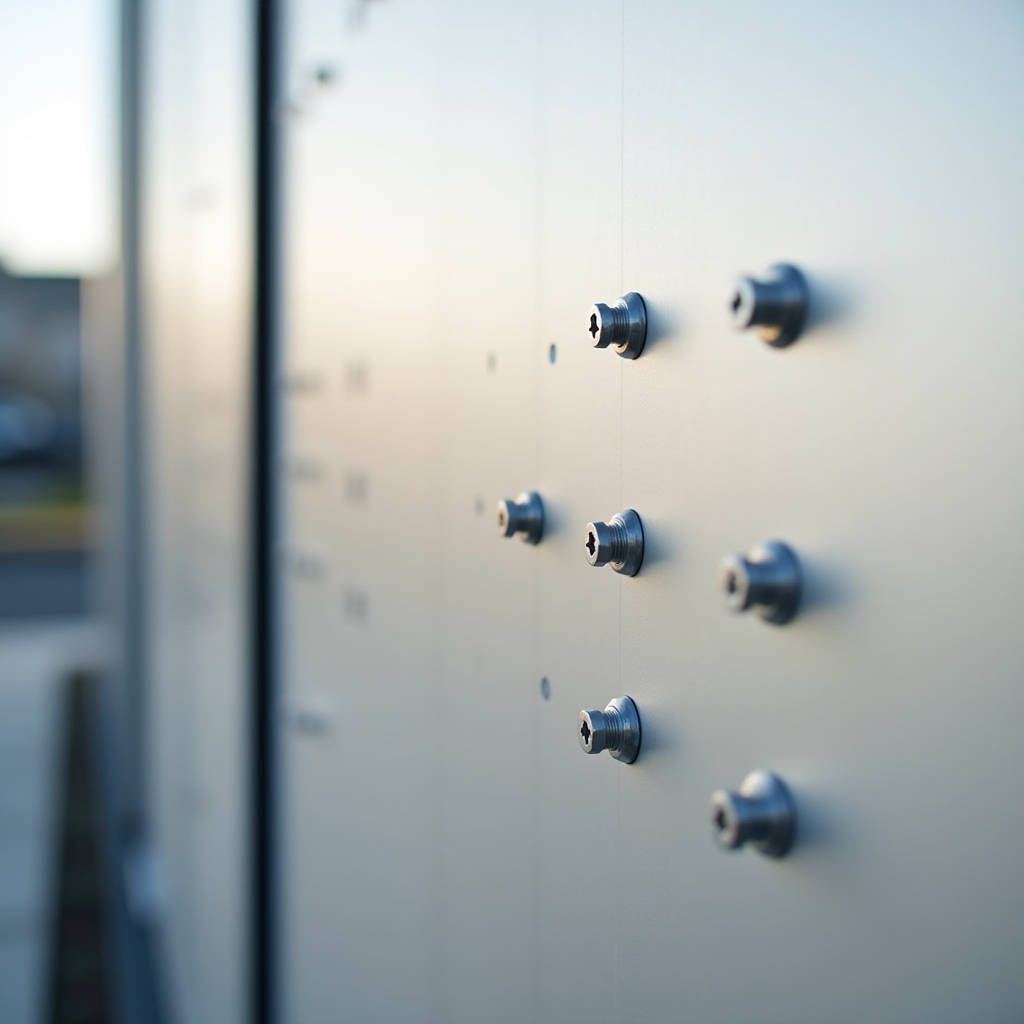
Specifying the right fastener for solid aluminium cladding panels is not a matter of simply picking a screw off the shelf. A countersunk screw for aluminum panel applications sits at the intersection of thermal expansion mechanics, dissimilar metal corrosion risk, and aesthetic flatness tolerances that architects obsess over. Get the head angle wrong and the panel puckers around the fastener. Choose a stainless steel screw without an isolation strategy and galvanic corrosion eats through the aluminium within three to five years in coastal environments. This article maps out the engineering decisions that determine whether a countersunk screw for aluminum panel installation holds up for two decades or becomes a call-back liability.
Why Head Geometry Dictates Panel Flatness
The defining feature of a countersunk screw is the conical underside of the head, which mates with a matching recess in the panel. For solid aluminium cladding panels—typically 2.0 mm, 2.5 mm, or 3.0 mm thick—the standard head angle is 90 degrees. This is the default across most commercial fastener ranges, including DIN 7991 aluminium socket countersunk screws. However, the aerospace and high-end architectural sectors often specify an 82-degree countersink, which distributes clamping force across a wider bearing surface and reduces the risk of the screw head pulling through the aluminium under wind suction loads.
The countersink depth relative to panel thickness is the critical variable. A 2.5 mm solid aluminium panel with a 90-degree countersink requires a head seating depth of approximately 1.2 mm to 1.5 mm to sit flush. If the fabricator over-countersinks by even 0.3 mm, the remaining material thickness under the screw head drops below 1.0 mm. Under cyclic wind loading—say, 2.5 kPa design pressure on a mid-rise facade—that thin web of aluminium fatigues. The failure mode is not dramatic; it is a hairline crack radiating from the fastener hole that lets water into the cavity behind the panel. By the time anyone notices the staining on the soffit, six months of moisture damage has already occurred.
For panels at the upper end of the thickness range—3.0 mm solid aluminium—some engineers specify a reduced countersink depth combined with a thin nylon or PTFE washer under the screw head. This creates a micro-standoff of 0.2 mm to 0.3 mm, which prevents the screw head edge from biting into the PVDF coating and creating a corrosion initiation point. The washer also acts as a slip plane, accommodating the differential thermal movement between the aluminium panel and the steel or aluminium substructure. Without this detail, a 3-meter-long panel on a south-facing facade in Dubai or Phoenix can expand by 2.0 mm to 2.5 mm over a diurnal cycle, and a rigidly clamped fastener will transfer that strain directly into the panel edge around the screw hole.
Material Selection and the Galvanic Corrosion Problem
The most common mistake in specifying a countersunk screw for aluminum panel systems is defaulting to standard 304 stainless steel without considering the galvanic couple. Aluminium and stainless steel sit approximately 0.5 to 0.7 volts apart on the galvanic series in seawater. In the presence of an electrolyte—rainwater, condensation, or coastal salt spray—the aluminium becomes the anode and sacrifices itself. The corrosion rate accelerates dramatically when the cathode (stainless steel) has a much larger surface area than the anode (aluminium around the fastener hole).
The practical consequence: a 304 stainless countersunk screw installed directly into a solid aluminium panel on a building 500 meters from the ocean in Singapore will show visible white corrosion product around the fastener head within 18 to 24 months. After five years, the panel material around the hole has thinned enough that the screw head loses bearing. The panel is still attached to the substructure, but it is now free to rattle under wind gusts, and the PVDF coating has delaminated in a 15 mm radius around each fastener.
Three mitigation strategies are available, and the choice depends on the project's corrosion severity classification under ISO 9223:
- Aluminium fasteners (DIN 7991 aluminium socket countersunk screws): Eliminates the galvanic couple entirely. 6000-series or 7000-series aluminium alloy screws with anodised finish provide adequate shear strength for most cladding applications. The downside is lower tensile strength compared to stainless steel—typically 300–350 MPa yield versus 500+ MPa for A2-70 stainless—which limits their use in high-wind zones where pull-out loads are significant.
- 316 stainless steel with isolation: For C3 and C4 corrosion environments (coastal, industrial), 316 stainless countersunk screws with a nylon isolation bushing or EPDM sealing washer under the head break the electrical circuit. The bushing must extend through the full thickness of the panel, not just sit under the head, because the screw shank also makes contact with the panel edge inside the hole.
- Coated carbon steel with cathodic protection: In C1 and C2 environments (dry inland), a high-quality zinc-flake coating on carbon steel countersunk screws provides adequate protection at lower cost. This is common in warehouse and industrial cladding where aesthetics are secondary.
Futeng® has supplied solid aluminium cladding systems where the fastener specification was developed in parallel with the panel engineering, ensuring that the countersunk screw for aluminum panel connections matched the project's specific corrosion category and wind load requirements rather than relying on a generic specification.
Installation Methods: Countersinking vs. Depressing
There are two fundamentally different approaches to seating a countersunk screw flush with a solid aluminium panel surface. The conventional method—machining a conical countersink into the panel—is straightforward but removes material. The alternative, sometimes called the depression method, uses the screw itself to deform the aluminium surface into a shallow cone. This technique is referenced in Alucobond® installation guidelines for composite panels, but it also appears in some solid aluminium cladding specifications.
The depression method requires the panel hole to be drilled slightly larger than the screw major diameter—typically 0.5 mm to 1.0 mm oversize. The screw is driven in, and the conical underside of the head presses the aluminium surface downward, creating a countersunk recess without cutting. The advantage is that no material is removed, so the panel retains its full thickness around the fastener. The disadvantage is that the cold-working of the aluminium around the hole introduces residual stresses. In 5000-series aluminium alloys (common for cladding panels), this cold work can increase susceptibility to stress corrosion cracking in marine environments.
For solid aluminium panels 2.5 mm and thicker, conventional countersinking with a piloted countersink tool is the safer approach. The pilot ensures the countersink is concentric with the drilled hole, preventing the screw from seating off-center and creating an uneven bearing surface. The countersink diameter should be matched to the screw head diameter with a tolerance of +0.1 mm / -0.0 mm. A countersink that is too wide leaves a visible gap around the screw head; too narrow and the head sits proud of the panel surface, creating a shadow line that architects will flag during inspection.
On the jobsite, the difference between a clean installation and a rejected facade often comes down to the countersink tooling. A worn or un-piloted countersink bit chatters, producing a faceted rather than conical recess. The screw head then makes contact on three or four points rather than a continuous 360-degree bearing surface. Under wind load, those point contacts act as stress concentrators. The fix is simple but requires discipline: replace countersink bits after every 200 to 300 holes in aluminium, and always use a depth stop collar to maintain consistent countersink depth across thousands of fasteners on a single elevation.
Thermal Expansion and Fastener Compliance
Solid aluminium panels expand and contract at approximately 24 × 10⁻⁶ per °C. A 4-meter panel subjected to a 60°C temperature swing (from -10°C winter night to 50°C summer afternoon on a dark-colored PVDF finish) changes length by 5.76 mm. If the panel is rigidly fixed at multiple points with countersunk screws that do not allow any slip, the panel will buckle. The buckling mode is typically a wave pattern between fastener rows, with amplitudes of 3 mm to 8 mm that are visible under glancing light conditions—the exact condition that facade consultants use during snagging inspections.
The engineering solution is to differentiate between fixed points and sliding points in the fastener layout. A typical arrangement for a rectangular solid aluminium panel uses two fixed points near the center of the panel and sliding connections at all other fastener locations. The sliding connections use countersunk screws with an oversized hole in the panel and a slotted hole in the substructure, combined with a low-friction washer stack that allows the panel to move relative to the screw.
The following table provides a practical guide for selecting the appropriate fastener strategy based on panel dimensions and expected thermal range:
| Panel Length (mm) | ΔT Range (°C) | Expansion (mm) | Fixed Points | Sliding Hole Oversize (mm) | Recommended Screw Type |
|---|---|---|---|---|---|
| ≤ 1500 | 30–40 | ≤ 1.4 | 2 (center) | 0.5 | Aluminium DIN 7991, M6 |
| 1500–2500 | 40–55 | 1.4–3.3 | 2 (center) | 1.0 | 316 SS + EPDM washer, M8 |
| 2500–4000 | 55–70 | 3.3–6.7 | 2 (center) | 1.5 | 316 SS + slotted subframe, M8 |
| 4000–6000 | 60–80 | 5.8–11.5 | 3 (center row) | 2.0 + slotted subframe | 316 SS + PTFE slip washer, M10 |
This table assumes a 5000-series aluminium alloy with a coefficient of thermal expansion of 24 × 10⁻⁶/°C. For 6000-series alloys, which have a slightly lower coefficient (approximately 23 × 10⁻⁶/°C), the expansion values can be reduced by about 4%. The sliding hole oversize values are minimums; increasing them by 0.5 mm adds a safety margin against installation tolerances stacking up.
Coating Integrity Around the Fastener
The PVDF coating on a solid aluminium panel is typically 25–35 microns thick for a two-coat system and 40–50 microns for a three-coat system. When a countersunk screw for aluminum panel installation is torqued down, the edge of the screw head bears directly on this coating. If the coating is brittle—common with improperly cured PVDF or with some polyester powder coatings—the compression causes micro-cracking around the fastener head. These cracks are invisible to the naked eye but provide a pathway for moisture to reach the aluminium substrate.
The failure sequence is predictable: moisture ingress leads to filiform corrosion, which propagates under the coating at a rate of 0.5 mm to 2 mm per year depending on humidity. After three to five years, the corrosion filaments extend 5 mm to 10 mm from the fastener, and the coating begins to delaminate in those areas. The panel itself is structurally intact, but the facade has a mottled, peeling appearance that is unacceptable for any commercial or institutional building.
Prevention requires attention to three details. First, the countersink should be machined before the panel is coated, not after, so the PVDF layer wraps continuously into the countersunk recess. Second, the screw head underside should be smooth, with no burrs or sharp edges from the manufacturing process. Forged or machined screw heads are preferable to stamped heads for this reason. Third, the installation torque should be controlled—typically 3–5 Nm for M6 fasteners in aluminium, which is enough to seat the screw flush without crushing the coating. Impact drivers without torque control are responsible for a significant percentage of coating damage on cladding installations.
Wind Load and Pull-Out Resistance
A countersunk screw for aluminum panel systems must resist both shear loads (from panel self-weight and seismic movement) and tensile loads (from wind suction). The pull-out resistance of a screw in aluminium depends on the thread engagement length, the aluminium alloy and temper, and the hole diameter relative to the screw pitch diameter.
For a standard M6 × 1.0 mm thread in 5005-H14 aluminium (a common cladding alloy with tensile strength around 145 MPa), the pull-out strength per millimeter of thread engagement is approximately 18–22 N/mm. With a 2.5 mm panel thickness providing 2.5 mm of engagement (assuming the screw threads fully into the panel, which is rare—most connections are into the substructure behind the panel), the pull-out resistance is only 45–55 N. That is inadequate for any exterior application where wind suction pressures exceed 0.5 kPa.
This is why countersunk screws in solid aluminium cladding panels almost always pass through the panel and thread into the aluminium or steel substructure behind it. The panel itself is clamped between the screw head and the substructure, and the structural load path bypasses the panel material. The screw's pull-out resistance is then determined by the substructure material and thickness, not the panel. For a typical aluminium subframe with 3 mm wall thickness, an M6 self-tapping screw provides 2–4 kN of pull-out resistance—more than adequate for wind loads up to 5 kPa on a panel with four fasteners.
The specification should reference ASTM E330 for wind load testing of the complete panel assembly, including fasteners. A properly designed solid aluminium cladding system with countersunk screw fastening should demonstrate no permanent deformation after cyclic loading at 1.5 times the design pressure, per AAMA 501.1 test protocols.
Quality Control and Inspection
On a large facade project, the number of countersunk fasteners can exceed 50,000. Statistical process control is the only practical approach to quality assurance. A sampling plan based on ISO 2859-1, with an Acceptable Quality Level (AQL) of 1.0 for critical defects, means that for a lot of 10,000 screws, 125 are inspected and the lot is accepted if no more than three defects are found.
The critical checks for a countersunk screw for aluminum panel applications include: head angle tolerance (±1 degree from nominal), head diameter tolerance (±0.1 mm), thread form (no burrs, no missing threads), surface finish (no discoloration, uniform coating thickness on plated screws), and concentricity of the head relative to the shank (runout less than 0.1 mm). A screw with poor concentricity will seat off-center in the countersink, creating an uneven gap that is visible on the finished facade.
On the installation side, the inspection criteria should include: flushness of the screw head relative to the panel surface (0.0 mm to +0.2 mm proud is acceptable; recessed is not), absence of coating damage around the fastener (no cracks visible under 10× magnification), and correct torque (verified with a torque wrench on a sample of fasteners per elevation). These criteria should be documented in the project's quality plan and agreed upon with the facade consultant before installation begins.
For projects where the aesthetic standard is particularly high—corporate headquarters, luxury retail, museum facades—some specifiers require that all countersunk fasteners on visible elevations be oriented with the drive recess aligned in the same direction. This is a purely cosmetic requirement, but it demands disciplined installation and is a marker of a high-quality cladding contractor.
Cost Implications and Lifecycle Economics
The unit cost of a countersunk screw for aluminum panel installation ranges from approximately $0.05 for a basic zinc-plated carbon steel screw to $0.80 or more for a custom 316 stainless fastener with a PTFE-coated washer and captive design. On a facade with 40,000 fasteners, the difference between the cheapest and most expensive option is roughly $30,000—significant but not enormous in the context of a multi-million-dollar cladding contract.
The real cost difference emerges over the building's service life. Replacing corroded fasteners on a high-rise facade requires swing stage access, which costs $5,000 to $15,000 per mobilization depending on building height and location. If 5% of fasteners on a 20-story building require replacement after 10 years due to corrosion, the access cost alone can exceed $50,000—far more than the upfront savings from using cheaper fasteners. For buildings in C3 and C4 corrosion zones, the lifecycle economics strongly favor 316 stainless or aluminium fasteners with proper isolation detailing, even though the initial material cost is higher.
The specification decision should be informed by a lifecycle cost analysis that accounts for the building's design life (typically 50 years for commercial buildings), the corrosion environment, the accessibility of the facade for maintenance, and the consequences of fastener failure. A fastener that fails in shear on a panel 30 meters above a public plaza is a safety hazard; a fastener that corrodes on a ground-floor panel behind landscaping is a maintenance annoyance. The risk profile is not uniform across the building, and the fastener specification can be tiered accordingly.
Selecting a countersunk screw for aluminum panel cladding comes down to five engineering decisions: head angle, material pairing, corrosion protection strategy, thermal movement accommodation, and installation quality control. Each decision has a correct answer for a given project context, and the correct answer is rarely the cheapest option on the bill of materials. The buildings that still look sharp after 15 years of weather exposure are the ones where the fastener specification received as much engineering attention as the panel itself.