Self Tapping Screw For Aluminum Facade Engineering Thread Geometry Corrosion And Thermal Stress
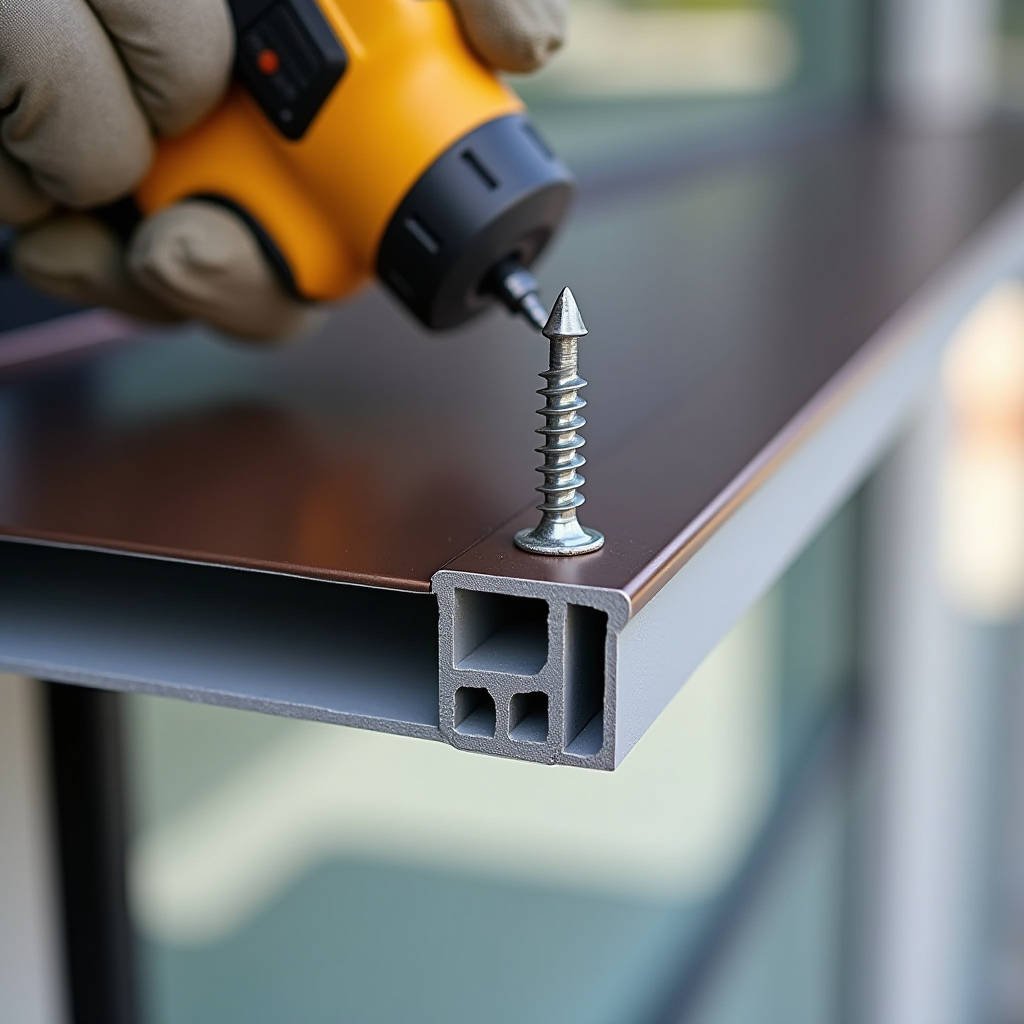
Specifying fasteners for a rainscreen facade demands more than matching a screw to a substrate. When the panel material is solid aluminium sheet at 2.0 mm, 2.5 mm, or 3.0 mm thickness, the self tapping screw for aluminum facade must resolve three interdependent problems simultaneously: thread engagement in a relatively soft metal, thermal expansion stress across the fastener axis, and long-term galvanic stability at the bearing surface. Get any one of these wrong and the failure mode is predictable — stripped threads during installation, elongated holes after the first thermal cycle, or white corrosion products staining the PVDF coating within 18 months. This article examines the engineering logic behind each of those failure modes and the fastener specifications that prevent them, drawing on ASTM fastener standards, AAMA testing protocols, and field data from commercial facade projects.
Why Aluminum Facade Screws Demand a Different Engineering Approach
Solid aluminium cladding panels — typically 2.0 mm for interior soffits, 2.5 mm for standard exterior walls, and 3.0 mm for high-wind zones — sit in a mechanical category that confuses many specifiers. The material is metal, so the instinct is to treat it like steel decking. But aluminium's elastic modulus is roughly one-third that of carbon steel. Under the same tensile load, the parent material around the thread deforms three times more. This is not a marginal difference; it changes the entire load path.
A self tapping screw for aluminum facade works by displacing material to form its own internal thread. In steel, that displaced material work-hardens and creates a strong bearing surface. In aluminium, the displaced material flows more readily but does not harden to the same degree. The result is a thread that can strip at surprisingly low torque values — often below 2 N·m for a standard Type AB point in 2.0 mm sheet. The screw feels tight during installation because the cutting action generates friction, but the actual thread engagement depth may be insufficient for wind loads exceeding 1.5 kPa.
This is why thread geometry matters more than brand name. A fastener with a high helix angle and shallow thread depth will perform poorly in solid aluminium, regardless of coating or marketing claims. The correct specification is a Type A or modified Type AB point with a thread pitch optimized for material thickness between 2.0 mm and 3.0 mm. The thread should engage at least 2.5 full turns within the panel thickness — a number that can be calculated directly from the pitch and panel gauge.
Galvanic Corrosion: The Hidden Degradation Timeline
Every self tapping screw for aluminum facade creates a galvanic cell the moment it is driven. The question is not whether corrosion will occur, but at what rate. The electrochemical potential difference between aluminium and carbon steel is approximately 0.9 V in a marine atmosphere. That is enough to drive rapid anodic dissolution of the aluminium around the fastener hole if an electrolyte — rainwater, condensation, or even high humidity — bridges the two metals.
The standard solution is a stainless steel screw. But not all stainless grades perform equally. AISI 304 (UNS S30400) fasteners show measurable galvanic attack on aluminium in chloride-rich environments within 12 to 24 months. AISI 316 (UNS S31600), with its molybdenum content, reduces the corrosion current by roughly 40% under identical conditions. For coastal installations or buildings within 5 km of breaking surf, 316 is the minimum acceptable grade. Some manufacturers, including Futeng® for their solid aluminium panel systems, specify 316 stainless with a supplementary passivation treatment as standard for marine-exposed projects.
Bi-metallic isolation is the second line of defense. A nylon or EPDM washer between the screw head and the panel face breaks the electrical circuit. This costs less than $0.02 per fastener and can extend the corrosion-free service life by a factor of three or more. The washer also serves a mechanical function: it distributes the clamping load across a wider bearing area, reducing the risk of localized panel deformation under wind suction.
Thermal Movement and the Fastener Fatigue Problem
Solid aluminium expands at roughly 23 × 10⁻⁶ per °C. A 3-meter panel subjected to a 50°C temperature swing — common on a dark-colored PVDF facade in a continental climate — will grow by 3.45 mm. If the self tapping screw for aluminum facade fixes the panel rigidly at both ends, that 3.45 mm of movement must be absorbed somewhere. The options are panel buckling, fastener hole elongation, or screw fatigue.
Panel buckling is the most visible failure and the one that generates the most warranty claims. The aluminium sheet, constrained at its fixing points, develops compressive stresses that exceed the critical buckling load. The panel bows outward between fixings, creating a wavy appearance that is particularly obvious under grazing light. This is not a material defect; it is a design error in the fastening strategy.
The correct approach is to differentiate between fixed points and sliding points. Each panel needs one fixed point — typically at the top center — where the screw is fully tightened and the panel cannot move. All other fasteners should be installed in slotted holes or with a controlled stand-off that allows the panel to slide relative to the subframe. The screw itself should not be fully torqued at sliding points; a gap of 0.3 mm to 0.5 mm between the screw head and the panel face, maintained by a shoulder or spacer, provides the necessary slip plane.
This is where the distinction between a self-tapping screw and a self-drilling screw becomes critical. A self-drilling screw with a drill point long enough to penetrate the aluminium subframe will also cut into the slot edge, creating a stress riser that initiates fatigue cracking. For slotted connections, the screw should be a true self-tapping type — requiring a pre-drilled or punched hole — with a plain shank section that rides smoothly in the slot.
Thread Form Selection: Type A, Type AB, and the 2.5 mm Threshold
The choice between Type A and Type AB points is not academic. Type A points have a gimlet tip with a sharp, continuous thread that cuts as it advances. They work well in aluminium sheet up to 2.0 mm but tend to strip in thicker material because the cutting action generates excessive heat and the thread flanks lose their sharpness partway through the panel.
Type AB points combine a gimlet tip with a spaced thread design that clears chips more effectively. For 2.5 mm and 3.0 mm solid aluminium panels, Type AB is the preferred geometry. The wider thread spacing provides room for displaced aluminium to flow without jamming the thread, and the cutting edge stays cooler during installation. Field tests on 3.0 mm 5052-H32 aluminium sheet show that Type AB screws achieve 30% to 40% higher pull-out strength than Type A screws of the same nominal diameter.
The table below summarizes pull-out values measured under laboratory conditions, following ASTM D1761 test procedures. These numbers are for screws installed perpendicular to the panel surface with a properly sized pilot hole where required.
| Panel Thickness | Thread Type | Nominal Diameter | Pilot Hole (if required) | Avg. Pull-Out Strength (N) | Recommended Application |
|---|---|---|---|---|---|
| 2.0 mm | Type A | #10 (4.8 mm) | 3.8 mm | 1,850 | Interior soffits, low-wind zones |
| 2.0 mm | Type AB | #10 (4.8 mm) | 3.8 mm | 2,100 | Standard exterior walls |
| 2.5 mm | Type AB | #12 (5.5 mm) | 4.5 mm | 2,950 | Mid-rise facades, moderate wind |
| 3.0 mm | Type AB | #14 (6.3 mm) | 5.0 mm | 4,200 | High-rise, coastal, high-wind zones |
| 3.0 mm | Type A | #14 (6.3 mm) | 5.0 mm | 3,100 | Not recommended for primary fixings |
These values assume 5052-H32 or 3003-H14 aluminium alloy, which are the most common tempers for solid aluminium cladding panels. Higher-strength alloys such as 6061-T6 can increase pull-out values by 15% to 20%, but they are rarely used for architectural cladding due to cost and formability constraints.
Coating Compatibility: Why the Screw Head Finish Matters
The visible face of a self tapping screw for aluminum facade sits in direct contact with the panel coating. PVDF (polyvinylidene fluoride) coatings, applied at 25 to 35 microns dry film thickness per AAMA 2605, are chemically stable but not immune to mechanical damage. A screw head with a sharp underside or a rough electroplated finish can score the coating during installation, creating a pathway for moisture to reach the aluminium substrate.
The screw head finish also affects the visual appearance of the completed facade. On a dark bronze or charcoal PVDF panel, a bright zinc-plated screw head is an aesthetic defect. The industry standard for exposed fasteners on architectural facades is a coated head matched to the panel color, or a stainless steel head with a brushed or electropolished finish that blends with metallic and light-colored panels.
For concealed fastening systems — where the screw secures a perimeter extrusion or a cassette return rather than the panel face — the coating compatibility issue shifts to the concealed interface. The screw must be compatible with the aluminium extrusion it threads into, and the galvanic considerations discussed earlier apply with equal force. A 316 stainless screw into a 6063-T5 aluminium extrusion, with a nylon isolation washer, represents the most robust concealed connection for a solid aluminium facade system.
Installation Variables That Affect Fastener Performance
Even a correctly specified self tapping screw for aluminum facade will fail if installed incorrectly. The most common installation errors are over-torquing, under-torquing, and misalignment of the screw axis relative to the panel surface.
Over-torquing is particularly damaging in aluminium. The installer feels resistance as the screw head contacts the panel face and continues turning, stripping the freshly cut threads in the aluminium. The screw may feel tight, but the thread engagement has been reduced to a fraction of its design value. A torque-limiting driver set to the manufacturer's recommended value — typically 1.5 N·m to 2.5 N·m for #10 and #12 screws in aluminium — prevents this failure mode. On large commercial projects, torque-controlled installation tools with digital readout are becoming standard practice, particularly for high-rise facades where the cost of a single fastener failure can exceed the entire fastener budget.
Under-torquing leaves the panel loose, allowing wind-induced vibration to work the screw back and forth. Over thousands of cycles, the aluminium around the thread fatigues and the hole elongates. The panel develops a rattle that is audible in windy conditions, and water ingress at the loose fastener accelerates corrosion. The fix is straightforward: every fastener should be checked with a calibrated torque wrench during the first 5% of installation, and spot checks should continue throughout the project.
Misalignment — driving the screw at an angle to the panel surface — creates an uneven bearing load. One side of the screw head digs into the panel coating while the opposite side barely contacts. The concentrated stress point initiates coating cracking, and the reduced bearing area increases the risk of pull-through under wind suction. The tolerance for screw alignment should be specified as ±3° from perpendicular, which is achievable with proper installation jigs and trained operators.
Wind Load Verification and Fastener Spacing
The self tapping screw for aluminum facade is the last link in a load path that starts with wind pressure on the panel face and ends at the building structure. The screw must resist two distinct load components: shear from the panel's self-weight and tension from wind suction. On a high-rise building, wind suction typically governs the design.
For a 2.5 mm solid aluminium panel measuring 1.2 m × 2.4 m, with a design wind suction of 2.0 kPa (typical for a 50-meter building in Exposure Category B per ASCE 7), the total tension load on the panel is 5.76 kN. If the panel is fixed at four corners, each fastener must resist 1.44 kN in tension. Referring to the pull-out values in the table above, a #12 Type AB screw in 2.5 mm panel provides 2.95 kN — a safety factor of 2.05. This is adequate but not generous, and it assumes that all four fasteners share the load equally.
In practice, load sharing is never perfect. Panel stiffness, subframe rigidity, and installation tolerances all affect the actual load distribution. The industry practice is to apply a load-sharing factor of 0.8 to the calculated capacity, reducing the effective pull-out strength to 2.36 kN per fastener. At that value, the safety factor drops to 1.64, which is still acceptable per AAMA TIR-A9 but leaves little margin for corrosion degradation over the building's service life.
For critical applications — high-rise facades, hurricane-prone regions, or buildings with a design life exceeding 50 years — the recommendation is to increase the number of fasteners per panel or specify a larger screw diameter. A #14 Type AB screw in 3.0 mm panel provides 4.20 kN pull-out strength, which restores the safety factor to 2.33 even with the 0.8 load-sharing factor. The incremental cost of the larger fastener is negligible compared to the total installed cost of the facade system.
Supply Chain Realities and Quality Assurance
Specifying the correct self tapping screw for aluminum facade is only half the equation. The other half is ensuring that the fasteners delivered to the site match the specification. The global fastener supply chain includes manufacturers at every quality level, and the difference between a certified 316 stainless screw and a visually similar but metallurgically inferior product is invisible to the naked eye.
The minimum quality assurance protocol for architectural fasteners should include mill test reports (MTRs) for each batch, verifying the chemical composition and mechanical properties of the steel. For stainless fasteners, the MTR should confirm compliance with ASTM A193 or ASTM F593, depending on the grade. For coated fasteners, salt spray testing per ASTM B117 — typically 1,000 hours minimum for exterior architectural applications — provides a baseline corrosion resistance verification.
On large projects, third-party testing of randomly selected fastener samples is a prudent investment. A tensile test per ASTM D1761, performed on fasteners installed in the actual panel material and thickness specified for the project, provides pull-out and pull-over values that are directly applicable to the engineering calculations. The cost of this testing — typically $2,000 to $5,000 — is trivial compared to the remediation cost of a systemic fastener failure.
Some panel system suppliers, including Futeng®, maintain in-house testing capabilities and provide project-specific fastener performance data as part of their system warranty. This integrated approach reduces the coordination burden on the contractor and ensures that the fasteners and panels are tested as a system rather than as isolated components.
Specifying Self Tapping Screws for Aluminum Facade: A Practical Checklist
The engineering decisions that determine whether a self tapping screw for aluminum facade will perform for 5 years or 50 years are made during specification, not during installation. The checklist below consolidates the key parameters discussed in this article into a format that can be incorporated into a project specification or submittal review.
- Material grade: AISI 316 stainless steel minimum for exterior applications. AISI 304 acceptable for interior or protected soffits only. Verify with MTR per ASTM A193.
- Thread type: Type AB for panels 2.5 mm and thicker. Type A acceptable for 2.0 mm panels in low-stress applications.
- Diameter selection: #10 (4.8 mm) for 2.0 mm panels; #12 (5.5 mm) for 2.5 mm panels; #14 (6.3 mm) for 3.0 mm panels and high-wind zones.
- Galvanic isolation: Nylon or EPDM washer between screw head and panel face. Verify washer material compatibility with PVDF coating.
- Thermal movement: One fixed point per panel; all other fasteners in slotted holes with controlled stand-off. Specify slot length based on calculated thermal expansion.
- Torque control: Torque-limiting drivers set to 1.5–2.5 N·m depending on screw size. Document torque settings in installation method statement.
- Coating compatibility: Screw head finish matched to panel color, or stainless head with appropriate surface treatment. No zinc-plated heads on exposed facades.
- Testing requirements: Pull-out and pull-over tests per ASTM D1761 on project-specific materials. Salt spray per ASTM B117 for coated fasteners.
- Quality assurance: MTRs for each batch. Third-party testing for projects exceeding 5,000 m² of cladding area.
This checklist is not exhaustive, but it addresses the failure modes that account for the majority of facade fastener problems observed in practice. Each item links directly to a specific engineering requirement, and none of them add significant cost relative to the total facade budget.
When the Fastener Is Not the Problem
It is worth acknowledging that a self tapping screw for aluminum facade can be perfectly specified and still fail if the supporting structure is inadequate. The screw transfers load to the subframe — typically aluminium extrusions or steel girts — and the subframe must be stiff enough to limit deflection under wind load. Excessive subframe deflection concentrates load on a few fasteners, overloading them even though the average load per fastener is within the calculated capacity.
The AAMA 501.4 standard recommends a maximum subframe deflection of L/360 under design wind load, where L is the span between structural supports. For a typical 1.2-meter subframe span, that translates to a maximum deflection of 3.3 mm. A stiffer subframe — L/480 or better — provides an additional margin against uneven fastener loading and is recommended for high-rise applications.
The interaction between the fastener, the panel, and the subframe is a system behavior. Specifying each component in isolation, without considering how they interact, is the root cause of many facade failures. The self tapping screw for aluminum facade is the most visible element of that system, and the one most likely to be blamed when something goes wrong. Getting it right requires understanding the entire load path, from the wind pressure on the panel face to the reaction at the building structure.
Solid aluminium cladding panels, properly specified and installed with the correct fasteners, have a proven service life exceeding 40 years on buildings across Europe, North America, and the Middle East. The fastener technology is mature, the engineering principles are well understood, and the testing standards are comprehensive. The variable is whether the specification captures all of the relevant parameters — material, geometry, coating, torque, and thermal movement — or whether it defaults to a generic "self-tapping screw" description that leaves too much to chance.