Self Drilling Screw For Aluminum Facade Selection Guide For Solid Panel Rainscreen Systems
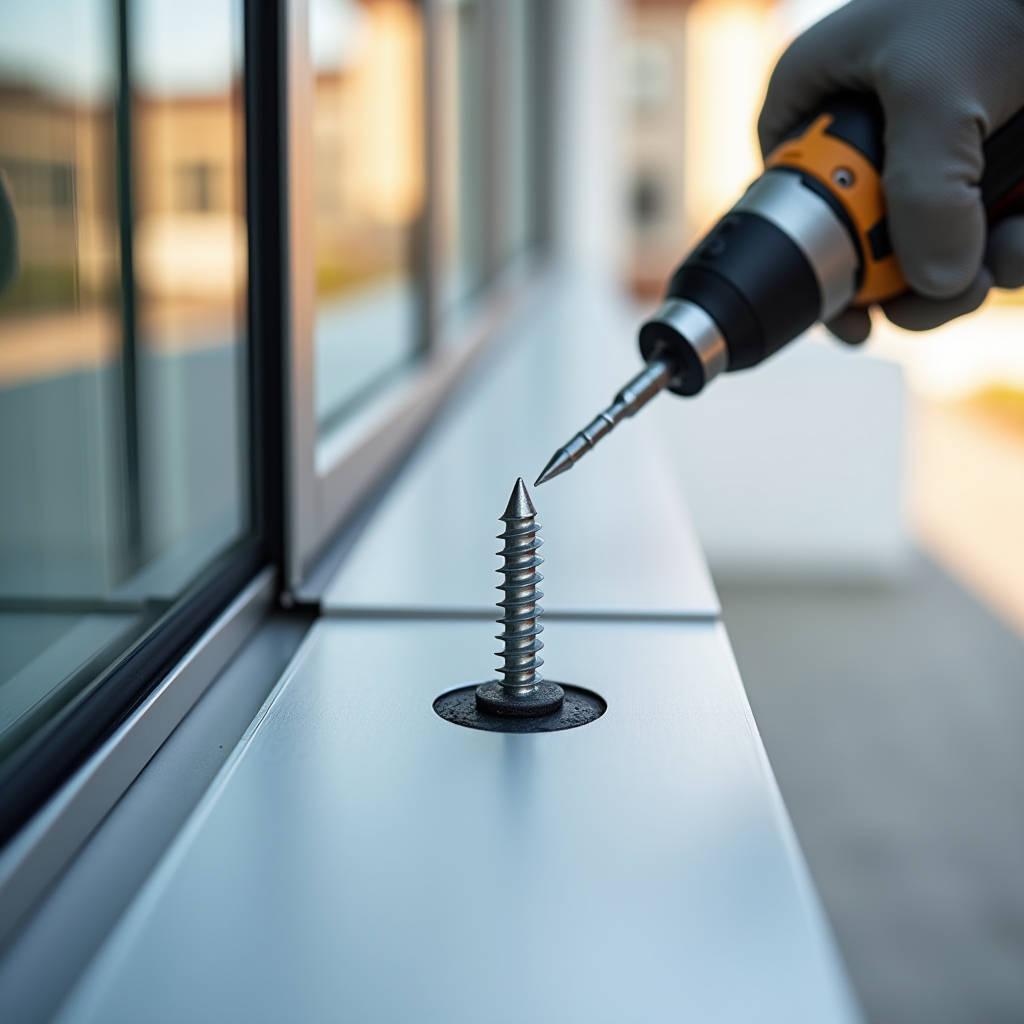
When a rainscreen facade starts rattling three years after handover, nobody blames the screw. But they should. The self drilling screw for aluminum facade applications carries more structural responsibility than most engineers assign to it on paper. It resists wind suction, accommodates thermal movement, maintains electrical continuity, and — if specified wrong — becomes the single point of failure across an entire elevation. This article breaks down what actually matters when selecting and installing self drilling screws into solid aluminium cladding panels, with a focus on the mechanical and electrochemical realities that show up long after the scaffolding comes down.
Why Solid Aluminium Panels Demand a Different Fastener Mindset
Solid aluminium cladding panels — typically 2.0mm, 2.5mm, or 3.0mm thick sheets with PVDF or FEVE coating systems — behave nothing like composite materials at the fastener interface. There is no polyethylene core to absorb vibration. No soft middle layer to deform around threads. The screw bites into homogeneous 3003 or 5052 aluminium alloy, and every micron of thread engagement matters. A self drilling screw for aluminum facade systems must form clean threads without galling, without cracking the panel around the drill point, and without creating a galvanic cell that will eat through the substructure within a decade.
The drill point geometry is the first differentiator. Standard carbon steel self-drillers with a #3 point will skate across 2.5mm solid aluminium before they catch. The material is too soft for aggressive flute angles designed for structural steel. You need a reduced rake angle on the drill tip — something in the range of 20° to 25° rather than the 35° common on steel-rated fasteners. This prevents the screw from grabbing too aggressively and stripping the hole before the threads engage. Suppliers like Futeng® have observed this exact failure mode on projects where contractors substituted generic drywall screws into aluminium substructure, resulting in thread stripping rates exceeding 40% during installation alone.
Galvanic Corrosion: The Silent Specification Error
Put a carbon steel screw into an aluminium panel on a coastal facade, add rain, and you have built a battery. The aluminium becomes the anode. It corrodes. Not the screw — the expensive panel. This is why any self drilling screw for aluminum facade installations must be stainless steel, and not just any stainless grade. The conversation starts at A2 (304) and moves quickly to A4 (316/316L) for anything within 5km of saltwater or in industrial zones with moderate SO₂ concentrations.
But the stainless grade alone is not enough. The screw's surface passivation matters. A properly passivated A4 screw maintains its chromium oxide layer and stays cathodic relative to the aluminium panel. If that passivation is damaged during drilling — common with high-speed installation tools — the localised corrosion potential shifts. The fix is not always a more expensive screw. Sometimes it is a nylon or EPDM washer that isolates the screw head from the panel face, breaking the metallic circuit entirely. This is standard practice in DBV (drained and back-ventilated) rainscreen systems across Northern Europe, where the combination of A4 stainless fasteners and isolating washers has delivered 20-year corrosion-free performance on solid aluminium facades.
Drill Point Capacity and Substructure Compatibility
The self-drilling capability of a fastener is not a yes/no property. It is a thickness range. A screw rated for 0.7mm to 1.6mm steel will struggle in 2.0mm aluminium not because aluminium is harder — it is not — but because aluminium's thermal conductivity draws heat away from the drill point faster than steel does. The tip cools. Cutting efficiency drops. The operator leans harder on the drill, and the screw head snaps.
For aluminium substructure, the sweet spot is a screw with a drill point capacity rated for 0.5mm to 2.5mm in aluminium specifically, not just in steel. The Hilti S-AD01L series, for example, specifies its drill capacity against aluminium substrates directly, which is the kind of transparency specifiers should demand. When fastening into aluminium rails or profiles — common in unitised curtain wall systems — the screw length must account for the drill point length plus at least three full threads of engagement beyond the panel thickness. For a 2.5mm solid panel on a 2.0mm aluminium rail, that means a minimum screw length of roughly 16mm, assuming a standard drill point consumes 4-5mm of length before threads begin.
Thermal Expansion and the Case for Controlled Clamping
Aluminium expands at roughly 23 × 10⁻⁶ per °C. A 3-metre solid aluminium panel facing a 60°C temperature swing between summer sun and winter night will move approximately 4.1mm. If every screw along that panel is torqued down hard — fully clamped, zero slip — the panel cannot move. Stress accumulates at the fastener holes. Over hundreds of thermal cycles, the aluminium around each hole work-hardens, then cracks.
The solution is not fewer screws. It is controlled clamping. A self drilling screw for aluminum facade panels should be specified with a stand-off or shoulder that prevents over-tightening, or paired with a calibrated setting on the installation tool. Many facade-specific fasteners incorporate a dome head with an integrated bearing surface that limits compression. The goal is to hold the panel against wind loads while allowing it to slide fractionally under thermal movement. This is standard in rainscreen design but often overlooked in face-fixed solid aluminium systems where the aesthetic preference for flush fasteners leads to over-tightening.
Head Geometry, Aesthetics, and the Architect's Eye
Architects care about what the screw head looks like from 20 metres away. On a solid aluminium facade with a metallic PVDF finish, a protruding hex washer head with visible zinc plating reads as a defect. The market has responded with low-profile dome heads, painted heads matched to RAL colours, and countersunk options with colour-matched caps.
The low dome head — sometimes called a mushroom head or reduced pan head — is the workhorse of visible facade fixings. It sits roughly 2.5mm to 3.0mm above the panel surface, casts a minimal shadow, and provides enough bearing area to distribute wind load without deforming the panel. For face-fixed solid aluminium panels in the 2.0mm to 3.0mm range, a head diameter of 10mm to 12mm is typical. Smaller heads concentrate stress and can pull through under high negative wind pressure. Larger heads become visually intrusive.
Colour-matched heads are available from specialist suppliers who apply PVDF or polyester powder coatings to the screw heads after forming. The colour match is rarely perfect — the coating chemistry on a formed steel screw differs from that on a flat aluminium sheet — but a Delta E of less than 2.0 is achievable with proper process control. For projects where the fasteners are recessed into the panel joint, a plain A4 stainless finish is often preferred, as the shadow line hides the screw entirely.
Wind Load, Fastener Spacing, and the Numbers That Matter
Wind load calculations drive fastener spacing, not the other way around. A solid aluminium panel on a high-rise in a coastal zone might see design wind pressures of 2.5 kPa or more. Each screw has a pull-out capacity in aluminium and a pull-over capacity for the panel itself. The weaker of the two governs the design.
For a 2.5mm solid aluminium panel with a 10mm head diameter screw, the pull-over capacity is typically in the range of 1.2 kN to 1.8 kN, depending on the alloy temper and the hole diameter. The pull-out capacity from a 2.0mm aluminium rail with a #10-16 self-tapping thread is roughly 0.8 kN to 1.2 kN. In this scenario, pull-out from the rail governs, and the fastener spacing must be calculated accordingly.
Here is a practical wind load and fastener spacing reference table based on solid aluminium panel systems:
| Design Wind Pressure (kPa) | Panel Thickness (mm) | Fastener Type | Max Fastener Spacing (mm) | Fasteners per m² |
|---|---|---|---|---|
| 1.0 | 2.0 | A4 SS, #10-16, 16mm | 450 | ~5 |
| 1.5 | 2.0 | A4 SS, #10-16, 16mm | 350 | ~8 |
| 2.0 | 2.5 | A4 SS, #12-14, 19mm | 300 | ~11 |
| 2.5 | 2.5 | A4 SS, #12-14, 19mm | 250 | ~16 |
| 3.0 | 3.0 | A4 SS, #14-14, 22mm | 200 | ~25 |
These figures are indicative and must be verified against project-specific structural calculations and local building codes. The key takeaway is that doubling the wind pressure roughly quadruples the number of fasteners required, because spacing reduces in both directions. On a 10,000 m² facade, the difference between 5 fasteners per square metre and 25 fasteners per square metre is 200,000 screws — a line item that deserves attention during estimating.
Installation Speed, Tooling, and the Hidden Cost of Rework
A self drilling screw eliminates the pre-drilling step. On paper, that saves 30% to 50% of installation time compared to a two-step drill-and-fasten process. On site, the savings can be larger or smaller depending on the tooling setup.
The ideal installation tool is a cordless screwdriver with adjustable torque control and a depth-sensitive clutch, running at 2,000 to 2,500 RPM. Impact drivers are faster but problematic: the hammering action can damage the drill point before it penetrates, and the uncontrolled torque can strip threads in aluminium substructure. Installers who switch from impact drivers to controlled-torque screwdrivers report a 15% to 20% reduction in fastener failure rates, based on feedback from European facade installation contractors.
Another installation variable is the angle of attack. The screw must enter perpendicular to the panel surface. Even a 5° deviation increases the effective hole diameter and reduces thread engagement. On a scissor lift 30 metres up, with wind buffeting the platform, maintaining perpendicularity is non-trivial. Some contractors use drill guides or magnetic bit holders with alignment sleeves to enforce the correct angle. The cost of these accessories is negligible compared to the cost of replacing panels with elongated or stripped holes.
Material Traceability and the ISO 9001 Paper Trail
On major commercial projects, the fastener supply chain comes under the same scrutiny as the cladding panels themselves. The specifier will ask for mill certificates, batch numbers, and corrosion test reports. A self drilling screw for aluminum facade systems sourced from a supplier without ISO 9001 quality management or without EN 14566 test documentation for the fastener assembly is a risk that few main contractors will accept.
The relevant standards include ASTM A193 for stainless steel fasteners, ISO 3506 for corrosion-resistant stainless steel fasteners, and EN 14566 for mechanical fasteners used in gypsum plasterboard systems (often referenced for the screw's mechanical properties even when the application is facade). For coastal applications, ASTM B117 salt spray testing data is often requested, with 1,000 hours being a common benchmark for A4 stainless fasteners.
Traceability also matters for warranty claims. If a fastener fails and the supplier cannot trace the batch back to the mill, the entire facade's fastener population becomes suspect. This is not theoretical. There have been cases in Southeast Asian markets where mixed batches of A2 and A4 screws were supplied interchangeably, and the resulting selective corrosion required full fastener replacement on completed buildings. The cost ran into six figures.
Coating Compatibility and the PVDF Interface
When a screw head contacts a PVDF-coated solid aluminium panel, two coating systems meet. The PVDF coating on the panel is typically 25-35 microns thick, with a primer layer and a colour coat. The screw head may have its own coating — polyester powder, PVDF, or a thin organic finish. If these coatings are chemically incompatible, the interface can degrade under UV exposure and thermal cycling.
The conservative approach is to specify a plain A4 stainless screw head with an EPDM washer, eliminating coating compatibility as a variable. Where colour matching is essential, the screw coating should be specified from the same chemical family as the panel coating — PVDF on PVDF — and the curing process should be validated for adhesion to the stainless steel substrate. This level of specification is common on high-end architectural projects where the fastener heads are a visible design element.
When to Use Rivets Instead of Screws
Self drilling screws are not always the right answer. For solid aluminium panels in high-vibration environments — near railway lines, industrial machinery, or in seismic zones — blind rivets with a retained mandrel can provide more consistent clamping force over time. Screws can loosen under cyclic vibration; rivets generally do not.
The trade-off is installation speed and reversibility. Screws can be removed and replaced. Rivets must be drilled out. For facade panels that may need to be accessed for behind-panel maintenance — common in ventilated rainscreen systems with integrated services — screws offer a practical advantage. The decision should be documented in the facade access strategy, not left to the installer's preference on the day.
Specification Checklist for the Project Manager
When reviewing a fastener submittal for a solid aluminium facade project, the following points should be verified against the project specification:
- Material grade: A4 (316) stainless steel minimum for exterior applications. A2 (304) acceptable only for dry indoor or low-pollution rural environments.
- Drill point capacity: Rated for the specific aluminium thickness, not just steel. Verify the manufacturer's published drill capacity for aluminium substrates.
- Head type: Low dome, countersunk, or hex washer, with or without colour-matched finish. Confirm head diameter relative to panel thickness to avoid pull-through.
- Washer: EPDM or nylon isolating washer required for galvanic separation unless the substructure is also aluminium and the screw is A4 stainless.
- Thread engagement: Minimum three full threads into the substructure beyond the panel thickness.
- Torque control: Specify installation tool type and torque range. Prohibit impact drivers unless validated by mock-up testing.
- Documentation: Mill certificates, ISO 9001, salt spray test reports per ASTM B117, and batch traceability records.
- Mock-up testing: Require a visual mock-up with at least 20 fasteners installed, inspected for perpendicularity, thread stripping, and coating damage.
This checklist is not exhaustive, but it covers the failure modes that account for the majority of facade fastener problems observed in the field. The cost of getting these details right during specification is measured in hours of engineering time. The cost of getting them wrong is measured in scaffold hire, panel replacement, and reputational damage.
The self drilling screw for aluminum facade systems is a small component with an outsized impact on long-term facade performance. It deserves the same level of engineering attention as the panel alloy, the coating system, and the substructure design. When the wind picks up and the temperature swings, the only thing holding the facade together is a few grams of stainless steel and a properly formed thread. That thread should be specified, not assumed.