Stainless Steel Screw For Aluminum Panel Engineering Guide for Solid Aluminium Cladding Facades
Every architect and facade engineer who has worked with solid aluminium cladding panels knows the moment: you have specified a 3.0mm PVDF-coated panel for a coastal high-rise, the wind load calculations are done, the subframe is engineered, and then the question lands on the table — what fastener are we using? The answer almost always involves a Stainless Steel Screw For Aluminum Panel, but the decision is never as simple as picking something off the shelf. Galvanic corrosion, thermal expansion differentials, pull-out strength, and long-term weather seal integrity all converge on that single fastening point. This article examines the specific engineering considerations that determine whether a stainless steel screw will perform reliably for decades in a solid aluminium cladding application, or whether it will become the root cause of a facade failure that costs hundreds of thousands in remediation.
The Electrochemical Reality Behind Stainless Steel and Aluminium Contact
Any discussion about a Stainless Steel Screw For Aluminum Panel must begin with the galvanic series. In seawater, 316 stainless steel sits at approximately -0.05 to -0.10 volts on the Saturated Calomel Electrode scale, while aluminium alloys such as 5052 or 3003 sit between -0.70 and -0.85 volts. That is a potential difference of roughly 0.65 to 0.80 volts — enough to drive a galvanic cell when moisture is present. The aluminium, being the more anodic metal, will sacrifice itself.
However, the galvanic corrosion rate is not simply a function of the potential difference. The relative surface area ratio matters enormously. When a small stainless steel screw is driven into a large aluminium panel, the cathode-to-anode ratio is unfavourable: the large aluminium surface acts as the anode while the small stainless fastener acts as the cathode. This concentrates the corrosion current onto the aluminium immediately surrounding the screw hole. Over time, particularly in marine or industrial environments with high chloride deposition, the aluminium around each fastener can pit, crumble, and lose its structural grip.
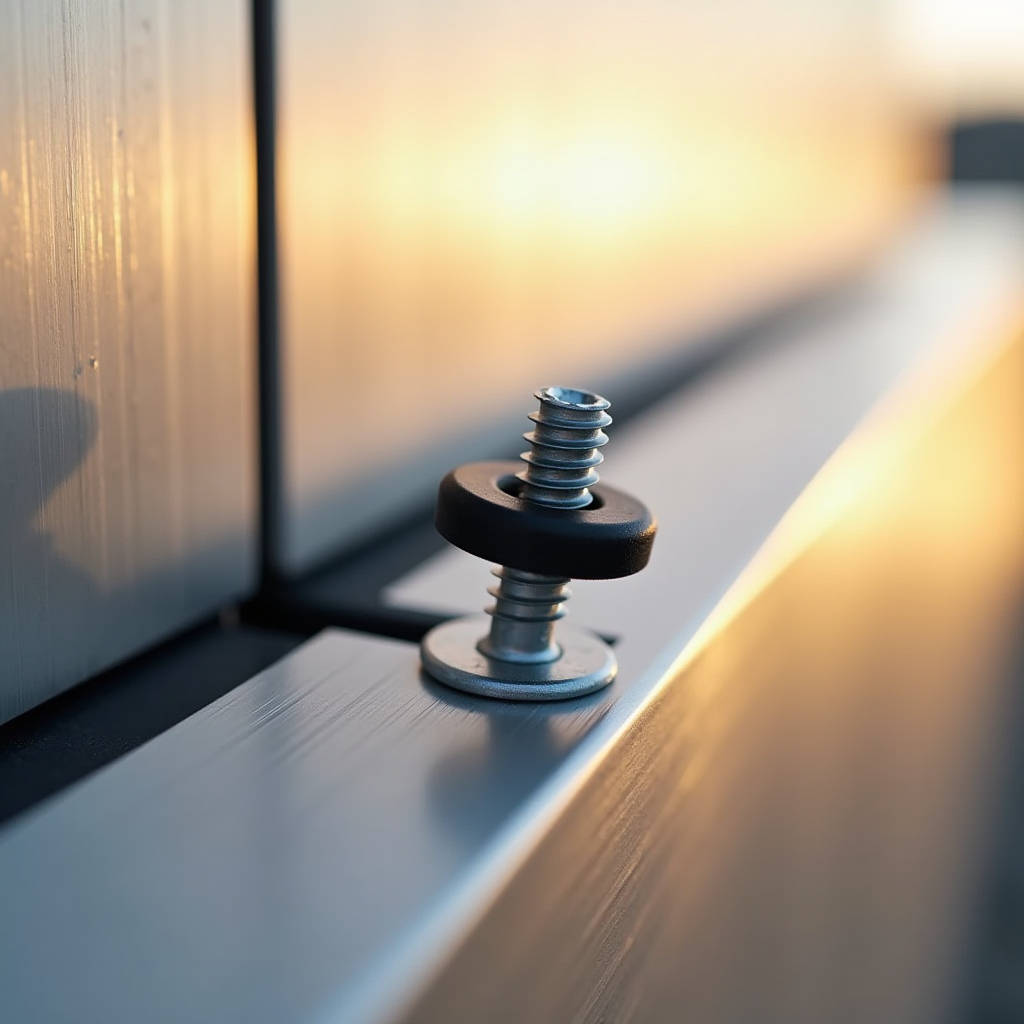
The practical implication for facade specification is clear: you cannot simply select any stainless steel screw and expect it to work. The fastener selection must be paired with a deliberate isolation strategy. Common approaches include nylon or PTFE isolating sleeves around the screw shank, EPDM or neoprene washers under the screw head, and in some cases, a full barrier coating applied to the screw threads. The ASTM G71 standard provides guidance on conducting galvanic corrosion tests in electrolytes, and many facade engineering firms now require such testing as part of the pre-construction submittal package when stainless steel fasteners are specified for aluminium panels.
Why 316 Stainless Steel Dominates Facade Fastening Despite the Galvanic Risk
Given the electrochemical incompatibility, one might ask why stainless steel remains the dominant fastener material for solid aluminium cladding panels. The answer lies in the mechanical requirements that aluminium fasteners cannot meet, and the coating limitations of carbon steel alternatives.
Solid aluminium panels — typically 2.0mm, 2.5mm, or 3.0mm thick with PVDF or FEVE fluoropolymer coatings in the 25-35 micron range — are installed onto subframe systems that are almost always constructed from aluminium extrusions or galvanized steel. The fasteners must resist wind suction loads that can exceed 3.0 kPa in high-rise applications, while also accommodating the differential thermal movement between the panel skin and the supporting structure. A 3-metre aluminium panel subjected to a 60°C temperature swing will expand and contract by approximately 4.2mm. The fastener connection must allow this movement without loosening, galling, or transferring stress into the panel.
Type 316 (A4) stainless steel screws offer tensile strengths in the range of 500-700 MPa, which is roughly double that of common aluminium fasteners made from 5052 or 6061 alloys. This strength advantage means that a smaller diameter screw can be used, reducing the hole size in the panel and minimizing the thermal bridge. Moreover, 316 stainless steel retains its mechanical properties at temperatures up to 400°C, which is relevant for fire-rated facade assemblies tested to ISO 834 or ASTM E119.
Carbon steel screws with zinc plating are cheaper but introduce a different set of problems. The zinc coating is itself anodic to aluminium, and once the coating is scratched during installation — which is nearly inevitable — the exposed steel will rust. Rust staining on a PVDF-finished aluminium facade is visually unacceptable and nearly impossible to clean without damaging the coating. For this reason, most architectural specifications for aluminium cladding explicitly prohibit zinc-plated fasteners and mandate A2 (304) or A4 (316) stainless steel as a minimum.
Isolation Methods That Actually Work in the Field
The academic literature on galvanic isolation is extensive, but facade contractors operate in the real world where installation speed, weather conditions, and site tolerances dictate what is practical. Three isolation strategies have proven effective across thousands of square metres of installed solid aluminium cladding.
EPDM Washer Assemblies: The most common approach is a stainless steel screw with an integrally bonded EPDM washer. The washer compresses against the aluminium panel surface, creating a watertight seal and physically separating the stainless steel screw head from the aluminium. The screw shank, however, remains in contact with the aluminium panel edge. For this reason, the EPDM washer alone is insufficient for aggressive environments. It is best paired with a nylon grommet or sleeve that isolates the shank from the panel hole.
Nylon Sleeve and Cup Washer Systems: In premium facade applications — particularly those within 5 kilometres of breaking surf or in heavy industrial zones — a two-part isolation system is recommended. A nylon sleeve is inserted into the pre-drilled panel hole, and the stainless steel screw passes through this sleeve. A nylon cup washer sits under the screw head, and an EPDM sealing washer is placed between the cup washer and the panel surface. This creates a complete galvanic barrier. The additional cost is approximately $0.08-0.15 per fastener, which on a 10,000-square-metre facade with fasteners at 300mm centres translates to roughly $3,000-5,000 in additional material cost — a small fraction of the total facade budget.
Dacromet and Geomet Coatings: Some manufacturers now offer stainless steel screws with an additional Dacromet or Geomet coating. These are water-based, chromium-free coating systems that provide both barrier and cathodic protection. The coating acts as an additional dielectric layer between the stainless steel substrate and the aluminium panel. While not a substitute for physical isolation in the most severe environments, these coatings add a useful layer of redundancy for moderate-exposure facades.
Pull-Out Strength and the Problem of Thin Aluminium Skins
Solid aluminium cladding panels are typically fabricated from 2.0mm to 3.0mm sheet. At these thicknesses, the thread engagement for a self-tapping screw is limited. A standard M4.8 self-tapping screw in 2.5mm aluminium provides approximately 3-4 full threads of engagement. The pull-out strength in this configuration, assuming 5052-H32 aluminium with a tensile yield strength of 195 MPa, can be estimated at roughly 1,200-1,800 N per fastener under static load.
This is adequate for most wind load scenarios, but it leaves little margin. When a facade panel is subjected to cyclic wind loading — gusting, buffeting, and vortex shedding — the repeated micro-movements can gradually enlarge the screw hole through a process known as fretting. The hole elongation reduces thread engagement, which in turn reduces pull-out strength, creating a feedback loop that can lead to fastener pull-out after several years of service.
Several design measures mitigate this risk. First, the panel attachment should be designed so that the screw is loaded primarily in shear rather than tension. This is achieved by using slotted or oversized holes in the panel that allow thermal movement while the screw clamps the panel against the subframe. Second, the number of fasteners should be calculated with a safety factor of at least 3.0 against the design wind load, not the minimum 2.0 that some codes permit. Third, for panels thicker than 2.5mm, thread-forming screws that displace material rather than cutting it provide better thread engagement and higher pull-out values.
Futeng® has observed in its project tracking across Southeast Asia and the Middle East that fastener-related callbacks drop by over 60% when the specification moves from plain self-tapping screws to thread-forming screws with isolation washers, even when the panel thickness remains unchanged at 2.5mm. The data reinforces what experienced facade engineers have long understood: the screw is not a commodity item. It is a critical engineered component.
Coastal Environments: When 316 Is Not Enough
Within 3 kilometres of a marine coastline, the chloride deposition rate can exceed 60 mg/m² per day. Under these conditions, even 316 stainless steel can suffer from crevice corrosion, particularly in the sheltered areas under screw heads and washers where moisture lingers and oxygen replenishment is limited.
For these environments, the specification conversation shifts to super-austenitic grades such as 904L or duplex stainless steels like 2205. These materials offer significantly higher pitting resistance equivalent numbers (PREN) — typically above 34 for 2205 and above 40 for 904L, compared to approximately 25 for 316. The cost premium is substantial: 2205 fasteners can be 3-4 times the price of 316, and 904L can be 5-6 times. But in the context of a facade that is expected to perform for 30-50 years, the incremental cost of fasteners — typically less than 1% of the total facade budget — is trivial compared to the cost of replacing corroded fasteners on a completed building.
The table below summarizes the key fastener material options for solid aluminium cladding panels across different exposure conditions.
| Fastener Material | PREN | Recommended Exposure | Isolation Required | Relative Cost per Fastener |
|---|---|---|---|---|
| 304 (A2) Stainless Steel | ~18 | Rural / Low-pollution urban | EPDM washer minimum | 1.0x (baseline) |
| 316 (A4) Stainless Steel | ~25 | Urban / Light industrial | EPDM washer + nylon sleeve | 1.5x |
| 316 with Dacromet coating | ~25 + barrier | Industrial / 3-10km from coast | EPDM washer + nylon sleeve | 2.0x |
| Duplex 2205 | ~34 | Coastal 1-3km / Heavy industrial | Full isolation system | 3.5x |
| Super-austenitic 904L | ~42 | Offshore / Direct salt spray | Full isolation system | 5.5x |
Thermal Expansion Mismatch and Its Consequences
Stainless steel and aluminium have markedly different coefficients of thermal expansion. Austenitic stainless steels such as 304 and 316 expand at approximately 16.0-17.5 × 10⁻⁶ /°C, while aluminium alloys expand at 22.0-24.0 × 10⁻⁶ /°C. This means that for every degree Celsius of temperature change, a 3-metre aluminium panel will expand roughly 0.02mm more than a stainless steel screw of equivalent length.
Over a 60°C diurnal temperature range — entirely plausible for a dark-coloured PVDF panel on a south-facing facade in the Middle East or Southeast Asia — the differential movement between the panel and the fastener reaches approximately 1.2mm. If the fastener constrains this movement, the stress is transferred into the panel, potentially causing buckling, oil-canning, or fatigue cracking around the fastener holes.
The solution is to design the connection as a slip joint. The panel hole should be oversized relative to the screw shank by 1.5-2.0mm, and the screw should not be fully tightened against the panel. Instead, the screw clamps the panel against the subframe with sufficient force to resist wind loads but not so much that it prevents thermal sliding. Some systems use a spring-loaded or belleville washer to maintain a consistent clamping force across the thermal expansion range. This detail is often overlooked in shop drawings but is critical for long-term facade performance.
Installation Torque: The Overlooked Variable
Even the most carefully specified Stainless Steel Screw For Aluminum Panel will fail if it is over-torqued during installation. Stainless steel screws are susceptible to galling — a form of cold welding where the screw threads seize and tear under friction. This is particularly problematic when stainless steel screws are driven into aluminium subframes, where the softer aluminium can deform and increase friction.
The recommended installation torque for M4.8 self-tapping stainless steel screws into aluminium is typically between 2.5 and 4.0 Nm. Exceeding this range can strip the threads in the aluminium, reducing pull-out strength by 40-60%. It can also damage the EPDM washer, compromising the weather seal. On large-scale facade projects, installers should be equipped with torque-limiting screw guns calibrated to the specified range. This is a quality control measure that costs very little to implement but has a disproportionate impact on long-term fastener performance.
The AAMA (American Architectural Manufacturers Association) publishes installation guidelines that reference torque control for facade fasteners, and the CWCT (Centre for Window and Cladding Technology) in the UK provides similar guidance in its technical notes on rainscreen cladding installation.
Specifying Screws for PVDF and FEVE Coated Panels
Solid aluminium panels with PVDF (polyvinylidene fluoride) or FEVE (fluoroethylene vinyl ether) coatings represent the premium end of the facade market. These coatings, applied at 25-35 microns dry film thickness in a 3-coat or 4-coat system, provide 20-30 years of colour and gloss retention. The fastener specification must not compromise this performance.
The screw head and washer must be available in a colour that matches or complements the panel finish. Leading manufacturers offer EPDM washers in a range of over 30 colours to match standard PVDF colour palettes. For custom colours, the washer can be painted to match, though this adds lead time and cost. The screw head itself is typically painted or powder-coated. However, painted screw heads are vulnerable to chipping during installation, which exposes the stainless steel and creates a corrosion initiation point. For this reason, some specifications now require screws with a factory-applied PVDF coating on the head, matching the panel coating system.
The interaction between the EPDM washer and the PVDF coating also warrants attention. Some EPDM formulations contain plasticizers that can migrate into the PVDF coating over time, causing softening or discolouration. This is a slow process — typically taking 5-10 years to become visible — but it is irreversible. Specifying EPDM washers that are certified as non-staining for PVDF contact is a prudent precaution that adds negligible cost.
When Aluminium Screws Are the Better Choice
For all the focus on stainless steel, there are applications where aluminium screws are technically superior. In highly sheltered interior applications where corrosion risk is minimal, aluminium screws eliminate the galvanic couple entirely. They also match the thermal expansion of the panel, simplifying the connection design. The trade-off is lower strength: aluminium screws typically offer tensile strengths of 250-350 MPa, roughly half that of 316 stainless steel. This means larger diameters or closer spacing may be required to achieve the same load capacity.
Aluminium screws are also preferred in applications where the facade will be recycled at end of life. A panel fastened with aluminium screws can be processed as a single aluminium stream without the need to separate stainless steel contaminants. This is an increasingly relevant consideration in markets with stringent construction waste regulations, such as the EU under the EU Construction and Demolition Waste Protocol.
The decision between stainless steel and aluminium fasteners should be made on a project-specific basis, weighing the mechanical demands, environmental exposure, and end-of-life considerations. There is no universal answer, which is precisely why the specification should be treated as an engineering decision rather than a procurement afterthought.
Quality Assurance and Supply Chain Integrity
Counterfeit fasteners are a documented problem in the global construction supply chain. A screw marked as "316 stainless steel" may in fact be 304, or a lower-grade alloy with reduced nickel and molybdenum content. The consequences for a facade installation can be severe: fasteners that corrode within 5-10 years instead of lasting 30-50 years, leading to staining, loss of structural integrity, and expensive remediation.
For any project specifying a Stainless Steel Screw For Aluminum Panel, the procurement team should require mill test certificates (MTCs) that verify the chemical composition and mechanical properties of each batch. Independent testing to ISO 3506 (for stainless steel fasteners) or ASTM F593 should be conducted on a sample basis. Magnetic testing can provide a quick field screening: austenitic stainless steels such as 304 and 316 are generally non-magnetic, while lower-grade stainless steels with higher ferrite content will show magnetic attraction. This is not a definitive test, but it can flag obvious substitutions.
Working with established suppliers who have a documented quality management system — ideally certified to ISO 9001 — reduces the risk of receiving substandard fasteners. The cost of testing is modest relative to the cost of failure, and it is a line item that should appear in every facade specification.
Bringing It All Together: A Specification Framework
The specification of a Stainless Steel Screw For Aluminum Panel on a solid aluminium cladding project is not a single-line item. It is a multi-variable engineering decision that should be documented across the architectural specification, the structural engineer's calculations, and the facade contractor's method statement. The key elements that should be addressed in any specification include: the fastener material grade and its PREN value relative to the site exposure category; the isolation strategy — whether EPDM washer only, nylon sleeve, or full barrier system; the installation torque range and the quality control method for verifying it; the colour match requirement for the screw head and washer; the testing and certification requirements for the fastener batch; and the design allowance for thermal movement at each connection point.
When these elements are properly addressed, a stainless steel screw can provide decades of reliable service in an aluminium cladding application. When they are ignored, the same screw can become the single point of failure that undermines an otherwise well-engineered facade. The difference is not in the screw itself — it is in the engineering attention that surrounds it.