Aluminum Panel Cassette Clip Load Path Engineering and Total Installed Cost Analysis
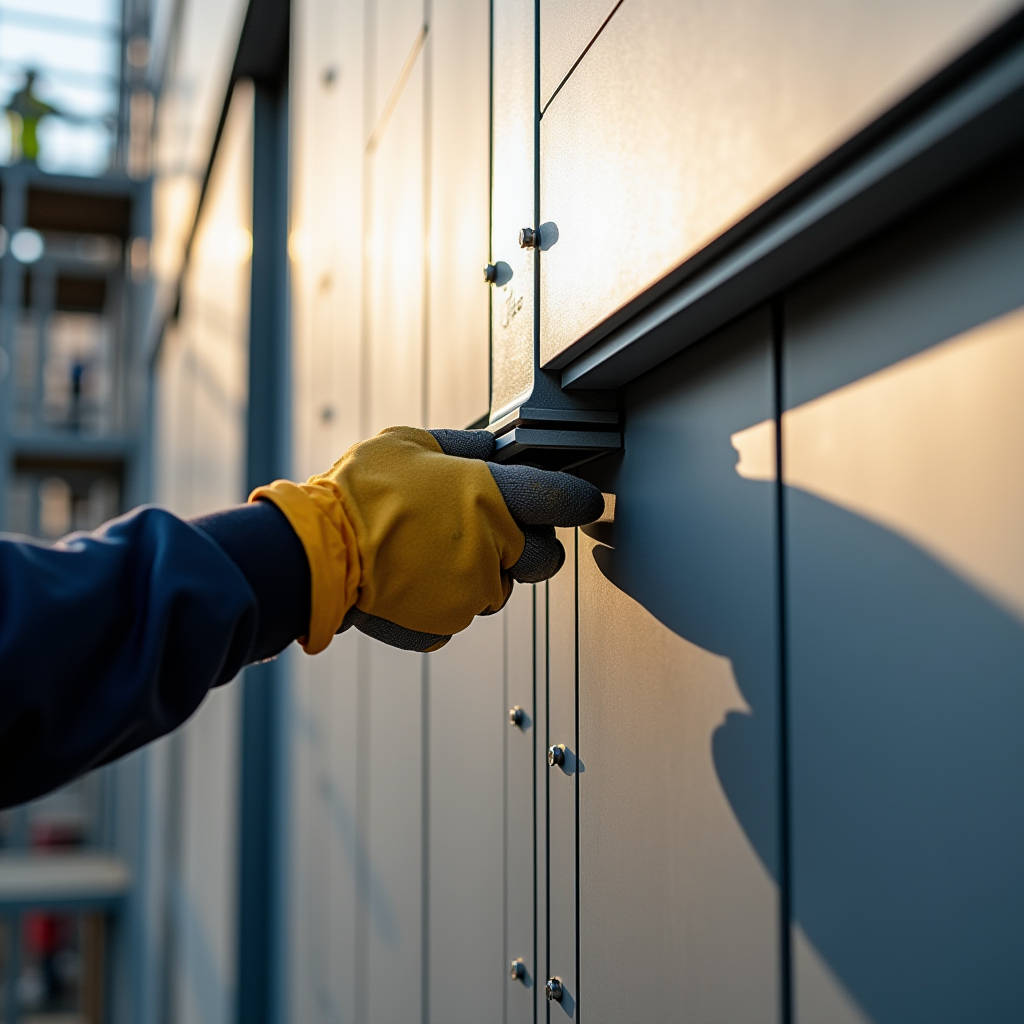
When a rainscreen facade fails, the post-mortem rarely points to the panel itself. The culprit is almost always the connection. A solid aluminium cladding panel carries dead load, wind load, and thermal movement through a single point of attachment: the Aluminum Panel Cassette Clip. This small extruded or pressed component determines whether a 3.0mm PVDF-coated panel stays plumb for 20 years or starts rattling in the first seasonal storm. General contractors and facade engineers who treat the clip as a commodity item learn this lesson the hard way — through punch lists, water ingress claims, and warranty disputes. The Aluminum Panel Cassette Clip is not a bracket. It is a structural interface that must resolve conflicting demands: invisible fixing, predictable load transfer, thermal expansion accommodation, and installer-friendly engagement. Getting it right means understanding geometry, alloy selection, and the specific cassette joint design the project demands.
What Separates a Cassette Clip from Generic Panel Hardware
Standard Z-clips and French cleats serve the interior fit-out market. They hold MDF panels, acoustic baffles, and decorative wall linings. An Aluminum Panel Cassette Clip operates under entirely different conditions. It lives outside, exposed to temperature swings from -20°C to +80°C surface temperatures, wind suction pressures exceeding 2.5 kPa on high-rise elevations, and constant vibration from building movement. The clip must maintain panel alignment across a 3000mm vertical joint while allowing the panel to expand and contract independently of the substructure.
Three design features distinguish a cassette-grade clip from off-the-shelf hardware:
- Concealed engagement geometry. The clip body sits entirely behind the panel return leg. No fastener head, no visible bracket, no shadow line interruption. The panel appears to float.
- Controlled movement capacity. A properly engineered clip provides a defined sliding plane. The panel hooks onto the clip and can move ±3mm to ±5mm along the engagement axis without binding.
- Load-rated extrusion profile. Unlike bent sheet metal brackets, cassette clips are typically extruded from 6063-T5 or 6061-T6 aluminium alloy, with a calculated section modulus that resists bending under negative wind load.
Aluclad Systems' cassette interlock system, referenced in industry literature, demonstrates the hook-on principle where the clip functions as both locator and load-bearing element. The panel's top return leg hooks over the clip's bearing surface, while the bottom return leg engages a separate restraint clip that prevents wind-induced disengagement. This two-clip-per-panel logic — one load-bearing, one anti-lift — is the standard configuration for open-joint rainscreen systems on buildings above four storeys.
Load Path Analysis: What the Clip Actually Carries
Facade engineers model the Aluminum Panel Cassette Clip as a cantilevered beam subjected to combined loading. The dead load of a solid aluminium panel is straightforward: a 3.0mm thick panel measuring 1200mm × 3000mm weighs approximately 29.2 kg (density 2.7 g/cm³). Distributed across four clips, each clip carries roughly 7.3 kg dead load — negligible for aluminium. But dead load is not the design driver.
Wind load governs. On a 100-metre building in London, the design wind pressure per BS EN 1991-1-4 can reach 1.8 kPa for corner zones. Applied to a 3.6 m² panel, the total wind force is 6.48 kN. If four clips share this load equally, each clip sees 1.62 kN in tension or compression, depending on wind direction. But load sharing is never equal. Corner clips on the windward edge can carry 40% more load than interior clips. The clip's ultimate tensile capacity must exceed the factored design load by a safety factor of 2.0 minimum, per AAMA TIR-A9 guidelines for metal curtain wall fasteners.
The load path flows from panel to clip to rail to bracket to structural backup wall. Each interface introduces a potential failure mode. A clip that is strong enough in isolation can still fail if the rail engagement slot is too shallow or if the stainless steel fixing screw pulls through the aluminium extrusion under cyclic loading. This is why reputable system suppliers like Futeng® validate the entire assembly — clip, rail, fastener, and panel — as a tested system rather than selling components in isolation.
Extrusion vs. Press-Formed: Material and Manufacturing Trade-offs
The Aluminum Panel Cassette Clip comes in two manufacturing forms, each with distinct performance implications. The choice affects corrosion resistance, dimensional tolerance, and long-term creep behaviour.
| Parameter | Extruded Clip (6063-T5) | Press-Formed Clip (5052-H32) |
|---|---|---|
| Dimensional Tolerance | ±0.15 mm across profile | ±0.50 mm after springback |
| Tensile Strength (Yield) | 145 MPa minimum | 193 MPa minimum |
| Corrosion Resistance | Good; susceptible to intergranular attack if improperly heat-treated | Excellent; marine-grade alloy with high magnesium content |
| Profile Complexity | High; can include integrated drainage channels and stiffening ribs | Low; limited to simple L, Z, or hat-section geometries |
| Cost per Linear Metre (Ballpark) | $3.50 – $6.00 | $1.80 – $3.20 |
| Typical Application | High-rise rainscreen, open-joint systems, visible-return cassettes | Low-rise, soffit linings, interior feature walls |
The extrusion route allows engineers to design a profile that solves multiple problems simultaneously. A well-designed extruded clip can incorporate a drip groove that breaks capillary action, a serrated bearing surface that prevents panel creep, and a bulbous engagement nose that provides audible click-in feedback for installers. Press-formed clips cannot match this functional density. However, for projects within 10 metres of breaking waves or industrial chemical exposure, the 5052 alloy's superior pitting resistance may outweigh the geometric limitations. The decision should reference ASTM B209 for aluminium sheet and plate specification and ASTM B221 for extruded bars and shapes.
Thermal Movement: The Silent Clip Killer
Aluminium expands at approximately 0.024 mm per metre per degree Celsius. A 3000mm panel subjected to a 60°C temperature swing (winter night to summer solar gain) will elongate by 4.32 mm. If the Aluminum Panel Cassette Clip restrains this movement, the panel will buckle. If the clip allows too much movement, the panel will rattle. The engineering sweet spot is a clip that provides positive location at the fixed point while permitting sliding at all other attachment points.
The standard detailing approach places two fixed clips at the panel's centreline and allows the panel ends to float. The fixed clip includes a positive locking feature — typically a grub screw, a toothed insert, or a compression wedge — that prevents movement along the panel's long axis. The floating clips use a smooth bearing surface with no mechanical lock. The panel slides freely across these clips as it expands and contracts.
A common failure mode observed in forensic facade investigations: the installer tightens all clips equally, eliminating the sliding mechanism. The panel cannot move. Thermal stress accumulates until the panel oil-cans, the fastener fatigues, or the clip body fractures at the root of the cantilever. The fix is procedural, not material. Shop drawings must clearly identify fixed and sliding clip locations, and the installation sequence must be verified by the facade consultant before panels are closed up.
Open-Joint vs. Closed-Joint Systems: Clip Selection Logic
The joint between cassettes defines the rainscreen type and dictates the clip's exposure to the elements. Open-joint systems, governed by the pressure-equalised rainscreen principle, leave a 10–20mm gap between panels. The cavity behind the panel is at near-ambient pressure, so water is not driven through the joint. The Aluminum Panel Cassette Clip sits in this ventilated cavity, protected from direct rain but exposed to condensation and airborne salt. The clip must be corrosion-resistant but does not need to be fully sealed.
Closed-joint systems use a gasketed or silicone-sealed joint. The clip sits in a sealed cavity that should remain dry. If the seal fails, trapped moisture can sit against the clip for extended periods. This is a more aggressive corrosion environment than the open-joint cavity. In closed-joint systems, the clip and all fasteners should be stainless steel grade 316 or aluminium with a minimum 25-micron anodised layer per ISO 7599 for anodic oxidation coatings.
The open-joint system also demands tighter clip geometry tolerances. Since there is no sealant bead to hide misalignment, any deviation in clip position translates directly to an uneven joint width visible from street level. The clip's rail engagement slot must be machined or extruded to a tolerance that keeps the panel-to-panel joint within ±1.5 mm of the specified dimension across the entire elevation.
Installation Realities: What the Site Team Needs to Know
The best-engineered clip fails if the installation team cannot execute the design intent. Three field issues recur across projects globally:
1. Rail Alignment Tolerance Stack-Up
The clip attaches to a vertical or horizontal rail, which attaches to a bracket, which attaches to an anchor, which is cast into or bolted to the structural slab. Each interface adds positional uncertainty. A 2mm deviation at the anchor, plus 1.5mm at the bracket, plus 1mm at the rail, can push the clip 4.5mm out of plane. The clip must provide enough rotational adjustment to compensate. Extruded clips with an elongated slot and serrated washer interface allow ±5mm of vertical adjustment and ±3° of rotational correction. This adjustability should be specified in the clip procurement, not improvised on site with washers and shims.
2. Fastener Galvanic Compatibility
The Aluminum Panel Cassette Clip is aluminium. The rail may be aluminium or galvanised steel. The fixing screw is typically stainless steel. This creates a galvanic cell. In the presence of an electrolyte — rainwater, condensation, or even high humidity — the aluminium will corrode preferentially. The standard mitigation is a nylon or EPDM isolating washer between the stainless screw head and the aluminium clip body, plus a nylon bushing in the screw hole. This detail costs less than $0.05 per clip and prevents a failure mode that can require full facade recladding. The ASTM G82 galvanic series provides the reference data for material pairing decisions.
3. Panel Engagement Verification
An installer can hook a panel onto a clip without fully seating it. The panel appears secure but the engagement depth is insufficient. Under negative wind load, the panel lifts off the clip. The solution is an engagement indicator — a witness line on the clip body, an audible click feature, or a visual inspection port. Some extruded clip profiles include a small observation hole that aligns with the panel return leg only when the panel is fully seated. This simple feature eliminates the most common installation defect.
Specifying Clips for Fire-Rated Facades
Post-Grenfell regulatory changes have reshaped rainscreen material specifications globally. The Aluminum Panel Cassette Clip must now be considered within the context of the entire facade fire performance. Solid aluminium panels with A1 fire classification (per EN 13501-1) are increasingly specified for buildings over 18 metres. The clip, being aluminium, is also non-combustible — but the isolation pads, thermal breaks, and gaskets are not.
For fire-rated assemblies, the clip system should use:
- Aluminium clip body with no polymeric coating or sleeve
- Mineral fibre or intumescent thermal break pads in place of nylon or EPDM
- Steel or aluminium cavity barriers that integrate with the clip rail layout
The clip must also maintain its load-bearing capacity during a fire event. Aluminium loses approximately 50% of its yield strength at 200°C and 90% at 400°C. A clip that is marginally sized for ambient conditions will fail early in a fire. The structural fire engineering report should include a clip capacity derating curve based on time-temperature exposure, and the clip cross-section should be upsized accordingly for fire-rated walls.
Cost Engineering: Clip Selection and Total Installed Cost
Procurement managers often compare clip prices per linear metre and select the cheapest option. This is a false economy. The clip itself represents 3–5% of the total rainscreen system cost. But the clip determines installation speed, defect rate, and long-term maintenance liability. A clip that saves $1.50 per metre but requires 30% more labour to install and generates a 5% rework rate is not cheaper.
A realistic total-installed-cost comparison for a 5000 m² facade:
- Budget press-formed clip: $2.20/m clip cost × 4 clips/panel × 1,389 panels = $12,223. Installation labour: 0.45 hours/m² × 5,000 m² × $65/hr = $146,250. Rework allowance (8%): $11,700. Total: $170,173.
- Engineered extruded clip with adjustment features: $4.80/m clip cost × 4 clips/panel × 1,389 panels = $26,669. Installation labour: 0.32 hours/m² × 5,000 m² × $65/hr = $104,000. Rework allowance (2%): $2,080. Total: $132,749.
The engineered clip saves $37,424 on a 5,000 m² project — roughly $7.48 per square metre. This is the difference between a project that hits margin targets and one that bleeds contingency. The calculation assumes standard panel sizes and mid-rise access conditions. High-rise projects with crane-dependent logistics will see even larger labour savings from faster clip engagement.
Future Trends: Unitised Cassette Systems and Digital Integration
The industry is moving toward unitised panel systems where the clip, rail, bracket, and panel are pre-assembled into a single cassette module in factory conditions. The Aluminum Panel Cassette Clip in this context becomes a factory-installed component with quality-controlled engagement. The site team simply hooks the unitised cassette onto pre-set wall anchors. This approach shifts the clip's function from a site-adjustable connector to a precision-located interlock.
Digital workflows are also changing clip specification. BIM models now include clip families with parametric adjustment ranges. The facade engineer can run clash detection on clip positions against structural anchors and window frames before a single clip is ordered. Some manufacturers provide BIM-ready clip models with embedded load data, enabling automated structural verification. This reduces the gap between design intent and site reality — a gap that has historically been filled with expensive remedial work.
Specifying the Aluminum Panel Cassette Clip is fundamentally a risk management exercise. The clip is inexpensive, but the consequences of its failure are not. The right clip is the one that has been tested as part of a complete system, provides documented adjustment capacity, and is supported by shop drawings that clearly communicate fixed and sliding points to the installation team.
For project teams evaluating solid aluminium rainscreen systems, the clip specification deserves the same scrutiny as the panel alloy, the coating system, and the structural bracket design. A 3.0mm PVDF-coated panel with an A1 fire rating is only as reliable as the clip that holds it to the building. Ask suppliers for system test reports, not just component data sheets. Verify that the clip has been cycled through movement testing that simulates 50 years of thermal expansion. Check that the engagement mechanism includes a positive verification feature. These checks take an afternoon. The alternative — discovering a systemic clip failure after panel installation — takes months and costs millions.