Aluminum Stiffener Profile Engineering for Solid Cladding Panel Deflection Control
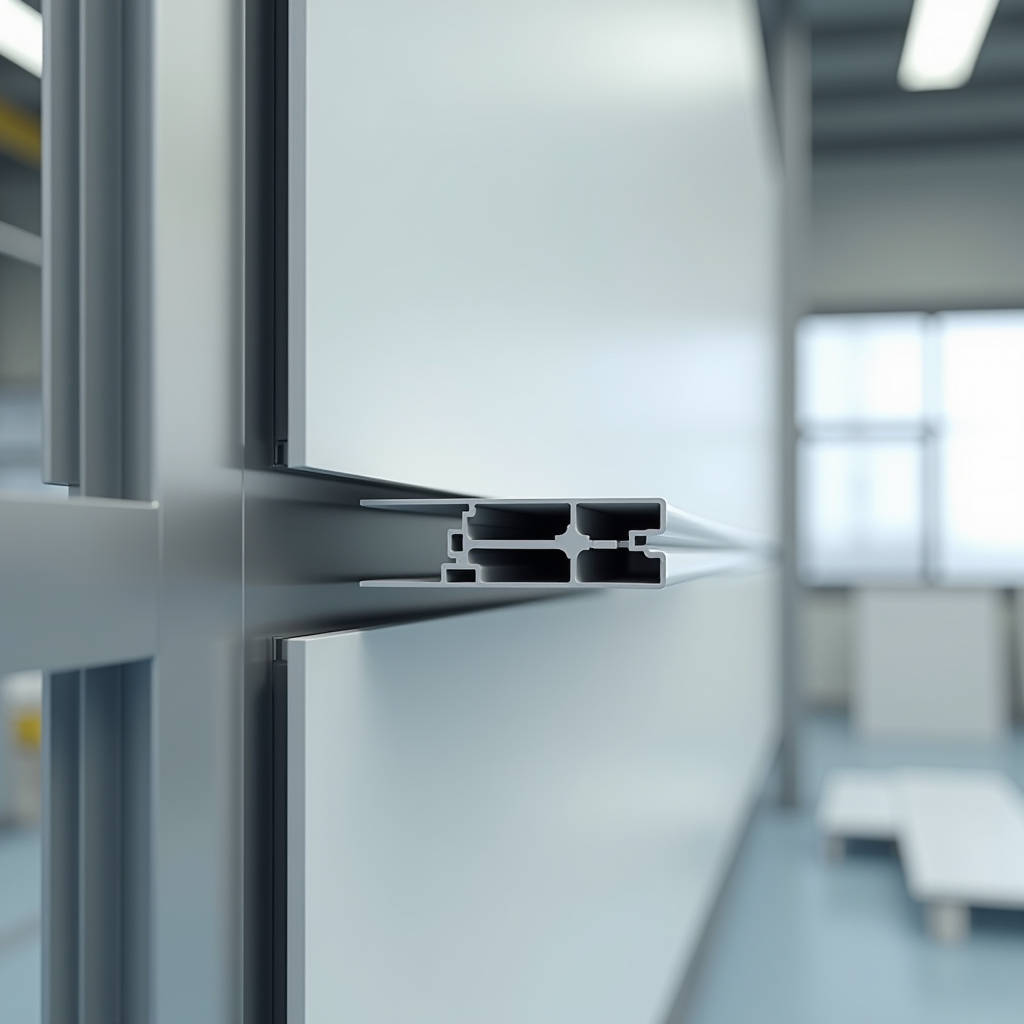
When a curtain wall panel spans more than 1.8 meters between mullions, the difference between a flat facade and a wavy mess often comes down to one component: the Aluminum Stiffener Profile. These extruded aluminum ribs, bonded or mechanically fastened to the rear face of solid aluminum cladding panels, resist the out-of-plane deflection that wind loads, thermal stress, and dead weight impose on thin-gauge sheet metal. Without them, even a 3.0mm solid aluminum panel will oil-can under suction pressure, producing visible distortions that architects and facade consultants flag immediately during inspection. The stiffener profile is not a secondary accessory. It is a primary structural element that determines whether the installed panel stays optically flat across a 30-year service life. Getting the profile geometry, alloy selection, bonding method, and spacing right requires engineering discipline that goes well beyond picking a stock extrusion from a catalog.
How Wind Load Dictates Stiffener Profile Geometry
Wind load is the dominant load case for most exterior cladding panels. ASCE 7-22 provides the baseline velocity pressure calculations, but the real challenge is translating a design pressure of, say, 2.4 kPa (50 psf) into a specific stiffener cross-section, spacing, and attachment schedule. The Aluminum Stiffener Profile functions as a beam element that reduces the effective span of the panel between supports. A solid aluminum panel measuring 1.5m × 3.0m with a 2.5mm thickness, for example, has virtually no bending stiffness on its own across the long axis. Adding two intermediate stiffener ribs running parallel to the short span cuts the unsupported panel width from 1.5m to 0.5m, reducing the maximum bending moment by a factor of nine.
Profile geometry matters enormously. A rectangular hollow section (RHS) 40mm × 20mm × 2mm wall thickness provides roughly 4.2 cm⁴ of moment of inertia about its strong axis. A C-channel of similar weight might only deliver 2.8 cm⁴. The difference shows up in the allowable span tables that every facade engineer should generate before specifying stiffener layouts. For panels in high-rise applications above 60 meters, where corner zone pressures can exceed 3.5 kPa, a single central stiffener is rarely sufficient. Two or three ribs, spaced evenly, become the baseline.
The Aluminum Association's Aluminum Design Manual provides the allowable stress design methodology. For 6063-T6 stiffener extrusions, the allowable bending stress runs around 110 MPa. A quick calculation: a panel subjected to 2.0 kPa uniform suction, with stiffeners spaced at 600mm centers and spanning 2.4m between mullion connections, generates a bending moment of approximately 0.86 kN·m per stiffener. The required section modulus is 7.8 cm³. An off-the-shelf 50mm × 25mm × 3mm RHS delivers about 8.5 cm³, giving a comfortable margin. Skip this calculation, and the panel will deflect beyond the typical L/175 serviceability limit.
6063-T5 vs. 6063-T6: Alloy Selection for Stiffener Extrusions
Most Aluminum Stiffener Profile extrusions come from the 6xxx series, with 6063-T5 and 6063-T6 dominating the market. The choice between them is not trivial. 6063-T5, with a minimum tensile strength of 150 MPa and yield strength of 110 MPa, extrudes easily and takes anodizing well. It is the default for many architectural applications. 6063-T6 pushes the yield strength to 170 MPa minimum, a 55% increase over T5, at the cost of slightly higher extrusion difficulty and reduced ductility. For stiffeners in high-wind zones or panels with tight deflection limits, T6 is the better engineering choice.
There is a cost delta. 6063-T6 typically runs 8-12% more per kilogram than T5 in the Asian extrusion market, and lead times can stretch by 5-7 working days depending on the die availability. For a curtain wall project requiring 4,000 linear meters of stiffener, that premium might add $1,200-1,800 to the material budget. Against a total facade contract value that often exceeds $2 million, this is negligible. The real cost of using T5 where T6 is needed shows up in rejected panels, rework, and delayed handover.
6061-T6 enters the conversation when stiffeners double as structural connections or when the panel system involves bolted rather than bonded stiffener attachments. With a yield strength of 240 MPa, 6061-T6 is substantially stronger but harder to extrude into thin-walled, complex shapes. Its use is generally limited to heavy-duty applications such as blast-resistant facades or panels spanning more than 4 meters between supports.
Bonding Methods: Structural Adhesive vs. Mechanical Fastening
How the Aluminum Stiffener Profile attaches to the back of the solid aluminum panel determines both the composite action of the assembly and its long-term durability. Two methods dominate: structural adhesive bonding and mechanical fastening with stainless steel rivets or screws. A third hybrid method, using adhesive with intermittent rivets for fixturing, has gained traction on large-scale projects in the Middle East and Southeast Asia.
Structural adhesive bonding, typically using two-part epoxy or polyurethane adhesives, provides a continuous load path between the panel skin and stiffener. This matters because the adhesive transfers shear stress along the entire length of the stiffener, enabling partial composite action. The panel and stiffener deflect together, and the assembly's effective stiffness exceeds the sum of its parts. The downside is process control. Adhesive bonding requires clean surfaces, controlled temperature and humidity during application, and adequate curing time before handling. On a production line pushing 80 panels per day, the curing bottleneck can be real.
Mechanical fastening avoids the curing problem but introduces stress concentrations around each fastener hole. A 3.0mm solid aluminum panel with a #10-24 stainless steel screw every 300mm along the stiffener creates a discrete connection pattern. Under cyclic wind loading, the panel material around each fastener can work-harden and eventually crack if the edge distance is insufficient. The AAMA 508 standard provides guidance on fastener spacing and edge distances for aluminum panels.
Below is a comparison of the three bonding approaches based on project data from facade contractors in the GCC region:
| Bonding Method | Shear Transfer Efficiency | Production Speed (panels/day) | Relative Cost per Panel | Best Application |
|---|---|---|---|---|
| Full Structural Adhesive | High (continuous) | 40-60 | $$$ | High-rise, high wind zones |
| Mechanical Fastening | Moderate (discrete) | 80-120 | $ | Low-rise, sheltered facades |
| Hybrid (Adhesive + Rivets) | High | 60-80 | $$ | Large-format panels, fast-track projects |
Thermal Expansion Compatibility and Stress Mitigation
Aluminum expands at roughly 23.4 × 10⁻⁶ per °C. A 3-meter-long Aluminum Stiffener Profile bonded to a 3-meter solid aluminum panel will expand and contract in unison if both are the same alloy, which is the standard case. The problem arises when the stiffener is attached to a steel subframe or when the panel system includes mixed materials with different coefficients of thermal expansion (CTE). A steel mullion expands at 11.7 × 10⁻⁶ per °C, about half the rate of aluminum. Over a 50°C temperature swing, a 3-meter aluminum panel grows 3.5mm relative to the steel support. The stiffener must accommodate this differential movement without buckling or debonding.
Slotted connections at one end of the stiffener are the standard solution. Rather than fixing both ends rigidly, the stiffener is fixed at one mullion and allowed to slide at the other through a slotted hole with a shoulder screw. The slot length is calculated based on the expected thermal movement plus a safety factor of 1.5. For a 3-meter panel, a 6mm slot is typical. The Aluminum Stiffener Profile must have sufficient bearing area around the slot to prevent localized yielding of the extrusion web under the screw head.
Dark-colored PVDF coatings absorb more solar radiation, raising the panel's peak service temperature. A black panel in Dubai can reach 85°C on a summer afternoon, while the supporting steel structure might be at 55°C in the shade. The 30°C differential within the assembly itself generates thermal bowing if the stiffener layout does not account for it. Symmetric stiffener placement, with equal numbers of ribs on each half of the panel, minimizes the tendency for the panel to curl toward one edge.
Stiffener Spacing and Panel Aspect Ratio: Engineering Rules of Thumb
Panel aspect ratio drives stiffener layout decisions. A square panel, say 1.5m × 1.5m, distributes wind load evenly to all four edges and may not need stiffeners at all if the panel thickness is 3.0mm and the design pressure is below 1.5 kPa. A panel with a 3:1 aspect ratio, such as 1.0m × 3.0m, behaves like a one-way slab and almost always requires stiffeners running parallel to the short dimension.
The following rules of thumb come from facade engineering practice across multiple projects:
- Panel thickness 2.0mm: Maximum unsupported span between stiffeners or panel edges: 400mm for design pressures up to 1.5 kPa. Reduce to 300mm for pressures above 2.5 kPa.
- Panel thickness 2.5mm: Maximum unsupported span: 500mm for pressures up to 1.5 kPa, 400mm for pressures above 2.5 kPa.
- Panel thickness 3.0mm: Maximum unsupported span: 600mm for pressures up to 1.5 kPa, 500mm for pressures above 2.5 kPa.
- Stiffener end fixity: Assume simply supported conditions unless both ends are welded or bolted with a minimum of two fasteners per connection.
- Stiffener depth-to-span ratio: Keep stiffener depth at least 1/30 of the span between supports. A 2.4m span requires a minimum stiffener depth of 80mm.
These are starting points. Full-scale mockup testing under ASTM E330, with deflection measurements at quarter points and mid-span, validates or refines the layout. No amount of FEA modeling replaces a physical test when the panel is 3 meters tall and the architect is standing underneath it with a straightedge.
Corrosion Protection for Stiffeners in Aggressive Environments
The Aluminum Stiffener Profile sits in the cavity behind the cladding panel, protected from direct rain but exposed to condensation, salt-laden air in coastal zones, and industrial pollutants. While aluminum naturally forms a protective oxide layer, the mill finish is insufficient for long-term durability in C4 or C5 corrosion categories per ISO 12944.
Anodizing to AA-M10C22A21 (Class I architectural anodizing, 18 microns minimum) provides adequate protection for most urban and light industrial environments. For coastal projects within 5 kilometers of saltwater, a 25-micron anodized layer or a chromate conversion coating followed by a thin PVDF topcoat is recommended. The stiffener does not need the full 30-40 micron PVDF system that the visible panel face receives, but a 15-20 micron single-coat system on the stiffener adds meaningful corrosion resistance at modest cost.
Galvanic corrosion is a specific concern when aluminum stiffeners contact steel fasteners or steel subframe components. Stainless steel fasteners (A2 or A4 grade) are mandatory. Carbon steel screws, even zinc-plated ones, will initiate galvanic attack on the aluminum within months in humid conditions. An isolating tape or gasket between the aluminum stiffener and any dissimilar metal surface is cheap insurance. 3M's VHB tape, commonly used for panel bonding, also serves as an effective isolation layer when applied between the stiffener and a steel mullion.
Production Tolerances and Quality Control
An Aluminum Stiffener Profile that arrives from the extrusion mill 2mm longer than specified will not fit into the panel assembly jig. Tolerances matter at every stage. Extrusion straightness should be held to 0.5mm per meter, with a maximum bow of 2mm over a 3-meter length. Cut length tolerance is typically ±1.0mm. The contact surface that bonds to the panel must be flat within 0.2mm across its width to ensure uniform adhesive thickness.
For bonded stiffeners, adhesive thickness control is critical. A bond line that varies from 0.5mm to 2.0mm along the same stiffener creates uneven stress distribution and reduces the effective shear transfer area. Production jigs that hold the panel and stiffener in precise alignment during curing are not optional. They are the difference between a panel that passes the ASTM E330 test and one that fails because the stiffener debonded at a thin glue line.
Incoming inspection of extruded stiffeners should include a random sample check of dimensions, straightness, and alloy temper using a handheld XRF analyzer or conductivity meter. A batch of 6063-T5 mistakenly supplied as T6 will have 35% lower yield strength, and the only way to catch it before the stiffeners are bonded into panels is through material verification at receiving. For projects where the facade contractor sources stiffeners from a different supplier than the panels, this step is non-negotiable.
Cost Drivers in Stiffener Profile Specification
Several factors push the cost of the Aluminum Stiffener Profile beyond the raw billet price. Custom die design for a non-standard profile shape adds $1,500-3,000 to the upfront tooling cost, amortized over the project's total linear meter requirement. For a project needing 10,000 meters, the die cost adds $0.15-0.30 per meter. Standard profiles from existing dies avoid this charge entirely.
Finish adds cost in a predictable hierarchy. Mill finish is the baseline. Clear anodizing adds $0.80-1.20 per meter for standard architectural profiles. PVDF single-coat on the stiffener adds $1.50-2.50 per meter. Powder coating, rarely used on stiffeners due to thickness buildup that interferes with bonding, sits in between. The cost of the finish can exceed the cost of the raw extrusion for small profiles with high surface-area-to-weight ratios.
Shipping costs for 6-meter-long stiffener bundles are disproportionately high relative to the material value. Ocean freight from Asian extrusion mills to US East Coast ports runs $180-250 per cubic meter. A bundle of 500 stiffeners, each 3 meters long, occupies roughly 0.4 cubic meters. The freight cost alone can be $0.15-0.20 per linear meter. For projects in the Middle East, sourcing from regional extruders in the UAE or Saudi Arabia often yields lower landed costs than shipping from East Asia, despite higher per-kilogram extrusion prices.
Futeng® has supplied stiffener profiles for solid aluminum cladding projects across Southeast Asia and the Middle East, with in-house extrusion and finishing capabilities that keep the supply chain under one roof. For contractors managing multi-tower developments, consolidating panel and stiffener procurement with a single supplier eliminates the finger-pointing that occurs when the panel fabricator blames the stiffener supplier for dimensional issues and vice versa.
Designing for Installation: What the Shop Drawing Should Show
A shop drawing that simply calls out "Aluminum Stiffener Profile — see structural drawings" is incomplete. The facade contractor's shop drawings should include a stiffener layout plan for every unique panel type, with dimensions locating each stiffener relative to the panel edges, the stiffener cross-section detail, the connection detail at each end, the bonding or fastening specification, and the finish requirement.
Panel numbering should correlate with stiffener type. A panel marked "P-03A" might use two 50mm × 25mm RHS stiffeners at 500mm spacing, while "P-03B" uses three 40mm × 20mm C-channels at 400mm spacing. The installer on site should not have to interpret which stiffener goes where. The drawing should make it obvious.
For panels with openings—windows, louvers, or penetrations for lighting—the stiffener layout must account for the interrupted load path. An opening in the center of a panel eliminates the most effective location for a central stiffener. The engineer should add stiffeners above and below the opening, sized to carry the additional tributary area that the missing central rib would have supported. This is basic structural logic, but it is missed often enough that facade consultants regularly flag it during design review.
Testing and Validation: Beyond the Calculation
ASTM E330 is the standard test method for structural performance of exterior windows, doors, skylights, and curtain walls under uniform static air pressure difference. For solid aluminum panels with bonded stiffeners, the test should include both positive and negative pressure cycles, with deflection measurements at multiple points across the panel surface. The pass/fail criterion is typically L/175 at design pressure, with no permanent deformation exceeding 0.2% of the span after the load is removed.
AAMA 508 provides additional guidance specific to aluminum panels. The standard addresses panel flatness tolerances, fastener pull-through resistance, and adhesive bond durability after accelerated weathering. Panels that pass the ASTM E330 structural test may still fail the AAMA 508 flatness requirement if the stiffener spacing was too generous. The two standards should be read together during specification writing.
For projects in seismic zones, the AAMA 501.4 test for inter-story drift should be considered. Panels with rigidly attached stiffeners that span floor-to-floor may need slotted connections to accommodate the 25-50mm of relative movement that a seismic event can impose. The Aluminum Stiffener Profile connection detail that works for wind loads may be too stiff for seismic drift, and the solution is to let one end slide.
The engineering behind a properly specified Aluminum Stiffener Profile is not complicated, but it is detailed. Panel thickness, stiffener alloy, profile geometry, spacing, bonding method, thermal movement accommodation, corrosion protection, and quality control each contribute to whether the installed facade stays flat and secure for decades. A facade that oil-cans under wind load, or a stiffener that debonds because the adhesive was applied in a 40°C factory without climate control, turns a premium architectural finish into a warranty claim. The time to get the stiffener specification right is during shop drawing review, not after the first panel comes off the truck.