Aluminum Z Purling Structural Design and Lifecycle Cost for Corrosive Environments
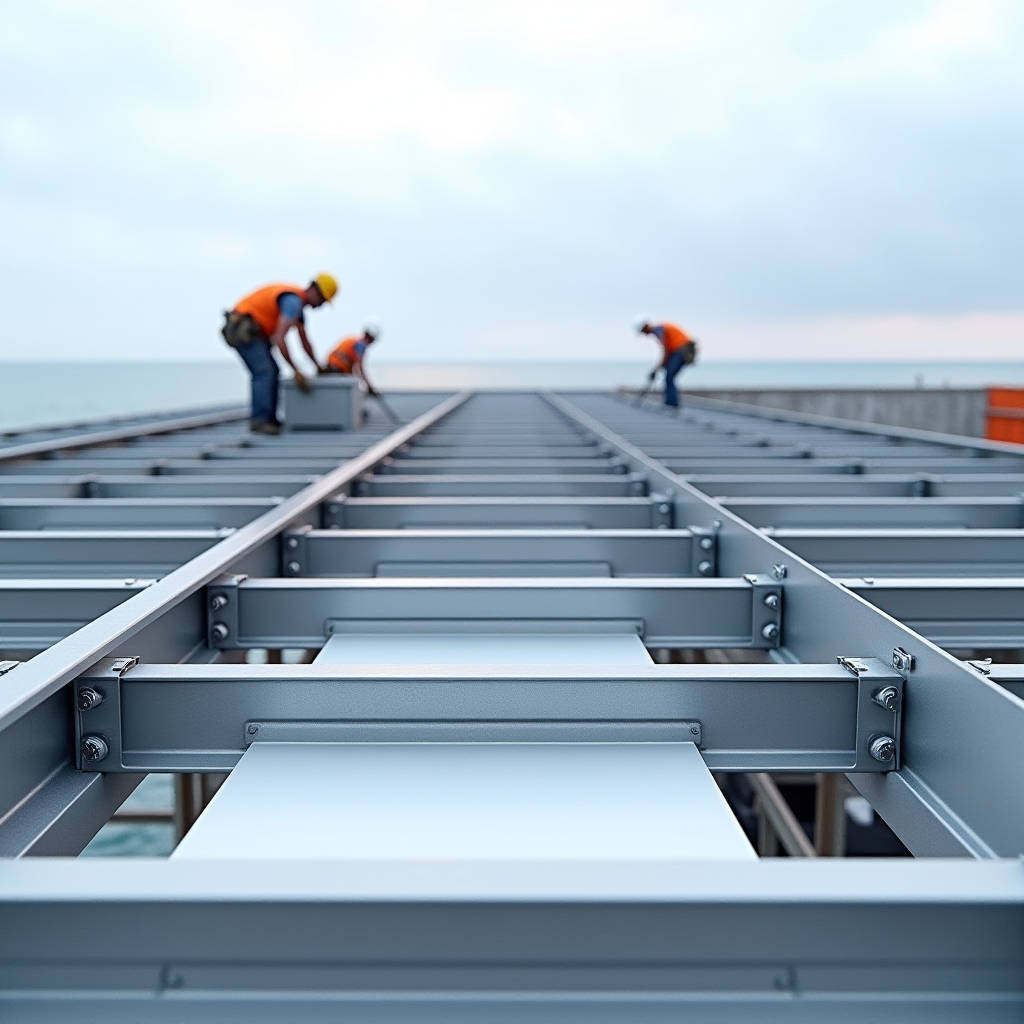
When engineers evaluate secondary framing for large-scale metal building envelopes, the conversation usually centers on galvanized steel Cees and Zees. That assumption leaves a gap in the specification toolkit. Aluminum Z Purling has been quietly solving problems that steel cannot touch — particularly in coastal environments, chemical processing plants, and high-humidity climates where corrosion eats standard galvanized purlins within a decade. The material shift from steel to aluminum in the Z-profile is not a cosmetic upgrade. It changes the corrosion lifecycle, the dead load on primary framing, and the long-term maintenance calculus for facilities that cannot afford recurring roof tear-offs. This article examines the structural logic, material economics, and installation realities of specifying aluminum Z purlins in place of traditional galvanized steel.
What a Z Purlin Actually Does in the Building Envelope
A Z-purlin is a cold-formed secondary structural member with a cross-section that resembles the letter Z. The flanges point in opposite directions, which creates a geometry that is fundamentally different from C-channel sections. In a metal building system, Z-purlins run perpendicular to the main rafters, supporting the roof cladding and transferring dead loads, live loads, snow loads, and wind uplift forces down to the primary frame.
The Z-shape is not arbitrary. The asymmetrical flange design allows end-lapping at supports. When two Z-purlins overlap across a rafter, the combined section depth doubles at the critical moment region, which is precisely where bending stress peaks. A continuous lapped Z-purlin line behaves more like a multi-span beam than a series of simply supported spans. This continuity reduces deflection by roughly 30 to 40 percent compared to an equivalent non-lapped C-section, depending on lap length and gauge.
Wall girts follow the same principle. Z-purlins rotated 90 degrees become horizontal girts that brace the wall cladding and transfer wind pressure to the main columns. The same lapping advantage applies: a continuous girt line stiffens the entire wall plane against lateral drift.
Where aluminum enters the picture, the structural logic does not change. The Z-profile works identically whether the material is 50-ksi steel or 6061-T6 aluminum. What changes is the weight, the corrosion mechanism, and the connection detailing — all of which we will examine.
Why Aluminum Instead of Galvanized Steel
Galvanized Z-purlins dominate the market for good reason. They are inexpensive, widely available, and understood by every erector crew in North America. The G90 zinc coating provides a sacrificial layer that protects the base steel — until it does not. In marine environments, the chloride deposition rate determines how fast that zinc layer disappears. ASTM B117 salt spray testing shows G90 coatings failing between 200 and 400 hours depending on scratch depth and coating uniformity. Real-world coastal installations in Southeast Asia and the Middle East Gulf region have documented purlin perforation within 8 to 12 years.
Aluminum Z Purling eliminates the corrosion clock. The 6000-series aluminum alloys — 6061-T6 and 6063-T6 being the most common for structural extrusions — form a self-healing aluminum oxide layer that stabilizes within hours of surface exposure. There is no coating to deplete, no zinc to sacrifice. The oxide layer is chemically stable in pH ranges from roughly 4 to 9, which covers nearly all atmospheric conditions except direct contact with strong alkalis or certain industrial acids.
The weight difference matters more than first-cost calculations suggest. Aluminum weighs approximately 2.7 grams per cubic centimeter versus 7.85 for steel — roughly one-third the density. An 8-inch-deep Z-purlin in 12-gauge steel (0.105 inch nominal thickness) weighs about 2.5 pounds per linear foot. The same profile in aluminum at a slightly thicker gauge to match stiffness targets weighs approximately 1.1 to 1.3 pounds per linear foot. Across a 50,000-square-foot roof with purlins spaced at 5 feet on center, the dead-load reduction approaches 4 to 5 tons. That reduction cascades through the primary frame design, potentially shrinking column and rafter sections.
Material Grades and Mechanical Properties
Not all aluminum is structural. The two alloys that matter for Aluminum Z Purling applications are 6061-T6 and 6063-T6. The table below compares their key mechanical properties against standard galvanized steel purlin material.
| Property | 6061-T6 Aluminum | 6063-T6 Aluminum | ASTM A653 Grade 50 Steel |
|---|---|---|---|
| Tensile Yield Strength (ksi) | 35 - 40 | 25 - 31 | 50 (minimum) |
| Ultimate Tensile Strength (ksi) | 42 - 45 | 30 - 35 | 65 (minimum) |
| Modulus of Elasticity (ksi) | 10,000 | 10,000 | 29,000 |
| Density (lb/in³) | 0.0975 | 0.0975 | 0.2836 |
| Corrosion Mechanism | Self-passivating oxide | Self-passivating oxide | Sacrificial zinc depletion |
| Typical Service Life (Coastal) | 40+ years | 35+ years | 8 - 20 years (G90 dependent) |
The modulus of elasticity is the critical number. Aluminum is roughly three times more flexible than steel at the same section geometry. An aluminum Z-purlin will deflect more under the same load unless the section is deepened or the gauge is thickened. Engineers compensate by increasing the web depth or specifying a heavier gauge. The weight advantage persists even after these adjustments because aluminum's density is so much lower.
For projects where Aluminum Z Purling must match the stiffness of a given steel section, a rule of thumb is to increase the aluminum gauge by two steps — for example, from 14-gauge steel (0.075 inch) to 12-gauge aluminum (0.081 inch) — and deepen the section by 10 to 15 percent. The resulting aluminum purlin still weighs roughly 40 percent less than the steel equivalent.
Galvanic Corrosion: The Hidden Risk in Mixed-Metal Assemblies
Aluminum Z Purling does not corrode on its own, but it can corrode catastrophically when it touches dissimilar metals in the presence of an electrolyte. This is galvanic corrosion, and it is the single most common failure mode in aluminum secondary framing.
The galvanic series ranks metals by their electrochemical potential. Aluminum sits at approximately -0.75 to -0.90 volts (depending on alloy) relative to a saturated calomel electrode. Steel sits around -0.60 to -0.70 volts. When aluminum and steel are bolted together and rainwater or condensation bridges the joint, the aluminum becomes the anode. It sacrifices itself to protect the steel.
The fix is straightforward but demands discipline on site. Every connection between an aluminum Z-purlin and a steel rafter or column must include a physical isolation barrier. The standard details are:
- Isolation tape or gasket: A 0.030-inch minimum thickness of neoprene, EPDM, or PTFE tape between the aluminum purlin and the steel substrate. The tape must extend at least 1/4 inch beyond all edges of the purlin flange.
- Stainless steel fasteners: Type 304 or 316 stainless steel bolts, washers, and nuts. Stainless is cathodic to aluminum but the potential difference is small, and the small fastener surface area relative to the large aluminum purlin area keeps the galvanic current density low.
- Isolation washers: Nylon or PTFE washers under the bolt head and nut to prevent the stainless fastener from directly contacting the aluminum.
- Edge sealing: A bead of neutral-cure silicone sealant along all cut edges and bolt holes to prevent moisture ingress into the aluminum-steel interface.
When these details are followed, galvanic corrosion is effectively eliminated. The American Galvanizers Association publishes detailed guidance on dissimilar metal connections that applies directly to aluminum purlin installations. Ignoring these details, however, can lead to visible white corrosion product and section loss within the first two years of service.
Load-Bearing Design: Wind Uplift and Deflection Limits
Wind uplift governs purlin design more often than gravity loads, especially in hurricane-prone regions and on buildings with wide roof bays. The Aluminum Z Purling section must resist a net upward pressure that can exceed 40 to 60 psf (pounds per square foot) in ASCE 7-22 wind zones above 130 mph basic wind speed.
The critical check is not just strength — it is deflection. The IBC (International Building Code) and the Metal Building Manufacturers Association (MBMA) recommend deflection limits of L/180 for roof purlins under live load and L/120 under total load for metal roof panels. For brittle finishes or architectural metal panels with PVDF coatings, a tighter L/240 limit is often specified to prevent coating cracking.
Aluminum's lower modulus means deflection checks often control the section selection rather than bending strength. An engineer designing with Aluminum Z Purling can take several approaches:
- Reduce purlin spacing: Dropping from 5-foot to 4-foot centers reduces the tributary load on each purlin by 20 percent, directly cutting deflection.
- Increase lap length: Longer end laps at supports increase the effective section modulus at the moment peak. A lap length of 1.5 times the purlin depth is a common starting point; extending to 2.0 times the depth can reduce mid-span deflection by 10 to 15 percent.
- Specify deeper sections: An 8-inch Z-purlin is roughly 60 percent stiffer than a 6-inch Z-purlin of the same gauge. The depth increase adds minimal weight while dramatically improving stiffness.
- Add sag rods or bridging: Lateral-torsional buckling is a failure mode for Z-purlins under uplift because the compression flange is not continuously braced by the roof panel. Bridging rows at third-points or quarter-points of the span brace the compression flange and increase the allowable bending stress.
Thermal Movement and Expansion Joint Strategy
Aluminum expands and contracts roughly twice as much as steel under the same temperature swing. The coefficient of thermal expansion for 6061 aluminum is 13.1 × 10⁻⁶ in/in/°F, compared to 6.7 × 10⁻⁶ for structural steel. A 100-foot-long purlin run subjected to a 100°F temperature swing (from 30°F winter night to 130°F roof surface in summer sun) will expand by approximately 1.57 inches in aluminum versus 0.80 inches in steel.
This differential movement must be accommodated in the connection detailing. Rigid bolted connections at both ends of a long purlin run will induce axial forces that can buckle the purlin or tear out the bolt holes. The standard approach is to fix one end of the purlin line and allow the other end to slide. Slotted holes with a length of 1.5 to 2.0 times the calculated movement range, combined with a slip-critical connection using stainless steel bolts tightened to a specified torque, provide controlled movement without loosening.
Expansion joints in the cladding system must align with the purlin movement joints. A mismatch between cladding joint location and purlin slip connection creates a shear lag that can wrinkle the metal panels or pop fasteners.
Compatibility with Solid Aluminum Cladding Panels
The pairing of Aluminum Z Purling with solid aluminum cladding panels creates a fully aluminum building envelope — substrate, framing, and skin. This is not a marketing gimmick. It eliminates the galvanic couple between steel purlins and aluminum panels that would otherwise require isolation tape at every clip and fastener.
Solid aluminum cladding panels — typically 2.0 mm, 2.5 mm, or 3.0 mm thick sheets with PVDF (polyvinylidene fluoride) coil-applied or spray-applied coatings — are mechanically fixed to the Z-purlin substructure using aluminum or stainless steel clips and fasteners. The PVDF coating system, based on Kynar 500® or Hylar 5000® resin with a minimum 70 percent fluoropolymer content, provides a 25- to 30-micron dry film thickness that resists chalking and fading for decades. When the entire assembly — panel, clip, fastener, and purlin — is aluminum, the thermal expansion rates match, and the corrosion compatibility is inherent.
Futeng® has supplied solid aluminum cladding panels for projects where the specifier chose aluminum Z-purlins specifically to avoid mixed-metal corrosion risks in coastal installations. The panel thicknesses — 2.0 mm for interior soffits, 2.5 mm for standard exterior walls, and 3.0 mm for high-wind facades — are engineered to work with purlin spans determined by the structural consultant.
The American Architectural Manufacturers Association (AAMA) publishes AAMA 2605, the performance specification for high-performance organic coatings on aluminum extrusions and panels. Specifiers should reference AAMA 2605 for the PVDF coating on both the cladding panels and any exposed aluminum purlins in architectural applications.
Fabrication Tolerances and Quality Standards
Aluminum Z Purling is typically produced by cold-forming from coil stock or by extrusion, depending on the section depth and order volume. Cold-formed aluminum Z-purlins follow tolerances similar to those in the ASTM International standards for cold-formed steel framing, adapted for aluminum's different springback behavior.
Key dimensional tolerances that specifiers should include in purchase documents:
- Web depth: ±1/16 inch for depths up to 8 inches, ±3/32 inch for 10 to 12 inches.
- Flange width: ±1/16 inch.
- Length: ±1/8 inch for lengths up to 20 feet, ±1/4 inch for 20 to 40 feet.
- Twist: Maximum 1/4 inch per 10 feet of length when the purlin rests on a flat surface.
- Camber: Maximum 1/8 inch per 10 feet.
- Hole placement: ±1/32 inch from specified location.
Extruded aluminum Z-purlins can achieve tighter tolerances — typically ±0.015 inch on the web and flange dimensions — because the extrusion die controls the cross-section precisely. The trade-off is higher tooling cost and longer lead times for custom dies. For projects requiring more than 5,000 linear feet of a given profile, extrusion becomes cost-competitive with cold-forming.
Cost Comparison: Aluminum vs. Galvanized Steel Purlins
The first-cost comparison between Aluminum Z Purling and galvanized steel Z-purlins is straightforward but misleading if viewed in isolation. The table below breaks down the cost components for a representative 10,000-square-foot roof with purlins at 5-foot centers, comparing 8-inch-deep sections in both materials.
| Cost Component | Galvanized Steel (8" Z, 14 ga) | Aluminum 6061-T6 (8" Z, 12 ga) |
|---|---|---|
| Material cost per linear foot | $2.80 - $3.50 | $5.50 - $7.00 |
| Total material cost (2,400 LF) | $6,720 - $8,400 | $13,200 - $16,800 |
| Fasteners and isolation accessories | $800 - $1,200 | $2,400 - $3,600 |
| Installation labor (same crew) | $4,500 - $6,000 | $3,800 - $5,200 (lighter material) |
| Corrosion-related maintenance (30-year) | $8,000 - $25,000 (coastal) | $500 - $1,500 (inspection only) |
| 30-year total cost of ownership | $20,020 - $40,600 | $19,900 - $27,100 |
The numbers tell a clear story. The aluminum option costs roughly 60 to 100 percent more upfront but breaks even within 15 to 20 years in a corrosive environment, and pulls ahead over a 30-year building life. For inland installations with low corrosion risk, galvanized steel remains the more economical choice. For coastal, industrial, or high-humidity sites, the lifecycle math favors aluminum.
Installation Practices That Prevent Field Failures
Erection crews accustomed to steel purlins need to adjust their methods for Aluminum Z Purling. The material is softer and more prone to surface damage during handling. Key field practices:
- Lifting and handling: Use nylon slings, not steel chains. Stack purlins on timber dunnage with spacers between layers. Dragging aluminum across steel trailer beds embeds steel particles that become corrosion initiation sites.
- Cutting: Carbide-tipped saw blades with a negative rake angle designed for non-ferrous metals. Standard steel-cutting abrasive wheels load up with aluminum and can shatter. Lubricate cuts with a wax stick or light oil to prevent galling.
- Drilling: Use sharp high-speed steel or cobalt drill bits at 3,000 to 5,000 RPM. Peck-drill to clear chips. Aluminum chips can weld to the drill bit if the bit overheats.
- Bolting sequence: Install isolation tape first, then position the purlin, then drill through both the aluminum and the tape in one operation. This ensures hole alignment and prevents the tape from shifting.
- Torque control: Stainless steel bolts in aluminum threads must be torqued to lower values than steel-on-steel connections. Overtightening strips the aluminum or crushes the purlin flange. A torque table from the bolt manufacturer, adjusted for aluminum, should be in the erector's hands.
When Aluminum Z Purling Is the Right Specification
The decision to specify Aluminum Z Purling over galvanized steel should be driven by the project's environmental exposure and the owner's tolerance for maintenance. The cases where aluminum makes engineering and economic sense include:
- Marine and coastal buildings: Within 3 miles of saltwater, chloride deposition rates exceed the protective capacity of G90 zinc within 10 to 15 years. Aluminum eliminates this failure mode.
- Chemical processing plants: Airborne acids and alkalis attack zinc coatings aggressively. Aluminum's oxide layer is stable across a wider pH range.
- Water treatment facilities: High humidity combined with chlorine compounds creates a corrosive microclimate inside the building envelope.
- Food processing and cold storage: Washdown environments and condensation cycles demand materials that do not rust. Aluminum purlins eliminate the risk of rust staining on insulated metal panels.
- Long-life institutional buildings: Schools, hospitals, and government facilities with 50-year design lives benefit from the reduced maintenance burden.
The Aluminum Association maintains design manuals and alloy selection guides that structural engineers can reference when developing aluminum purlin specifications. Combining these resources with project-specific wind load calculations and corrosion exposure assessments produces a defensible specification that stands up to value-engineering challenges.
Aluminum Z Purling is not a universal replacement for steel. It is a targeted solution for environments where corrosion is the primary life-limiting factor. The engineering trade-offs — lower stiffness, higher material cost, galvanic isolation requirements — are manageable when the alternative is replacing rusted purlins at year 12.
For specifiers evaluating the option, the sequence is clear: characterize the environmental exposure per ISO 9223 or an equivalent corrosion classification standard, calculate the required section properties based on governing load combinations, detail the connections to isolate dissimilar metals, and compare the 30-year lifecycle cost against galvanized steel. In corrosive environments, the numbers will point to aluminum.