Aluminum Edge Folding Return Depth and Fabrication Tolerances for Solid Cladding Panels
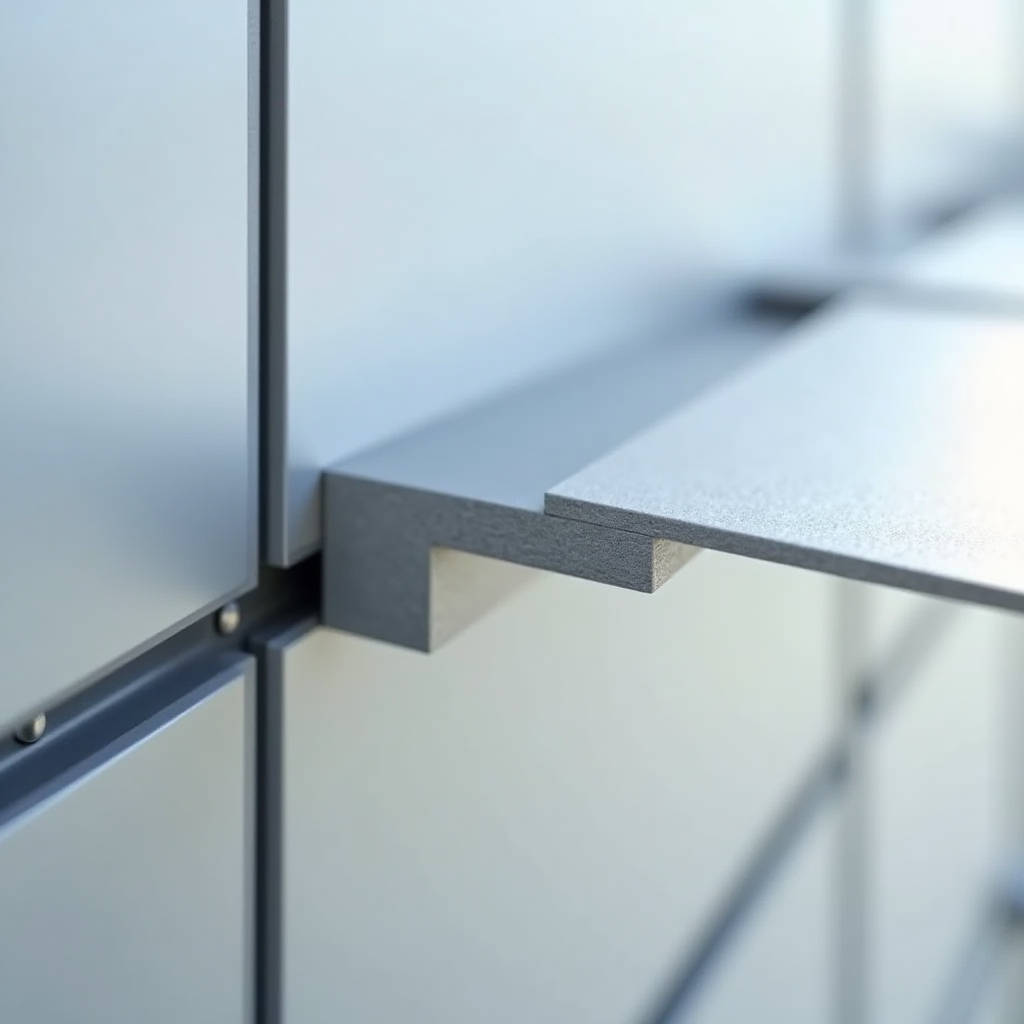
When a facade contractor receives shop drawings for a solid aluminium panel system, one of the first details that jumps off the page is the edge treatment. A panel is not just a flat sheet bolted to a substructure. How the perimeter of that panel is folded, hemmed, or returned dictates everything from wind load resistance to how tight the shadow gap reads at 20 meters. Aluminum Edge Folding sits at the intersection of fabrication precision and on-site performance. Get the fold radius, return depth, and corner strategy right, and the facade looks monolithic. Get any of them wrong, and you get oil-canning, corner blowout, or panels that simply refuse to sit flush on their brackets. This article takes a hard look at what drives edge folding decisions for solid aluminium cladding panels — specifically 2.0 mm to 3.0 mm gauge 5052 or 3003 alloy sheets with PVDF-coated surfaces — and how those decisions ripple through cost, lead time, and long-term facade integrity.
What Aluminum Edge Folding Actually Means for Solid Panels
Aluminum Edge Folding refers to the process of bending the perimeter of a flat aluminium sheet along a predetermined line, creating a structural return that stiffens the panel and provides a clean, finished edge. In solid aluminium cladding — not composite — this fold is executed on a single homogeneous sheet, typically 2.0 mm, 2.5 mm, or 3.0 mm thick. The fold line is first routed with a V-groove on the reverse side, removing a precise amount of material to create a controlled weak point. The remaining web of aluminium — often 0.5 mm to 0.8 mm depending on the alloy and temper — acts as a living hinge. The panel is then folded to the specified angle, usually 90 degrees, though acute and obtuse returns are common for sloped soffits or angled facade transitions.
This is not the same as routing and folding aluminium composite material. ACP panels rely on a polyethylene core that provides the hinge. Solid aluminium has no core. The hinge is the aluminium itself. That changes everything: the minimum bend radius, the springback behavior, the tooling required, and the risk of micro-cracking along the fold line if the routing depth is off by even 0.1 mm.
Why Edge Return Depth Is a Structural Decision, Not an Aesthetic One
Many architects treat the edge return as a visual detail — a 20 mm or 30 mm shadow gap that defines the panel rhythm. But for the engineer and the fabricator, the return depth is a structural parameter. A deeper return — say 35 mm to 50 mm — adds significant bending stiffness to the panel, reducing deflection under wind load. This allows larger panel sizes without increasing material gauge, which saves weight and cost on the substructure.
Consider a 2.5 mm thick panel measuring 1,200 mm x 2,400 mm. With a 25 mm edge return on all four sides, the panel's effective moment of inertia at the perimeter increases substantially compared to a flat sheet with no return. Under a design wind pressure of 2.0 kPa (typical for mid-rise buildings in many regions), the center deflection can drop by 30% to 40% simply by deepening the return from 20 mm to 40 mm. This is not a marginal gain. It can mean the difference between passing and failing deflection criteria under ASTM E330.
The trade-off is material utilization. A deeper return consumes more aluminium per panel. A 50 mm return on all four sides of a 1,200 mm x 2,400 mm panel adds roughly 0.36 m² of material compared to a 20 mm return. Across a facade with 2,000 panels, that is 720 m² of additional aluminium — a cost that must be weighed against the potential savings from lighter stiffeners or thinner gauge. Fabricators who understand this balance, such as Futeng®, can help project teams run these numbers early in the design phase to avoid over-engineering or under-specifying.
The Routing Depth Problem Nobody Talks About
The V-groove routed into the back of a solid aluminium panel before folding is the single most critical quality control point in the entire edge folding process. Route too shallow, and the panel resists folding, requiring excessive force that can distort the face. Route too deep, and the remaining web is too thin — it may crack during folding, or worse, fail after installation when thermal cycling stresses the hinge.
For 5052-H32 alloy at 2.5 mm gauge, a typical routing depth leaves a residual web of 0.6 mm to 0.7 mm. This is not a guess. It is calculated based on the alloy's elongation at break, the fold angle, and the desired bend radius. The formula is straightforward but unforgiving:
Residual web thickness = (Panel gauge × (180° - fold angle) / 180°) × k-factor
Where the k-factor accounts for the material's neutral axis shift during bending. For 5052 aluminium, this typically ranges from 0.35 to 0.45 depending on temper. A fabricator who does not calibrate this for each batch of material is gambling with every panel that leaves the shop.
CNC routing machines with automatic tool height compensation are the standard for precision work. Manual routing with a hand-held router and a guide rail is still used for small batches or site modifications, but the consistency is entirely dependent on operator skill. A deviation of 0.1 mm in routing depth across a 2.4 m edge can produce visible waviness after folding — a defect that becomes painfully obvious under grazing light on a completed facade.
Corner Treatment: Where Edge Folding Gets Complicated
When four edges of a panel are folded, the corners become the problem. Three methods dominate solid aluminium panel fabrication:
- Welded corners: After folding, the open corner joints are TIG-welded, ground smooth, and the panel is re-coated or touched up. This produces a seamless, fully sealed corner with maximum structural integrity. The downside is cost and lead time. Welding introduces heat distortion that must be managed, and the touch-up coating on the corner will never match a factory PVDF finish perfectly under close inspection.
- Mechanical corner brackets: Pre-formed aluminium corner brackets are riveted or screwed into the folded returns, tying the adjacent edges together. This is faster and cheaper than welding, and avoids heat distortion. The trade-off is a visible joint line at the corner and slightly reduced stiffness compared to a fully welded corner.
- Notched and folded corners: The panel blank is notched at the corners before folding, so the returns fold up and meet without overlapping. A small gap remains, typically 1 mm to 2 mm, which can be left open for drainage or filled with sealant. This is the most economical method but offers the least structural continuity.
The choice of corner treatment should be driven by the facade's exposure category, the design wind load, and the aesthetic expectations. For a high-rise tower in a coastal environment with wind-driven rain, welded and sealed corners are non-negotiable. For a low-rise industrial building with a ventilated rainscreen, notched corners with open gaps may be perfectly adequate — and significantly cheaper.
Stiffener Integration and Edge Folding Coordination
Solid aluminium panels larger than roughly 600 mm x 600 mm typically require stiffeners bonded or mechanically attached to the back face to control deflection and prevent oil-canning. The edge folding geometry directly affects how these stiffeners are designed and attached.
Stiffeners are usually aluminium extrusions — hat sections, channels, or flat bars — bonded to the panel back with structural adhesive tape or two-part epoxy. They must stop short of the folded returns, typically leaving a 10 mm to 15 mm gap to avoid interfering with the fold radius and to allow for thermal movement. If the stiffener is too close to the return, it can create a hard point that telegraphs through to the face under thermal cycling.
The coordination between stiffener layout and edge folding also affects the fixing hole locations. Fixing holes are typically drilled through the folded returns, not through the panel face. The return must be deep enough to accommodate the required hole diameter and edge distance. Per The Aluminum Association guidelines, the minimum edge distance from the center of a hole to the edge of the return should be at least 1.5 times the hole diameter. For a typical 6 mm fixing hole, that means a minimum 9 mm edge distance. If the return is only 20 mm deep, and the hole is placed 10 mm from the panel face, the remaining edge distance is tight. A 25 mm or 30 mm return provides much more comfortable geometry.
Springback: Why 90 Degrees Is Never Exactly 90 Degrees
Anyone who has bent aluminium knows about springback. When the folding force is released, the material relaxes slightly, and the fold angle opens up by a degree or two. For 5052-H32, springback on a 90-degree fold can be 2° to 4°, depending on the gauge and the bend radius. Fabricators compensate by over-bending — folding to 87° or 88° so the material relaxes to exactly 90°.
Springback is not constant. It varies with material batch, temper, grain direction, and even ambient temperature. A fabricator running a batch of panels in the morning at 15°C will get different springback than the same batch in the afternoon at 30°C. The solution is not to guess. It is to measure. A quality fabricator runs test coupons from each batch of material, measures the actual springback, and adjusts the folding program accordingly. This is labor-intensive but essential for panels that must fit together on-site with 5 mm or 6 mm joints.
For projects with extremely tight joint tolerances — 3 mm or less — some fabricators will fold the returns slightly acute, say 88°, and rely on the panel's own stiffness to pull the joint open to the design dimension when installed. This is a nuanced technique that requires close coordination between the fabricator and the installation team.
Coating Integrity Across the Fold Line
PVDF coatings — typically 70% PVDF resin content per AAMA 2605 — are applied to the flat sheet before folding. The coating must survive the folding process without cracking, delaminating, or losing adhesion. This is not a given. The elongation of the coating must match or exceed the elongation of the aluminium at the fold line.
On the outside face of the fold, the coating is stretched. The strain depends on the bend radius and the material thickness. For a 2.5 mm panel folded with a 1.5 mm inside radius, the outer surface strain can reach 15% to 20%. A high-quality PVDF coating formulated for post-forming can handle this. A lower-grade coating, or one applied at insufficient film thickness, will micro-crack. These cracks are invisible to the naked eye at installation but become initiation points for corrosion and coating delamination over time.
The minimum dry film thickness for PVDF on architectural aluminium is typically 25 μm to 30 μm for a two-coat system and 35 μm to 40 μm for a three-coat system with a clear topcoat. The three-coat system provides better post-formability because the clear coat adds a layer of flexible resin that can absorb some of the folding strain. For panels with aggressive fold geometries — tight radii, acute angles — a three-coat system is strongly recommended.
Panel Size Limits and What Edge Folding Enables
Edge folding fundamentally changes the structural behavior of a solid aluminium panel, and this has direct implications for maximum panel sizes. A flat sheet with no returns behaves like a plate simply supported on its edges. Add folded returns, and the panel behaves more like a shallow tray — the returns act as edge beams that stiffen the perimeter.
The table below summarizes practical maximum panel sizes for different edge return configurations, based on 2.5 mm 5052-H32 solid aluminium with a design wind load of 2.0 kPa and deflection limit of L/60:
| Edge Return Depth | Stiffener Configuration | Max Panel Width (mm) | Max Panel Height (mm) | Approx. Weight (kg/m²) |
|---|---|---|---|---|
| 20 mm | 2 vertical stiffeners | 1,000 | 2,000 | 8.5 |
| 25 mm | 2 vertical stiffeners | 1,200 | 2,400 | 8.9 |
| 35 mm | 2 vertical + 1 horizontal | 1,500 | 3,000 | 9.6 |
| 50 mm | 3 vertical + 1 horizontal | 1,800 | 3,600 | 10.5 |
| 50 mm + welded corners | 3 vertical + 2 horizontal | 2,000 | 4,000 | 11.2 |
These are not absolute limits. They are engineering estimates that must be verified by project-specific calculations per ASTM E330 and the relevant local building code. But they illustrate the principle: deeper returns and better corner treatment unlock larger panels, which means fewer joints, faster installation, and a cleaner facade.
Fabrication Tolerances That Affect Installation
The best edge folding in the world is worthless if the panels do not fit the substructure. Dimensional tolerances on folded panels must be tight enough to maintain consistent joint widths across the facade. The industry benchmark for solid aluminium panel fabrication is typically ±1.0 mm on overall dimensions and ±0.5 mm on return depth. These are achievable with CNC folding equipment but difficult to maintain with manual processes.
Two specific tolerance issues cause the most site problems:
- Squareness: If the panel is not perfectly square after folding — if the diagonal measurements differ by more than 2 mm — the panel will not sit correctly in its opening. The joints will be wider on one side than the other, and the cumulative error across multiple panels can throw off the entire facade grid.
- Return flatness: The folded returns must be flat and straight along their entire length. A return that bows inward or outward by even 1 mm over 2.4 m will create a visible gap between the panel edge and the adjacent panel or the substructure. This is particularly critical for panels with open joints where there is no sealant to hide the variation.
Quality fabricators use CNC folding centers with automatic angle measurement and correction. These machines measure the actual fold angle after each bend and adjust the next bend accordingly. The result is a batch of panels where every return is within 0.5° of the target angle — and that translates directly to faster, cleaner installation on site.
Cost Drivers in Edge Folding
Not all edge folding is priced equally. The cost to fabricate a folded panel depends on several variables that project teams should understand before finalizing specifications:
- Number of folded edges: A panel with four folded edges costs more than a panel with two folded edges and two flat edges. The difference is not just the folding time — it is also the corner treatment. Four folded edges means four corners to deal with.
- Return depth: Deeper returns consume more material and require longer folding cycles. A 50 mm return takes roughly twice as long to fold as a 25 mm return on the same machine.
- Corner treatment: Welded and ground corners add 15% to 25% to the fabrication cost compared to notched corners. The cost is in the skilled labor, not the materials.
- Coating touch-up: If welded corners require coating touch-up, that adds cost and lead time. The touch-up will never match the factory finish perfectly, which can be a source of dispute if not clearly communicated in the specification.
- Batch size: Edge folding setup time is amortized across the batch. A run of 50 identical panels is far cheaper per panel than a run of 5.
For budget estimation, a typical 2.5 mm solid aluminium panel with four 30 mm folded returns, notched corners, and two bonded stiffeners might cost $45 to $65 per square meter for fabrication alone, excluding material. The same panel with welded corners and touch-up could push $75 to $95 per square meter. These are rough figures that vary by region, project complexity, and market conditions, but they give a sense of the relative cost impact of edge folding decisions.
Thermal Movement and the Folded Edge
Aluminium expands and contracts with temperature. The coefficient of thermal expansion for 5052 alloy is approximately 23.8 × 10⁻⁶ per °C. A 3,000 mm panel subjected to a 60°C temperature swing (from -10°C in winter to 50°C on a summer afternoon) will expand by about 4.3 mm. The edge folding detail must accommodate this movement without binding, buckling, or transferring stress to the substructure.
The fixing holes in the folded returns are typically slotted horizontally to allow the panel to slide relative to the bracket. The slot length must account for the full thermal movement range plus installation tolerance. A common detail uses a 6 mm diameter fixing in a 10 mm x 6 mm slot, providing ±2 mm of movement. For longer panels, the slot may need to be longer or the fixing pattern may need to include fixed and sliding points — typically fixed at the top center, sliding everywhere else.
The folded return itself must also be considered. A deep return that is rigidly fixed at multiple points can restrain the panel's thermal movement, causing it to buckle. The stiffener attachment to the return must allow for differential movement between the panel face and the stiffener. This is why structural adhesive tapes with some shear compliance are preferred over rigid epoxy bonds for stiffener attachment in high-movement applications.
Quality Control Checks Before Shipping
Before panels leave the factory, a systematic quality control inspection of the edge folding should catch defects that would cause problems on site. The following checks should be standard:
- Fold angle verification: Use a digital angle gauge to check the fold angle at multiple points along each edge. All readings should be within ±1° of the specification.
- Return depth measurement: Measure the return depth at the center and both ends of each edge. Tolerance: ±0.5 mm.
- Visual inspection of the fold line: Look for cracking, discoloration, or coating delamination along the outside of the fold. Any visible crack is a reject.
- Corner inspection: Check welded corners for porosity, incomplete fusion, or grinding marks that cut into the base metal. Check notched corners for consistent gap width.
- Flatness check: Place the panel on a granite surface plate and check for rocking or visible gaps. Oil-canning that is visible under flat lighting will only get worse after installation.
- Dimensional check: Verify overall length, width, and diagonal measurements against the shop drawing. Tolerance: ±1.0 mm for dimensions under 2,000 mm, ±1.5 mm for larger panels.
These checks take time, but they are far cheaper than discovering defects on the 20th floor with a crane standing by. A reputable fabricator documents these checks and provides the records with the shipment. If a fabricator cannot or will not provide QC documentation, find another fabricator.
Site Handling and the Fragile Fold
A folded solid aluminium panel is surprisingly vulnerable during transport and handling. The folded returns are stiff, but the fold line itself is thin — that 0.6 mm web of aluminium that makes the hinge possible is also the panel's weakest point. Dropping a panel on its corner can tear the fold line. Stacking panels without proper interleaving can deform the returns. Even overtightening a strap across a stack of panels can crush the returns on the top and bottom panels.
Site teams should handle folded panels vertically, not flat, and should store them on purpose-built A-frames with padded supports. Panels should never be dragged across each other or across the ground. The folded returns should be protected with edge guards during transport, and those guards should stay on until the panel is ready to be lifted into place.
The cost of a damaged panel is not just the replacement panel. It is the delay while the replacement is fabricated, shipped, and installed. On a project with a tight schedule, that delay can cascade through the entire facade installation sequence. Protecting the edge folding is protecting the program.
Aluminum Edge Folding is not a standalone process. It is a thread that runs through every stage of a solid aluminium cladding project — from the architect's first sketch of the shadow gap to the installer's final adjustment of the panel on its brackets. The decisions made about return depth, corner treatment, routing tolerance, and coating compatibility are engineering decisions, not just fabrication preferences. They determine whether the facade reads as a single, continuous surface or as a collection of individual panels. For project teams looking to get these details right, working with a fabricator that has deep experience in solid aluminium — not just composite — makes the difference between a facade that performs and one that needs explaining.